
Imagine standing in an open field as darkness gradually takes over, visibility becomes limited, and distant objects disappear into the shadows. What would otherwise be difficult to observe with the naked eye becomes much easier with the right thermal imaging technology. Whether you’re scanning open terrain, observing wildlife, or assessing distant targets, a reliable thermal scope with an integrated rangefinder can make a remarkable difference. By combining heat detection with distance-measuring technology, these advanced optics provide users with valuable visual information and improved situational awareness, even in challenging lighting conditions.
The growing popularity of thermal optics has introduced an impressive selection of devices, each offering different imaging capabilities, detection ranges, magnification levels, and ranging technologies. However, choosing the right model can be overwhelming, particularly when comparing specifications such as thermal sensor resolution, refresh rates, laser rangefinder accuracy, battery performance, and display quality. This is where finding the Best Thermal Scopes with Rangefinders becomes important. A well-designed model should offer more than just impressive imaging; it should provide dependable performance, convenient controls, and features that make distance assessment easier.
In this comprehensive review, we explore the 9 Best Thermal Scopes with Rangefinders, highlighting a selection of products designed to deliver impressive thermal imaging and integrated distance-measuring capabilities. We’ll examine what makes each option stand out, from advanced thermal sensors and high-quality displays to built-in laser rangefinders and user-friendly functionality. Whether you’re an experienced thermal optics enthusiast or exploring this technology for the first time, our guide will help you understand the features worth considering before making a purchase.
Ultimately, selecting the Best Thermal Scopes with Rangefinders comes down to finding the right balance between imaging clarity, ranging capabilities, durability, ease of use, and overall value. Let’s explore nine noteworthy options and discover what each brings to the table.
9 Best Thermal Scopes with Rangefinders – Top Picks for Precision, Long-Range Targeting & Enhanced Thermal Imaging
| # | Product | Thermal Sensor | Magnification | Rangefinder | Approx. Price (USD) |
|---|---|---|---|---|---|
| 1 | ATN ThOR 6 Elite LRF 384 | 384 × 288 | 3.5–28x | 1,000 m | $1,890 |
| 2 | oneleaf.ai Mars MT1000LRF | 640 × 512 | 2x base | 1,300 yards | $1,274 |
| 3 | RIX Storm S6R 640 | 640 × 512 | 2x base | Integrated LRF | $2,469 |
| 4 | Pulsar Thermion 2 LRF XQ50 Pro | 384 × 288 | Variable | 800 m | $2,999 |
| 5 | ATN BlazeHunter 650 LRF | 640 × 512 | 3.5–28x | Integrated LRF | $1,890 |
| 6 | Vistaget Tarantula LRF 384-35 | 384 × 288 | Verify listing | Integrated LRF | $1,999.99 |
| 7 | DNT Optics Hydra-LRF HS225R | 256 × 192 (model-dependent) | Model-dependent | Up to 1,300 yards | Verify Amazon |
| 8 | ATN BlazeHunter 335 LRF | 384 × 288 | Verify listing | 1,000 yards | $1,595 |
| 9 | Pulsar Oryx LRF XG35 | 640 × 480 | Verify listing | Up to 1,640 yards | $2,799.97 |
1. ATN ThOR 6 Elite LRF 3.5–28x
The ATN ThOR 6 Elite LRF 3.5–28x is an advanced thermal imaging riflescope designed for users seeking enhanced heat detection, detailed thermal imagery, and integrated distance-measuring technology. Built around a 6th-generation 384 × 288 thermal sensor, this optic is designed to identify heat signatures in challenging environments where conventional optical devices may struggle. Its ultra-sensitive ≤15 mK NETD rating and 12 μm pixel pitch help capture subtle temperature differences, making it suitable for thermal observation in conditions involving fog, humidity, brush, and low-contrast terrain.
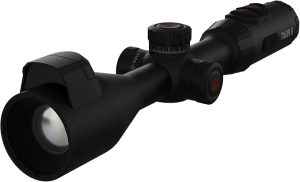
One of its standout features is the built-in laser rangefinder combined with a ballistic calculator. This technology provides distance readings and supports automatic reticle adjustments, helping simplify distance assessment. The scope also incorporates ATN’s SharpIR AI technology, which enhances image definition and contrast in real time to make thermal details easier to distinguish.
The ThOR 6 Elite LRF offers adjustable 3.5–28x magnification, allowing users to switch between wider viewing and greater digital enlargement. Its 1920 × 1080 Full HD OLED display provides a detailed viewing interface, while additional features such as Picture-in-Picture, Hot Point Tracking, multiple thermal palettes, and onboard video recording expand its functionality. Constructed from magnesium alloy and weighing approximately 1.8 pounds, it combines advanced thermal technology with a relatively lightweight design.
Key Specifications
-
Brand: ATN
-
Model: ThOR 6 Elite LRF
-
Color: Black
-
Magnification: 3.5–28x
-
Maximum Magnification: 28x
-
Minimum Magnification: 3.5x
-
Product Dimensions: 16.93″L × 3.35″W × 3.15″H
-
Weight: 1.8 pounds
-
Material: Magnesium Alloy
-
Sport: Hunting
-
Compatible Device: Rifle
-
Thermal Sensor Resolution: 384 × 288
-
Thermal Generation: 6th Generation
-
NETD Sensitivity: ≤15 mK
-
Pixel Pitch: 12 μm
-
Display: 1920 × 1080 Full HD OLED
-
Rangefinder: Built-in Laser Rangefinder
-
Ballistic Calculator: Integrated
-
Image Enhancement: SharpIR AI
-
Image Features: Picture-in-Picture and Hot Point Tracking
-
Thermal Palettes: Multiple viewing palettes
-
Video Recording: Recoil Activated Video and onboard recording
-
Connectivity: WiFi streaming
-
Durability: Recoil-rated and weather-resistant design
Specification note: The supplied product information does not specify the exact laser rangefinder measurement distance, battery runtime, or the distinction between optical and digital magnification. These details should be verified against the manufacturer’s specifications or the exact Amazon listing before publication.
Key Features
6th-Generation 384 × 288 Thermal Sensor
The ATN ThOR 6 Elite LRF features a 384 × 288 thermal sensor designed to detect heat signatures and produce thermal images in environments where ordinary visibility is limited. Its 6th-generation imaging technology is supported by a 12 μm pixel pitch and an ultra-sensitive ≤15 mK NETD rating, helping capture subtle temperature variations even in challenging environmental conditions.
Built-In Laser Rangefinder and Ballistic Calculator
One of the most important features of this riflescope is its integrated laser rangefinder. It provides distance readings, while the accompanying ballistic calculator supports automatic reticle adjustments. Combining these technologies gives the device an additional layer of functionality beyond thermal imaging alone.
SharpIR AI Image Enhancement
The scope incorporates SharpIR AI technology, which enhances thermal image definition and contrast in real time. Rather than simply displaying detected heat, this technology is designed to make important visual details easier to distinguish, particularly when observing objects against complicated backgrounds.
3.5–28x Adjustable Magnification
With a magnification range of 3.5–28x, the ThOR 6 Elite LRF provides flexibility when viewing different distances. The lower magnification offers a wider field of view, while the higher settings allow greater enlargement of the displayed thermal image.
1920 × 1080 Full HD OLED Display
The integrated Full HD 1920 × 1080 OLED display provides the viewing interface for thermal images. Its high resolution complements the thermal sensor and allows users to view enhanced thermal details through the scope’s electronic display.
Picture-in-Picture and Hot Point Tracking
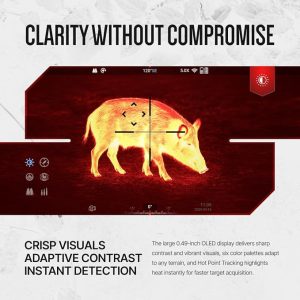
The Picture-in-Picture feature allows users to view an enlarged section of the thermal image while retaining a broader view of the surrounding scene. Additionally, Hot Point Tracking helps identify the warmest area within the displayed image, making it easier to locate prominent heat signatures.
Recoil Activated Video and WiFi Streaming
The ThOR 6 Elite LRF includes Recoil Activated Video, which supports automatic footage capture associated with recoil events. Its onboard recording and WiFi streaming capabilities provide additional flexibility for recording and viewing thermal footage.
Lightweight Magnesium Alloy Construction
Despite its extensive technology, the scope weighs approximately 1.8 pounds. Its magnesium alloy construction provides a durable housing while keeping the overall weight relatively manageable for a thermal riflescope.
Technology & Special Features
The ATN ThOR 6 Elite LRF brings together several technologies designed to improve thermal imaging and viewing functionality. At its core is the 6th-generation 384 × 288 thermal sensor, supported by ≤15 mK NETD sensitivity and 12 μm pixel pitch. These specifications are particularly important because thermal sensitivity influences how effectively a sensor can distinguish subtle temperature differences.
Another notable component is the SharpIR AI image enhancement system, which processes thermal imagery to improve contrast and visual definition. This works alongside the Full HD OLED display to provide a more detailed viewing experience.
The integrated laser rangefinder and ballistic calculator add distance-measuring functionality to the thermal imaging system. Rather than relying on thermal observation alone, users also have access to distance information and automatic reticle adjustment support.
Additional features, including Picture-in-Picture, Hot Point Tracking, multiple thermal palettes, WiFi streaming, and Recoil Activated Video, make the device a feature-rich thermal optic. Its combination of imaging technology, digital functionality, and magnesium alloy construction gives it a distinct position among advanced thermal riflescopes.
Best Uses
The ATN ThOR 6 Elite LRF is particularly suited to:
-
Thermal observation: Its 384 × 288 sensor and ≤15 mK NETD sensitivity support heat detection in challenging visibility conditions.
-
Long-distance viewing: Its adjustable 3.5–28x magnification provides flexibility when viewing distant objects.
-
Distance measurement: The integrated laser rangefinder provides distance readings without requiring a separate measuring device.
-
Enhanced thermal imaging: SharpIR AI technology improves image contrast and definition.
-
Detailed thermal viewing: The 1920 × 1080 OLED display provides a high-resolution viewing interface.
-
Thermal footage recording: Recoil Activated Video and onboard recording provide video capture functionality.
-
Extended outdoor observation: Its recoil-rated and weather-resistant construction is designed for demanding outdoor conditions.
Pros & Cons
Pros
-
Advanced 6th-generation thermal imaging technology.
-
384 × 288 thermal sensor resolution.
-
Ultra-sensitive ≤15 mK NETD rating.
-
12 μm pixel pitch.
-
Integrated laser rangefinder.
-
Built-in ballistic calculator.
-
SharpIR AI image enhancement.
-
Adjustable 3.5–28x magnification.
-
1920 × 1080 Full HD OLED display.
-
Picture-in-Picture functionality.
-
Hot Point Tracking.
-
Multiple thermal imaging palettes.
-
Recoil Activated Video.
-
WiFi streaming and onboard recording.
-
Lightweight 1.8-pound construction.
-
Durable magnesium alloy material.
-
Recoil-rated and weather-resistant design.
Cons
-
The 384 × 288 sensor resolution is lower than the 640 × 512 resolution available in some premium thermal optics.
-
The 1.8-pound weight may still add noticeable bulk to lightweight rifle setups.
Why We Selected It
The ATN ThOR 6 Elite LRF 3.5–28x earns its place on our list because of its combination of 6th-generation thermal imaging, integrated laser rangefinding, and AI-powered image enhancement. Its ≤15 mK NETD sensitivity, SharpIR AI technology, and Full HD OLED display make it an interesting choice for users who prioritize thermal image clarity and advanced digital features.
What particularly distinguishes this model is its integrated rangefinder and ballistic calculator. These features complement its thermal imaging capabilities by providing distance information and automatic reticle adjustment support within a single optical device. Its 3.5–28x magnification range, video recording capabilities, and magnesium alloy construction further strengthen its feature set.
For our 9 Best Thermal Scopes with Rangefinders – Top Picks for Precision, Long-Range Targeting & Enhanced Thermal Imaging guide, the ATN ThOR 6 Elite LRF represents a feature-rich thermal imaging option, particularly for readers interested in combining sensitive heat detection, AI-enhanced imagery, and integrated distance-measuring technology in one device.
2. oneleaf.ai Mars MT1000LRF 35mm Thermal Scope
The oneleaf.ai Mars MT1000LRF 35mm is an advanced thermal imaging riflescope designed for users who want high-resolution heat detection, adjustable magnification, and integrated distance-measuring technology in a compact optical device. Its standout feature is a 640 × 512 thermal sensor supported by an ultra-sensitive NETD rating of less than 20 mK, allowing it to detect subtle temperature differences and produce detailed thermal images in challenging environments. According to the supplied product description, it can detect targets at distances of up to 1,969 yards, making it an interesting option for long-range thermal observation.
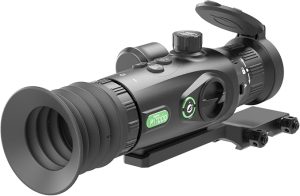
One of its most valuable features is the built-in laser rangefinder, which can measure distances of up to 1,300 yards. This is complemented by an integrated ballistic calculator capable of storing up to seven sets of ballistic data. Together, these technologies provide additional functionality for users who need distance information alongside thermal imaging capabilities.
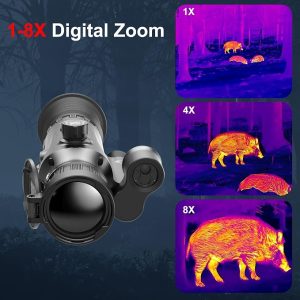
The Mars MT1000LRF features a 35mm objective lens with 2x base magnification and supports digital zoom from 1x to 8x, providing flexibility when observing objects at different distances. It also offers adjustable refresh rates of 30Hz, 50Hz, and 60Hz, alongside 11 thermal colour palettes for different viewing environments. Constructed from aluminum and weighing approximately 1.2 pounds, it combines a relatively lightweight design with an extensive collection of thermal imaging features.
Key Specifications
-
Brand: oneleaf.ai
-
Model: Mars MT1000LRF
-
Color: Black
-
Style: Thermal
-
Magnification: 2–8x
-
Maximum Magnification: 8x
-
Minimum Magnification: 2x
-
Objective Lens Diameter: 35mm
-
Product Dimensions: 6.55″L × 2.64″W × 3.18″H
-
Weight: 1.2 pounds
-
Material: Aluminum
-
Sport: Hunting
-
Thermal Sensor Resolution: 640 × 512
-
NETD Sensitivity: Less than 20 mK
-
Base Magnification: 2x
-
Digital Zoom: 1x–8x
-
Refresh Rate: Adjustable 30Hz, 50Hz, and 60Hz
-
Detection Range: Up to 1,969 yards (manufacturer-stated)
-
Laser Rangefinder: Built-in
-
Rangefinder Measurement Distance: Up to 1,300 yards
-
Ballistic Calculator: Integrated
-
Ballistic Data Storage: Up to seven profiles
-
Thermal Color Palettes: 11
-
Interchangeable Lenses: 35mm and optional 50mm
-
Included Lens: 35mm
-
Optional Lens: 50mm (sold separately)
Specification note: The supplied listing describes the 35mm version, which has 2x base magnification. The optional 50mm lens offers 2.8x base magnification but is sold separately. Also, the stated 1–8x digital zoom should not be confused with optical magnification. The advertised detection range and laser rangefinder measurement distance are separate specifications.
Key Features
640 × 512 High-Resolution Thermal Sensor
The oneleaf.ai Mars MT1000LRF features a 640 × 512 thermal sensor designed to capture detailed heat signatures across different environments. Its relatively high sensor resolution allows it to display thermal information with greater image detail than many entry-level 256 × 192 and 384 × 288 thermal devices.
Combined with its NETD sensitivity of less than 20 mK, the sensor is designed to recognize subtle temperature variations, making it useful for thermal observation in challenging visibility conditions.
Built-In Laser Rangefinder
One of the defining features of this thermal scope is its integrated laser rangefinder, which provides distance measurements of up to 1,300 yards according to the supplied product information. This allows users to obtain distance readings without relying on a separate measuring device.
The integrated design also keeps the rangefinding functionality within the same optical unit, contributing to a more convenient overall setup.
Integrated Ballistic Calculator
The Mars MT1000LRF includes a built-in ballistic calculator designed to support long-range shooting calculations. It can store up to seven sets of ballistic data, allowing users to save different configurations rather than repeatedly entering the same information.
This feature complements the integrated rangefinder and distinguishes the device from thermal optics that focus exclusively on image detection and display.
35mm Objective Lens with 2x Base Magnification
The supplied version comes with a 35mm objective lens and a base magnification of 2x. This configuration provides a viewing arrangement suited to different thermal observation distances.
The product also supports an optional 50mm interchangeable lens with 2.8x base magnification. However, the larger lens is sold separately and is not included in the standard 35mm package.
1x–8x Digital Zoom
The scope offers digital magnification from 1x to 8x, allowing users to enlarge the displayed thermal image when additional visual detail is required. This provides flexibility across different observation distances, although digital enlargement does not increase the sensor’s native resolution.
Adjustable 30Hz, 50Hz, and 60Hz Refresh Rates
Another notable feature is its adjustable refresh rate. Users can select between 30Hz, 50Hz, and 60Hz, depending on their viewing preferences and operating conditions.
The availability of a 60Hz setting is particularly useful for producing smoother image updates when observing movement.
11 Customizable Thermal Color Palettes
The Mars MT1000LRF provides 11 thermal imaging palettes, allowing users to customize how heat differences appear on the display. These include Black Hot, White Hot, Red Hot, Ironbow, Rainbow, Night, Aurora, and Jungle, among other available viewing options.
Different palettes provide alternative ways of distinguishing warm objects from their surroundings, giving users greater flexibility when observing different environments.
Compact and Lightweight Aluminum Construction
Weighing approximately 1.2 pounds, the Mars MT1000LRF is relatively lightweight compared with many larger thermal riflescopes. Its aluminum construction provides a durable housing, while its dimensions of 6.55 × 2.64 × 3.18 inches make it a compact option for users who prioritize portability.
Technology & Special Features
The oneleaf.ai Mars MT1000LRF combines several thermal imaging and digital technologies within a relatively compact design. Its foundation is the 640 × 512 thermal sensor, which works alongside less than 20 mK NETD sensitivity to capture subtle heat differences. This combination is particularly relevant when observing objects against backgrounds with similar temperatures.
Its integrated laser rangefinder adds another layer of functionality by providing distance measurements of up to 1,300 yards. The accompanying ballistic calculator can store seven different ballistic data profiles, offering additional flexibility within the device’s digital system.
The scope also incorporates an adjustable refresh rate, supporting 30Hz, 50Hz, and 60Hz operation. This allows users to select different image update settings depending on their viewing requirements.
Another distinguishing feature is its interchangeable lens system. The supplied 35mm lens provides 2x base magnification, while an optional 50mm lens offers 2.8x base magnification. This gives the Mars MT1000LRF additional configuration flexibility without requiring an entirely different thermal imaging device.
Finally, its 11 thermal palettes provide multiple viewing presentations, while the 1x–8x digital zoom allows users to enlarge displayed images when necessary.
Best Uses
The oneleaf.ai Mars MT1000LRF is particularly suited to:
-
Thermal observation: Its 640 × 512 sensor and less than 20 mK NETD sensitivity support detailed heat detection.
-
Long-range thermal detection: Its advertised detection range of up to 1,969 yards makes it suitable for observing distant heat signatures under appropriate conditions.
-
Distance measurement: Its integrated laser rangefinder provides measurements of up to 1,300 yards.
-
Versatile thermal viewing: Its 11 thermal palettes offer different ways to display heat signatures.
-
Adjustable magnification: The 2x base magnification and 1x–8x digital zoom provide flexibility when observing different distances.
-
Customized optical configuration: Its interchangeable lens system supports an optional 50mm lens for users seeking a different base magnification.
-
Portable outdoor applications: Its 1.2-pound weight and aluminum construction make it a relatively lightweight thermal imaging option.
Pros & Cons
Pros
-
High-resolution 640 × 512 thermal sensor.
-
NETD sensitivity of less than 20 mK.
-
Integrated laser rangefinder.
-
Rangefinder measurement distance of up to 1,300 yards.
-
Built-in ballistic calculator.
-
Stores up to seven ballistic data profiles.
-
35mm objective lens.
-
2x base magnification.
-
1x–8x digital zoom.
-
Adjustable 30Hz, 50Hz, and 60Hz refresh rates.
-
11 customizable thermal palettes.
-
Optional interchangeable 50mm lens.
-
Advertised thermal detection range of up to 1,969 yards.
-
Lightweight 1.2-pound construction.
-
Durable aluminum material.
-
Compact dimensions.
Cons
-
The included 35mm lens offers only 2x base magnification, which may not appeal to users seeking higher native magnification.
-
The optional 50mm lens requires a separate purchase, potentially increasing the overall cost.
Why We Selected It
The oneleaf.ai Mars MT1000LRF 35mm earns its place on our list because it combines a 640 × 512 thermal sensor, an integrated laser rangefinder, and a built-in ballistic calculator in a relatively lightweight 1.2-pound design. Its less than 20 mK NETD sensitivity, adjustable refresh rates, and 11 thermal palettes further strengthen its thermal imaging capabilities.
What makes this model particularly interesting is the combination of its imaging and distance-measuring technologies. The rangefinder provides measurements of up to 1,300 yards, while the integrated ballistic calculator supports the storage of seven different ballistic data profiles. Its interchangeable lens system also provides additional flexibility for users interested in expanding beyond the included 35mm configuration.
For our 9 Best Thermal Scopes with Rangefinders – Top Picks for Precision, Long-Range Targeting & Enhanced Thermal Imaging guide, the oneleaf.ai Mars MT1000LRF represents the high-resolution, lightweight option, particularly for readers interested in combining detailed thermal imaging, integrated rangefinding, and customizable viewing features in one compact device.
3. RIX Storm S6R 640×512 35mm Thermal Scope
The RIX Storm S6R 640×512 35mm is a compact thermal imaging riflescope designed for users who prioritize high-resolution thermal detection, integrated distance measurement, and convenient operation in challenging outdoor environments. Featuring a next-generation 640 × 512 thermal sensor with a NETD sensitivity of less than 20 mK, the device is engineered to capture subtle temperature differences while reducing image noise. This makes it particularly interesting for thermal observation in environments involving high humidity, rain, and fog, where maintaining image clarity can be challenging.
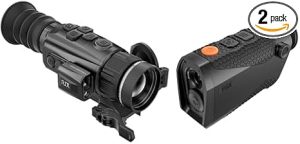
One of its standout features is its built-in compact laser rangefinder, which offers a stated measurement range of up to 1,312 yards and an accuracy of ±1.09 yards. The rangefinder is complemented by a free ballistic calculator, adding distance-measuring functionality to its thermal imaging capabilities. Despite incorporating these technologies, the Storm S6R maintains a lightweight design, weighing approximately 1 pound (16 ounces).
The device also incorporates a 1024 OLED display, alongside specialized Sunny Mode and Rain Mode settings designed to improve thermal image presentation under different environmental conditions. Its intuitive operating system features enlarged directional buttons that correspond directly with functions displayed on the user interface, making navigation easier even when wearing gloves. Additionally, the included quick-detach (QD) mount supports convenient installation and removal. In this particular package, the Storm S6R is bundled with the RIX Pocket K3, providing two products in one package.
Key Specifications
-
Brand: RIX
-
Model Name: Storm S6R
-
Model: RIX Storm S6R 640×512 35mm
-
Color: Black
-
Style: Storm S6R and RIX Pocket K3 Bundle
-
Sport: Hunting and Target Shooting
-
Objective Lens Diameter: 35mm
-
Weight: 16 ounces (1 pound)
-
Thermal Sensor Resolution: 640 × 512
-
NETD Sensitivity: Less than 20 mK
-
Pixel Pitch: 12 μm
-
Display: 1024 OLED
-
Laser Rangefinder: Built-in
-
Rangefinder Measurement Range: Up to 1,312 yards
-
Rangefinder Accuracy: ±1.09 yards
-
Ballistic Calculator: Included free
-
Image Modes: Sunny Mode and Rain Mode
-
Mounting Type: Quick Detach (QD) Mount
-
Included Accessories: QD Mount
-
Bundle: RIX Storm S6R and RIX Pocket K3
-
Number of Items: 2
-
Number of Packs: 1
Specification note: The supplied listing describes a bundle containing the RIX Storm S6R and RIX Pocket K3. The 16-ounce weight and 1-pound description refer to the Storm S6R itself, not necessarily the combined package. The listing does not specify the magnification range, battery runtime, or the exact detection-versus-identification performance of the thermal sensor. These details should be verified before publication.
Key Features
640 × 512 High-Resolution Thermal Sensor
The RIX Storm S6R features a 640 × 512 thermal sensor designed to capture detailed heat signatures while reducing image noise. Its high-resolution imaging system is supported by a NETD sensitivity of less than 20 mK, allowing it to detect relatively subtle temperature variations.
The sensor also uses a 12 μm pixel pitch, contributing to its compact thermal imaging configuration. These specifications make the Storm S6R an interesting option for users who want detailed thermal observation in different environmental conditions.
Built-In Compact Laser Rangefinder
One of the most important features of the Storm S6R is its integrated laser rangefinder, which provides distance measurements of up to 1,312 yards according to the supplied product information.
The rangefinder is designed with a compact structure that integrates into the device without significantly increasing its overall weight. Its stated measurement accuracy of ±1.09 yards adds further value for users who prioritize reliable distance information.
Free Integrated Ballistic Calculator
The Storm S6R comes with a free ballistic calculator, providing additional functionality alongside its built-in rangefinder. This feature is intended to support distance-related calculations and complement the device’s thermal imaging system.
The combination of a rangefinder and ballistic calculator makes the S6R more than a conventional thermal viewing device, bringing multiple digital functions together within one compact unit.
1024 OLED Display
The device incorporates a 1024 OLED display designed to present thermal images through a clear electronic viewing interface. The display works alongside its thermal sensor and specialized image modes to provide a more adaptable viewing experience.
This combination is particularly relevant when observing thermal information in environments where humidity and changing weather conditions can affect image quality.
Sunny Mode and Rain Mode
A particularly interesting aspect of the Storm S6R is its specialized image processing modes.
-
Sunny Mode: Designed to reduce image noise and improve image presentation in brighter environmental conditions.
-
Rain Mode: Designed to enhance thermal sensitivity and reveal subtle temperature differences in high-humidity environments.
These settings provide additional flexibility when observing in different weather conditions, including rainy days and foggy nights.
Lightweight 1-Pound Construction
Portability is one of the defining characteristics of the RIX Storm S6R. Weighing approximately 16 ounces (1 pound), it is designed to remain manageable during extended outdoor use.
Its lightweight construction also supports dual-purpose operation, allowing it to be used as a mounted thermal optic or as a handheld thermal viewing device, according to the manufacturer’s description.
Quick-Detach Mounting System
The Storm S6R includes a Quick Detach (QD) mount, which supports convenient installation and removal. This mounting arrangement is useful for users who prefer a system that can be attached or detached without dealing with a complicated mounting process.
The included mount also adds value to the package by providing an essential mounting accessory.
Intuitive Button-Controlled Operating System
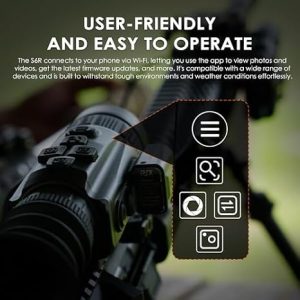
Another distinguishing feature is its user-friendly control layout. The S6R uses enlarged, four-directional buttons that correspond directly with functions displayed on its interface.
When a button is pressed, the corresponding function on the user interface lights up, helping users understand which control they are operating. The larger button design is particularly useful when wearing gloves or working in outdoor conditions where small controls can be difficult to identify.
Technology & Special Features
The RIX Storm S6R combines advanced thermal imaging, laser distance measurement, and simplified digital controls in a lightweight design. Its 640 × 512 thermal sensor, supported by less than 20 mK NETD sensitivity and 12 μm pixel pitch, forms the foundation of its imaging capabilities.
Its environmental image processing features are particularly noteworthy. Rather than relying on a single image presentation setting, the Storm S6R offers Sunny Mode and Rain Mode to help maintain a clearer thermal display under different environmental conditions. Rain Mode is especially relevant because high humidity can affect thermal imaging performance.
The integrated laser rangefinder provides measurements of up to 1,312 yards, while its stated ±1.09-yard accuracy offers additional precision. The accompanying ballistic calculator further expands its digital functionality.
Another important design consideration is portability. At approximately one pound, the Storm S6R is intended to support both mounted and handheld use. Its quick-detach mounting system makes installation more convenient, while its enlarged directional buttons simplify navigation.
For this particular listing, the inclusion of the RIX Pocket K3 makes the package a two-item bundle rather than a standalone thermal optic. Buyers should check the exact bundle contents to understand what accessories and additional capabilities are included.
Best Uses
The RIX Storm S6R is particularly suited to:
-
Thermal observation: Its 640 × 512 sensor and less than 20 mK NETD sensitivity support detailed heat detection.
-
Distance measurement: Its integrated laser rangefinder provides measurements of up to 1,312 yards.
-
Outdoor observation: Sunny Mode and Rain Mode provide alternative image settings for different environmental conditions.
-
High-humidity environments: Its Rain Mode is designed to improve thermal sensitivity when observing in humid or foggy conditions.
-
Portable thermal viewing: Its approximately 1-pound weight supports convenient handheld use.
-
Convenient mounting: Its included quick-detach mount allows easier installation and removal.
-
Users who prefer simplified controls: Its enlarged directional buttons make navigating the interface more straightforward.
-
Multi-item packages: The Storm S6R and Pocket K3 bundle offers two products in one purchase.
Pros & Cons
Pros
-
High-resolution 640 × 512 thermal sensor.
-
NETD sensitivity of less than 20 mK.
-
12 μm pixel pitch.
-
Integrated compact laser rangefinder.
-
Rangefinder measurement distance of up to 1,312 yards.
-
Stated rangefinder accuracy of ±1.09 yards.
-
Free integrated ballistic calculator.
-
1024 OLED display.
-
Sunny Mode for image-noise reduction.
-
Rain Mode for enhanced thermal sensitivity.
-
Lightweight 1-pound construction.
-
Supports mounted and handheld use.
-
Included quick-detach mounting system.
-
Enlarged four-directional control buttons.
-
User-friendly operating interface.
-
Includes RIX Pocket K3 in the advertised bundle.
Cons
-
The supplied listing does not specify the magnification range, making it difficult to compare directly with thermal scopes that advertise detailed magnification specifications.
-
The 1024 OLED display specification provides less information about display characteristics than a listing that states its exact pixel resolution.
Why We Selected It
The RIX Storm S6R 640×512 35mm earns its place on our list because it combines high-resolution thermal imaging, an integrated laser rangefinder, and a free ballistic calculator in an approximately 1-pound design. Its less than 20 mK NETD sensitivity, 12 μm pixel pitch, and specialized Sunny and Rain Modes make it an interesting option for users who value thermal image clarity across changing environmental conditions.
What particularly distinguishes this model is its emphasis on portability without abandoning advanced functionality. The compact rangefinder offers measurements of up to 1,312 yards, while the included quick-detach mount and enlarged directional controls make the overall device more convenient to handle. The addition of the RIX Pocket K3 also makes this particular listing worth considering for buyers interested in a bundled package.
For our 9 Best Thermal Scopes with Rangefinders – Top Picks for Precision, Long-Range Targeting & Enhanced Thermal Imaging guide, the RIX Storm S6R represents the lightweight, high-resolution option, particularly for readers interested in combining detailed thermal imaging, integrated distance measurement, and convenient portability in one compact optical system.
4. Pulsar Thermion 2 LRF XQ50 Pro 3–12x Thermal Riflescope
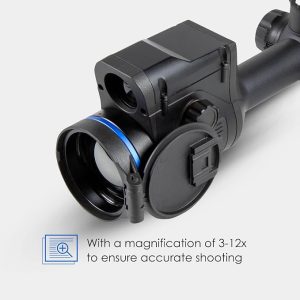
The Pulsar Thermion 2 LRF XQ50 Pro is an advanced thermal imaging riflescope designed for users who want dependable heat detection, detailed thermal observation, and enhanced viewing capabilities in challenging outdoor environments. Built around a highly sensitive thermal imaging sensor with a NETD rating of less than 25 mK, this device is designed to recognize subtle temperature differences, even when environmental conditions such as rain, fog, and cold temperatures make thermal observation more difficult.
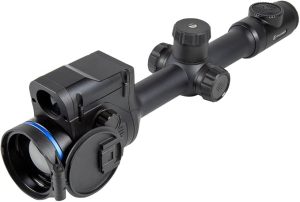
One of its standout characteristics is its 50mm F50/1.0 objective lens, which works alongside the sensitive thermal sensor to provide an advertised detection range of up to 2,000 yards. According to the supplied product description, the scope can detect a standard 6-foot-tall object at this distance, even in complete darkness. This makes it an interesting option for users who prioritize extended-range thermal detection.
The Thermion 2 XQ50 Pro also incorporates Picture-in-Picture functionality, allowing users to view an enlarged section of the image while maintaining visibility of the wider field of view. Additionally, its built-in Wi-Fi connectivity supports integration with the Stream Vision 2 application, enabling smartphone connectivity, image streaming, software updates, and remote control of selected digital functions. Constructed from magnesium alloy and weighing approximately 2 pounds, it combines a durable housing with a range of advanced thermal imaging features.
Key Specifications
-
Brand: Pulsar
-
Model: Thermion 2 LRF XQ50 Pro
-
Color: Black
-
Style: Thermal
-
Sport: Hunting
-
Magnification: 3–12x
-
Maximum Magnification: 12x
-
Minimum Magnification: 3x
-
Objective Lens Diameter: 50mm
-
Weight: 2 pounds
-
Material: Magnesium Alloy
-
Compatible Device: Rifle
-
Thermal Sensor Sensitivity: NETD less than 25 mK
-
Objective Lens: F50/1.0
-
Detection Range: Up to 2,000 yards (manufacturer-stated)
-
Picture-in-Picture: Supported
-
Connectivity: Built-in Wi-Fi
-
Mobile Application: Stream Vision 2
-
Smartphone Compatibility: Android and iOS
-
Image Streaming: Supported through the mobile application
-
Remote Control: Supported through Stream Vision 2
-
Software Updates: Supported through the application
-
Construction: Magnesium Alloy
-
Export Restrictions: Subject to ITAR export and transfer controls
Specification note: The supplied product information does not explicitly confirm an integrated laser rangefinder or ballistic calculator for this particular XQ50 Pro version. Although the Pulsar Thermion 2 LRF range includes models with laser rangefinding capabilities, the exact product variant should be verified before advertising this model as having an integrated rangefinder. The stated 3–12x magnification and 2,000-yard detection range should also be checked against the exact listing.
Key Features
Highly Sensitive Thermal Imaging Sensor
The Pulsar Thermion 2 XQ50 Pro features a thermal imaging sensor with a NETD sensitivity rating of less than 25 mK. This specification indicates its ability to recognize relatively subtle temperature differences, making it useful when observing objects in environments with limited thermal contrast.
Its sensitivity is particularly relevant in challenging weather conditions such as rain, fog, and cold mornings, where distinguishing objects from their surroundings can become more difficult.
50mm F50/1.0 Objective Lens
Another important component is its 50mm F50/1.0 objective lens. The lens works alongside the thermal sensor to collect thermal information and support the scope’s long-range detection capabilities.
According to the supplied description, this optical configuration contributes to an advertised detection distance of up to 2,000 yards, depending on environmental and target conditions.
Up to 2,000-Yard Thermal Detection Range
The Thermion 2 XQ50 Pro offers a stated thermal detection range of up to 2,000 yards. The manufacturer describes this capability using a standard 6-foot-tall object as the detection reference.
This is an important distinction because detection does not necessarily mean that an object can be clearly identified or recognized at the same distance. Actual performance depends on factors such as target size, temperature contrast, weather, and atmospheric conditions.
3–12x Adjustable Magnification
The scope features a stated magnification range of 3–12x, providing different viewing levels for thermal observation. Its lower magnification offers a wider viewing perspective, while higher magnification enlarges the displayed thermal image.
This flexibility allows users to adjust the viewing experience according to their observation requirements.
Picture-in-Picture Functionality
The integrated Picture-in-Picture mode is another useful feature. It displays an enlarged section of the thermal image within a smaller portion of the screen, occupying approximately 10% of the total display area according to the supplied description.
This allows users to examine a magnified area while retaining visibility of the wider thermal scene. The feature also provides an enlarged view of the reticle and aiming area.
Stream Vision 2 and Built-In Wi-Fi
The Thermion 2 XQ50 Pro includes built-in Wi-Fi connectivity, allowing it to connect with compatible Android and iOS smartphones through the Stream Vision 2 application.
Through this application, users can:
-
Transfer and view thermal images on a smartphone.
-
Stream real-time images to a connected mobile device.
-
Update the device’s software.
-
Remotely control supported digital functions.
-
Access additional connected-device features.
This connectivity adds convenience for users who want to interact with their thermal imaging device through a smartphone.
Durable Magnesium Alloy Construction
The Pulsar Thermion 2 XQ50 Pro uses a magnesium alloy housing, providing a durable construction for outdoor applications. At approximately 2 pounds, it offers a relatively manageable weight for a full-sized thermal riflescope while incorporating its 50mm objective lens and digital imaging components.
Technology & Special Features
The Pulsar Thermion 2 XQ50 Pro combines sensitive thermal imaging, advanced optical components, and smartphone connectivity in one electronic riflescope. Its NETD rating of less than 25 mK is particularly important because it supports the detection of subtle temperature differences, even in environments with limited thermal contrast.
Its 50mm F50/1.0 objective lens complements the thermal sensor by supporting long-range detection. Together, these components contribute to the manufacturer’s stated detection range of up to 2,000 yards.
Another notable technology is its Picture-in-Picture system. Instead of requiring users to enlarge the entire thermal image, this feature displays a magnified section within a smaller viewing window. This preserves awareness of the surrounding image while providing additional detail in the selected area.
The integration of Stream Vision 2 and Wi-Fi connectivity further expands the device’s functionality. Smartphone compatibility allows users to stream images, transfer footage, update software, and access supported remote-control functions.
Its magnesium alloy construction completes the design, providing a durable housing for the thermal imaging system and its electronic components.
Best Uses
The Pulsar Thermion 2 XQ50 Pro is particularly suited to:
-
Long-range thermal detection: Its advertised 2,000-yard detection range supports observation of distant heat signatures.
-
Low-contrast environments: Its less than 25 mK NETD sensitivity is designed for challenging conditions involving rain, fog, and cold temperatures.
-
Detailed thermal observation: Its 50mm F50/1.0 objective lens supports its thermal imaging capabilities.
-
Adjustable thermal viewing: Its 3–12x magnification provides flexibility across different observation distances.
-
Magnified image inspection: Picture-in-Picture allows users to examine an enlarged section while retaining the wider viewing area.
-
Smartphone connectivity: Built-in Wi-Fi and Stream Vision 2 provide additional digital functionality.
-
Outdoor applications: Its magnesium alloy construction provides a durable housing for demanding outdoor environments.
Pros & Cons
Pros
-
Highly sensitive thermal imaging sensor.
-
NETD sensitivity of less than 25 mK.
-
50mm F50/1.0 objective lens.
-
Advertised detection range of up to 2,000 yards.
-
Adjustable 3–12x magnification.
-
Integrated Picture-in-Picture functionality.
-
Enlarged viewing area for detailed image inspection.
-
Built-in Wi-Fi connectivity.
-
Compatible with Android and iOS through Stream Vision 2.
-
Real-time image streaming to smartphones.
-
Supports software updates through the mobile application.
-
Remote control of supported digital functions.
-
Durable magnesium alloy construction.
-
Relatively manageable 2-pound weight.
Cons
-
The supplied listing does not confirm an integrated laser rangefinder, despite the rangefinder-focused naming used in the wider Thermion 2 LRF product family.
-
The supplied information does not specify a ballistic calculator.
Why We Selected It
The Pulsar Thermion 2 XQ50 Pro earns its place in our comparison because of its combination of high thermal sensitivity, a 50mm F50/1.0 objective lens, and an advertised 2,000-yard detection range. Its less than 25 mK NETD rating makes it particularly interesting for users who prioritize thermal image recognition in challenging weather conditions.
Its Picture-in-Picture functionality and Stream Vision 2 connectivity further distinguish it from more basic thermal imaging devices. The ability to view magnified image sections while maintaining the wider scene, together with smartphone streaming and remote-control capabilities, provides additional flexibility.
For our 9 Best Thermal Scopes with Rangefinders – Top Picks for Precision, Long-Range Targeting & Enhanced Thermal Imaging guide, the Pulsar Thermion 2 XQ50 Pro represents the long-range thermal detection option. However, buyers specifically seeking an integrated laser rangefinder should verify that the exact model they purchase includes this feature, as the supplied specifications do not establish its presence.
5. ATN BlazeHunter 335 384×288 Thermal Monocular – Power Bundle
The ATN BlazeHunter 335 384×288 Thermal Monocular is a compact thermal imaging device designed for users who want advanced heat detection, integrated distance measurement, and convenient digital connectivity in a portable package. Unlike traditional thermal riflescopes, this model is a handheld thermal monocular, making it suitable for outdoor observation, wildlife monitoring, scouting, and other applications where portability is important. It features a 384 × 288 vanadium oxide (VOx) uncooled focal plane detector with an impressive NETD sensitivity of less than 18 mK, allowing it to detect subtle temperature differences even in challenging environmental conditions.
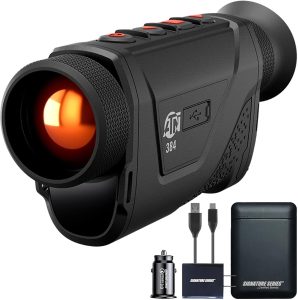
One of its most notable features is the built-in laser rangefinder (LRF), which provides distance-measuring functionality without requiring an additional device. The monocular also offers a stated detection range of up to 1,800 yards, making it an interesting option for users who need extended-range thermal observation. Its adjustable magnification of 4–32x provides flexibility when viewing objects at different distances, while its built-in Wi-Fi and video recording capabilities add further convenience.
Another appealing aspect of this particular listing is its Signature Series Power Bundle, which includes rechargeable batteries and a charger. According to the supplied product information, the device can provide up to 14 hours of continuous operation with its two rechargeable batteries. Weighing approximately 12.8 ounces and measuring 5.98 inches in height, the BlazeHunter 335 offers a compact design for users who prioritize lightweight thermal observation equipment.
Key Specifications
-
Brand: ATN
-
Model Name: TIMNBLH335LRF Power Bundle
-
Product: ATN BlazeHunter 335 Thermal Monocular
-
Color: Not specified
-
Product Dimensions: 1.67″D × 2.93″W × 5.98″H
-
Weight: 12.8 ounces
-
Focus Type: Auto Focus
-
Power Source: Rechargeable Battery
-
Battery Type: Lithium-Ion
-
Number of Batteries: 2 rechargeable batteries included in the advertised power bundle
-
Battery Life: Up to 14 hours (manufacturer-stated)
-
Thermal Sensor Resolution: 384 × 288
-
Sensor Type: Vanadium Oxide (VOx) Uncooled Focal Plane Detector
-
NETD Sensitivity: Less than 18 mK
-
Magnification: 4–32x
-
Zoom Ratio: 4–32x (as stated in the listing)
-
Detection Range: Up to 1,800 yards (manufacturer-stated)
-
Rangefinder: Built-in Laser Rangefinder
-
Connectivity: Built-in Wi-Fi
-
Video Recording: Supported
-
Compatible Devices: Smartphones, tablets, and laptops
-
Field of View: Listing states 1,000 yards
-
Bundle: Signature Series Power Bundle
-
Included Accessories: Rechargeable batteries and charger
Specification note: The ATN BlazeHunter 335 is a thermal monocular, not a rifle-mounted thermal scope. Its inclusion in this comparison is relevant because of its integrated laser rangefinder and thermal imaging capabilities. The supplied listing also contains some specifications worth verifying: the stated 4–32x magnification should be checked against the manufacturer’s exact optical and digital zoom specifications, and the 1,000-yard field-of-view entry appears ambiguous because field of view is normally expressed as an angular measurement or width at a specified distance. The battery bundle is described as including two rechargeable batteries, although the general listing specification mentions one included battery.
Key Features
384 × 288 VOx Thermal Imaging Sensor
The ATN BlazeHunter 335 features a 384 × 288 vanadium oxide (VOx) uncooled focal plane detector designed to capture thermal information by detecting differences in temperature.
Its NETD sensitivity of less than 18 mK is particularly noteworthy because it indicates the sensor’s ability to recognize very subtle temperature variations. This helps the monocular produce detailed thermal imagery in environments where ordinary visibility may be limited.
Built-In Laser Rangefinder
One of the defining features of the BlazeHunter 335 is its integrated laser rangefinder. This technology allows users to obtain distance measurements without carrying a separate rangefinding device.
The built-in design makes the monocular more convenient for outdoor observation, wildlife monitoring, and scouting activities where understanding the distance to an observed object can be useful.
Up to 1,800-Yard Detection Range
According to the supplied product description, the BlazeHunter 335 offers a thermal detection range of up to 1,800 yards. This provides an indication of its long-range observation capabilities.
However, detection range should not be confused with identification range. Detecting a heat signature at a particular distance does not necessarily mean that the object can be clearly recognized or identified at that same distance. Actual performance depends on environmental conditions, target size, and temperature contrast.
4–32x Magnification
The monocular offers a stated magnification range of 4–32x, allowing users to enlarge the displayed thermal image when observing distant objects.
This provides flexibility across different viewing distances, although higher digital magnification can reduce perceived image detail. Buyers should also verify the distinction between optical and digital magnification in the exact product version.
Automatic Focus System
The supplied listing identifies Auto Focus as the focus type. This feature is intended to simplify the viewing experience by reducing the need for repeated manual focus adjustments.
It is particularly useful for users who prefer a more convenient thermal observation experience when switching between different viewing distances.
Built-In Wi-Fi Connectivity
The BlazeHunter 335 incorporates Wi-Fi connectivity, allowing it to connect with compatible digital devices. Its smartphone, tablet, and laptop compatibility provides additional flexibility for accessing and viewing thermal content.
This feature complements its video recording capabilities, making it easier to incorporate digital viewing and footage management into outdoor observation activities.
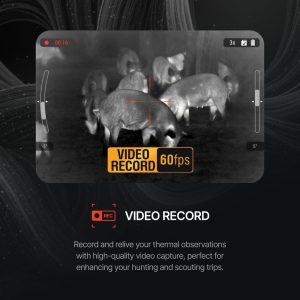
Integrated Video Recording
Another useful feature is its built-in video recording functionality. Users can capture thermal observations and preserve footage for later viewing.
This is particularly relevant for wildlife monitoring, outdoor exploration, and scouting activities where reviewing recorded thermal images can provide additional information about observed movement and environmental conditions.
Extended Battery Life and Power Bundle
The Signature Series Power Bundle is an attractive addition to this particular listing. It includes two rechargeable batteries and a charger, with the manufacturer advertising up to 14 hours of continuous operation.
Having an additional rechargeable battery provides greater flexibility during extended outdoor activities, reducing dependence on immediate access to a charging source.
Compact and Lightweight Design
Weighing approximately 12.8 ounces, the BlazeHunter 335 is designed for convenient handheld use. Its dimensions of 1.67 × 2.93 × 5.98 inches give it a compact profile that is relatively easy to carry during outdoor observation.
Its lightweight construction is one of its strongest advantages compared with larger thermal imaging systems.
Technology & Special Features
The ATN BlazeHunter 335 combines thermal imaging, laser distance measurement, and digital connectivity in a compact handheld device. Its 384 × 288 VOx thermal sensor forms the foundation of its imaging capabilities, while its less than 18 mK NETD sensitivity supports the detection of subtle temperature variations.
The integrated laser rangefinder adds distance-measuring functionality, making the device more versatile than a basic thermal monocular. Its advertised detection range of up to 1,800 yards further highlights its intended long-range observation capabilities.
Digital functionality is another important part of its design. Built-in Wi-Fi allows connectivity with compatible smartphones, tablets, and laptops, while video recording provides the ability to preserve thermal observations.
Its rechargeable power system is particularly appealing in the advertised bundle. With two rechargeable batteries and a charger, the device is designed to provide up to 14 hours of continuous use, according to the manufacturer.
Finally, its compact dimensions and 12.8-ounce weight make portability a central part of its overall design. Rather than being a permanently mounted optical device, the BlazeHunter 335 offers a handheld approach to thermal imaging.
Best Uses
The ATN BlazeHunter 335 is particularly suited to:
-
Wildlife observation: Its thermal imaging sensor helps detect heat signatures in different outdoor environments.
-
Long-range thermal detection: Its advertised detection range of up to 1,800 yards supports distant thermal observation.
-
Distance measurement: Its built-in laser rangefinder provides additional information when observing distant objects.
-
Outdoor scouting: Its compact handheld design makes it convenient to carry during outdoor activities.
-
Thermal video recording: Its onboard recording capability allows users to preserve and review thermal observations.
-
Digital connectivity: Built-in Wi-Fi supports connections with compatible smartphones, tablets, and laptops.
-
Extended outdoor use: Its two-battery power bundle is advertised to provide up to 14 hours of continuous operation.
-
Portable thermal imaging: Its lightweight 12.8-ounce construction makes it suitable for users who prefer handheld thermal equipment.
Pros & Cons
Pros
-
384 × 288 thermal sensor resolution.
-
Vanadium oxide uncooled focal plane detector.
-
Excellent stated NETD sensitivity of less than 18 mK.
-
Built-in laser rangefinder.
-
Advertised detection range of up to 1,800 yards.
-
Stated 4–32x magnification.
-
Automatic focus functionality.
-
Built-in Wi-Fi connectivity.
-
Compatible with smartphones, tablets, and laptops.
-
Integrated video recording.
-
Two rechargeable batteries included in the advertised power bundle.
-
Up to 14 hours of stated continuous operation.
-
Charger included.
-
Compact dimensions.
-
Lightweight 12.8-ounce construction.
-
Convenient handheld design.
Cons
-
It is a handheld thermal monocular rather than a traditional rifle-mounted thermal scope.
-
Its 384 × 288 sensor resolution is lower than the 640 × 512 resolution found in some premium thermal imaging devices.
Why We Selected It
The ATN BlazeHunter 335 384×288 Thermal Monocular earns its place in our comparison because it combines sensitive thermal imaging, an integrated laser rangefinder, and convenient digital connectivity in a lightweight handheld design. Its less than 18 mK NETD sensitivity is particularly impressive for a device in its category, while the advertised 1,800-yard detection range makes it an interesting option for users who prioritize extended-range thermal observation.
What makes this particular listing stand out is its Signature Series Power Bundle. The inclusion of two rechargeable batteries and a charger, together with an advertised 14-hour operating time, provides additional convenience for extended outdoor activities. Its built-in Wi-Fi and video recording capabilities further strengthen its appeal for users interested in preserving and reviewing thermal observations.
For our 9 Best Thermal Scopes with Rangefinders – Top Picks for Precision, Long-Range Targeting & Enhanced Thermal Imaging guide, the ATN BlazeHunter 335 represents the compact handheld thermal imaging option, particularly for readers interested in a portable device that combines heat detection, integrated distance measurement, and extended battery convenience.
6. VISTAGET Tarantula LRF 384-35 Thermal Riflescope
The VISTAGET Tarantula LRF 384-35 is an advanced thermal imaging riflescope designed for users seeking high-sensitivity heat detection, integrated laser rangefinding, and convenient digital functionality in a rugged optical device. Featuring a 384 × 288 thermal sensor with a NETD sensitivity of ≤15 mK, this riflescope is designed to capture subtle temperature differences and provide detailed thermal imagery in challenging outdoor environments. Its shutterless imaging technology is another notable feature, helping eliminate image freezing and mechanical clicking sounds associated with conventional shutter-based calibration systems.
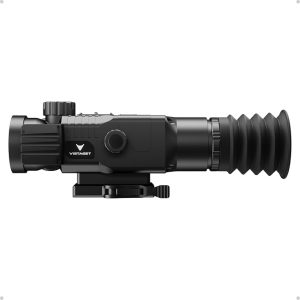
One of its most important features is the integrated 1,000-meter laser rangefinder, which works alongside an instant ballistic calculator to provide distance information and calculated aiming solutions. The scope also offers continuous 1–8x magnification, allowing users to adjust the displayed thermal image across different viewing levels. These capabilities make it an interesting option for users who want thermal imaging and distance-measuring technology integrated into one device.
The Tarantula LRF 384-35 also incorporates several features focused on durability and convenience. Its IP67 water-resistance rating, stated 1,200g shock resistance, and tool-free quick-detach mounting system are designed to support use in demanding outdoor environments. Additionally, it includes Recoil-Activated Video (RAV), 32GB of internal storage, six thermal color palettes, and 40 reticle options. Its dual-battery system and advertised five-year warranty further strengthen its overall feature set.
Key Specifications
-
Brand: VISTAGET
-
Model: Tarantula LRF 384-35
-
Color: Black
-
Style: Tactical
-
Sport: Hunting
-
Material: Metal
-
Magnification: 1–8x
-
Maximum Magnification: 8x
-
Minimum Magnification: 1x
-
Objective Lens Diameter: 35mm
-
Compatible Device: Rifle
-
Thermal Sensor Resolution: 384 × 288
-
NETD Sensitivity: ≤15 mK
-
Imaging Technology: Shutterless Thermal Imaging
-
Laser Rangefinder: Integrated
-
Rangefinder Measurement Distance: Up to 1,000 meters
-
Ballistic Calculator: Integrated
-
Digital Zoom: Continuous 1–8x
-
Water Resistance: IP67
-
Shock Resistance: 1,200g (manufacturer-stated)
-
Mounting Type: Picatinny Mount
-
Mounting System: Tool-free Quick-Detach (QD)
-
Video Recording: Recoil-Activated Video (RAV)
-
Internal Storage: 32GB
-
Thermal Color Palettes: 6
-
Reticle Options: 40
-
Power System: Dual-battery system
-
Warranty: 5 years (manufacturer-stated)
Specification note: The supplied product description does not specify the battery runtime, exact display resolution, pixel pitch, or whether the 1–8x magnification represents optical and digital magnification separately. The 1,200g shock-resistance specification should also be interpreted according to the manufacturer’s testing conditions. Buyers should confirm the exact warranty coverage and mounting compatibility with the seller before purchasing.
Key Features
384 × 288 High-Sensitivity Thermal Sensor
The VISTAGET Tarantula LRF 384-35 features a 384 × 288 thermal imaging sensor with a NETD sensitivity rating of ≤15 mK. This combination is designed to capture subtle temperature variations and provide detailed thermal images, even when environmental conditions make heat detection more challenging.
Its high thermal sensitivity is particularly relevant when observing objects against backgrounds with relatively similar temperatures. By detecting small differences in thermal signatures, the sensor helps produce clearer images for outdoor observation.
Shutterless Thermal Imaging Technology
One of the distinguishing features of this riflescope is its shutterless thermal imaging technology. Conventional thermal imaging devices may use mechanical shutters during calibration, sometimes resulting in temporary image interruptions and audible clicking sounds.
The Tarantula’s shutterless system is designed to eliminate these interruptions, providing a smoother and quieter thermal viewing experience. This is particularly useful for users who value uninterrupted image presentation and minimal operating noise.
Integrated 1,000-Meter Laser Rangefinder
The Tarantula LRF 384-35 incorporates a built-in laser rangefinder capable of measuring distances of up to 1,000 meters according to the supplied product information.
Having the rangefinder integrated into the riflescope means users do not need to rely on a separate distance-measuring device. This adds convenience and makes distance information readily accessible within the same optical system.
Built-In Ballistic Calculator
Another important feature is its integrated ballistic calculator, which works alongside the laser rangefinder to provide calculated aiming solutions.
This combination brings distance-measuring and ballistic calculation capabilities into one device, making the Tarantula more versatile than thermal optics that focus exclusively on image detection and display.
Continuous 1–8x Magnification
The scope offers continuous magnification from 1x to 8x, allowing users to adjust the displayed thermal image according to their viewing requirements.
The lower magnification provides a broader viewing perspective, while higher magnification enlarges the displayed image. This flexibility makes the device adaptable to different thermal observation situations.
IP67 Water Resistance and Rugged Construction
Durability is another important aspect of the Tarantula’s design. Its IP67 water-resistance rating indicates protection against dust ingress and temporary immersion in water under specified laboratory testing conditions.
The manufacturer also states a shock-resistance rating of 1,200g, highlighting its intended ability to withstand demanding outdoor conditions. Its metal construction further contributes to its rugged design.
Tool-Free Quick-Detach Mounting System
The Tarantula LRF includes a tool-free quick-detach mounting system designed for convenient installation and removal. Its Picatinny mounting configuration supports compatibility with suitable Picatinny-equipped platforms.
This mounting arrangement is particularly useful for users who value a convenient attachment system without requiring complicated installation procedures.
Recoil-Activated Video and 32GB Internal Storage
The device incorporates Recoil-Activated Video (RAV), which automatically records footage associated with recoil events. This allows users to preserve relevant video footage without having to manually activate recording every time.
Its 32GB internal storage provides built-in space for saving recorded content, adding convenience for users who want to review and manage their thermal footage.
Six Thermal Palettes and 40 Reticle Options
The Tarantula offers six thermal color palettes, allowing users to change how temperature differences appear on the display. Different palettes provide alternative visual presentations depending on environmental conditions and personal viewing preferences.
Additionally, its 40 reticle options provide a range of display configurations, allowing users to customize the appearance of the reticle within the viewing interface.
Dual-Battery System and Five-Year Warranty
The riflescope features a dual-battery power system designed to support extended outdoor use. Although the supplied listing does not provide an exact runtime, having a dual-battery configuration offers additional power-management flexibility.
The advertised five-year warranty is another attractive feature, providing buyers with additional reassurance. However, the specific warranty terms, exclusions, and registration requirements should be confirmed with VISTAGET or the seller.
Technology & Special Features
The VISTAGET Tarantula LRF 384-35 combines thermal imaging, laser rangefinding, and digital recording technologies in a rugged riflescope configuration. Its 384 × 288 thermal sensor with ≤15 mK NETD sensitivity forms the foundation of its imaging capabilities, helping capture subtle heat differences across different environments.
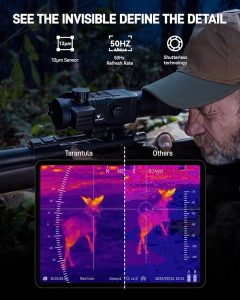
Its shutterless imaging technology is particularly noteworthy because it is designed to eliminate mechanical shutter interruptions and clicking sounds. This contributes to a smoother thermal viewing experience.
The integrated laser rangefinder and ballistic calculator add further functionality by combining distance measurement with calculated aiming information. Its continuous 1–8x magnification also provides flexibility when viewing thermal images at different enlargement levels.
Beyond imaging, the Tarantula incorporates several durability and convenience features. Its IP67 rating, stated 1,200g shock resistance, and tool-free quick-detach mounting system are designed to support outdoor use. Meanwhile, RAV recording and 32GB of internal storage allow users to preserve thermal footage.
Finally, the dual-battery system, six thermal palettes, 40 reticle options, and advertised five-year warranty contribute to a feature-rich overall package.
Best Uses
The VISTAGET Tarantula LRF 384-35 is particularly suited to:
-
Thermal observation: Its 384 × 288 sensor and ≤15 mK NETD sensitivity support the detection of subtle heat signatures.
-
Distance measurement: Its integrated laser rangefinder provides measurements of up to 1,000 meters.
-
Enhanced thermal viewing: Its shutterless technology is designed to provide uninterrupted image presentation.
-
Flexible image enlargement: Its continuous 1–8x magnification provides different viewing levels.
-
Outdoor applications: Its IP67 rating and rugged metal construction are designed for demanding environmental conditions.
-
Convenient mounting: Its tool-free quick-detach system supports easier installation and removal.
-
Thermal video recording: Recoil-Activated Video and 32GB of storage provide onboard recording functionality.
-
Customizable viewing: Its six thermal palettes and 40 reticle options offer additional display flexibility.
-
Extended outdoor sessions: Its dual-battery system provides additional power-management convenience.
Pros & Cons
Pros
-
High-sensitivity 384 × 288 thermal sensor.
-
NETD sensitivity of ≤15 mK.
-
Shutterless thermal imaging technology.
-
Integrated laser rangefinder.
-
Rangefinder measurement distance of up to 1,000 meters.
-
Built-in ballistic calculator.
-
Continuous 1–8x magnification.
-
35mm objective lens.
-
IP67 water-resistance rating.
-
Manufacturer-stated 1,200g shock resistance.
-
Tool-free quick-detach mounting system.
-
Picatinny mounting compatibility.
-
Recoil-Activated Video functionality.
-
32GB internal storage.
-
Six thermal color palettes.
-
40 reticle options.
-
Dual-battery power system.
-
Advertised five-year warranty.
Cons
-
The 384 × 288 sensor resolution is lower than the 640 × 512 resolution available in some premium thermal imaging models.
-
The supplied product information does not specify battery runtime.
Why We Selected It
The VISTAGET Tarantula LRF 384-35 earns its place on our list because it combines high-sensitivity thermal imaging, an integrated 1,000-meter laser rangefinder, and shutterless technology in a rugged riflescope design. Its ≤15 mK NETD sensitivity is particularly impressive, while its shutterless imaging system offers a distinctive advantage for users who prefer uninterrupted thermal viewing.
What makes this model especially interesting is its combination of digital functionality and durability. The built-in ballistic calculator, continuous 1–8x magnification, Recoil-Activated Video, and 32GB internal storage provide a comprehensive collection of features. Its IP67 water-resistance rating, quick-detach mounting system, and dual-battery configuration further strengthen its outdoor-oriented design.
For our 9 Best Thermal Scopes with Rangefinders – Top Picks for Precision, Long-Range Targeting & Enhanced Thermal Imaging guide, the VISTAGET Tarantula LRF 384-35 represents the rugged, feature-rich option, particularly for readers interested in combining sensitive thermal detection, integrated rangefinding, and convenient recording capabilities in one durable optical device.
7. DNT Optics HYDRA-LRF HS225R 256×192 Thermal Scope
The DNT Optics HYDRA-LRF HS225R is a versatile thermal imaging device designed to offer several viewing configurations in one compact unit. Rather than functioning exclusively as a traditional thermal riflescope, it can operate as a standalone scope, thermal clip-on, or handheld monocular. It also incorporates a built-in laser rangefinder and ballistic calculator, making it an interesting option for users looking for multiple thermal imaging capabilities without purchasing separate devices.
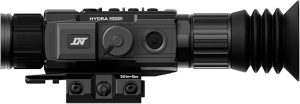
At the heart of the HS225R is a 256 × 192 uncooled infrared sensor with a 12μm pixel pitch and NETD sensitivity of ≤25 mK. It is paired with a 1024 × 768 Micro-OLED display operating at 50Hz, designed to provide smooth thermal imagery. DNT’s Image Super Resolution (ISR) technology further enhances the displayed image, producing what the manufacturer describes as 384-equivalent resolution.
The device offers 3x base magnification and up to 12x digital zoom, providing flexibility when viewing thermal targets at different levels of enlargement. Its integrated laser rangefinder measures distances from 5 to 1,300 yards, while the onboard ballistic calculator uses measured distance information to provide calculated drop compensation. Users can also adjust ballistic profiles directly on the device or through the DNT mobile application.
Durability and adaptability are other important aspects of the HS225R. Its IP67-rated construction is designed to protect against dust and water exposure, while its rugged housing is stated to withstand recoil up to .50 BMG. When paired with the separately sold QDM150 quick-detach mount, the device can be configured for different thermal viewing applications.
Key Specifications
-
Brand: DNT Optics
-
Model: HYDRA-LRF HS225R
-
Style: 256-25
-
Color: Black
-
Product Dimensions: 8 × 2.7 × 2 inches
-
Item Weight: 1.3 pounds
-
Material: Aluminum
-
Sport: Hunting and Shooting
-
Thermal Sensor Resolution: 256 × 192
-
Pixel Pitch: 12μm
-
NETD Sensitivity: ≤25 mK
-
Display Type: Micro-OLED
-
Display Resolution: 1024 × 768
-
Refresh Rate: 50Hz
-
Image Enhancement Technology: DNT Image Super Resolution (ISR)
-
Enhanced Resolution: 384-equivalent (manufacturer-stated)
-
Base Magnification: 3x
-
Maximum Magnification: 12x
-
Digital Zoom: Up to 12x
-
Objective Lens Diameter: 25mm
-
Laser Rangefinder: Integrated
-
Rangefinder Measurement Range: 5–1,300 yards
-
Ballistic Calculator: Built-in
-
Ballistic Profile Management: On-device and through the DNT App
-
Operating Modes: Standalone Scope, Thermal Clip-On, Handheld Monocular
-
Water and Dust Resistance: IP67
-
Recoil Resistance: Up to .50 BMG (manufacturer-stated)
-
Compatible Mounting Accessory: QDM150 Quick Detach Mount (sold separately)
Specification note: The supplied listing identifies the HS225R as a 256 × 192 thermal device, while its ISR technology produces a manufacturer-described 384-equivalent enhanced image. This should not be confused with a native 384 × 288 sensor. The 12x maximum magnification refers to digital enlargement, rather than 12x optical magnification. The QDM150 quick-detach mount is sold separately, so buyers should account for this when considering the different operating configurations.
Key Features
256 × 192 Thermal Sensor with Image Super Resolution
The DNT Optics HYDRA-LRF HS225R features a 256 × 192 uncooled infrared sensor with a 12μm pixel pitch and NETD sensitivity of ≤25 mK. This sensor detects differences in thermal radiation and translates them into images that can be viewed through the device’s display.
To improve the presentation of thermal details, DNT incorporates its Image Super Resolution (ISR) technology. According to the manufacturer, this enhancement produces a 384-equivalent image, helping improve perceived clarity and preserve additional visual detail.
It is important to distinguish this enhanced output from native sensor resolution: the underlying thermal sensor remains 256 × 192.
Integrated Laser Rangefinder with 5–1,300-Yard Measurement Range
One of the most valuable features of the HS225R is its built-in laser rangefinder. It measures distances from 5 to 1,300 yards, allowing users to obtain distance information without relying on a separate rangefinding device.
The integration of the rangefinder into the thermal unit makes the system more convenient, particularly for users who want thermal observation and distance measurement within one device.
Built-In Ballistic Calculator
The HS225R combines its laser rangefinder with an onboard ballistic calculator. This system uses measured distance information to generate calculated drop compensation based on the configured ballistic profile.
Users can adjust their ballistic profiles directly through the device or make changes using the DNT App. This provides additional flexibility when configuring the system.
1024 × 768 Micro-OLED Display
The device features a 1024 × 768 Micro-OLED display with a 50Hz refresh rate. This display presents the thermal image generated by the infrared sensor, while the refresh rate is designed to provide smooth image transitions during observation.
The combination of the Micro-OLED display and ISR image enhancement helps make the most of the device’s thermal imaging capabilities.
3x Base Magnification and Up to 12x Digital Zoom
The HS225R offers 3x base magnification and up to 12x digital zoom. This allows users to enlarge the displayed thermal image according to their viewing preferences.
Its 3x base magnification provides the starting viewing level, while digital zoom offers additional enlargement. However, because digital zoom enlarges the existing image rather than increasing the sensor’s native optical detail, image quality may become less detailed at higher zoom levels.
Three-in-One Thermal Viewing Versatility
One of the most distinctive aspects of the HYDRA-LRF HS225R is its ability to support three different thermal viewing configurations:
-
Standalone scope: Functions as a thermal scope.
-
Thermal clip-on: Can be configured as a clip-on thermal device with the appropriate mounting accessory.
-
Handheld monocular: Can be used as a handheld thermal observation device.
This versatility makes the HS225R more adaptable than devices designed for only one viewing configuration. However, the supplied listing specifies that the QDM150 quick-detach mount needed to maximize these configurations is sold separately.
IP67 Protection and Rugged Construction
The HS225R is designed for outdoor use, featuring an IP67-rated housing that provides protection against dust ingress and temporary water immersion under specified testing conditions.
Its rugged construction is also designed to withstand recoil of up to .50 BMG, according to the manufacturer. This makes durability an important part of its overall design, particularly for users who require equipment capable of handling demanding environments.
DNT App Integration and Ballistic Profile Management
Another useful feature is its compatibility with the DNT App. Users can fine-tune ballistic profiles through the application rather than relying exclusively on the device’s onboard controls.
This additional connectivity provides more flexibility when configuring the device and managing its ballistic settings.
Technology & Special Features
The DNT Optics HYDRA-LRF HS225R brings together several technologies intended to make thermal observation more versatile and accessible.
Its 256 × 192 uncooled infrared sensor uses a 12μm pixel pitch and ≤25 mK NETD sensitivity to capture thermal information. DNT’s Image Super Resolution technology enhances the displayed image to a manufacturer-described 384-equivalent resolution, while the 1024 × 768 Micro-OLED display and 50Hz refresh rate provide the viewing interface.
Its integrated laser rangefinder measures distances from 5 to 1,300 yards, and the built-in ballistic calculator uses configured ballistic profiles to provide calculated drop compensation. The ability to manage these profiles through the DNT App adds another layer of convenience.
The device’s three-in-one operating concept is particularly noteworthy. With the appropriate mounting accessory, it can serve as a standalone thermal scope, a thermal clip-on, or a handheld monocular. This adaptability gives users more flexibility in how they use the same thermal imaging unit.
Finally, its IP67-rated housing and manufacturer-stated recoil resistance up to .50 BMG make it a rugged option within DNT’s HYDRA-LRF range.
Best Uses
The DNT Optics HYDRA-LRF HS225R is particularly suited to:
-
Thermal observation: Its infrared sensor and ISR image enhancement support thermal viewing in low-visibility environments.
-
Distance measurement: Its integrated laser rangefinder measures distances from 5 to 1,300 yards.
-
Multiple viewing configurations: It supports standalone scope, thermal clip-on, and handheld monocular modes.
-
Ballistic information management: Its built-in calculator and adjustable profiles provide additional functionality.
-
Flexible thermal magnification: Its 3x base magnification and up to 12x digital zoom offer different viewing levels.
-
Outdoor applications: Its IP67-rated construction is designed to withstand dust and water exposure.
-
Demanding environments: Its manufacturer-stated recoil resistance supports use on compatible platforms.
-
Digital configuration: DNT App integration allows users to adjust ballistic profiles conveniently.
Pros & Cons
Pros
-
Three-in-one thermal viewing functionality.
-
Integrated laser rangefinder.
-
Rangefinder measurement range of 5–1,300 yards.
-
Built-in ballistic calculator.
-
Adjustable ballistic profiles through the device and DNT App.
-
256 × 192 thermal sensor with 12μm pixel pitch.
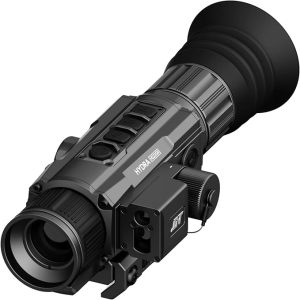
-
NETD sensitivity of ≤25 mK.
-
DNT Image Super Resolution technology.
-
1024 × 768 Micro-OLED display.
-
50Hz refresh rate.
-
3x base magnification and up to 12x digital zoom.
-
IP67-rated dust and water protection.
-
Manufacturer-stated recoil resistance up to .50 BMG.
-
Compact design weighing approximately 1.3 pounds.
Cons
-
Its native 256 × 192 sensor resolution is lower than that of some higher-end 384 × 288 and 640 × 512 thermal scopes.
-
The 384-equivalent image produced through ISR is enhanced resolution, not native sensor resolution.
Why We Selected It
The DNT Optics HYDRA-LRF HS225R earns its place on our list because of its versatility and combination of thermal imaging, laser rangefinding, and ballistic calculation technologies. Its three-in-one operating concept is particularly appealing, allowing one device to function as a standalone thermal scope, clip-on, or handheld monocular when paired with the appropriate mounting accessory.
Although its native 256 × 192 sensor resolution is more modest than that of some premium thermal optics, DNT’s Image Super Resolution technology, 1024 × 768 Micro-OLED display, and 50Hz refresh rate add useful imaging enhancements. Its integrated rangefinder, with a measurement range of up to 1,300 yards, is another significant advantage.
For our 9 Best Thermal Scopes with Rangefinders – Top Picks for Precision, Long-Range Targeting & Enhanced Thermal Imaging guide, the HYDRA-LRF HS225R stands out as the versatile entry-level option. It is particularly interesting for readers who value multiple thermal viewing configurations and integrated rangefinding functionality in a compact device, without necessarily needing the higher native sensor resolution of more expensive models.
8. ATN BlazeHunter 335 384×288 Thermal Monocular – Signature Series Power Bundle
The ATN BlazeHunter 335 384×288 Thermal Monocular is a handheld thermal imaging device designed for outdoor observation, hunting, scouting, and wildlife monitoring. Unlike traditional thermal riflescopes, this model is a handheld monocular, meaning it is intended primarily for observing thermal signatures rather than mounting directly onto a rifle. Its compact design, built-in Wi-Fi, video recording capability, and integrated laser rangefinder make it a versatile option for users who want portable thermal imaging technology.
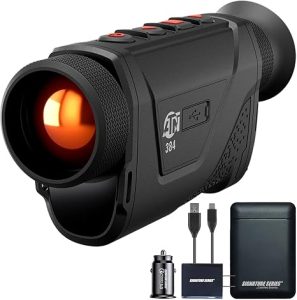
At the centre of the BlazeHunter 335 is a 384 × 288 vanadium oxide (VOx) uncooled focal plane detector with a NETD sensitivity of less than 18 mK. This sensor is designed to detect subtle temperature differences, helping users distinguish heat signatures in darkness and other challenging viewing conditions. The monocular also offers a stated magnification range of 4–32x, providing different levels of image enlargement for thermal observation.
Another notable feature is its integrated laser rangefinder, which allows users to measure distances without carrying a separate ranging device. The supplied product description advertises a thermal detection range of up to 1,800 yards, although this should not be confused with the laser rangefinder’s measurement distance, which is not specified in the provided listing.
The BlazeHunter 335 also supports video recording, allowing users to capture and review their thermal observations. Its built-in Wi-Fi provides additional connectivity, while the Signature Series Power Bundle includes two rechargeable batteries and a charger, according to the product description. With an advertised continuous operating time of up to 14 hours, the package is designed to support extended outdoor observation sessions.
Key Specifications
-
Brand: ATN
-
Product Model: BlazeHunter 335
-
Model Number: TIMNBLH335LRF Power Bundle
-
Device Type: Handheld Thermal Monocular
-
Color: Not specified
-
Product Dimensions: 1.67 × 2.93 × 5.98 inches
-
Item Weight: 12.8 ounces
-
Focus Type: Autofocus
-
Power Source: Rechargeable batteries
-
Thermal Sensor Type: Vanadium Oxide (VOx) Uncooled Focal Plane Detector
-
Thermal Sensor Resolution: 384 × 288
-
NETD Sensitivity: Less than 18 mK
-
Magnification: 4–32x
-
Advertised Thermal Detection Range: Up to 1,800 yards
-
Laser Rangefinder: Built-in
-
Laser Rangefinder Measurement Range: Not specified in the supplied listing
-
Field of View: Listed as 1,000 yards; exact angular or linear measurement is unclear
-
Video Recording: Supported
-
Wireless Connectivity: Built-in Wi-Fi
-
Compatible Devices: Smartphones, tablets, and laptops
-
Battery Type: Rechargeable lithium-ion
-
Battery Configuration: Two rechargeable batteries and charger included in the bundle description
-
Advertised Battery Life: Up to 14 hours of continuous use
-
Bundle: Signature Series Power Bundle
Specification note: The listing contains some inconsistencies that buyers should verify. Its generic specifications state that one lithium-ion battery is required and included, while the Power Bundle description specifies two rechargeable batteries and a charger. The 1,800-yard figure refers to the advertised thermal detection range, not the laser rangefinder’s measurement distance. Additionally, the 1,000-yard field-of-view entry is ambiguous and should not be interpreted as a confirmed angular field-of-view measurement. The supplied information also does not clarify whether 4–32x represents optical magnification, digital zoom, or a combination of both.
Key Features
384 × 288 VOx Thermal Imaging Sensor
The ATN BlazeHunter 335 features a 384 × 288 vanadium oxide (VOx) uncooled thermal sensor designed to detect heat signatures and convert temperature differences into visible thermal images.
Its NETD sensitivity of less than 18 mK is particularly noteworthy. NETD measures a thermal sensor’s ability to distinguish small temperature differences, with lower values generally indicating greater thermal sensitivity. This helps the monocular capture subtle variations in thermal signatures, supporting observation in darkness and other challenging environments.
High Thermal Sensitivity with NETD Below 18 mK
One of the most important specifications of the BlazeHunter 335 is its NETD rating of less than 18 mK. This indicates a highly sensitive thermal detector capable of distinguishing relatively small temperature differences.
For outdoor observation, this can be useful when viewing objects against backgrounds with similar temperatures. The sensor’s sensitivity contributes to the device’s ability to present thermal information in varying environmental conditions.
4–32x Magnification
The BlazeHunter 335 offers a stated magnification range of 4–32x, giving users multiple levels of image enlargement for observing thermal subjects.
The lower magnification level provides the starting viewing perspective, while higher magnification allows users to enlarge the displayed image. This can be useful when observing distant thermal signatures, although the actual level of visible detail at higher magnification depends on the underlying sensor resolution and whether the enlargement is optical or digital.
Integrated Laser Rangefinder
The monocular incorporates a built-in laser rangefinder, allowing users to obtain distance measurements without carrying a separate ranging device.
This adds convenience to its thermal observation capabilities, particularly when assessing distances during outdoor activities. However, the supplied listing does not provide a specific maximum laser measurement distance, so the advertised 1,800-yard thermal detection range should not be used as a substitute for that specification.
Advertised Detection Range of Up to 1,800 Yards
According to the supplied product description, the BlazeHunter 335 offers a thermal detection range of up to 1,800 yards.
Detection range refers to the distance at which a thermal device may detect a heat signature under suitable conditions. It does not necessarily mean that the user can clearly identify an object or recognize fine details at that same distance. Actual performance can vary depending on the target’s size, temperature, weather, and surrounding environment.
Built-In Wi-Fi Connectivity
The BlazeHunter 335 includes built-in Wi-Fi, allowing it to connect with compatible electronic devices. The listing identifies smartphones, tablets, and laptops as compatible devices.
This connectivity adds flexibility for users who want to integrate their thermal observation experience with other digital devices. It also complements the monocular’s video-recording functionality.
Video Recording Capability
Another useful feature is its ability to record thermal observations. Users can capture footage during hunting, scouting, or wildlife-monitoring activities and review it later.
Video recording can be particularly helpful when documenting animal movement or preserving observations from outdoor trips. Combined with its Wi-Fi connectivity, this feature makes the BlazeHunter more than a basic thermal viewing device.
Signature Series Power Bundle
The Power Bundle is designed to provide additional battery support for extended outdoor use. According to the supplied description, it includes two rechargeable batteries and a charger, with an advertised continuous operating time of up to 14 hours.
This additional power arrangement can be useful for users who spend extended periods away from charging facilities. Having a spare rechargeable battery also provides greater flexibility when one battery needs to be replaced or recharged.
Technology & Special Features
The ATN BlazeHunter 335 combines thermal imaging, distance measurement, wireless connectivity, and video recording in a compact handheld design.
Its 384 × 288 VOx uncooled focal plane detector provides the core thermal imaging functionality, while its NETD sensitivity of less than 18 mK supports the detection of subtle temperature differences. The stated 4–32x magnification range provides different viewing levels, although the listing does not clarify the optical and digital zoom breakdown.
Its integrated laser rangefinder adds distance-measuring functionality, eliminating the need for a separate rangefinding device. The advertised thermal detection range of up to 1,800 yards further highlights its intended use for observing distant heat signatures, subject to environmental and target conditions.
Beyond thermal imaging, the monocular incorporates built-in Wi-Fi and video recording, allowing users to connect compatible devices and preserve their observations. These features make it suitable for users who value both live thermal viewing and the ability to document what they observe.
Finally, the Signature Series Power Bundle adds two rechargeable batteries and a charger, with the manufacturer or seller advertising up to 14 hours of continuous operation. This makes the package particularly appealing for extended outdoor observation sessions.
Best Uses
The ATN BlazeHunter 335 is particularly suited to:
-
Wildlife observation: Its thermal sensor helps detect heat signatures in darkness and challenging viewing environments.
-
Hunting and scouting: Its handheld design and integrated rangefinder support outdoor observation and distance assessment.
-
Long-distance thermal detection: Its advertised detection range of up to 1,800 yards supports observation of distant heat signatures under suitable conditions.
-
Thermal image enlargement: Its stated 4–32x magnification provides different viewing levels.
-
Distance measurement: Its built-in laser rangefinder eliminates the need for a separate ranging device.
-
Video documentation: Its recording capability allows users to capture and review thermal observations.
-
Digital connectivity: Built-in Wi-Fi supports connection with compatible smartphones, tablets, and laptops.
-
Extended outdoor sessions: The Power Bundle’s rechargeable batteries and charger provide additional power-management flexibility.
Pros & Cons
Pros
-
384 × 288 VOx uncooled thermal imaging sensor.
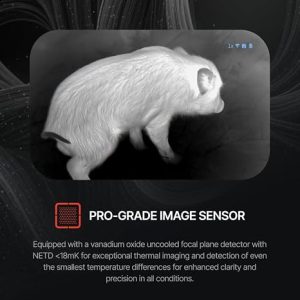
-
NETD sensitivity of less than 18 mK.
-
Advertised thermal detection range of up to 1,800 yards.
-
Built-in laser rangefinder.
-
Stated 4–32x magnification range.
-
Built-in Wi-Fi connectivity.
-
Video recording capability.
-
Compatible with smartphones, tablets, and laptops.
-
Compact handheld monocular design.
-
Signature Series Power Bundle includes two rechargeable batteries and a charger, according to the supplied bundle description.
-
Advertised battery life of up to 14 hours.
Cons
-
It is a handheld thermal monocular, not a traditional rifle-mounted thermal riflescope.
-
The supplied listing does not specify the laser rangefinder’s maximum measurement distance.
Why We Selected It
The ATN BlazeHunter 335 384×288 Thermal Monocular earns its place in our roundup because of its combination of sensitive thermal imaging, integrated laser rangefinding, and convenient digital features. Its VOx sensor, with NETD sensitivity below 18 mK, provides an impressive foundation for thermal observation, while its advertised detection range of up to 1,800 yards makes it an interesting option for users who need to observe distant heat signatures.
Its built-in Wi-Fi and video recording capabilities further distinguish it from simpler handheld thermal devices. The Signature Series Power Bundle also adds practical value through its rechargeable batteries and charger, with up to 14 hours of continuous use advertised.
Although it is important to recognize that this model is a handheld monocular rather than a conventional riflescope, its integrated rangefinder and versatile observation capabilities make it a useful alternative for readers exploring thermal optics.
For our 9 Best Thermal Scopes with Rangefinders – Top Picks for Precision, Long-Range Targeting & Enhanced Thermal Imaging guide, the ATN BlazeHunter 335 stands out as the portable thermal observation option, particularly for readers who prioritize handheld convenience, thermal sensitivity, video recording, and integrated distance measurement over direct rifle mounting.
9. Pulsar Oryx LRF 35mm Thermal Monocular
The Pulsar Oryx LRF 35mm is a thermal imaging device designed to combine long-range thermal observation with integrated laser distance measurement. Although it is described in the supplied listing as compatible with rifles, the product description specifically identifies it as a thermal monocular. This distinction is important because it is primarily intended for handheld observation rather than functioning as a conventional rifle-mounted thermal riflescope.
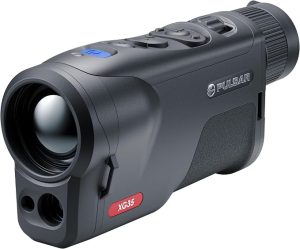
Featuring a 35mm objective lens and an AMOLED display with a resolution of 1024 × 768 pixels, the Oryx LRF is designed to deliver detailed thermal images in different environmental conditions. Its stated 12.5-degree field of view provides a relatively broad viewing perspective, while its magnification range of 2.5–20x allows users to enlarge thermal images when observing distant objects.
One of its most notable features is its integrated laser rangefinder, which offers a measurement range of up to 1,500 meters with a stated accuracy of ±1 meter. This allows users to obtain distance information without relying on a separate rangefinding device. The monocular also advertises a thermal detection range of up to 1,969 yards, making it suitable for observing distant heat signatures under appropriate conditions.
The Oryx LRF is designed for more than hunting applications. Its supplied product description highlights potential uses in observation, security, terrain navigation, and search-and-rescue activities. It is also advertised as suitable for use during the day and at night, including challenging weather conditions such as fog and rain.
Key Specifications
-
Brand: Pulsar
-
Model: Oryx LRF
-
Device Type: Thermal Monocular
-
Objective Lens Diameter: 35mm
-
Focal Length: 35mm
-
Item Weight: 1.1 pounds
-
Compatible Devices: Rifles (as stated in the supplied listing; mounting configuration not specified)
-
Eyepiece Lens Description: Digital/Electronic
-
Display Type: AMOLED
-
Display Resolution: 1024 × 768 pixels
-
Field of View: 12.5 degrees
-
Magnification: 2.5–20x
-
Laser Rangefinder: Integrated
-
Laser Rangefinder Measurement Range: Up to 1,500 meters
-
Rangefinder Accuracy: ±1 meter (manufacturer-stated)
-
Advertised Thermal Detection Range: Up to 1,969 yards
-
Operating Conditions: Day and night use
-
Battery: One product-specific battery (included)
-
Export Restrictions: Subject to U.S. Export Administration Regulations (EAR)
Specification note: The supplied listing identifies the Oryx as a thermal monocular, despite also listing rifle compatibility. It does not provide a specific rifle-mounting system or confirm that the device functions as a dedicated riflescope. Buyers should verify the exact product configuration before purchasing it for rifle mounting. Also, the 1,969-yard figure is the advertised thermal detection range, whereas 1,500 meters refers to the laser rangefinder’s measurement range. These are separate performance specifications. The listing does not provide the thermal sensor resolution, NETD sensitivity, or a detailed battery runtime.
Key Features
35mm Objective Lens and AMOLED Display
The Pulsar Oryx LRF features a 35mm objective lens designed to collect thermal information for image processing and display. It is paired with a 1024 × 768 AMOLED display, which presents the resulting thermal imagery to the user.
AMOLED technology provides a digital viewing interface with detailed image presentation. This combination is intended to support thermal observation in different environments, including situations where ordinary optical visibility is limited.
12.5-Degree Field of View
Another important specification is its 12.5-degree field of view. This describes the angular area visible through the device at a given viewing setting.
A broader field of view can be useful when scanning surroundings and observing larger areas, while higher magnification generally provides a more focused view of a smaller portion of the scene. The Oryx combines this field of view with its variable magnification range to support different observation requirements.
Integrated 1,500-Meter Laser Rangefinder
The Oryx LRF incorporates a built-in laser rangefinder capable of measuring distances of up to 1,500 meters. Its stated accuracy of ±1 meter makes distance measurement one of its central features.
Having this technology integrated into the monocular eliminates the need to carry a separate rangefinder for distance assessment. It can also help users understand the distance between themselves and observed objects during outdoor activities.
Advertised Thermal Detection Range of 1,969 Yards
The supplied product description advertises a thermal detection range of up to 1,969 yards. This highlights the device’s intended long-distance observation capabilities.
It is important to understand that detection range does not necessarily represent identification range. Detecting a heat signature at a particular distance does not mean that the user can clearly identify the object or distinguish fine details at that same distance. Actual performance depends on factors such as target size, temperature differences, weather, and surrounding conditions.
2.5–20x Magnification
The Pulsar Oryx LRF offers a stated magnification range of 2.5–20x, providing flexibility when observing thermal subjects at different distances.
The lower magnification setting offers a wider viewing perspective, while higher magnification enlarges the displayed image for closer examination. This makes the device adaptable to different observation situations, although the supplied listing does not clarify the optical and digital magnification breakdown.
Day and Night Observation
The Oryx is advertised for both daytime and nighttime use. Unlike conventional optical devices that rely heavily on visible light, thermal imaging detects differences in heat radiation.
This allows the device to present thermal information even in darkness. Its supplied description also highlights its ability to provide useful thermal visuals in challenging conditions such as fog, rain, and environments with branches or dense foliage.
However, environmental obstacles can still affect thermal detection and identification performance, so these conditions should not be interpreted as guaranteeing visibility through every obstruction.
Versatile Outdoor Applications
Although hunting is one of the intended applications, the Oryx LRF is also presented as suitable for observation, security, terrain navigation, and search-and-rescue activities.
Its combination of thermal imaging and laser distance measurement makes it relevant to users who need to observe their surroundings and obtain distance information using a single handheld device.
Compact Design and Included Battery
Weighing approximately 1.1 pounds, the Oryx LRF has a relatively portable design for outdoor observation. The supplied listing also indicates that one product-specific battery is included.
Its compact weight can be useful for users who prefer handheld equipment that is easier to carry during extended outdoor activities. However, the listing does not specify the battery’s operating time or charging arrangements.
Technology & Special Features
The Pulsar Oryx LRF combines digital thermal imaging with laser distance measurement in a handheld monocular configuration.
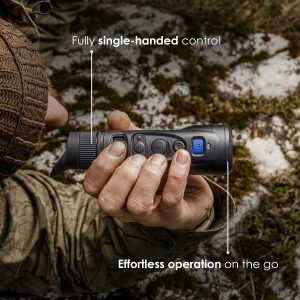
Its 35mm objective lens works alongside an AMOLED display with 1024 × 768 resolution to provide the thermal viewing experience. The stated 12.5-degree field of view and 2.5–20x magnification range offer flexibility when scanning surroundings and enlarging thermal images.
Its integrated laser rangefinder is another major technological feature, measuring distances of up to 1,500 meters with manufacturer-stated accuracy of ±1 meter. This is separate from its advertised thermal detection range of up to 1,969 yards.
The device is also designed for day and night use, with the supplied listing highlighting its suitability for foggy and rainy conditions and environments containing branches or dense foliage. These capabilities make it relevant to different outdoor observation applications.
One important consideration is the product’s export-control notice. The supplied listing states that the Oryx LRF is subject to the U.S. Export Administration Regulations (EAR), including restrictions on export and in-country transfers. Buyers should review the applicable restrictions before arranging international purchases or transfers.
Best Uses
The Pulsar Oryx LRF is particularly suited to:
-
Thermal observation: Its 35mm objective lens and AMOLED display support digital thermal viewing.
-
Long-distance detection: Its advertised thermal detection range reaches up to 1,969 yards under suitable conditions.
-
Distance measurement: Its integrated laser rangefinder measures distances up to 1,500 meters.
-
Outdoor navigation: Its thermal imaging and distance-measuring capabilities can support terrain observation.
-
Hunting observation: Its variable 2.5–20x magnification provides flexibility when viewing thermal subjects.
-
Security and surveillance: Its day-and-night thermal observation capabilities can support situational awareness.
-
Search and rescue: Its thermal imaging technology can assist with detecting heat signatures in suitable search environments.
-
Challenging weather conditions: It is advertised for use in fog and rain, although actual performance depends on environmental conditions.
Pros & Cons
Pros
-
Integrated laser rangefinder.
-
Rangefinder measurement distance of up to 1,500 meters.
-
Manufacturer-stated rangefinder accuracy of ±1 meter.
-
Advertised thermal detection range of up to 1,969 yards.
-
35mm objective lens.
-
1024 × 768 AMOLED display.
-
12.5-degree field of view.
-
2.5–20x magnification range.
-
Designed for day and night observation.
-
Advertised suitability for foggy and rainy conditions.
-
Versatile applications beyond hunting.
-
Relatively portable weight of 1.1 pounds.
-
One product-specific battery included.
Cons
-
The supplied product description identifies it as a thermal monocular rather than a conventional rifle-mounted thermal scope.
-
Rifle-mounting compatibility and mounting accessories are not clearly specified.
Why We Selected It
The Pulsar Oryx LRF 35mm earns its place in our roundup because of its combination of long-range thermal observation, integrated laser rangefinding, and a high-resolution AMOLED display. Its 1,500-meter rangefinder measurement capability, with stated accuracy of ±1 meter, is particularly noteworthy for users who value precise distance information alongside thermal imaging.
Its advertised detection range of up to 1,969 yards and variable 2.5–20x magnification further contribute to its appeal. Additionally, its 12.5-degree field of view and advertised suitability for day and night observation make it a versatile option for different outdoor applications.
However, it is important to distinguish this model from traditional thermal riflescopes. The supplied description identifies it as a thermal monocular, and buyers interested in direct rifle mounting should verify the exact configuration and compatibility before purchasing.
For our 9 Best Thermal Scopes with Rangefinders – Top Picks for Precision, Long-Range Targeting & Enhanced Thermal Imaging guide, the Pulsar Oryx LRF stands out as the long-range thermal observation option, particularly for readers who prioritize extended detection capability, integrated laser distance measurement, and versatile outdoor applications.
Frequently Asked Questions (FAQs)
1. What is a thermal scope with a rangefinder?
A thermal scope with a rangefinder is an optical device that combines thermal imaging technology with a laser rangefinder. The thermal sensor detects heat signatures and converts temperature differences into visible images, allowing users to observe objects in darkness and other low-visibility conditions. The integrated rangefinder measures the distance to an observed object, providing additional information without requiring a separate distance-measuring device.
2. What is the advantage of having a built-in laser rangefinder in a thermal scope?
A built-in laser rangefinder offers convenience by combining thermal observation and distance measurement in one device. Instead of carrying separate equipment, users can view thermal images and obtain distance readings through the same optical system. When paired with a ballistic calculator, as found in models such as the ATN ThOR 6 Elite LRF and DNT Optics HYDRA-LRF HS225R, it can also provide calculated ballistic information based on configured profiles.
3. How far can thermal scopes with rangefinders detect objects?
Detection range varies depending on the thermal sensor, objective lens, target size, environmental conditions, and overall device design. Among the products reviewed, the ATN BlazeHunter 335 advertises a thermal detection range of up to 1,800 yards, while the Pulsar Oryx LRF advertises up to 1,969 yards. However, detection range should not be confused with identification range or laser rangefinder measurement distance. Detecting a heat signature does not necessarily mean being able to identify the object clearly at that distance.
4. What is the difference between thermal detection range and laser rangefinder range?
These specifications describe two different capabilities. Thermal detection range indicates how far a thermal imaging device can detect a heat signature under suitable conditions. Laser rangefinder range indicates the maximum distance at which its laser system can measure the distance to an object.
For example, the oneleaf.ai Mars MT1000LRF advertises thermal detection up to 1,969 yards, while its laser rangefinder measures up to 1,300 yards. Similarly, the Pulsar Oryx LRF advertises 1,969-yard thermal detection and a 1,500-meter laser rangefinder measurement distance.
5. Is a 640 × 512 thermal sensor better than a 384 × 288 sensor?
Generally, a 640 × 512 thermal sensor provides more native image pixels than a 384 × 288 sensor, allowing it to capture more image information when other factors are comparable. This can improve image detail and support better target identification at suitable distances.
However, resolution is not the only factor determining thermal performance. NETD sensitivity, objective lens quality, image processing, display resolution, and environmental conditions also matter. For example, the oneleaf.ai Mars MT1000LRF and RIX Storm S6R offer 640 × 512 sensors, while the ATN ThOR 6 Elite LRF features a 384 × 288 sensor with additional image-enhancement technology.
6. What does NETD mean in thermal imaging?
NETD stands for Noise Equivalent Temperature Difference. It measures a thermal sensor’s ability to distinguish small differences in temperature. It is usually expressed in millikelvin (mK).
A lower NETD value generally indicates greater thermal sensitivity, allowing the device to distinguish smaller temperature differences. For instance, the VISTAGET Tarantula LRF 384-35 advertises NETD sensitivity of ≤15 mK, while the ATN BlazeHunter 335 specifies less than 18 mK. These values can help buyers compare thermal sensitivity, although they should not be considered the sole measure of image quality.
7. Can thermal scopes be used during the day as well as at night?
Yes. Thermal imaging devices detect infrared radiation emitted by objects rather than relying on visible light. This means they can operate during both daytime and nighttime conditions.
They can also be useful in certain challenging visibility conditions, including darkness, fog, and some forms of light obstruction. However, weather, dense materials, and environmental conditions can affect thermal performance. Thermal imaging does not guarantee visibility through solid walls or every type of obstacle.
8. What is the difference between a thermal riflescope and a thermal monocular?
A thermal riflescope is designed to be mounted onto a compatible rifle and used as a rifle-mounted optical device. A thermal monocular, on the other hand, is primarily designed for handheld observation.
This distinction is important when comparing products in this roundup. The ATN BlazeHunter 335 and Pulsar Oryx LRF are described as thermal monoculars rather than conventional riflescopes. The DNT Optics HYDRA-LRF HS225R is more versatile, offering standalone scope, clip-on, and handheld monocular configurations when paired with the appropriate mounting accessory.
Buyers should always confirm mounting compatibility and the exact product configuration before purchasing.
9. What features should I consider when choosing a thermal scope with a rangefinder?
Several specifications are worth comparing before making a purchase:
-
Thermal sensor resolution: Higher native resolution generally provides more image detail.
-
NETD sensitivity: Lower values generally indicate better sensitivity to subtle temperature differences.
-
Objective lens diameter: Influences the optical system’s light-gathering and field-of-view characteristics.
-
Laser rangefinder distance: Check the actual measurement range rather than relying on the thermal detection range.
-
Magnification: Compare base optical magnification with digital zoom.
-
Display quality: Resolution and display technology affect how thermal images appear.
-
Battery life: Consider runtime and whether spare batteries are included.
-
Durability: Water resistance, dust protection, and recoil compatibility matter for demanding outdoor applications.
-
Additional technology: Features such as ballistic calculators, video recording, Wi-Fi, and quick-detach mounts can improve convenience.
Ultimately, the best choice depends on the intended application, required performance, and available budget.
10. Are thermal scopes with rangefinders worth the investment?
For users who regularly require thermal observation and distance measurement, an integrated rangefinder can be a worthwhile investment. Combining both functions in one device reduces the need to carry separate equipment and can make outdoor observation more convenient.
Models such as the ATN ThOR 6 Elite LRF, oneleaf.ai Mars MT1000LRF, and RIX Storm S6R offer combinations of thermal imaging and rangefinding, while other reviewed products provide additional features such as ballistic calculators, video recording, and multiple viewing configurations.
However, buyers should compare native sensor resolution, rangefinder measurement distance, battery performance, and mounting compatibility before deciding whether a particular model justifies its price.
Conclusion
Choosing the right thermal scope with a rangefinder involves more than simply looking for the highest magnification or longest advertised detection distance. Factors such as thermal sensor resolution, NETD sensitivity, laser rangefinder performance, display quality, durability, and battery life all contribute to the overall experience. Understanding these specifications makes it easier to identify a device that meets your particular observation and outdoor equipment requirements.
Our selection of the 9 Best Thermal Scopes with Rangefinders covers a variety of models with different strengths and capabilities. The ATN ThOR 6 Elite LRF offers advanced thermal imaging and integrated digital features, while the oneleaf.ai Mars MT1000LRF and RIX Storm S6R stand out with their 640 × 512 thermal sensors. The VISTAGET Tarantula LRF 384-35 brings together shutterless imaging, rangefinding, and rugged construction, while the DNT Optics HYDRA-LRF HS225R offers multiple thermal viewing configurations in one device.
Other options, including the ATN BlazeHunter 335 and Pulsar Oryx LRF, provide handheld thermal observation alternatives with integrated laser rangefinders. Although these are not conventional rifle-mounted scopes, they offer useful capabilities for users interested in portable thermal imaging. The Pulsar Thermion 2 LRF XQ50 Pro and other models in the selection also deserve careful consideration, particularly when verifying the exact model configuration and included features.
Ultimately, the best thermal imaging device is the one that offers the right balance of image quality, rangefinding capability, reliability, and practicality for your intended application. Before purchasing, always verify the manufacturer’s specifications, included accessories, warranty conditions, and mounting compatibility. Pay particular attention to the difference between thermal detection range and laser rangefinder measurement distance, as these figures describe separate capabilities.
With the right information and a clear understanding of your requirements, you can make a more informed decision and choose a thermal imaging device that offers dependable performance and long-term value.