
A power outage can happen at the most inconvenient time. One moment, everything in your home is working normally, and the next, the lights go out, the Wi-Fi router shuts down, phones stop charging, and essential appliances are suddenly without electricity. For short interruptions, this may be little more than an inconvenience. But when an outage lasts for several hours—or even longer—having a dependable backup power source can make a significant difference.
This is where the Best Portable Power Stations for Home Power Outages come in. Unlike traditional gasoline-powered generators, portable power stations store electricity in rechargeable batteries and deliver it through AC outlets, USB ports, and other outputs. Many modern models can also be recharged from a wall outlet, a vehicle, or compatible solar panels, giving homeowners several ways to replenish their stored energy.
A portable power station can be particularly useful for keeping essential electronics running during an outage. Depending on its battery capacity and inverter output, a suitable model may power devices such as Wi-Fi routers, smartphones, laptops, televisions, LED lights, fans, CPAP machines, refrigerators, and selected kitchen appliances. Larger units can provide substantially more energy and higher output for households that need to keep several devices operating at the same time.
However, choosing a power station for home backup is not simply about finding the model with the largest battery. Battery capacity, continuous output, surge capacity, recharge speed, battery chemistry, available outlets, UPS functionality, solar-input capability, portability, and expandability all affect how useful a power station will be during an actual blackout.
For example, a compact 500Wh-class power station may be convenient for keeping phones, laptops, lights, and networking equipment running, while a 1,000Wh or larger model can provide considerably more stored energy for longer outages. Models around 2,000Wh and above are more appropriate when the goal is to support higher-demand household equipment or maintain several essential devices for extended periods.
Another important consideration is the inverter. Battery capacity tells you how much energy the station can store, while the inverter’s wattage determines how much power the unit can deliver at a given moment. A power station with plenty of watt-hours but insufficient output may still be unable to operate a high-powered appliance. Conversely, a high-wattage inverter does not necessarily mean the station will run an appliance for a long time if its battery capacity is relatively small.
Recharge speed also matters. During a prolonged outage, being able to recharge quickly from AC power or compatible solar panels can make a portable power station considerably more practical. Several current models from brands such as EcoFlow, BLUETTI, Jackery, and Anker SOLIX are designed around fast charging and multiple charging methods. Amazon-linked listings and product references show these brands among the portable power options available to shoppers.
For example, the EcoFlow DELTA 2 is a 1,024Wh-class power station that has been listed on Amazon, while the BLUETTI AC200L and Anker SOLIX F2000 are larger 2,048Wh-class options. These different capacity classes illustrate why it is important to consider what you actually want to power rather than choosing solely by brand or price.
Portability is another factor worth considering. A smaller power station can be moved around the house relatively easily and may be convenient for temporary outages, camping, travel, or outdoor work. Larger home-backup units generally provide more capacity and higher output, but their additional battery capacity also means greater size and weight. For some households, a compact unit that can be moved from the office to the living room may be more practical; for others, a larger stationary backup system may make more sense.
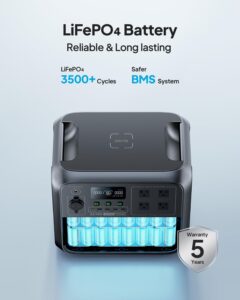
Battery chemistry can also influence long-term ownership. Many newer portable power stations use LiFePO4 (lithium iron phosphate) batteries, which are valued for their cycle life and suitability for frequent charging and discharging. The exact battery specifications vary between models, so shoppers should check the manufacturer’s specifications for the particular generation they are considering.
Another useful feature for home outages is UPS or EPS functionality. When supported, this can allow compatible equipment to switch to battery power automatically when utility power is interrupted. This can be particularly useful for routers, computers, networking equipment, and other electronics where even a brief interruption can cause a shutdown.
Solar charging can further increase the usefulness of a power station during extended outages. Instead of depending entirely on the electrical grid to recharge the battery, compatible solar panels can provide another charging source. This is particularly relevant for emergency preparedness, off-grid use, camping, and areas where outages may continue for an extended period.
With all these factors in mind, the following comparison brings together 10 portable power stations worth considering for home backup and emergency power. Rather than treating every model as identical, the table highlights the specifications that can help you determine which capacity and feature set best matches your household’s needs.
10 Best Portable Power Stations for Home Power Outages – Top Picks for Reliable Backup, Fast Charging & Emergency Power
| # | Product | Battery Capacity | AC Output | Battery Type | Solar Charging | Best Use |
|---|---|---|---|---|---|---|
| 1 | EF ECOFLOW DELTA 2 | 1,024Wh | 1,800W | LiFePO4 | Yes | Everyday home backup |
| 2 | Jackery Explorer 1000 v2 | 1,070Wh | 1,500W | LiFePO4 | Yes | Essential electronics & appliances |
| 3 | BLUETTI AC180 | 1,152Wh | 1,800W | LiFePO4 | Yes | Home backup & high-demand devices |
| 4 | Anker SOLIX C1000 | 1,056Wh | 1,800W | LiFePO4 | Yes | Home, office & emergency backup |
| 5 | EF ECOFLOW DELTA 2 Max | 2,048Wh | 2,400W | LiFePO4 | Yes | Extended home backup |
| 6 | BLUETTI AC200L | 2,048Wh | 2,400W | LiFePO4 | Yes | Appliances & longer outages |
| 7 | Anker SOLIX F2000 | 2,048Wh | 2,400W | LiFePO4 | Yes | Large-capacity home backup |
| 8 | Jackery Explorer 2000 Plus | 2,042Wh | 3,000W | LiFePO4 | Yes | High-power appliances |
| 9 | EF ECOFLOW DELTA Pro | 3,600Wh | 3,600W | LiFePO4 | Yes | Extended emergency backup |
| 10 | BLUETTI AC300 | Expandable | 3,000W | LiFePO4 | Yes | Expandable whole-home backup |
1. EF ECOFLOW DELTA 3 Portable Power Station
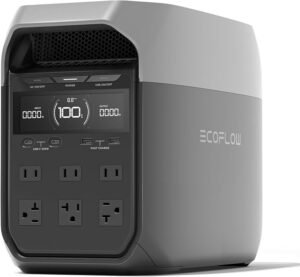
When a power outage interrupts your home, the difference between simply having a battery and having a capable portable power station becomes immediately obvious. The EF ECOFLOW DELTA 3 is designed to provide substantial backup power while remaining versatile enough for camping, emergency preparedness, and everyday portable power needs. With a 1,024Wh-class battery, 1,800W AC output, rapid recharging, and expandable storage, it offers a combination of capacity and flexibility that makes it worth considering for homeowners who want dependable backup electricity.
One of the DELTA 3’s biggest attractions is its ability to recharge quickly. According to the supplied product specifications, it can combine up to 1,500W of AC input with 500W of solar input to reach a full charge in as little as 56 minutes, while an 80% charge can be reached in approximately 30 minutes. That can be particularly useful during an outage when you need to replenish the battery quickly rather than waiting several hours.
The unit also stands out for its expandable design. Its storage capacity can be expanded up to 5kWh using compatible EcoFlow extra batteries, giving users the option to increase their energy reserve as their backup-power requirements grow. Combined with LiFePO4 battery technology, 4,000 cycles to 80% capacity, multiple charging methods, and the ability to power up to 13 devices simultaneously, the DELTA 3 is built around more than just short-term emergency charging.
Key Specifications
- Brand: EF ECOFLOW
- Model: DELTA 3
- Color: Black and Gray
- Voltage: 120V AC
- Battery Chemistry: LiFePO4 (LFP)
- AC Output: 1,800W
- X-Boost: Supports higher-demand resistive appliances
- Expandable Capacity: Up to 5kWh with compatible EcoFlow batteries
- Solar Input: Up to 500W
- Maximum AC Input: 1,500W
- Full Recharge: As fast as 56 minutes under specified conditions
- 80% Recharge: Approximately 30 minutes under specified conditions
- Battery Life: Up to 4,000 cycles to 80% capacity
- Simultaneous Devices: Up to 13 appliances
- Battery Pack Protection: IP65-rated battery pack
- Recommended Use: Camping and emergency backup
- Included: DELTA 3 power station, AC charging cable, user manual
- Customer Support: 5-year customer service
Fast Recharging for Emergency Situations
One of the strongest features of the EF ECOFLOW DELTA 3 is its rapid charging capability. During a blackout, the ability to restore your battery quickly can be just as important as the amount of energy it stores.
The DELTA 3 can use up to 1,500W of AC input and 500W of solar input according to the supplied specifications. Under the stated charging conditions, it can reach a full charge in around 56 minutes, while reaching 80% capacity in approximately 30 minutes.
This makes the power station especially practical when you have only a limited window of access to electricity. It also means users who regularly move between grid power, solar charging, and portable applications have greater flexibility when keeping the battery topped up.
Expandable Up to 5kWh
Another major advantage is the DELTA 3’s expandable architecture. Instead of being limited to the power station’s original battery capacity, users can add compatible EcoFlow battery packs and increase total storage to as much as 5kWh.
This is particularly useful for homeowners who initially need backup power for basic electronics but may eventually want to support a larger number of appliances or longer outages. Rather than replacing the entire power station when more storage is needed, the expandable design provides a way to increase available energy within the EcoFlow ecosystem.
The supplied information also notes that the DELTA 3 Extra Battery is one-third smaller and lighter than the DELTA 2 Extra Battery, which can make additional capacity easier to accommodate.
LiFePO4 Battery Designed for Long-Term Use
The DELTA 3 uses LiFePO4 (LFP) battery cells, a chemistry commonly used in newer portable power stations because of its emphasis on longevity and durability.
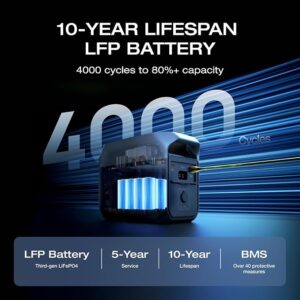
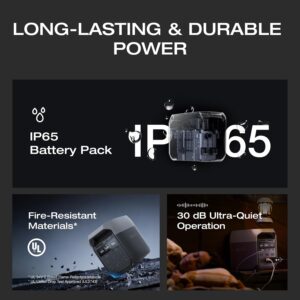
According to the supplied product information, the battery is rated for 4,000 cycles to 80% capacity and is designed for a lifespan of up to 10 years with daily use. The product information also describes the battery pack as IP65-rated, providing protection against splashes, dust, and oil.
For someone purchasing a power station specifically for emergency preparedness, this long-term design is valuable because the unit may spend much of its time stored and ready for use rather than being continuously discharged.
Power Up to 13 Appliances Simultaneously
During a home power outage, it is rarely just one device that needs electricity. You may need to charge phones while keeping your router, laptop, lights, fan, television, or other equipment running.
The DELTA 3 is designed with enough interfaces to support up to 13 connected appliances simultaneously. This gives it considerably more versatility than a basic battery bank intended primarily for phones and small electronics.
Its 1,800W AC output also gives it enough capacity for many common household electronics and appliances, while EcoFlow’s X-Boost technology is designed to support certain higher-demand resistive appliances.
However, actual runtime will depend heavily on the appliance’s wattage. A low-power router may run for considerably longer than a high-power heating appliance, so users should always check the wattage of their intended devices before relying on the DELTA 3 for backup.
X-Boost for Higher-Power Devices
EcoFlow’s X-Boost technology adds another layer of flexibility. The supplied specifications state that the DELTA 3 can support resistive appliances with power demands above 2,600W continuously using X-Boost, with the product information also referencing a 2,200W continuous level and 3,600W surge in its specifications.
This feature is particularly useful when an appliance’s rated wattage would otherwise exceed the standard output capability of the power station. However, X-Boost should not be interpreted as increasing the battery’s actual stored energy. High-powered appliances will still consume energy more quickly, meaning runtime will decrease as the load increases.
Multiple Charging Options
The DELTA 3 is designed to be flexible when it comes to replenishing its battery. The supplied product specifications describe five fast-recharging methods, with AC and solar charging being particularly useful for home backup.
Solar charging can be especially valuable during prolonged outages. If the electrical grid remains unavailable, compatible solar panels can provide an alternative way to replenish the power station during daylight hours.
This combination of AC and solar charging makes the DELTA 3 useful beyond emergency situations. It can also be used for camping, outdoor activities, remote work, and other situations where access to conventional electrical outlets is limited.
Pros
- Fast full recharge in as little as 56 minutes under specified conditions
- Can reach approximately 80% charge in 30 minutes
- 1,800W AC output
- Expandable up to 5kWh with compatible EcoFlow batteries
- Uses long-lasting LiFePO4 battery technology
- Rated for up to 4,000 cycles to 80% capacity
- Supports up to 13 appliances simultaneously
- Supports solar charging up to 500W
- Multiple charging methods provide additional flexibility
- IP65-rated battery pack
- Designed for both emergency backup and camping
- Includes a 5-year customer service offering
Cons
- Additional batteries increase the overall purchase cost
- Higher-power appliances can drain the battery considerably faster
Who Is the EF ECOFLOW DELTA 3 Best For?
The EF ECOFLOW DELTA 3 is best suited to homeowners, campers, and emergency-preparedness users who want a portable power station that can do more than simply charge phones and small electronics.
It is particularly appealing if fast charging, expandable battery capacity, LiFePO4 longevity, and multiple output options are important to you. The ability to expand the system up to 5kWh also makes it suitable for users whose backup-power requirements may grow over time.
For a typical home power outage, the DELTA 3 can provide a convenient way to keep essential electronics and selected appliances operating without relying exclusively on a fuel-powered generator. And because it can also be used for camping and other off-grid situations, its usefulness isn’t limited to emergency scenarios.
Overall, the EF ECOFLOW DELTA 3 combines fast recharging, expandable storage, durable LiFePO4 technology, and substantial AC output in a portable package, making it a strong candidate for anyone looking for a versatile backup power solution for home outages and outdoor use.
Also read : 5 Best 1000W Portable Power Stations – Top Picks for Reliable Backup, Fast Charging & Off-Grid Power
2. Jackery Explorer 1000 v2 Portable Power Station
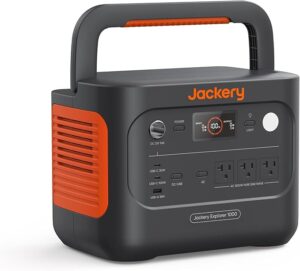
When a home power outage occurs, portability can be just as important as battery capacity. A large power station may provide plenty of energy, but if it is difficult to move from one room to another, its usefulness can be limited. The Jackery Explorer 1000 v2 takes a different approach by combining a substantial 1,070Wh battery with a relatively lightweight 23.8-pound design, a foldable handle, fast charging, and multiple ways to power household electronics.
With a 1,500W continuous AC output and 3,000W surge peak, the Explorer 1000 v2 is designed to handle considerably more than smartphones and laptops. According to the supplied product information, it can power appliances such as refrigerators, air-conditioning units, and electric pots, making it a potentially useful option when you need more than basic emergency charging. At the same time, its compact design makes it suitable for camping, road trips, and other situations where portability matters.
One of its most notable features is its one-hour emergency charging mode. When activated through the Jackery App, the Explorer 1000 v2 can reportedly recharge from 0% to 100% in approximately one hour. For everyday battery health, however, the power station defaults to a slower 1.7-hour charging mode. This gives users a useful balance between rapid emergency preparation and a charging mode designed to be gentler on the battery.
The Explorer 1000 v2 also uses an LFP (LiFePO4) battery, with the supplied specifications stating that it can retain more than 70% of its original capacity after 4,000 charge cycles. Jackery describes this as providing a lifespan exceeding 10 years. For someone purchasing a portable power station as an emergency backup rather than a device used only occasionally, that long-term battery design can be an important consideration.
Key Specifications
- Brand: Jackery
- Model: Explorer 1000 v2
- Battery Capacity: 1,070Wh
- Continuous AC Output: 1,500W
- Surge Peak: 3,000W
- Voltage: 120V
- Fuel Type: Electricity
- Power Sources: Battery and solar
- Battery Chemistry: LFP (LiFePO4)
- Weight: 23.8 pounds
- USB-C Ports: 2
- USB-A Ports: 1
- DC Car Port: 1
- AC Outlets: 3 pure sine wave AC ports
- USB-C Charging: Up to 100W PD
- Emergency Charging: 0–100% in approximately 1 hour when enabled through the Jackery App
- Standard Full Charging: Approximately 1.7 hours
- Battery Longevity: More than 4,000 cycles while retaining over 70% capacity
- Expected Lifespan: More than 10 years according to the supplied product information
- Quiet Charging Mode: Approximately 30dB
- Recommended Uses: Camping, emergencies, home backup
- Handle: Foldable
- Solar Panel: Not included
- Included Components: Explorer 1000 v2 and user manual
Powerful 1,500W Output in a Compact Design
The Jackery Explorer 1000 v2 is designed to provide a useful combination of power and portability. Its 1,500W AC output gives it considerably more capability than small battery packs designed primarily for personal electronics.
This output level can make the unit useful during home power interruptions when you need to keep several essential devices running. The supplied product information specifically mentions appliances such as AC units, refrigerators, and electric pots, although actual compatibility depends on each appliance’s operating and startup power requirements.
The 3,000W surge peak is another important specification. Some appliances briefly require more power when their motors or compressors start. The higher surge capability provides additional headroom for these short startup demands.
However, it is important to distinguish between surge power and continuous power. The 3,000W figure does not mean that the Explorer 1000 v2 can continuously operate a 3,000W appliance. Its continuous AC output is rated at 1,500W, so appliances should be checked against that figure when determining whether they are suitable for extended operation.
1,070Wh Battery Capacity for Home Backup
The Explorer 1000 v2 has a 1,070Wh battery capacity, placing it in a useful middle ground for portable home backup.
For example, relatively low-power devices such as LED lights, smartphones, Wi-Fi routers, tablets, and laptops consume much less energy than heating appliances or large refrigerators. Consequently, the actual runtime you receive can vary dramatically depending on what you connect and how much power those devices consume.
This is an important point when shopping for the best portable power stations for home power outages. A power station’s watt-hour rating tells you approximately how much energy it can store, while its wattage rating tells you how much power it can deliver at a particular moment.
The 1,070Wh capacity therefore makes the Explorer 1000 v2 particularly interesting for households that want a portable reserve for essential electronics and selected appliances, rather than a large whole-home battery system.
Lightweight 23.8-Pound Design
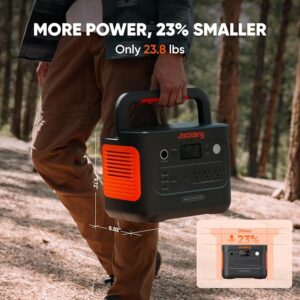
One of the Explorer 1000 v2’s biggest advantages is its portability.
At approximately 23.8 pounds, it is considerably easier to move than many larger 2,000Wh-class power stations. Its foldable handle also makes transportation more convenient, whether you’re moving it between rooms during a blackout or loading it into a vehicle for camping.
This portability makes the Explorer 1000 v2 useful in situations beyond home emergencies. You can take it on:
- Camping trips
- Road trips
- Outdoor work
- Tailgating
- Remote work
- Emergency preparedness trips
- Backup-power situations around the house
For someone who wants one power station that can serve both as a home backup device and an outdoor power source, this smaller form factor can be a major advantage.
One-Hour Emergency Charging
A particularly interesting feature is Jackery’s one-hour emergency charging capability.
The Explorer 1000 v2 can be charged from 0% to 100% in approximately one hour when the emergency charging function is activated through the Jackery App. This can be especially useful when you know an outage is approaching or when you have only a short period of access to mains electricity.
There is an important distinction, however. The product does not automatically operate in one-hour charging mode. According to the supplied information, it normally defaults to a 1.7-hour charging mode to help optimize battery health.
To take advantage of the one-hour charging capability, users need to activate the emergency charging function through the Jackery App before charging.
This gives users a choice: use the standard charging mode for everyday use or activate the faster mode when speed is more important.
LFP Battery Built for Long-Term Use
The Explorer 1000 v2 uses an LFP battery, also known as lithium iron phosphate or LiFePO4.
Battery longevity is particularly important for emergency power equipment. A power station may sit unused for long periods before suddenly becoming essential during a blackout. The ability to withstand repeated charging and discharging therefore matters when considering long-term ownership.
According to the supplied product information, the Explorer 1000 v2 is designed to maintain more than 70% of its original capacity after 4,000 charge cycles. Jackery describes this as supporting a lifespan of more than 10 years.
This makes the unit more suitable for users who expect to use their power station repeatedly over a long period rather than treating it as a short-term emergency purchase.
Multiple Ports for Simultaneous Charging
The Explorer 1000 v2 provides several connection options, allowing users to charge different types of equipment without relying on additional adapters.
The configuration includes:
- Three pure sine wave AC ports
- Two USB-C ports
- One USB-A port
- One DC car port
The two USB-C ports also support 100W PD fast charging, which can be useful for compatible laptops, tablets, smartphones, and other USB-C devices.
This means you can charge personal electronics directly from the power station while reserving the AC outlets for equipment that requires conventional wall-style power.
During an outage, this can simplify your setup considerably. Instead of searching for multiple chargers or extension arrangements, several essential devices can connect directly to the Explorer 1000 v2.
Pure Sine Wave AC Power
The three AC outlets provide pure sine wave output, which is an important feature when powering many modern electronic devices.
Pure sine wave output is designed to provide a cleaner form of AC electricity that is suitable for a wide range of sensitive electronics. This makes the Explorer 1000 v2 more versatile than basic battery systems that may use less sophisticated AC output.
For home emergency use, this can be particularly useful when powering electronics such as computers, monitors, networking equipment, televisions, and other household devices that rely on AC power.
Smart Jackery App Control
The Explorer 1000 v2 isn’t simply controlled from the physical power station. It can also be managed through the Jackery App.
The app allows users to select different operating and charging modes based on their circumstances. According to the supplied information, these include:
- One-hour emergency charging
- 30dB quiet overnight charging mode
- Energy-efficiency mode
This level of control can be useful in different situations.
For example, if you’re preparing for an impending outage, emergency charging can prioritize speed. If you’re charging the unit overnight in a living space, the quiet charging mode can help reduce disturbance. Energy-efficiency settings can also be useful when you’re trying to manage consumption more carefully.
Quiet Overnight Charging
Noise can be an overlooked consideration when choosing a portable power station for home use.
The Explorer 1000 v2 includes a 30dB quiet charging mode, which is designed for situations where reduced noise is desirable. This can be particularly convenient if the power station is charging overnight in a bedroom, home office, or other living area.
For emergency preparedness, quiet operation can also be beneficial because the unit does not necessarily need to become a disruptive part of the household whenever it is charging.
Solar-Powered Charging Capability
The Explorer 1000 v2 supports solar charging, providing an alternative to conventional AC charging.
This can be particularly valuable during extended power outages. If grid electricity is unavailable for an extended period, solar panels can provide a way to replenish the battery during daylight hours.
However, there is an important purchasing detail: the solar panel is not included with this particular package. Buyers who want to recharge the Explorer 1000 v2 using solar energy will need to purchase a compatible Jackery solar panel separately.
The supplied information also states that the Explorer 1000 v2 is compatible only with Jackery solar panels for solar charging, so buyers should pay close attention to compatibility when building a solar-powered backup setup.
Useful for Camping and Emergencies

Although this article focuses on home power outages, the Explorer 1000 v2 is not limited to emergency use.
Its relatively lightweight design, foldable handle, battery-powered operation, and solar compatibility make it suitable for camping and road trips as well.
For campers, it can provide a convenient source of electricity for compatible lighting, phones, laptops, small appliances, and other equipment. During road trips, its 23.8-pound weight makes it considerably more practical to transport than many high-capacity home backup systems.
This versatility can increase the value of the power station because you’re not purchasing a device that may remain unused except during emergencies.
Pros
- 1,070Wh battery capacity
- 1,500W continuous AC output
- 3,000W surge peak
- Relatively lightweight at 23.8 pounds
- Foldable handle makes transportation easier
- Uses a durable LFP battery
- Designed for more than 4,000 charge cycles while retaining over 70% capacity
- Potential lifespan of more than 10 years according to the supplied specifications
- One-hour emergency charging when enabled through the Jackery App
- Standard 1.7-hour charging mode designed to optimize battery health
- Two USB-C ports with up to 100W PD charging
- One USB-A port
- Three pure sine wave AC ports
- DC car port
- 30dB quiet charging mode
- Supports solar charging
- Suitable for camping, emergencies, and home backup
- App-based control provides additional flexibility
Cons
- Solar panels are not included in the package
- Solar charging requires compatible Jackery solar panels according to the supplied information
- One-hour charging must be manually enabled through the Jackery App
- 1,070Wh capacity may be insufficient for very long outages involving several high-power appliances
- The 1,500W continuous output limits which high-wattage appliances can be operated continuously
- Larger home appliances can consume the stored battery energy relatively quickly
Who Is the Jackery Explorer 1000 v2 Best For?
The Jackery Explorer 1000 v2 is best suited to users who want a balance between home backup capability and portability.
It can be a practical choice for someone who wants to keep essential electronics running during an outage without investing in a much larger, heavier power station. Its 1,070Wh capacity and 1,500W output give it enough capability for a range of household electronics and selected appliances, while its 23.8-pound weight makes it considerably easier to transport.
It is also a strong fit for people who enjoy camping and road trips and want their emergency power station to serve a second purpose. Instead of purchasing one battery system exclusively for the home and another for outdoor activities, the Explorer 1000 v2 can perform both roles.
The LFP battery, 4,000-cycle rating, fast charging, solar compatibility, multiple ports, and smart-app controls further broaden its usefulness.
3. BLUETTI AC180 Portable Power Station
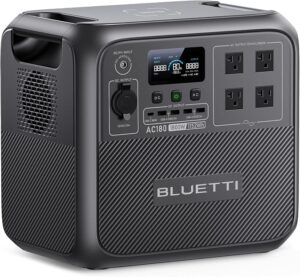
When a power outage occurs, having a backup battery that is ready to deliver electricity almost immediately can make a major difference. The BLUETTI AC180 Portable Power Station is designed specifically around that idea, combining a 1,152Wh LiFePO4 battery, 1,800W AC output, rapid charging, solar compatibility, and UPS functionality in a portable package. It is positioned not only as an outdoor power source for camping and off-grid activities, but also as a home backup solution for essential equipment during unexpected outages.
One of the AC180’s most appealing characteristics is its combination of battery capacity and charging speed. The supplied specifications state that its 1,152Wh LiFePO4 battery can be fully charged in approximately one hour when using the maximum 1,440W AC input. For emergency preparedness, this is particularly useful because you do not necessarily need to leave the unit connected to a wall outlet for many hours before it is ready for use.
The AC180 also supports 500W solar charging, allowing it to be replenished without relying exclusively on the electrical grid. Under the stated conditions, solar charging can take approximately 2.8–3.3 hours, while combining solar and AC charging can reduce the charging time to around one hour. This makes the AC180 especially interesting for users who want a power station that can continue to provide useful backup capability during extended outages.
Another feature that distinguishes this model is its UPS functionality. According to the supplied product information, the AC180 can provide emergency power to connected essentials within approximately 20 milliseconds when utility power is interrupted. This can be particularly useful for equipment such as networking devices, computers, and other electronics where an unexpected power interruption could be inconvenient.
With 1,800W of output, eight outlets, optional 2,700W power boosting through the BLUETTI App, and a 37.4-pound portable design, the AC180 provides a combination of power and versatility that can work across home emergencies, outdoor activities, camping, and off-grid applications.
Key Specifications
- Brand: BLUETTI
- Model: AC180
- Battery Capacity: 1,152Wh
- Battery Chemistry: LiFePO4
- Continuous Output: 1,800W
- Boosted Output: Up to 2,700W through the BLUETTI App
- Voltage: 120V AC
- Weight: 37.4 pounds
- AC Input: Up to 1,440W
- Solar Input: Up to 500W
- AC Charging Time: Approximately 1 hour
- Solar Charging Time: Approximately 2.8–3.3 hours under stated conditions
- UPS Response: Approximately 20ms
- Number of Outlets: 8
- Special Feature: Super Quiet operation
- Power Sources: AC, solar, and car charging
- Recommended Uses: Camping, emergency backup, home backup, off-grid use, outdoor use, and power outages
- Included: AC180 power station, AC charging cable, car charging cable, solar charging cable, user manual
- Warranty: 5 years
1,152Wh LiFePO4 Battery for Reliable Backup
At the heart of the BLUETTI AC180 is a 1,152Wh LiFePO4 battery.
This capacity gives the AC180 a useful amount of stored energy for emergency applications. During a power outage, the available runtime will depend on the equipment connected to the power station. Low-power electronics such as LED lights, smartphones, routers, and laptops will generally consume much less energy than high-demand appliances such as heaters, kettles, cooking equipment, or air-conditioning systems.
This distinction is important when evaluating any of the Best Portable Power Stations for Home Power Outages. Battery capacity and output capacity perform two different jobs. The 1,152Wh figure describes the energy stored in the battery, while the 1,800W output describes how much power the unit can deliver to connected equipment at a given time.
For households primarily concerned with maintaining essential electronics and selected appliances during an outage, the AC180’s capacity offers a useful middle ground between smaller portable batteries and much larger 2,000Wh-plus backup systems.
1,800W Output for Household Appliances

The AC180 delivers up to 1,800W of continuous AC output, giving it enough output capability for many everyday electrical devices.
This makes it more versatile than small power banks that are primarily intended for USB devices. Its AC outlets allow users to connect equipment that normally plugs into a household wall outlet.
The exact appliances you can operate will depend on their rated power requirements. Low- and medium-power devices are generally easier to accommodate, while appliances with heating elements, large motors, or high continuous wattage can consume substantial amounts of battery energy.
The AC180 therefore works particularly well when users prioritize essential loads during an outage rather than attempting to operate every electrical appliance in the home simultaneously.
Up to 2,700W with BLUETTI Power Boost
For situations where additional output capability is required, the AC180 can increase its output to up to 2,700W through the BLUETTI App.
This additional capability can be useful for certain higher-power appliances that would otherwise exceed the standard 1,800W output rating.
However, power boosting should not be confused with adding additional battery capacity. A higher output allows the power station to accommodate certain larger loads, but those loads can also consume the stored energy more rapidly.
For emergency use, it is therefore sensible to prioritize the devices that are most important to keep operating and use the boosted mode when the connected appliance genuinely requires it.
Fully Recharge in Approximately One Hour
Charging speed is one of the AC180’s standout features.
Using its maximum 1,440W AC input, the 1,152Wh battery can reportedly be fully charged in approximately one hour. This is particularly convenient when the power station needs to be prepared quickly.
Imagine experiencing an unexpected outage and discovering that the battery has been partially depleted after previous use. Being able to restore the battery relatively quickly when utility power returns can make the AC180 much easier to maintain as an emergency-ready device.
The rapid AC charging also makes it practical for users who use the power station regularly for camping or outdoor activities and do not want to spend most of their time waiting for the battery to recharge.
500W Solar Charging
The AC180 is also designed with off-grid use in mind.
Its 500W solar input allows users to recharge the power station using compatible solar panels. According to the supplied specifications, solar charging can take approximately 2.8 to 3.3 hours under the stated conditions.
This provides another way to replenish the battery when conventional grid electricity isn’t available.
Solar charging can be particularly useful during a prolonged outage. Rather than relying solely on the electricity grid to restore the battery, a compatible solar setup can provide an independent source of energy during daylight hours.
The AC180 can also combine an AC source with solar input, with the supplied information indicating that this combination can reduce charging time to approximately one hour.
UPS Functionality for Home Power Outages
One of the most important features for home use is the AC180’s UPS capability.
The supplied product information states that the unit can provide emergency power to connected essentials within approximately 20 milliseconds after a utility-power interruption.
This feature can be valuable for equipment that you do not want to shut down whenever the electricity goes off. For example, a household could potentially use the power station as backup for:
- Wi-Fi routers
- Modems
- Computers
- Monitors
- Networking equipment
- Selected medical or essential electronics, subject to the equipment’s requirements
The exact suitability of a particular appliance or medical device should always be confirmed before relying on it for critical backup power.
For everyday household use, however, UPS functionality can make the AC180 more convenient because it can function as both a portable power station and a backup battery connected to essential equipment.
Eight Outlets for Multiple Devices
The AC180 includes eight outlets, giving users several options for connecting equipment.
This is useful during a blackout because households rarely need power for only one device. You might simultaneously want to keep a router running, charge phones, operate a laptop, maintain lighting, and power another essential appliance.
Having multiple outlets reduces the need to repeatedly disconnect one device before connecting another.
It also makes the AC180 suitable for outdoor applications where several pieces of equipment may need power at the same time.
Designed for Solar, AC, and Car Charging
The AC180 offers several ways to recharge its battery, which adds flexibility for both home and outdoor use.
The package supplied with the product includes:
- AC charging cable
- Car charging cable
- Solar charging cable
This means the power station can be replenished from conventional AC electricity, a vehicle, or a compatible solar setup.
The car-charging option can be especially useful during road trips and camping, while solar charging provides an alternative for off-grid situations. At home, AC charging offers the fastest and most convenient method when grid electricity is available.
Super Quiet Operation
Noise can become an important consideration when a power station is used indoors or overnight.
The AC180 is marketed with super quiet operation, making it better suited to environments where excessive fan or operating noise would be undesirable.
This can be useful during nighttime outages when you want to keep essential equipment powered without introducing unnecessary noise into your living space.
For camping, quiet operation can also be beneficial, particularly when the power station is being used near sleeping areas.
37.4-Pound Portable Design
At approximately 37.4 pounds, the BLUETTI AC180 is portable, although it is considerably heavier than compact power stations such as the Jackery Explorer 1000 v2.
The additional weight reflects its larger battery and higher output capabilities. For home backup, this may not be a significant drawback because the unit can remain in a convenient location until it is needed.
For camping or outdoor use, however, its weight is worth considering. It is portable enough to transport by vehicle, but it may not be the ideal choice for activities where equipment must be carried long distances by hand.
In exchange, users receive a larger 1,152Wh battery, 1,800W output, eight outlets, and additional charging options.
Suitable for Home Backup and Off-Grid Use
The AC180’s feature set makes it particularly versatile.
For home emergencies, it can provide backup electricity for essential devices and selected appliances. Its UPS functionality also allows it to serve as a more permanent backup source for equipment that needs continuous access to power.
For camping, the AC180 can provide AC, USB, and other forms of portable electricity without requiring a fuel-powered generator.
For off-grid use, the combination of a 500W solar input and 1,152Wh battery gives users a way to store solar-generated electricity for later use.
This broad range of applications makes the AC180 more than a simple emergency battery. It can function as a flexible energy-storage device across several different scenarios.
Pros
- 1,152Wh LiFePO4 battery
- 1,800W continuous AC output
- Up to 2,700W boosted output through the BLUETTI App
- Fast one-hour AC charging
- 500W solar input
- Approximately 2.8–3.3-hour solar charging under stated conditions
- Can combine AC and solar charging
- UPS functionality with approximately 20ms response
- Eight outlets
- Super quiet operation
- Supports AC, solar, and car charging
- Useful for home backup and power outages
- Suitable for camping and off-grid applications
- Includes AC, car, and solar charging cables
- 5-year warranty
- LiFePO4 battery technology
Cons
- At 37.4 pounds, it is heavier than smaller portable power stations
- 1,152Wh may not be sufficient for very long outages involving multiple high-power appliances
Who Is the BLUETTI AC180 Best For?
The BLUETTI AC180 is particularly well suited to homeowners, campers, outdoor enthusiasts, and emergency-preparedness users who want a portable power station that combines high output, fast charging, solar capability, and UPS functionality.
It is a compelling option for someone who needs more output than a basic portable battery can provide but doesn’t necessarily need the size and weight of a very large 2,000Wh-plus system.
For home power outages, its 1,800W output and 1,152Wh capacity provide a useful combination for running essential electronics and selected household appliances. The UPS feature adds another layer of convenience for equipment that needs protection from sudden power interruptions.
For outdoor users, its solar and car-charging capabilities make it practical for camping and off-grid applications, while its quiet operation helps it fit more naturally into living and sleeping environments.
Also read : 5 Best 1000W Portable Power Stations – Top Picks for Reliable Backup, Fast Charging & Off-Grid Power
4. Anker SOLIX C1000 Portable Power Station
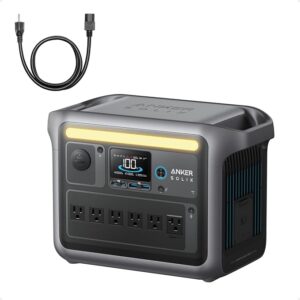
A portable power station needs to strike a careful balance between battery capacity, output, charging speed, portability, and durability. The Anker SOLIX C1000 Portable Power Station is designed around that balance, combining a 1,056Wh-class battery, 1,800W output, rapid recharging, solar compatibility, and a relatively compact design. It is intended to provide portable electricity for outdoor activities while also offering useful backup capability when the electricity supply is interrupted.
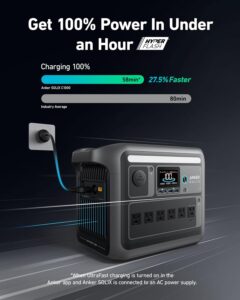
One of the most impressive aspects of the SOLIX C1000 is its UltraFast recharging capability. According to the supplied product information, the unit can reach 80% battery capacity in approximately 43 minutes and achieve a full charge in under an hour when AC charging is combined with UltraFast mode through the Anker App. For emergency preparedness, this can be especially convenient because the power station can be replenished quickly when electricity becomes available again.
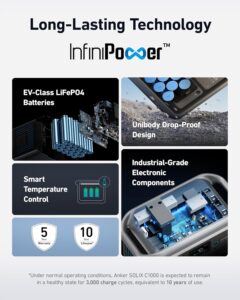
The C1000 also incorporates a LiFePO4 battery designed for long-term use. Anker states that the battery is rated for approximately 3,000 battery cycles over a 10-year lifespan, giving users a power-storage solution designed for repeated use rather than occasional emergency charging alone.
Another major attraction is its ability to handle a broad range of appliances. Its 1,800W output and SurgePad technology can provide up to 2,400W for compatible appliances, while its 11 ports offer multiple ways to connect electronics and household equipment. Combined with up to 600W of solar input, the SOLIX C1000 can also function as a solar-powered backup system for camping, RV use, outdoor activities, and power outages.
Perhaps most importantly for users who intend to move the power station frequently, the C1000 is designed to be 15% smaller than comparable 1kWh power stations. At approximately 27.6 pounds, it remains substantial enough to provide meaningful backup capacity while being easier to transport than many larger home-energy systems.
Key Specifications
- Brand: Anker
- Model: SOLIX C1000
- Battery Capacity: Approximately 1,056Wh / 1kWh class
- Continuous Output: 1,800W
- Surge/SurgePad Output: Up to 2,400W
- Battery Chemistry: LiFePO4
- Voltage: 230V AC according to the supplied listing
- Weight: 27.6 pounds
- Solar Input: Up to 600W
- AC Charging: Full charge in under 1 hour using UltraFast mode
- 80% AC Charge: Approximately 43 minutes
- Solar Charging: Approximately 1.8 hours under stated conditions
- Ports: 11 versatile ports
- Battery Life: Approximately 3,000 cycles
- Expected Lifespan: Up to 10 years according to the supplied product information
- App Control: Yes
- Recommended Uses: Camping, outdoor use, RVs, emergencies, and power outages
- Special Feature: Portable design
- Included: Anker SOLIX C1000, AC charging cable, car charging cable, user guide
Specification note: The supplied listing states 230V AC voltage. Because voltage specifications can vary between regional versions of portable power stations, verify the exact Amazon listing and regional model before publishing or purchasing.
1,800W Output for Everyday Appliances
The Anker SOLIX C1000 delivers up to 1,800W of continuous power, placing it firmly in the category of portable power stations capable of handling considerably more than phones, tablets, and laptops.
This level of output can make the C1000 useful during home power interruptions when you need to keep several essential devices operating. Depending on their individual wattage requirements, users may be able to power equipment such as refrigerators, cooking appliances, lighting, computers, televisions, fans, and other household electronics.
The actual combination of appliances will depend on their power consumption. Connecting several high-wattage devices at the same time can quickly increase the total load and reduce battery runtime.
For that reason, the C1000 is best viewed as a way to prioritize essential electrical loads during an outage, rather than as an unlimited replacement for household grid electricity.
SurgePad Technology for Higher-Power Appliances
One of the C1000’s notable features is Anker’s SurgePad technology.
The supplied product information states that the system can provide up to 2,400W of output, allowing it to support a wider range of appliances than its standard 1,800W rating might suggest.
Anker describes this capability as allowing the unit to power approximately 99% of appliances, although actual compatibility depends on the specific appliance, its operating requirements, and how much power it draws.
This feature can be particularly useful for equipment that requires additional power under certain operating conditions. However, users should remember that a higher output capability does not increase the battery’s stored energy. Running a high-wattage appliance will still consume the 1kWh-class battery more rapidly than operating smaller electronics.
UltraFast Charging in Under an Hour
For an emergency power station, recharge time can be just as important as battery capacity.
The SOLIX C1000 addresses this with Anker’s UltraFast recharging technology. According to the supplied product information, the power station can reach approximately 80% capacity in just 43 minutes and achieve a full charge in under an hour when the appropriate AC charging mode is activated.
This can be particularly useful during rolling power outages or situations where grid electricity becomes available only temporarily. Instead of requiring several hours to restore the battery, the C1000 can take advantage of a shorter charging window.
There is an important condition, however: users need to connect the unit to AC power and activate UltraFast charging through the Anker App. A smartphone is required for this feature.
For normal use, the ability to control charging speeds through the app also allows users to select a charging approach that fits their circumstances.
600W Solar Charging
The C1000 is not dependent entirely on conventional electricity for recharging.
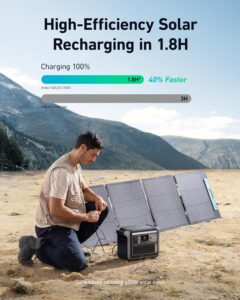
It supports up to 600W of solar input, allowing users to replenish the battery using compatible solar panels. Under the stated conditions, Anker indicates that the power station can be fully recharged through solar energy in approximately 1.8 hours.
This capability can be particularly valuable during prolonged outages.
If the grid remains unavailable, solar charging gives the C1000 another source of energy. During daylight hours, compatible solar panels can replenish the battery, allowing stored electricity to be used later when sunlight is no longer available.
For campers and RV users, solar charging also makes the C1000 more suitable for extended outdoor trips where access to conventional electrical outlets may be limited.
LiFePO4 Battery for Long-Term Reliability
The Anker SOLIX C1000 uses LiFePO4 battery technology, which is designed for long-term cycling.
According to the supplied specifications, the battery provides approximately 3,000 battery cycles over a 10-year lifespan.
This is particularly relevant for people who plan to use their power station regularly. Rather than being reserved solely for emergencies, the C1000 can be incorporated into everyday activities such as camping, outdoor work, RV trips, and temporary backup power.
The long-term battery design can also make the power station more practical for emergency preparedness. Even if the unit is used relatively infrequently, its purpose is to remain available when an outage occurs.
11 Ports for Flexible Connectivity
The SOLIX C1000 provides 11 versatile ports, giving users several options for connecting their devices.
Having multiple outlets can be particularly helpful during a power outage because several different types of equipment may need electricity at the same time.
For example, you could potentially use different ports for:
- Smartphones
- Tablets
- Laptops
- Wi-Fi equipment
- Lights
- Small appliances
- Camping equipment
- Other compatible electronics
The large number of connection points also makes the C1000 practical for outdoor use. Instead of carrying several separate battery packs for different devices, a single central power station can provide electricity to multiple pieces of equipment.
Smart App Control
Another advantage of the C1000 is its Anker App integration.
Rather than relying exclusively on physical controls, the app allows users to monitor and manage the power station from a smartphone.
According to the supplied information, the app can be used to:
- Customize charging speeds
- Activate UltraFast charging
- Monitor power statistics
- Track energy usage in real time
- Adjust charging behavior
This can be particularly useful during a blackout because you can monitor how much energy you’re consuming and make adjustments when necessary.
For example, if the battery is being depleted more quickly than expected, monitoring the power statistics can help identify which connected devices are consuming the most energy.
Compact Design for a 1kWh-Class Power Station
Portability is another area where the C1000 distinguishes itself.
Anker states that the SOLIX C1000 is 15% smaller than comparable 1kWh power stations. Combined with a weight of approximately 27.6 pounds, this gives the unit a reasonably portable design for its capacity class.
This can be helpful when the power station needs to move between different locations.
At home, it can be moved to whichever room requires backup electricity. For camping, it can be transported in a vehicle without taking up as much space as a larger power station. RV users can similarly benefit from a relatively compact energy source.
Of course, at nearly 28 pounds, it is not an ultra-light battery bank. Its weight reflects the considerably larger battery and inverter system inside. It is best considered portable rather than lightweight in the conventional sense.
Suitable for Camping and RV Use
Although the C1000 can be useful during home power outages, its design also targets outdoor applications.
Its battery-powered operation means users can access electricity away from conventional outlets, while solar charging provides an additional option for extended trips.
For camping, the power station can be used to support compatible lighting, electronics, cooking equipment, and other devices. For RV users, its combination of AC output and multiple ports can provide a convenient source of portable electricity.
The relatively compact dimensions compared with other 1kWh-class systems also make it easier to accommodate in a vehicle.
Useful During Home Power Outages
The C1000 can serve as a practical emergency power source for households that need to maintain essential equipment during a blackout.
Its 1,800W continuous output provides enough capacity for many common household devices, while the 1,056Wh-class battery provides a meaningful reserve of stored energy.
The key is to prioritize devices according to their importance and power consumption.
For example, a household might prioritize:
- Wi-Fi equipment
- Phones and communication devices
- LED lighting
- Laptops and computers
- Refrigeration
- Selected small appliances
High-power appliances should be used selectively because they can consume the available battery energy much more quickly.
The C1000 is therefore particularly useful for shorter outages, essential-device backup, and situations where electricity needs to be managed carefully.
Pros
- 1,800W continuous output
- Up to 2,400W through SurgePad technology
- Approximately 1,056Wh of battery capacity
- Uses LiFePO4 battery technology
- Approximately 3,000 battery cycles
- Designed for up to a 10-year lifespan according to supplied information
- 80% charge in approximately 43 minutes using UltraFast charging
- Full AC charge in under one hour under specified conditions
- Up to 600W solar input
- Approximately 1.8-hour solar charging under stated conditions
- 11 versatile ports
- Smartphone app control
- Real-time power monitoring
- Compact design for a 1kWh-class power station
- 27.6-pound weight
- Supports battery and solar power
- Suitable for camping, RVs, outdoor activities, and emergency backup
- Includes both AC and car charging cables
Cons
- UltraFast charging requires activation through the Anker App
- A smartphone is required to activate the UltraFast charging feature
- Solar panels are not included in the listed package
Who Is the Anker SOLIX C1000 Best For?
The Anker SOLIX C1000 is particularly well suited to users who want a portable power station that combines fast charging, strong AC output, solar compatibility, and relatively compact dimensions.
It is a good fit for people who want a backup system that can serve multiple purposes. At home, it can provide emergency electricity during power outages. Outdoors, it can serve as a portable source of power for camping and RV activities. With its solar input, it can also form part of a more flexible off-grid power setup.
The C1000 is especially appealing to users who value fast recharge times. Being able to reach 80% in around 43 minutes and fully recharge in under an hour, under the specified conditions, can significantly reduce the amount of time the unit needs to remain connected to AC power.
Its LiFePO4 battery and stated 10-year lifespan also make it suitable for people looking for a power station designed for repeated, long-term use.
5. EF ECOFLOW DELTA 2 Max Portable Power Station
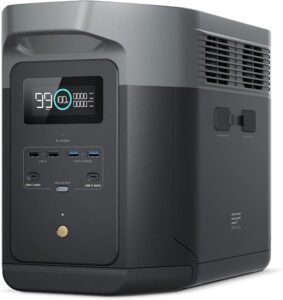
When a power outage lasts longer than expected, battery capacity becomes just as important as output power. A compact power station may be excellent for charging phones and laptops, but keeping a refrigerator, lights, networking equipment, and other household essentials running for an extended period requires substantially more stored energy. The EF ECOFLOW DELTA 2 Max addresses this need with a 2,048Wh battery capacity, 2,400W continuous AC output, expandable storage, fast charging, solar compatibility, and a design intended for home backup.
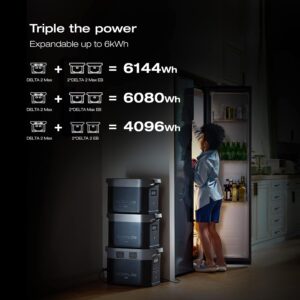
The DELTA 2 Max is particularly interesting because it doesn’t stop at its initial 2kWh capacity. Its expandable architecture allows users to increase total storage to as much as 6kWh by adding up to two compatible extra batteries. This gives homeowners the flexibility to start with a substantial backup battery and expand the system later if their energy requirements increase.
Another standout feature is its charging speed. According to the supplied product information, the DELTA 2 Max can combine up to 1,000W of solar input with AC charging to achieve an 80% charge in approximately 43 minutes. When using AC charging alone, an 80% charge can be achieved in approximately 1.1 hours. For emergency preparedness, fast replenishment can be extremely useful when grid electricity becomes available only for limited periods.
The power station also uses LFP battery chemistry, with the supplied specifications indicating approximately 3,000 cycles before the battery reaches 80% of its original capacity. EcoFlow also provides a 5-year service offering for the model. For users looking at portable power as a long-term investment rather than an occasional camping accessory, battery longevity can be an important consideration.
With 15 outlets, 2,400W of standard output, and up to 3,400W using X-Boost, the DELTA 2 Max is designed to handle a broad selection of household devices. It can also operate relatively quietly, with sound levels starting at approximately 30dB, making it more practical for overnight use in and around the home.
Key Specifications
- Brand: EF ECOFLOW
- Model: DELTA 2 Max
- Battery Capacity: 2,048Wh
- Battery Chemistry: LFP (LiFePO4)
- Standard AC Output: 2,400W
- X-Boost Output: Up to 3,400W
- Voltage: 120V
- Weight: 23kg
- Solar Input: Up to 1,000W when combined with AC charging
- 80% Charge with Solar + AC: Approximately 43 minutes
- 80% AC Charge: Approximately 1.1 hours
- Battery Cycle Rating: Approximately 3,000 cycles to 80% capacity
- Expandable Capacity: 2kWh to 6kWh
- Additional Batteries: Up to two compatible extra batteries
- Number of Outlets: 15
- Noise Level: As low as approximately 30dB
- Charging Methods: Solar, AC wall outlet, and car charging
- Recommended Use: Home backup
- Safety: Built-in Battery Management System
- Service: 5-year service offering according to supplied information
- Included: AC charging cable and DELTA 2 Max portable power station
2,048Wh Battery Capacity for Extended Home Backup
The most significant difference between the DELTA 2 Max and smaller 1kWh-class power stations is its 2,048Wh battery capacity.
This gives the unit considerably more stored energy for situations where an outage lasts for several hours or when multiple essential devices need to remain operational.
The actual runtime will depend on the total electrical load. A router, LED light, phone charger, or laptop consumes relatively little energy compared with a refrigerator, microwave, electric cooker, heater, or air-conditioning unit. Consequently, the same 2,048Wh battery can provide very different runtimes depending on what is connected.
For home emergency preparedness, the larger capacity makes the DELTA 2 Max particularly useful when you want to prioritize several essential devices simultaneously rather than limiting yourself to only small electronics.
It can therefore be a useful choice for households looking beyond basic phone and laptop charging and wanting a larger reserve of stored electricity.
2,400W Continuous Output
The DELTA 2 Max provides up to 2,400W of AC output, giving it substantial power-delivery capability for a portable battery system.
This output allows it to support a broad range of household devices, although the exact appliances that can be operated depend on their individual power requirements.
For example, lower-demand equipment such as lighting, networking equipment, televisions, computers, and chargers can generally be easier to accommodate than appliances that rely on powerful heating elements or motors.
The 2,400W rating should therefore be considered alongside the 2,048Wh battery capacity. The output determines how much power can be delivered at once, while the battery capacity determines how much energy is available to use.
X-Boost Up to 3,400W
EcoFlow’s X-Boost mode provides additional flexibility for higher-wattage appliances.
According to the supplied specifications, the DELTA 2 Max can support loads of up to 3,400W using X-Boost, compared with its standard 2,400W output.
This can broaden the range of appliances that the power station can accommodate. It is especially useful when an appliance’s power demand would otherwise exceed the standard inverter output.
However, X-Boost doesn’t increase the physical amount of energy stored in the battery. A high-powered appliance will still consume energy much faster than a low-powered device.
For that reason, homeowners should consider both wattage and runtime when deciding which appliances to connect during a blackout.
Expandable From 2kWh to 6kWh
One of the DELTA 2 Max’s biggest advantages for home backup is its expandable battery architecture.
The base system provides 2,048Wh of storage, but users can expand the system to as much as 6kWh by adding up to two compatible extra batteries.
This flexibility can be valuable because energy requirements are not necessarily the same for every household.
Someone living in a smaller home may initially need enough backup power for networking equipment, lighting, phones, laptops, and refrigeration. Another household may want a much larger reserve capable of supporting additional appliances during longer outages.
Instead of immediately purchasing the largest possible system, the expandable design provides the option to increase capacity as required.
The supplied product information also describes the expansion system as plug-and-play, making the process more straightforward for users who want to increase their available energy storage.
Fast 43-Minute Charging
The DELTA 2 Max is designed to minimize charging downtime.
When combining AC and solar input, it can receive up to 1,000W of solar input and achieve an 80% charge in approximately 43 minutes, according to the supplied specifications.
For AC charging alone, an 80% charge can be reached in approximately 1.1 hours.
This can be particularly useful during an unstable power supply. If electricity becomes available temporarily, a rapid charging system allows more stored energy to be accumulated before another interruption occurs.
Fast charging also benefits users who regularly use the DELTA 2 Max for camping or outdoor activities and need to prepare it for another trip without waiting for an extended charging period.
Solar Charging for Extended Outages
Solar compatibility is an important part of the DELTA 2 Max’s home-backup design.
During a short blackout, users can rely on stored battery energy. During a much longer outage, however, eventually the battery will need to be replenished. Solar panels provide another way of doing that without depending entirely on the electrical grid.
The supplied specifications indicate support for up to 1,000W of solar input when used in the appropriate charging configuration.
This can be especially useful for emergency preparedness and off-grid situations. Solar-generated electricity can be stored during daylight hours and then used later when needed.
The system also supports AC wall outlet and car charging, giving users multiple ways to replenish the battery depending on what energy sources are available.
15 Outlets for Multiple Devices
Another useful feature is the DELTA 2 Max’s 15 outlets.
During a home power outage, several devices may need electricity simultaneously. A household could have networking equipment, lighting, phones, computers, refrigeration, and other essential equipment operating at the same time.
The large number of available outlets reduces the need to constantly switch devices between a limited number of connections.
It also makes the DELTA 2 Max more useful for outdoor activities, where multiple people may need to charge different devices or operate several pieces of equipment from a single power source.
Quiet Overnight Operation
Power stations can become inconvenient if their fans or charging systems are loud enough to interfere with sleep.
The DELTA 2 Max is designed with quiet charging, with sound levels starting at approximately 30dB according to the supplied product information.
This makes it more suitable for overnight use in environments where noise matters.
For example, during an extended blackout, the power station can be positioned near essential equipment while remaining relatively unobtrusive. The EcoFlow App can also be used to manage energy consumption and configure certain operating settings.
For outdoor users, lower operating noise can similarly make the power station more comfortable to use at campsites.
10-Year Long-Lasting LFP Battery
The DELTA 2 Max uses LFP battery chemistry, designed to provide a long service life.
According to the supplied information, the battery is rated for approximately 3,000 cycles before reaching 80% of its original capacity.
For a device intended for emergency preparedness, battery longevity matters because the power station may be charged and discharged repeatedly over many years.
The LFP design also makes the DELTA 2 Max appropriate for users who intend to use it regularly rather than storing it exclusively for rare emergencies.
EcoFlow also provides a 5-year service offering according to the supplied product details, giving users additional support over the ownership period.
Built-In Battery Management System
The DELTA 2 Max incorporates a Battery Management System (BMS) designed to monitor important battery parameters.
According to the supplied product information, the system monitors voltage, current, and temperature in real time during charging and discharging.
Battery monitoring is important in a high-capacity power station because the battery and inverter can be subjected to significant electrical loads.
A BMS helps manage the battery system while users charge, discharge, and operate the power station, contributing to its overall safety and reliability.
Multiple Charging Options
The DELTA 2 Max isn’t restricted to a single charging method.
The supplied information lists three primary charging options:
- Solar charging
- AC wall outlet charging
- Car charging
This flexibility is particularly useful for a power station intended for emergency situations.
At home, AC charging can quickly replenish the battery when grid power is available. During an extended outage, solar charging can provide an alternative source of energy. When travelling, car charging can provide another option when neither a wall outlet nor solar setup is immediately available.
Having multiple charging methods effectively makes the DELTA 2 Max less dependent on any single energy source.
23kg Portable Design
The DELTA 2 Max weighs approximately 23kg, which is substantially heavier than compact 1kWh-class power stations.
This is an important consideration for anyone prioritizing portability.
At 23kg, the unit can still be transported, but it is better suited to movement between locations by an adult or transportation in a vehicle rather than frequent long-distance carrying.
For home backup, the weight may be less significant because the power station can be stored in a convenient location and moved only when necessary.
The additional weight is accompanied by a much larger 2,048Wh battery and 2,400W output, making it a trade-off between capacity and portability.
Pros
- Large 2,048Wh battery capacity
- 2,400W continuous AC output
- Up to 3,400W using X-Boost
- Expandable from 2kWh to 6kWh
- Supports up to two compatible extra batteries
- Fast 80% charging in approximately 43 minutes with AC and solar under stated conditions
- Approximately 1.1-hour 80% AC charging
- Up to 1,000W solar input in the specified charging configuration
- Uses long-lasting LFP battery chemistry
- Rated for approximately 3,000 cycles to 80% capacity
- 15 outlets
- Quiet operation starting at approximately 30dB
- Supports solar, AC, and car charging
- Built-in Battery Management System
- App-based energy management
- Suitable for home backup and emergency use
- Can be expanded as household energy requirements grow
Cons
- At approximately 23kg, it is considerably heavier than smaller portable power stations
- Larger capacity comes with a higher purchase cost
Who Is the EF ECOFLOW DELTA 2 Max Best For?
The EF ECOFLOW DELTA 2 Max is particularly well suited to homeowners who want a larger-capacity backup power station capable of supporting more demanding emergency-power requirements.
It is a good fit for households that want more stored energy than a typical 1kWh-class portable power station provides. Its 2,048Wh battery gives users a larger energy reserve, while its 2,400W output provides enough power for a wide variety of household electronics and appliances.
The expandable design is particularly useful for homeowners whose energy requirements may change over time. Starting at 2kWh and expanding toward 6kWh allows the system to grow without requiring an entirely new power station.
It is also appropriate for users who value rapid charging and solar flexibility. The ability to recharge using AC, solar, or a vehicle provides several options depending on the circumstances.
6. BLUETTI AC200L Portable Power Station
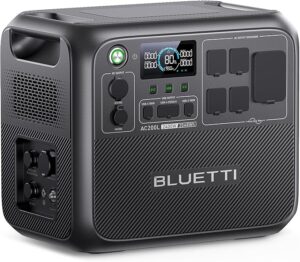
When a power outage stretches from a few hours into an extended emergency, having a larger energy reserve can become extremely valuable. The BLUETTI AC200L Portable Power Station is designed for precisely these situations, offering a substantial 2,400W AC output, a large battery system, fast charging, solar compatibility, multiple expansion options, and UPS backup functionality. Unlike smaller power stations intended mainly for phones, laptops, and a few low-power appliances, the AC200L is built with more demanding home backup, RV, and off-grid applications in mind.
The AC200L is an upgraded successor to the AC200MAX, with the supplied product information highlighting its 2,400W output, which is 200W higher than the AC200MAX. More importantly, its expandable architecture allows users to increase its battery capacity substantially. With compatible BLUETTI expansion batteries, the system can reach a maximum capacity of 8,192Wh, giving homeowners the ability to build a much larger energy reserve for prolonged outages.
Charging speed is another area where the AC200L stands out. It supports up to 2,400W of AC charging input, allowing the battery to reach 80% in approximately 45 minutes under the stated conditions. It also supports up to 1,200W of solar input, with a full solar recharge taking approximately 1.7–2.2 hours under suitable conditions. This combination of rapid AC charging and substantial solar input makes the AC200L particularly useful when electricity access is intermittent or unavailable.
The power station is also designed for RV and off-grid applications, with dedicated connections that go beyond what is found on many conventional portable power stations. Its supplied specifications mention an RV port, 48V/8A DC port, 100W PD capability, AC/USB/Car ports, and compatibility with a D40 voltage regulator for charging an RV battery.
At the same time, the AC200L includes a ≤10ms UPS backup function, allowing it to respond rapidly to interruptions in utility power. For households that need uninterrupted access to essential electronics, this can make the unit useful not only as an emergency battery but also as a more integrated home backup system.
Key Specifications
- Brand: BLUETTI
- Model: AC200L
- Battery Capacity: 2,048Wh-class base capacity
- AC Output: 2,400W
- Power Lifting Output: Up to 3,600W
- Voltage: 120V
- Weight: 61.4 pounds
- AC Charging Input: Up to 2,400W
- Solar Input: Up to 1,200W
- AC Charging: 0–80% in approximately 45 minutes
- Solar Charging: Approximately 1.7–2.2 hours under stated conditions
- Expandable Capacity: Up to 8,192Wh
- Expansion Options: Compatible with selected B300K, B210, B300, and B230 batteries
- UPS Response: ≤10ms
- PD Charging: Up to 100W
- RV Connection: 30A RV port
- DC Connection: 48V/8A DC port
- Battery Life: 3,000+ cycles according to supplied specifications
- Recommended Uses: Home backup, RV, off-grid, emergencies, camping
- Charging Sources: Solar, AC, car, lead-acid, and generator according to supplied listing
- Included: AC200L power station, AC charging cable, solar/car charging cable, XT90-to-aviation cable, user manual
Specification note: The supplied listing mentions both 13 versatile ports in the feature description and 11 ports in the detailed product description. Because the exact port count can vary by listing or configuration, verify the current Amazon product page before publishing the final comparison table.
2,400W AC Output for Demanding Loads
One of the defining characteristics of the BLUETTI AC200L is its 2,400W AC output.
This gives the unit significantly more output capability than smaller 1kWh-class portable power stations. It is designed to support a wider range of household equipment, making it particularly useful when a blackout affects appliances that require more power than phones, laptops, or lighting.
During an outage, the AC200L can be used to prioritize essential household equipment, provided the combined load remains within the station’s capabilities.
The important distinction is between output wattage and battery capacity. The 2,400W rating determines how much power the inverter can provide at a particular moment, while the battery’s stored energy determines how long that equipment can operate.
Consequently, connecting multiple high-power appliances simultaneously can reduce runtime considerably. Users should check the rated wattage of each appliance and determine which devices are most important before building an emergency backup plan.
Up to 3,600W Power Lifting
The AC200L also features a Power Lifting mode capable of reaching up to 3,600W, according to the supplied specifications.
This provides additional flexibility for certain high-power appliances that might otherwise exceed the standard 2,400W output.
Power Lifting can be useful when dealing with equipment that has a higher rated power requirement, although users should not interpret the 3,600W figure as meaning that the battery itself contains 3,600W of energy.
High-wattage appliances will still draw energy quickly from the battery. The feature primarily expands the range of loads the inverter can accommodate.
For emergency use, this makes the AC200L particularly versatile because it can potentially handle higher-demand equipment while still serving smaller electronics and essential household devices.
Expandable Up to 8,192Wh
One of the AC200L’s biggest advantages is its ability to expand beyond its base battery capacity.
The supplied information states that the system can reach a maximum capacity of 8,192Wh when paired with compatible expansion batteries.
This is a significant difference compared with fixed-capacity portable power stations.
The AC200L can be expanded using different BLUETTI battery combinations, including:
- Up to two B300K batteries at 2,764Wh each
- Up to two B210 batteries at 2,150Wh each
- Up to two B300 batteries at 3,072Wh each
- One B230 battery at 2,048Wh
The ability to choose from different expansion batteries gives users greater flexibility when designing their backup system.
For someone who only needs a moderate amount of emergency storage initially, the base unit may be sufficient. A homeowner anticipating longer or more frequent outages can expand the system as their energy requirements increase.
45-Minute Fast AC Charging
Large-capacity power stations can sometimes require many hours to recharge, making rapid charging particularly valuable.
The AC200L addresses this with support for up to 2,400W of AC charging input.
According to the supplied product information, the unit can charge from 0% to 80% in approximately 45 minutes under the specified conditions.
This can be extremely useful when grid electricity is available only temporarily.
For example, if electricity returns for a limited period after an outage, rapid charging allows the AC200L to recover a significant portion of its stored energy before another interruption.
It also reduces waiting time between uses for RV trips, camping, and outdoor activities.
1,200W Solar Input
The AC200L is also designed for substantial solar charging.
It supports up to 1,200W of solar input, and the supplied specifications indicate that a full charge can take approximately 1.7–2.2 hours under suitable solar conditions.
For extended outages, this feature can be especially important.
A large battery is useful only as long as energy remains stored. During a prolonged blackout, solar panels can provide a renewable method of replenishing the battery without requiring the electrical grid.
The 1,200W solar-input capability also makes the AC200L suitable for off-grid applications where solar energy is a primary source of electricity.
Actual solar charging time will depend on factors such as sunlight intensity, panel configuration, temperature, and other environmental conditions.
≤10ms UPS Backup
For home use, one of the most useful features is the AC200L’s UPS backup functionality.
The supplied specifications state that it can respond to a power interruption in 10 milliseconds or less.
This rapid transition can be valuable for electronics that should remain powered when grid electricity suddenly disappears.
For example, a household could use the AC200L as backup for:
- Wi-Fi routers
- Modems
- Computers
- Monitors
- Networking equipment
- Selected essential electronics
UPS functionality makes the AC200L more versatile than a power station that must be manually switched on after an outage occurs.
As always, critical equipment should be checked for compatibility before being connected to any portable power station.
11–13 Versatile Ports
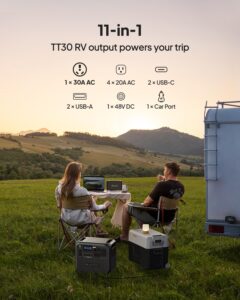
The AC200L provides a wide variety of connection options.
The supplied product listing references 13 versatile ports, while its detailed description identifies an 11-port configuration that includes AC, USB, car, 100W PD, a 30A RV port, and a 48V/8A DC port.
This broad selection is particularly useful for households and RV owners who need to power different categories of equipment.
The ports can support applications involving:
- AC appliances
- USB electronics
- Smartphones
- Laptops
- DC equipment
- Vehicle accessories
- RV systems
- Higher-power equipment
The inclusion of a 30A RV port is especially relevant for people who intend to use the AC200L as part of an RV setup.
Dedicated RV Power Capability
The AC200L isn’t simply a home backup system.
BLUETTI has designed it with RV use in mind, including a dedicated 30A RV port and a 48V/8A DC port.
According to the supplied product information, the unit can also work with the D40 voltage regulator to efficiently charge an RV battery.
This gives the AC200L a broader role for people who travel or live part-time in an RV.
Instead of carrying a power station exclusively for household emergencies, RV owners can use the same system during travel and then bring it into the home as a backup source when needed.
Multiple Charging Sources
Another advantage of the AC200L is its broad charging compatibility.
The supplied product information identifies support for:
- AC charging
- Solar charging
- Car charging
- Lead-acid charging
- Generator charging
This makes the system particularly useful for emergency situations where access to a single energy source cannot be guaranteed.
At home, AC charging provides a fast method of restoring the battery. During an extended blackout, solar charging can provide an alternative. When travelling, vehicle charging provides another option, while generator integration can add another layer of backup capability.
This flexibility can be especially valuable for off-grid users who need to manage energy from multiple sources.
Durable Battery for Repeated Use
The supplied specifications describe the AC200L’s battery as capable of 3,000+ cycles.
Battery cycle life matters when a power station is expected to be used repeatedly.
An emergency power station may spend some periods in storage and other periods being frequently charged and discharged. A high cycle rating is therefore useful for users who want to incorporate the unit into regular energy-management routines rather than reserving it exclusively for rare blackouts.
The AC200L’s expandable architecture further complements this long-term approach because users can increase storage capacity without necessarily replacing the base power station.
61.4-Pound Construction
There is one important trade-off with the AC200L: portability.
The supplied product information lists its weight at approximately 61.4 pounds.
That is considerably heavier than smaller power stations such as the Jackery Explorer 1000 v2 or Anker SOLIX C1000.
For home backup, this may not be a major problem. Once positioned in a convenient location, the AC200L can remain there until it is needed.
For camping and RV applications, the weight is more relevant. It is much better suited to vehicle-based transportation than activities where the power station needs to be carried long distances.
In return, users receive a substantially larger and more capable energy system with higher output, expandable capacity, and additional connection options.
Useful for Extended Power Outages
The AC200L is particularly suited to situations where a power interruption may last longer than a few hours.
Its base battery capacity provides a substantial energy reserve, while expansion options allow users to increase total storage significantly.
This makes it possible to build a backup setup around the household’s actual requirements.
For example, essential loads might include:
- Refrigerator
- Wi-Fi router
- LED lighting
- Phones
- Laptops
- Television
- Fans
- Selected kitchen equipment
The key is to prioritize the devices that matter most and monitor overall energy consumption.
If an appliance has a high wattage, it can consume stored energy quickly even when the battery has substantial capacity. Expanding the battery system provides more runtime, but it does not make high-power appliances energy-efficient.
Suitable for Off-Grid Applications
The combination of 1,200W solar input, multiple charging methods, expandable battery capacity, and substantial AC output makes the AC200L particularly relevant to off-grid applications.
An off-grid setup can use solar panels to generate electricity, store that energy in the AC200L, and then use the stored electricity when required.
This can provide greater flexibility than relying exclusively on solar generation at the exact moment electricity is needed.
For example, solar energy collected during daylight hours can be stored and used later when sunlight is unavailable.
The expandable battery architecture is particularly useful here because users with greater energy requirements can increase their storage capacity over time.
Pros
- 2,400W AC output
- Up to 3,600W Power Lifting capability
- Large expandable energy-storage system
- Expandable to up to 8,192Wh according to supplied specifications
- Multiple compatible expansion-battery options
- 2,400W maximum AC charging input
- 0–80% AC charging in approximately 45 minutes
- Up to 1,200W solar input
- Full solar charging in approximately 1.7–2.2 hours under stated conditions
- ≤10ms UPS backup response
- Multiple AC, USB, DC, and vehicle connections
- 100W PD capability
- Dedicated 30A RV port
- 48V/8A DC port
- Supports multiple charging sources
- Suitable for home backup, RVs, camping, emergencies, and off-grid use
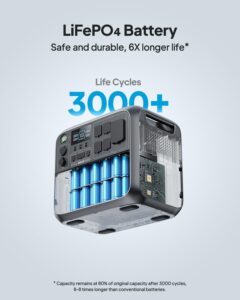
- 3,000+ battery cycles according to supplied information
Cons
- At 61.4 pounds, it is substantially heavier than smaller portable power stations
- Expansion batteries add to the overall cost and weight
Who Is the BLUETTI AC200L Best For?
The BLUETTI AC200L is best suited to users who need considerably more capability than a compact 1kWh-class power station can provide.
It is particularly appropriate for homeowners preparing for extended power outages, RV owners, off-grid users, campers, and emergency-preparedness enthusiasts who value high output and expandable energy storage.
For home backup, the combination of 2,400W AC output and expandable capacity up to 8,192Wh gives users substantial flexibility. The UPS function further allows the unit to serve as a rapid backup source for selected essential electronics.
For RV owners, the dedicated 30A RV port and 48V/8A DC connection add capabilities that aren’t necessarily available on smaller portable power stations.
The AC200L is also well suited to off-grid setups because of its 1,200W solar-input capability and multiple charging options.
The main consideration is its weight. At 61.4 pounds, it is portable in the sense that it can be transported, but it isn’t an especially convenient unit for frequent hand-carrying.
Also read : 5 Best 1000W Portable Power Stations – Top Picks for Reliable Backup, Fast Charging & Off-Grid Power
7. Anker 767 Portable Power Station (GaNPrime PowerHouse 2048Wh)
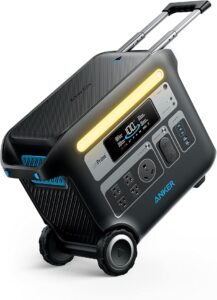
When a home power outage stretches beyond a few hours, having a portable power station with a substantial battery capacity can make a major difference. The Anker 767 Portable Power Station (GaNPrime PowerHouse 2048Wh) is designed for users who need considerable stored power while still wanting a portable solution that can be used for camping, emergencies, and backup power.
With a 2048Wh battery capacity and 2400W output, the Anker 767 sits in the higher-capacity class of portable power stations in this list. Its large battery is particularly useful when you need to keep several essential appliances and electronic devices running rather than relying on a smaller unit for just phones, lights, and small electronics.
The PowerHouse 767 also focuses heavily on convenience. Its HyperFlash technology can recharge the unit from 0% to 80% in about 1.4 hours, while its multiple AC, USB-C, USB-A, car, and RV connections allow several devices to be powered simultaneously. For users preparing for home outages or extended off-grid trips, its combination of capacity, output, and durability makes it a substantial backup-power option.
Key Specifications
- Brand: Anker
- Model: Anker 767 Portable Power Station / GaNPrime PowerHouse
- Battery Capacity: 2048Wh
- Output Wattage: 2400W
- Maximum Supported Power: Up to 3600W with SurgePad technology
- Power Source: Solar powered
- Fuel Type: Solar
- Voltage: 100V as stated in the supplied listing
- Item Weight: 30.5 kg
- Recommended Uses: Camping, backup power, emergency power, and portable power
- Special Feature: Portable
- Recharge Technology: HyperFlash
- Recharge Time: 0–80% in approximately 1.4 hours
- Device Support: Up to 12 devices simultaneously
- Warranty: 5-year full-device warranty
- Included: AC charging cable, car charging cable, solar charging cable, accessories bag, user manual, and Anker 767 Power Station
Listing note: The supplied listing identifies the product as the Anker 767, but the final “What You Get” section refers to the Anker SOLIX F2000. Those names appear inconsistent, so it would be wise to verify the exact Amazon listing/model before publishing the article. The review below follows the specifications supplied for the Anker 767.
2048Wh Battery Capacity for Extended Backup Power
One of the biggest advantages of the Anker 767 is its 2048Wh capacity. This gives it considerably more stored energy than compact portable power stations designed primarily for phones, tablets, lights, and small electronics.
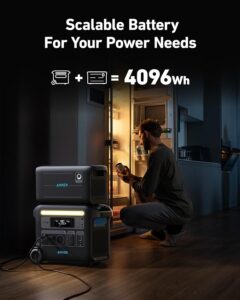
For home emergencies, that extra capacity can be useful when an outage lasts for an extended period. Instead of immediately worrying about finding another charging source, users have a larger energy reserve available for essential equipment.
The 2048Wh capacity can also be valuable when camping or traveling off-grid. You can bring more electronic equipment without having to depend entirely on a traditional electrical outlet.
Actual runtime will vary considerably depending on the power consumption of the connected devices. High-wattage appliances will naturally drain the battery much faster than low-power electronics such as LED lights, phones, or laptops.
2400W Output for High-Power Devices
The Anker 767 provides a 2400W output, placing it in a category suitable for considerably more demanding electrical equipment than small portable power banks.
This level of output gives users greater flexibility during emergencies. Rather than restricting the power station to USB electronics and lightweight equipment, the 767 can be used with a broader range of household and outdoor devices, provided their power requirements remain within the station’s capabilities.
For camping, this can be particularly convenient when several electrical devices need to be operated from the same power source.
SurgePad Technology Supports Up to 3600W
Another notable feature is SurgePad technology, which the supplied listing says allows the PowerHouse 767 to handle high-wattage devices up to 3600W without overloading the portable power station.
This is useful when dealing with equipment that requires a higher amount of power during operation. Instead of looking only at the standard 2400W figure, users have an additional level of flexibility for compatible high-wattage appliances.
However, the 3600W figure should not be interpreted as meaning that every 3600W appliance will continuously operate normally. Appliance requirements, startup loads, and the specific behavior of SurgePad should always be considered before connecting demanding equipment.
HyperFlash Rapid Recharge
A large battery is helpful, but recharge speed matters too—especially when you’re dealing with an ongoing power outage.
The Anker 767 uses HyperFlash technology and, according to the supplied listing, can recharge from 0% to 80% in approximately 1.4 hours.
That means the power station doesn’t necessarily have to remain connected to a charging source for most of the day before becoming useful again. For households experiencing intermittent electricity, this faster recharge can help users replenish the battery during periods when grid power returns.
It is also useful for camping trips where charging opportunities may be limited.
Multiple Ports for Up to 12 Devices
The Anker 767 is designed to serve multiple devices at once. The supplied listing states that it can power up to 12 devices through its combination of:
- 1 RV port
- 4 AC ports
- 3 USB-C charging ports
- 2 USB-A ports
- 2 car outlets
This variety makes the unit useful for more than one type of equipment. AC outlets can accommodate compatible household and camping appliances, while the USB ports are convenient for personal electronics.
The car outlets add another option for compatible 12V equipment, while the RV port makes the power station particularly interesting for RV and mobile applications.
Useful for Camping and Outdoor Adventures
Although the supplied listing recommends the Anker 767 for camping, its large capacity makes it suitable for more than simple outdoor charging.
A 2048Wh portable power station can provide a central source of electricity for a campsite where several people need to charge phones, cameras, laptops, lights, and other equipment.
Its 30.5kg weight does mean that it isn’t something most people will casually carry around like a small power bank. Instead, it is better viewed as a portable-but-substantial power system that can be transported to a campsite, RV, work area, or emergency location.
Solar-Powered Operation
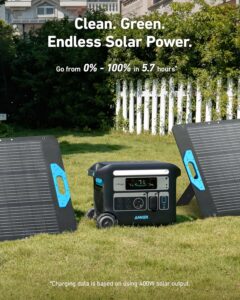
The supplied listing identifies the Anker 767 as solar powered and includes a solar charging cable.
Solar charging can be particularly useful during extended outages or off-grid trips because it provides an alternative to depending exclusively on mains electricity. When suitable solar equipment and conditions are available, users can replenish the power station using solar energy.
This makes the concept particularly appealing for emergency preparedness: the power station can store electricity ahead of time while solar charging can provide an additional way to replenish that stored energy later.
Built for a 10-Year Lifespan
Anker states that its InfiniPower technology gives the PowerHouse 767 a lifespan of more than 10 years, even with everyday use.
For a large portable power station, durability is an important consideration. These devices can represent a significant investment, so long-term usability can be just as important as initial battery capacity.
The 10-year lifespan claim is therefore one of the more notable aspects of the supplied product information, particularly for users purchasing a power station as part of a longer-term emergency preparedness setup.
5-Year Full-Device Warranty
The Anker 767 also comes with a 5-year full-device warranty, according to the supplied listing.
A warranty of this length can provide additional reassurance when purchasing a larger and more expensive portable power station. It is particularly relevant for users who intend to keep the unit available for emergencies over several years rather than treating it as a short-term camping accessory.
As always, warranty terms and coverage should be checked on the current listing before purchase because conditions can vary by market and seller.
Large Capacity Comes With Significant Weight
At 30.5kg, the Anker 767 is considerably heavier than compact portable power stations.
This is an important trade-off. The large 2048Wh capacity and 2400W output give the unit substantial capability, but moving more than 30kg of equipment isn’t effortless.
For home backup, this may not be a major issue because the power station can remain in a convenient location and be moved when necessary. For camping, it is more appropriate for vehicle-based trips than situations where you need to carry your power equipment over long distances.
A Practical Option for Emergency Power
The combination of 2048Wh capacity, 2400W output, multiple ports, and rapid recharge makes the Anker 767 well suited to emergency situations.
During an outage, users can prioritize essential electronics and compatible appliances rather than relying solely on small battery banks. The large capacity can also reduce the need to constantly recharge individual devices separately.
For longer emergencies, solar charging provides another potential energy source, while the 5-year warranty and stated 10-year lifespan make the unit suitable for users thinking about backup power as a long-term investment.
Pros
- Large 2048Wh battery capacity for extended power needs
- Strong 2400W output
- Supports high-wattage devices up to 3600W with SurgePad technology, according to the supplied listing
- Fast 0–80% recharge in approximately 1.4 hours
- Multiple AC, USB-C, USB-A, car, and RV connections
- Can power up to 12 devices
- Solar charging support
- Designed for a stated lifespan of more than 10 years
- Includes a 5-year full-device warranty
- Useful for camping, emergency situations, and backup power
- Provides a substantial energy reserve for longer outages
Cons
- 30.5kg weight makes it less convenient to carry over long distances
- Large size and capacity may be excessive for users who only need to charge phones and small electronics
Who Is the Anker 767 Best For?
The Anker 767 Portable Power Station is best suited to users who need substantial portable electricity rather than a lightweight charging bank.
It can be a good fit for:
- Homeowners preparing for power outages who want a larger energy reserve
- Campers who need electricity for several devices and appliances
- RV users who can benefit from the dedicated RV connection
- Off-grid users looking for solar-compatible backup power
- Emergency-preparedness users who want a high-capacity battery available when grid electricity is unavailable
- Users with multiple devices who need several charging and AC connections simultaneously
- People looking for long-term equipment, particularly given the stated 10-year lifespan and 5-year warranty
It may be less suitable for someone whose main requirement is simply charging a smartphone, smartwatch, or laptop because a smaller and lighter power station could meet those needs more conveniently.
8. Jackery Explorer 2000 Plus Portable Power Station
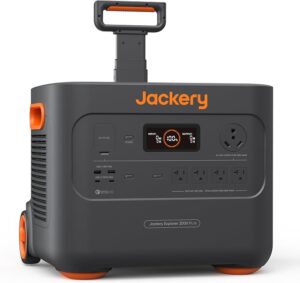
When a power outage turns from a brief inconvenience into an extended disruption, a compact battery bank may not be enough. The Jackery Explorer 2000 Plus Portable Power Station is designed for situations where you need a much larger reserve of stored electricity, whether you’re preparing for an emergency at home, powering an RV, working off-grid, or heading outdoors.
With a 2,042.8Wh capacity and up to 3,000W of output, the Explorer 2000 Plus is built to handle considerably more demanding equipment than smaller portable power stations. According to the supplied listing, it can support heavy-load devices such as air conditioners and RV equipment, making it particularly relevant for users who want portable power that can extend beyond phones and laptops.
What makes this Jackery particularly interesting is its ability to grow with your power requirements. The system can be expanded from roughly 2kWh to 12kWh, while two Explorer 2000 Plus units can reportedly be connected in parallel to reach 24kWh of capacity and 6,000W of output. Combined with solar charging, app control, a LiFePO4 battery, and quiet operation, it is designed as a flexible long-term backup system rather than simply an emergency charger.
Key Specifications
- Brand: Jackery
- Model: Explorer 2000 Plus
- Battery Capacity: Up to 2,042.8Wh
- Output Wattage: 3,000W
- Expandable Capacity: Up to 24kWh when using two power stations with expansion batteries, according to the supplied listing
- Maximum Expanded Output: Up to 6,000W
- Power Source: Solar powered
- Fuel Type: Electric
- Voltage: 240V as stated in the supplied listing
- Item Weight: 62 pounds
- Recommended Uses: Home backup, emergency power, professional power, off-grid use, power outages, and RVs
- Battery Type: LiFePO4
- Noise Level: As quiet as 30dB
- Charging: AC wall charging and solar charging
- Solar Charging Configuration: Up to 6 × Jackery SolarSaga 200W panels for the stated approximately 2-hour full charge
- Connectivity: Wi-Fi and Bluetooth
- Warranty: 5 years
- Included: Explorer 2000 Plus, AC charging cable, car charging cable, and user manual
2,042.8Wh Capacity for Serious Backup Power
The Explorer 2000 Plus starts with a substantial 2,042.8Wh battery capacity.
For home emergencies, this provides considerably more stored energy than smaller power stations designed primarily for personal electronics. A larger battery reserve gives users more flexibility when deciding which essential devices to keep operating during an outage.
It can also be useful for RVs and off-grid applications, where access to conventional electrical outlets may be limited. Instead of carrying several smaller battery solutions for different devices, the Explorer 2000 Plus can function as a central power source.
Of course, actual runtime depends on the wattage of the connected equipment. A high-power appliance will consume the battery considerably faster than a phone, laptop, LED light, or other low-power device.
3,000W Output for Heavy-Load Equipment
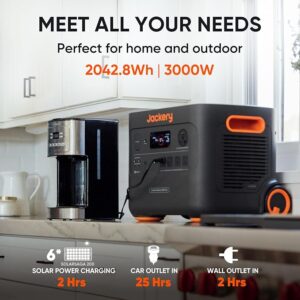
One of the defining features of this Jackery is its 3,000W output capacity.
That’s a substantial amount of power for a portable power station and allows the Explorer 2000 Plus to move beyond basic electronics into more demanding applications.
The supplied listing specifically mentions equipment such as air conditioners and RV equipment, making this model particularly relevant for users who need backup electricity for larger loads.
For home outages, this higher output can provide greater flexibility when selecting which compatible appliances to operate. For professional and off-grid applications, it can also be useful when electrical equipment requires more power than smaller portable units can provide.
Expandable from 2kWh to 24kWh
Perhaps the most interesting aspect of the Explorer 2000 Plus is its expandable architecture.
A single Explorer 2000 Plus can be expanded with up to five additional battery packs, taking the system from approximately 2kWh to 12kWh, according to the supplied product information.
For users with even greater energy requirements, the listing states that two Explorer 2000 Plus power stations can be connected in parallel. With the appropriate expansion setup, the overall system can reach up to 24kWh of capacity and 6,000W of output.
This makes the system adaptable to changing requirements. Someone may initially need around 2kWh of backup capacity but later decide that they need substantially more energy storage.
Instead of immediately purchasing an enormous system, the expandable approach allows the setup to grow over time.
Fast Solar Charging
The Explorer 2000 Plus can be charged directly from solar panels, which is particularly useful for emergency preparedness and off-grid living.
According to the supplied listing, connecting six Jackery SolarSaga 200W solar panels can fully recharge the power station in approximately 2 hours under suitable conditions.
Solar charging gives users another way to replenish their stored energy when grid electricity is unavailable. This can be particularly valuable during prolonged outages because the power station isn’t necessarily limited to whatever energy was stored before the outage began.
Actual charging performance will depend on sunlight, panel positioning, weather, temperature, and the particular solar setup.
Wall Charging for Everyday Convenience
Solar power is useful when you’re away from the grid, but traditional AC charging remains important for home users.
The Explorer 2000 Plus can be charged through a wall outlet, allowing you to replenish the battery before an anticipated outage or after using it.
This combination of AC and solar charging gives the power station two very different roles. It can function as a conventional backup battery at home while also serving as an off-grid power source when paired with suitable solar panels.
Quiet Operation at Around 30dB
Power stations with large batteries and substantial output can sometimes produce noticeable operating noise. Jackery’s Explorer 2000 Plus is advertised as operating at approximately 30dB, according to the supplied listing.
That whisper-quiet characteristic can be useful in residential environments, bedrooms, offices, RVs, and campsites where excessive fan noise would be distracting.
The quiet operation is especially relevant during power outages at night. A backup system that can operate without creating substantial noise can be less disruptive when you’re trying to sleep.
LiFePO4 Battery Designed for Long-Term Use
The Explorer 2000 Plus uses a LiFePO4 battery, a battery chemistry commonly used in modern portable power stations.
Jackery states that the battery can provide up to 10 years of use, while its ChargeShield Fast Charging Technology is described as extending battery life by 50%.
The listing also mentions Smart Shallow Charging Mode, which is intended to improve efficiency and reliability.
For a power station intended for emergency preparedness, longevity is important. Unlike a device purchased for occasional short-term use, a home backup power station may spend much of its life stored and waiting for the moment it is needed.
Safety and Temperature Management
The Explorer 2000 Plus incorporates several safety-oriented features according to the supplied listing.
Its lithium battery technology is described as temperature resistant, while a built-in cooling system is said to improve heat dissipation efficiency by 30%.
The listing also mentions protection against impacts and fire-related risks.
These features are particularly relevant when the unit is being used around the home, inside an RV, or in outdoor environments. Nevertheless, users should still follow Jackery’s operating, storage, ventilation, and charging instructions rather than treating the built-in protections as a replacement for safe use.
Smart App Control
Another convenient feature is Wi-Fi and Bluetooth connectivity.
Through the Jackery app, users can monitor the remaining battery level and access various settings. This means you don’t necessarily have to repeatedly walk over to the power station just to check its status.
For home backup applications, app connectivity can make it easier to keep track of the unit while it is positioned in a convenient location.
It can also be useful when you’re managing the power station as part of a broader off-grid or RV setup.
Designed for Home Backup and Power Outages
The Explorer 2000 Plus fits naturally into an emergency preparedness setup.
Its combination of 2,042.8Wh capacity and 3,000W output gives users a larger energy reserve and greater appliance flexibility than many smaller portable units.
During a blackout, the power station can provide electricity for compatible essential equipment while the solar charging capability offers a way to replenish the battery when sunlight is available.
For households that experience occasional outages, it can serve as a stored backup system. For users dealing with longer periods away from the grid, the expandable battery system and solar compatibility become even more relevant.
Useful for RV and Off-Grid Applications
The Explorer 2000 Plus isn’t limited to home use.
Its relatively large capacity makes it particularly relevant for RV owners and off-grid users who need a portable source of electricity without relying exclusively on campground hookups or conventional generators.
The absence of fuel combustion also means there’s no gasoline or diesel fuel to store for operation. According to the supplied listing, the unit produces no fumes during normal battery operation.
For camping and RV use, this can provide a quieter alternative to conventional fuel-powered generators, particularly in situations where noise or exhaust would be undesirable.
Professional Power for Mobile Work
The product information also lists professional power among its recommended uses.
That can include situations where electrical equipment needs to be operated away from a traditional outlet, such as outdoor work, temporary job sites, mobile workspaces, or other remote environments.
The 3,000W output provides considerably more flexibility than small portable battery packs, while the expandable capacity can become useful when equipment needs to operate for longer periods.
The 62-pound weight does mean that transportation is more practical by vehicle or with assistance rather than carrying it long distances.
62-Pound Construction and Portability

At 62 pounds, the Explorer 2000 Plus is a substantial piece of equipment.
Calling it portable doesn’t mean it is lightweight. Instead, its portability comes from being transportable compared with permanently installed backup systems or traditional generators.
For home use, you can position it where it’s needed and move it when necessary. For camping or RV trips, it is much more practical when transported in a vehicle.
The weight is an important trade-off for the large battery capacity and high output.
Pros
- Large 2,042.8Wh battery capacity
- Powerful 3,000W output
- Expandable up to 12kWh with additional battery packs
- Two units can reportedly be combined for up to 24kWh and 6,000W
- Solar and AC charging options
- Approximately 2-hour full solar recharge with the stated six 200W SolarSaga panel configuration
- Quiet operation rated at approximately 30dB
- LiFePO4 battery designed for long-term use
- Stated battery lifespan of up to 10 years
- Built-in cooling and multiple safety protections
- Wi-Fi and Bluetooth app control
- 5-year warranty
- Suitable for home backup, RVs, emergencies, professional work, and off-grid applications
Cons
- 62-pound weight makes it less convenient to carry over long distances
- Additional batteries and solar panels increase the overall cost of the system
Who Is the Jackery Explorer 2000 Plus Best For?
The Jackery Explorer 2000 Plus is particularly suited to users who need more than basic portable electricity and want the option to expand their energy storage over time.
It can be a strong fit for:
- Homeowners preparing for power outages
- RV owners who need substantial mobile electricity
- Off-grid users who can take advantage of solar charging
- Emergency-preparedness setups requiring a larger energy reserve
- Professional users who need portable power away from conventional outlets
- Campers with several electrical devices and appliances
- Users planning for long-term backup power who may eventually need additional battery capacity
- Households with higher electrical demands that can benefit from the 3,000W output
For someone who only needs to recharge a smartphone, tablet, or laptop occasionally, the Explorer 2000 Plus would likely be a much larger system than necessary.
9. EF ECOFLOW DELTA Pro Portable Power Station
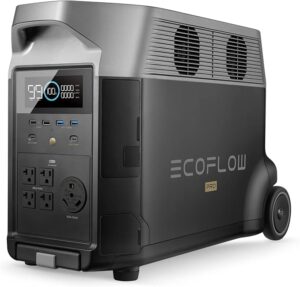
When a power outage lasts longer than expected, having a few hours of backup electricity can quickly become inadequate. This is where the EF ECOFLOW DELTA Pro Portable Power Station takes things to another level. With a substantial 3,600Wh LiFePO4 battery, high output capability, expandable storage, and multiple charging methods, the DELTA Pro is designed for users who need serious backup power at home, outdoors, or in professional environments.
The DELTA Pro is particularly interesting because it isn’t limited to its initial 3.6kWh capacity. According to the supplied listing, its capacity can be expanded from 3.6kWh up to 25kWh using compatible DELTA Pro Extra Batteries or Smart Generators. This gives users the ability to start with one power station and build a much larger energy-storage system as their requirements grow.
It also combines 3,600W of standard AC output with X-Boost technology capable of reaching 4,500W, while two DELTA Pro units can reportedly be paired to achieve up to 7,200W. Add X-Stream fast charging, solar charging, five charging methods, and smart app control, and the DELTA Pro becomes a substantial option for extended power outages and off-grid applications.
Key Specifications
- Brand: EF ECOFLOW
- Model: DELTA Pro
- Battery Capacity: 3,600Wh
- Battery Type: LiFePO4
- Standard AC Output: 3,600W
- X-Boost Output: Up to 4,500W
- Paired Output: Up to 7,200W with two units
- Voltage: 120V
- Power Source: Battery powered
- Fuel Type: Non-gasoline
- Weight: 99 pounds
- Recommended Uses: Commercial/residential, outdoor use, home backup, camping, and emergency power
- Expandable Capacity: 3.6kWh to up to 25kWh according to the supplied listing
- Charging Methods: EV station, solar, wall outlet, Smart Outdoor Generator, and car outlet
- Solar Charging: Up to 4 × 400W solar panels in the configuration described
- App Control: Wi-Fi and Bluetooth
- Special Features: X-BOOST Technology, X-Stream Fast Charging, expandable capacity, app smart control
- Included: 3600Wh Power Station, AC charging cable, car charging cable, DC5521 to DC5525 cable
3,600Wh LiFePO4 Battery for Extended Backup
The most obvious strength of the DELTA Pro is its 3,600Wh battery capacity.
A battery of this size provides a substantial energy reserve for situations where electricity may be unavailable for an extended period. Rather than using the power station simply to recharge phones and small electronics, the DELTA Pro is designed to support much more demanding backup-power requirements.
For residential use, the large battery can be useful during blackouts when users want to keep several essential devices operating. It can also serve as a substantial energy source for camping, outdoor activities, and professional applications where conventional electricity isn’t readily available.
Because actual runtime depends on the wattage of connected equipment, a 3,600Wh capacity should not be interpreted as a fixed number of hours. High-power appliances will consume the stored energy much faster than smaller electronics.
Expandable from 3.6kWh to 25kWh
One of the most notable features of the DELTA Pro is its expandable battery architecture.
According to the supplied listing, the system can grow from its initial 3.6kWh capacity to as much as 25kWh using compatible DELTA Pro Extra Batteries or Smart Generators.
This is particularly useful for users whose energy requirements may increase over time.
For example, someone might initially purchase the DELTA Pro for occasional power outages but later decide they need considerably more stored energy for longer blackouts, off-grid living, or larger outdoor applications. The expandable design provides a way to increase storage without replacing the original power station.
For emergency preparedness, this can be particularly valuable because additional battery capacity means more stored energy available when grid electricity is unavailable.
3,600W Standard Output
The DELTA Pro provides a substantial 3,600W AC output from a single unit.
This gives it considerably more capability than compact portable power stations and allows it to handle a broad range of compatible household, outdoor, and professional equipment.
For residential backup, the 3,600W output provides flexibility when selecting which devices to operate during an outage. For outdoor or professional use, it can serve as a portable source of electricity for equipment that requires considerably more power than a typical battery bank can provide.
The exact devices that can be powered will still depend on their continuous and startup power requirements.
X-Boost Technology up to 4,500W
EcoFlow’s X-Boost technology provides another level of output flexibility.
The supplied listing states that the DELTA Pro can increase its output capability from 3,600W to 4,500W with X-Boost.
This feature is designed to help the power station handle compatible high-wattage appliances without simply exceeding its normal output rating.
For users operating demanding equipment, this can provide additional flexibility. However, X-Boost should not be treated as equivalent to having a conventional 4,500W continuous output for every appliance. Users should check appliance compatibility and power requirements before connecting high-demand equipment.
Up to 7,200W With Two DELTA Pro Units
For users with particularly high power requirements, EcoFlow also provides the option of combining two DELTA Pro units.
According to the supplied listing, two units can achieve up to 7,200W of output.
This takes the system beyond what most users would need for basic emergency charging and into a much larger backup-power configuration.
For larger residential setups, professional applications, or situations where multiple high-power devices need to operate simultaneously, the ability to combine units provides another level of scalability.
Of course, using two power stations and the necessary accessories represents a substantially larger investment and physical setup.
X-Stream Fast Charging
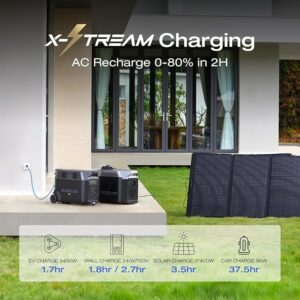
Large-capacity power stations can take a long time to recharge, but the DELTA Pro is designed to reduce that waiting period with X-Stream charging technology.
The supplied information states that the power station can fully recharge:
- In approximately 1.8 hours using a 240V outlet at 3,000W
- In approximately 2.7 hours using an 1,800W wall outlet
- In approximately 2.8 hours using four 400W solar panels, under the stated conditions
This makes recharge speed one of the more useful features of the DELTA Pro.
For home users, faster AC charging means the battery can be replenished during periods when grid power returns. For off-grid users, solar charging can provide another method of restoring the battery without relying exclusively on a conventional electrical outlet.
Solar Charging With Up to Four 400W Panels
The DELTA Pro can also be charged using solar energy.
The supplied listing describes a configuration using four 400W solar panels, with a full recharge time of approximately 2.8 hours under suitable conditions.
EcoFlow also states that the system can achieve solar conversion efficiency of up to 23%.
Solar charging is particularly valuable during extended outages. If grid electricity is unavailable for an extended period, having a compatible solar setup provides a way to replenish stored energy during daylight hours.
Actual solar charging times will naturally depend on sunlight intensity, weather, panel orientation, temperature, and the specific solar equipment being used.
Five Different Ways to Charge
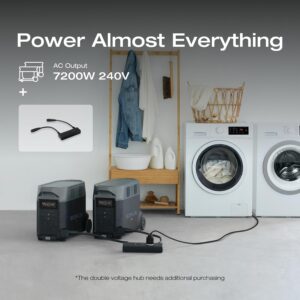
Flexibility is another major feature of the DELTA Pro.
The supplied listing identifies five charging methods:
- EV charging stations
- Solar panels
- Wall outlets
- Smart Outdoor Generator
- Car outlets
Having several charging options means the DELTA Pro isn’t dependent on a single energy source.
At home, users can rely on AC charging. During an outage, solar can provide an alternative. On a road trip, a car connection can provide another charging method, while EV charging infrastructure can be useful when available.
This variety is particularly valuable for users who plan to take the power station between home, camping locations, RVs, and other off-grid environments.
15 Output Methods for Multiple Devices
The DELTA Pro provides a broad range of connection options. The supplied listing describes 15 output methods, including:
- 2 USB-A ports
- 2 USB-A fast-charge ports
- 2 USB-C ports rated at 100W
- 5 AC outlets
- 2 DC outlets
- 1 car power output
- 1 Anderson port
This selection allows the DELTA Pro to serve several different types of equipment simultaneously.
The 100W USB-C ports can be particularly useful for compatible laptops and other higher-power USB-C devices, while the AC outlets provide conventional electrical connections for compatible appliances.
The variety of ports also means users don’t necessarily need separate adapters for every type of electronic device.
Smart App Control
The DELTA Pro can be controlled and monitored through the EcoFlow app using Wi-Fi or Bluetooth.
The app provides information about the power station’s condition and connected energy sources, including:
- Battery charge level
- Temperature
- Charging and discharging times
- Input and output information
- Various customizable settings
This can make managing a large power station considerably more convenient.
For home backup use, you can monitor the system without repeatedly checking the unit itself. For outdoor applications, the ability to check operating information from a connected smartphone can also be useful.
Battery Management and Charging Safety
The supplied listing states that X-Stream charging technology works together with the power station’s battery management system.
A battery management system is important in a large battery pack because it helps monitor operating conditions such as charging and discharging behavior.
For a high-capacity power station that may be used for extended periods, proper battery management is an important part of maintaining safe and reliable operation.
Users should still follow the manufacturer’s charging, storage, temperature, and maintenance instructions.
Useful for Home Power Outages
The DELTA Pro is particularly well suited to situations where a household needs more than a small emergency battery.
Its 3,600Wh capacity, high output, multiple ports, and expandable architecture provide several layers of flexibility.
During an outage, the system can be used to keep compatible essential electronics and appliances operating. If the outage continues, additional batteries and solar charging can help extend the overall energy supply.
For households that experience occasional short outages, the DELTA Pro may offer more capacity than necessary. However, for users who want a larger reserve or are preparing for potentially longer interruptions, the additional capacity can become more valuable.
Suitable for Outdoor and Professional Use
The DELTA Pro is not designed solely for residential backup.
The supplied listing also identifies outdoor and commercial/residential applications, making it relevant to users who need portable electricity away from traditional outlets.
Its 99-pound weight means that transportation is more practical with a vehicle or suitable handling equipment rather than carrying it over long distances. Nevertheless, it can provide a substantial source of electricity once positioned at a campsite, work area, RV, or temporary outdoor location.
For professional users, the combination of high output and numerous connection options can be useful when conventional power isn’t readily available.
99-Pound Weight: Powerful but Substantial
At 99 pounds, the DELTA Pro is one of the heavier units in this roundup.
This is an important consideration before purchasing. Its large battery capacity and powerful output come with considerable physical weight.
For home backup, the weight may be less problematic because the unit can remain in a designated location and only be moved when necessary. For camping or outdoor work, transportation by vehicle is likely to be much more practical than carrying the unit long distances.
In other words, the DELTA Pro is portable in the sense that it can be moved between locations, but it isn’t intended to behave like a lightweight power bank.
Pros
- Large 3,600Wh LiFePO4 battery capacity
- Powerful 3,600W AC output
- X-Boost capability up to 4,500W
- Two units can reportedly provide up to 7,200W
- Expandable from 3.6kWh to up to 25kWh according to the supplied listing
- Multiple charging options, including solar and EV charging
- Fast X-Stream AC charging
- Solar charging support
- Up to 15 output methods
- Two 100W USB-C ports
- Wi-Fi and Bluetooth app control
- Useful for home backup, outdoor use, camping, and professional applications
- No gasoline required for normal battery operation
Cons
- 99-pound weight makes transportation challenging
- Large size and capacity may be excessive for basic personal electronics
Who Is the EF ECOFLOW DELTA Pro Best For?
The EF ECOFLOW DELTA Pro is particularly suited to users who need substantial backup power and want the ability to expand their system over time.
It can be a practical fit for:
- Homeowners preparing for extended power outages
- Users with high electrical demands who need more than a compact power station can provide
- Off-grid households that can make use of solar charging
- RV users looking for a large portable electricity source
- Campers with multiple high-power electrical devices
- Professional users working away from conventional electrical outlets
- Emergency-preparedness users who want expandable energy storage
- Users planning a larger backup-power system that can grow beyond the initial 3.6kWh capacity
It is less suited to someone who simply needs a lightweight device for charging phones, tablets, and small electronics.
10. BLUETTI Apex 300 Portable Power Station
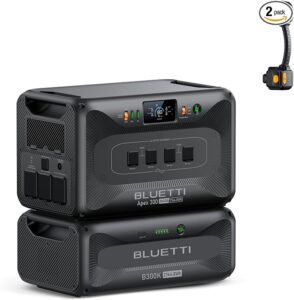
When a home power outage becomes an extended emergency, the ability to keep a few small electronics running may not be enough. The BLUETTI Apex 300 Portable Power Station is designed for much larger power requirements, combining high output, expandable battery capacity, dual-voltage operation, rapid charging, solar compatibility, and UPS functionality in one substantial backup-power system.
The Apex 300 is particularly interesting because it goes beyond the traditional portable power station concept. According to the supplied listing, it can provide 120V/240V simultaneous output, allowing compatible household, RV, and high-demand equipment to operate from the same system. With six AC outputs and a claimed 7,680W surge capability, it is designed for appliances that would be difficult to support with smaller battery generators.
The system also includes a B300K expansion battery, giving the configuration approximately 5.5kWh of energy storage according to the supplied listing. Its solar input can reach 2,400W, with the listing stating that expanded configurations can reach 6,400W. Add BLUETTI’s AI-enabled battery management system, 6,000+ cycle battery life claim, ≤10ms UPS response, and quiet 22dB operation, and the Apex 300 is positioned as a high-capacity solution for home backup, RVs, off-grid living, and emergency power.
Key Specifications
- Brand: BLUETTI
- Model: Apex 300
- Included Expansion Battery: B300K
- Battery Capacity: Approximately 5.5kWh with the supplied B300K configuration
- Standard AC Output: 3,840W
- Power Lifting: Up to 7,680W according to the supplied listing
- Output Voltage: 120V/240V simultaneous output
- Item Weight: 83.8 pounds
- Power Sources: Solar, AC, car, lead-acid battery, and generator
- Recommended Uses: Home backup, off-grid use, emergencies, RVs, camping, and outdoor applications
- Solar Input: 2,400W built-in, up to 6,400W in the expanded configuration described
- AC Charging: Up to 80% in approximately 45 minutes according to the supplied listing
- UPS Response: ≤10ms
- Noise Level: Approximately 22dB
- Battery Type: LiFePO4
- Battery Life: 6,000+ cycles to 80% capacity, according to the supplied listing
- Claimed Lifespan: Up to 17 years
- Ports: 14 versatile ports
- App: Smart app control
- Battery Management: BLUETOPUS AI-BMS
- Included: Apex 300 power station, B300K expansion battery, AC charging cable, car charging cable, grounding screw, and user manual
Listing note: The supplied specification table contains a few figures that appear to describe different aspects of the system—for example, 3,840 watts, 5,529Wh, and the approximately 5.5kWh B300K configuration. For the article, the detailed “About this item” information is used as the primary reference, but the exact Amazon configuration should be verified before publishing.
Approximately 5.5kWh of Combined Battery Capacity
The Apex 300 configuration supplied for this article includes a B300K expansion battery, giving the system approximately 5.5kWh of energy storage according to the listing.
That is a substantial amount of stored energy for a portable backup system. Instead of being limited to charging phones, laptops, and lights, the Apex 300 is designed to support much more demanding household and outdoor equipment.
For home backup, the larger energy reserve can help keep essential appliances running for longer during an outage. For RVs and off-grid locations, it can provide a central source of electricity without requiring a traditional fuel-powered generator.
Actual operating time will depend on the equipment being powered. Appliances with high continuous wattage will consume the stored energy considerably faster than low-power electronics.
3,840W AC Output
The Apex 300 provides up to 3,840W of AC output, according to the supplied product information.
This puts it firmly into the high-output category of portable power stations. The additional output capacity allows users to operate compatible appliances that would be beyond the capabilities of smaller battery systems.
For a home emergency setup, this can provide greater flexibility when selecting essential appliances to power. For an RV, it can potentially support demanding equipment such as an RV air conditioner or oven, provided the equipment’s electrical requirements are compatible with the system.
The actual appliances that can be powered should always be checked against their rated running and startup wattages.
Up to 7,680W Power Lifting
The Apex 300 also features a 7,680W power-lifting/surge capability according to the supplied listing.
This additional headroom is particularly relevant for equipment that requires a higher amount of power when starting.
Large appliances can have startup demands that are significantly higher than their normal operating consumption. A higher surge capability can therefore provide additional flexibility when starting compatible equipment.
However, the 7,680W figure should not be interpreted as a universal continuous 7,680W output. Users should check the specific appliance requirements and BLUETTI’s compatibility guidance before connecting heavy loads.
120V/240V Simultaneous Output
One of the most distinctive features listed for the Apex 300 is its ability to provide 120V and 240V output simultaneously.
This gives the system greater versatility for households and other environments containing equipment that operates at different voltage levels.
According to the supplied listing, the Apex 300 can simultaneously power equipment such as:
- Refrigerators
- Air-conditioning systems
- EV chargers
- RV equipment
- Other compatible 120V and 240V appliances
This can be particularly useful during a home power outage because users don’t necessarily have to restrict their backup setup to one voltage category.
As always, exact compatibility depends on the electrical specifications of the connected equipment and the installation setup.
Six AC Outputs for RV and Home Appliances
The supplied listing states that the Apex 300 has six AC outputs capable of directly powering AC appliances.
This is especially relevant for RV owners. Instead of relying exclusively on a campground or shore-power connection, the power station can act as an independent electrical source for compatible equipment.
For home use, multiple AC outlets also make it easier to operate several essential appliances without constantly unplugging and reconnecting equipment.
The system’s 14 versatile ports add even more connection possibilities beyond the AC outlets.
2,400W Built-In Solar Charging
Solar charging is a major part of the Apex 300’s design.
The supplied product information states that it has 2,400W of built-in solar input, with the potential to reach 6,400W in an expanded configuration.
For off-grid users, this can be particularly useful. Solar energy can replenish the battery during daylight hours without requiring gasoline or access to the electrical grid.
For emergency preparedness, solar charging also provides an additional energy source during prolonged outages. Rather than relying entirely on electricity stored before the outage, users with a suitable solar setup can continue replenishing the battery when conditions permit.
Actual solar charging performance will depend on sunlight, panel configuration, weather, temperature, and the connected solar equipment.
Fast AC Charging
The Apex 300 is also designed for rapid AC charging.
According to the supplied listing, the system can reach 80% charge in approximately 45 minutes using AC charging.
This can be particularly valuable after a power outage or when preparing for an expected interruption in electricity.
A fast recharge means users can restore a significant portion of the battery relatively quickly when grid power becomes available again. For emergency preparedness, that can make the power station easier to keep ready for the next interruption.
Generator Charging Support
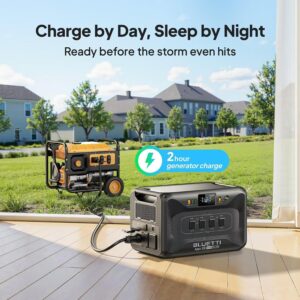
The Apex 300 supports generator charging as another way to replenish its battery.
The supplied listing states that it is compatible with approximately 95% of generators.
This provides an additional layer of flexibility for emergency situations. Users who already have access to a generator can potentially use the generator to recharge the battery rather than relying on it to power appliances continuously.
That can allow the stored battery energy to act as a buffer between generator operating periods.
Multiple Charging Sources
Beyond solar, AC, and generator charging, the supplied specifications identify several other power sources, including car and lead-acid battery charging.
Having multiple charging methods makes the Apex 300 adaptable to different environments.
For example, at home it can be charged from AC power. During a sunny off-grid trip, solar charging can be used. On the road, a compatible vehicle-based charging method may be available.
This flexibility is particularly useful for RV users and people who frequently move between home, outdoor, and off-grid environments.
6,000+ LiFePO4 Battery Cycles
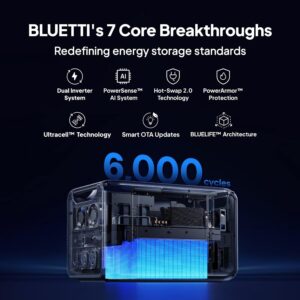
The Apex 300 uses a LiFePO4 battery, and BLUETTI states that its second-generation battery technology can provide 6,000+ cycles while retaining 80% of its capacity.
For a backup power system, battery longevity is important because the unit may be expected to remain useful for many years.
The supplied listing also gives a claimed lifespan of up to 17 years.
These figures make the Apex 300 particularly interesting as a long-term energy-storage system rather than simply a short-term emergency device.
Battery lifespan will still depend on factors such as operating temperature, charging behavior, depth of discharge, storage conditions, and usage patterns.
BLUETOPUS AI-BMS
The Apex 300 incorporates BLUETTI’s BLUETOPUS AI-BMS, or battery management system.
A battery management system is responsible for monitoring important battery operating conditions and helping manage charging and discharging.
For a large battery system that can handle substantial electrical loads, intelligent monitoring is particularly important.
The supplied listing also references extensive testing and temperature-related reliability, making battery management one of the system’s notable design features.
≤10ms UPS Backup
Another useful feature for home users is the ≤10ms UPS response.
A UPS, or uninterruptible power supply, is designed to provide backup power quickly when the primary electricity source is interrupted.
A response time of 10 milliseconds or less can be useful for compatible electronics and equipment that need a rapid transition between grid power and battery power.
This makes the Apex 300 more useful during sudden outages because it isn’t simply a battery that has to be manually switched on after the electricity disappears.
Users should still check which equipment and operating modes are officially supported for UPS functionality.
Silent Operation at Approximately 22dB
Despite its high power output, the Apex 300 is advertised as operating at approximately 22dB.
Quiet operation can be especially valuable in residential environments, bedrooms, offices, campsites, and RVs.
For emergency use, reduced noise can make a significant difference. Unlike a conventional fuel-powered generator, a battery power station doesn’t require an engine running continuously to provide electricity.
This can make it a more comfortable option when people need backup power overnight.
Smart App Control
The Apex 300 also supports smart app control, allowing users to manage and monitor the power station through a connected device.
Smart control can make it easier to keep track of battery status, energy consumption, charging, and other operating information without having to physically inspect the power station.
For a large system that may be positioned in a garage, RV, cabin, or designated backup-power area, remote monitoring can be particularly convenient.
Designed for Home Backup
The Apex 300’s combination of high output, large battery capacity, UPS functionality, and multiple charging options makes it particularly suited to home backup.
During an outage, users can connect compatible essential appliances and electronics while drawing power from the battery.
The dual-voltage capability is particularly notable because the supplied listing states that the system can simultaneously support 120V and 240V equipment.
For longer outages, solar and generator charging can provide additional ways to restore the battery.
Useful for RVs and Off-Grid Living
The Apex 300 is also designed with RVs and off-grid applications in mind.
The six AC outputs and high output capacity provide substantial flexibility for mobile electricity needs, while solar charging allows the battery to be replenished away from the grid.
For RV owners, the ability to operate compatible appliances without a shore-power connection can provide greater independence.
For cabins and other off-grid locations, the combination of solar input, large battery capacity, and multiple charging methods can serve as part of a broader independent energy system.
Suitable for Camping and Outdoor Use
Although the Apex 300 is a substantial 83.8-pound system, it remains transportable for vehicle-based camping and outdoor applications.
Its high output means campers can potentially operate equipment that would be difficult to support with a smaller power station.
The quiet 22dB operation is also useful outdoors. Without a combustion engine running, users don’t have the constant engine noise or fuel storage associated with conventional generators.
The weight is the primary trade-off. This is a system intended to be transported to a campsite or outdoor location rather than carried over long hiking distances.
83.8-Pound Weight
At 83.8 pounds, the Apex 300 is one of the heavier power stations in this list.
That weight reflects its substantial power capability and included expansion battery configuration.
For home use, this may not be a major disadvantage because the unit can be positioned in a suitable location and left there until needed. For RVs and camping, transportation by vehicle is much more practical.
Anyone looking for a power station specifically for backpacking or frequent manual carrying would likely need a much smaller system.
Pros
- High 3,840W AC output
- Up to 7,680W power-lifting/surge capability according to the supplied listing
- Approximately 5.5kWh configuration with the included B300K battery
- Supports 120V/240V simultaneous output
- Six AC outputs
- 14 versatile ports
- Up to 2,400W built-in solar charging
- Expanded solar input capability listed at up to 6,400W
- Approximately 45-minute AC charging to 80%
- Supports solar, AC, generator, car, and lead-acid battery charging
- 6,000+ cycle LiFePO4 battery claim
- Claimed battery lifespan of up to 17 years
- BLUETOPUS AI-BMS
- ≤10ms UPS backup
- Approximately 22dB silent operation
- Smart app control
- Suitable for home backup, RVs, camping, emergencies, and off-grid applications
Cons
- 83.8-pound weight makes it difficult to carry over long distances
- Large capacity and output may be excessive for users with basic charging requirements
Who Is the BLUETTI Apex 300 Best For?
The BLUETTI Apex 300 is best suited to users looking for a high-capacity, high-output backup system rather than a lightweight portable battery.
It can be particularly useful for:
- Homeowners preparing for extended power outages
- RV owners who need substantial independent electricity
- Off-grid households and cabins
- Emergency-preparedness setups
- Campers using several electrical appliances
- Users who need 120V and 240V power
- People who want solar charging as part of their backup strategy
- Users looking for a long-term LiFePO4 energy-storage system
- Households requiring UPS functionality for compatible equipment
Its size and weight make it less appropriate for lightweight travel, backpacking, or users who only need to charge small electronics.
Also read : 5 Best 1000W Portable Power Stations – Top Picks for Reliable Backup, Fast Charging & Off-Grid Power
Frequently Asked Questions
1. What is the best portable power station for home power outages?
The right portable power station depends on your power requirements, battery capacity needs, portability preferences, and budget. Smaller units are convenient for essential electronics, while larger models such as the EF ECOFLOW DELTA Pro, Jackery Explorer 2000 Plus, and BLUETTI Apex 300 are designed for higher-demand backup applications and longer outages.
2. How many watts should a portable power station have for home backup?
For basic emergency needs, a power station with around 1,000W to 1,500W of output may be sufficient for smaller electronics and selected appliances. If you want to operate more demanding appliances, a 2,000W to 4,000W-class power station provides considerably more flexibility. Always check both the continuous and startup wattage of the appliances you intend to use.
3. How much battery capacity do I need during a power outage?
Battery capacity is measured in watt-hours (Wh). A smaller 500–1,000Wh power station can be useful for phones, laptops, lights, routers, and other electronics. For longer outages or multiple appliances, a 2,000Wh or larger system can provide a much larger energy reserve.
Keep in mind that the actual runtime depends on how much electricity your connected devices consume.
4. Can a portable power station run a refrigerator during a blackout?
Yes, many higher-capacity portable power stations can run compatible refrigerators. However, refrigerators have startup or surge requirements that can be higher than their normal running wattage. Before connecting one, compare the refrigerator’s starting and running wattage with the power station’s output and surge capabilities.
5. Can a portable power station run an air conditioner?
Some high-output models can power compatible air conditioners, but this depends heavily on the air conditioner’s power requirements and startup load. Larger models in this roundup, such as the Jackery Explorer 2000 Plus, EF ECOFLOW DELTA Pro, and BLUETTI Apex 300, are designed for substantially higher loads than compact power stations.
Always check the specific appliance and power-station specifications before use.
6. Can portable power stations be charged with solar panels?
Yes. Many modern portable power stations support solar charging. Several models in this roundup, including EcoFlow, Jackery, Anker, and BLUETTI systems, offer solar-charging capabilities.
Solar charging can be particularly useful during extended power outages because you can potentially replenish the battery during daylight hours instead of relying entirely on stored electricity.
7. How long does it take to charge a portable power station?
Charging times vary considerably between models and charging methods. Some of the power stations reviewed offer rapid AC charging, while solar charging generally depends on the available solar input and weather conditions.
For example, several of the larger models advertise charging to substantial battery levels in under an hour using suitable AC charging configurations. Solar charging generally takes longer and varies according to sunlight and panel capacity.
8. Are LiFePO4 portable power stations better for long-term use?
LiFePO4, or lithium iron phosphate, batteries are widely used in modern portable power stations because they are designed for relatively long cycle life and durability.
Many of the models in this roundup use LiFePO4 battery technology. However, battery lifespan still depends on factors such as charging habits, operating temperature, depth of discharge, and storage conditions.
9. Can I use a portable power station while it is charging?
Many portable power stations support some form of pass-through or simultaneous charging and discharging, but the exact functionality varies by model and operating mode.
If you intend to use a power station as a continuously connected backup system, check the manufacturer’s specifications for its UPS, pass-through, or EPS capabilities.
10. What is UPS functionality in a portable power station?
UPS stands for Uninterruptible Power Supply. A portable power station with UPS functionality can switch to battery power rapidly when the main electrical supply is interrupted.
This can be useful for compatible equipment such as computers, networking equipment, and other electronics that may be affected by a sudden loss of electricity.
Several models in this roundup advertise rapid UPS switching, including the BLUETTI AC180, BLUETTI AC200L, and BLUETTI Apex 300.
11. Can a portable power station replace a gasoline generator?
A battery-powered portable power station can serve as an alternative to a conventional fuel generator for many applications, but the two technologies have different strengths.
Portable power stations don’t require gasoline or diesel during normal battery operation and generally operate much more quietly. They can also be charged using solar panels.
Traditional fuel generators, however, can continue producing electricity as long as fuel is available. The better option therefore depends on the user’s power requirements, expected outage duration, noise preferences, charging options, and available budget.
12. How long can a portable power station run during a power outage?
There isn’t one fixed runtime because it depends on both battery capacity and the devices being powered.
For example, a 2,000Wh power station will generally last much longer with a 50W load than with a 1,500W load. You can get a rough estimate by dividing the battery capacity by the total power consumption, while allowing for energy losses.
13. Are larger portable power stations difficult to move?
Larger models can be quite heavy. The products reviewed in this article range from relatively portable units to much larger systems weighing approximately 60–100 pounds or more.
If you plan to move the power station frequently, pay close attention to weight, handles, wheels, and overall dimensions rather than focusing only on battery capacity and output.
14. Can I use a portable power station for an RV?
Yes. Several of the power stations in this roundup are suitable for RV applications, particularly the higher-capacity models.
Features such as dedicated RV connections, high AC output, solar charging, multiple outlets, and expandable battery capacity can make a power station particularly useful for mobile living.
15. Is a 2,000Wh power station enough for a home emergency?
A 2,000Wh-class power station can provide a substantial amount of emergency electricity, but whether it is enough depends on what you want to operate.
It can be useful for essential electronics, lighting, communications equipment, refrigeration, and selected appliances. Running several high-power appliances simultaneously will consume the battery much faster.
For longer outages or larger household loads, an expandable system may be more appropriate.
Conclusion
A power outage can be more than an inconvenience. When electricity disappears, everyday essentials such as refrigeration, lighting, communication equipment, internet routers, computers, and medical or household devices may suddenly depend on whatever backup power you have available. Choosing the right portable power station therefore starts with understanding how much electricity you actually need and how long you expect your backup system to operate.
The 10 best portable power stations for home power outages reviewed in this guide offer a broad range of capacities and capabilities. Models such as the Jackery Explorer 1000 v2 and Anker SOLIX C1000 provide more compact solutions, while larger systems such as the EF ECOFLOW DELTA 2 Max, BLUETTI AC200L, Anker 767, and Jackery Explorer 2000 Plus provide substantially more stored energy and output for demanding applications.
For users who need even more capacity, expandable systems such as the EF ECOFLOW DELTA Pro and BLUETTI Apex 300 can be built into considerably larger backup-power configurations. Their combination of high output, solar charging, expansion options, and multiple charging methods makes them particularly relevant for extended outages and off-grid applications.
When choosing your own power station, don’t focus on wattage alone. Consider battery capacity, continuous output, surge capacity, recharge speed, solar-input capability, available ports, UPS functionality, battery chemistry, weight, warranty, and expandability. Most importantly, compare the power station with the actual wattage requirements of the appliances you intend to run.
For occasional outages, a smaller unit may provide everything you need. For frequent or extended blackouts, a larger LiFePO4 system with solar charging and expandable capacity can provide a much greater energy reserve.
Ultimately, the best portable power station for your home is the one that matches your essential appliances, expected outage duration, available charging sources, and portability requirements. With the right combination of capacity and output, a portable power station can provide a dependable source of electricity when the regular grid goes down.