
A beautiful garden rarely happens by accident. Behind every thriving flower bed, neatly trimmed shrub, flourishing vegetable patch, and healthy green lawn is a little patience, consistent care, and, most importantly, the right set of gardening tools. Whether you’re an enthusiastic beginner planting your first seeds or an experienced gardener looking to make everyday outdoor tasks easier, having dependable tools at your disposal can transform gardening from a tiring chore into a genuinely rewarding experience.
Imagine stepping into your garden on a cool morning, surrounded by the refreshing scent of freshly turned soil and the gentle colors of blooming flowers. You reach for a sturdy garden trowel to prepare the soil, use a reliable hand cultivator to loosen compacted earth, and finish by trimming overgrown stems with a sharp pair of pruning shears. Tasks that once seemed time-consuming suddenly become simpler, more comfortable, and far more enjoyable. That’s the difference the right gardening tools can make.
However, with so many gardening tools available on the market, choosing the best options for your needs can feel overwhelming. Some tools are designed specifically for digging and planting, while others excel at removing stubborn weeds, trimming branches, loosening soil, or maintaining flower beds. Materials, handle designs, blade quality, durability, and ease of use can also vary significantly from one product to another. Choosing poorly made tools may leave you struggling with uncomfortable grips, dull blades, or equipment that wears out sooner than expected.
That’s why we’ve put together this guide to the 9 best gardening tools, highlighting practical options designed to help you tackle essential gardening tasks with greater confidence and efficiency. From everyday hand tools to specialized equipment for planting, pruning, cultivating, and weeding, our goal is to help you discover tools that suit your gardening routine, outdoor space, and budget.
Throughout this guide, we’ll explore the features that make each product worth considering, including its construction, functionality, ease of handling, potential advantages, and limitations. Whether you’re caring for a small balcony garden, maintaining raised vegetable beds, nurturing ornamental plants, or managing a larger backyard, you’ll find useful insights to help you make a more informed purchasing decision.
We’ll also consider what matters most when shopping for gardening equipment. Durability, comfort, versatility, and value for money are important factors to consider, especially if you spend long hours tending to your plants. A well-designed tool should not only perform its intended job effectively but also feel comfortable in your hands and withstand regular use with appropriate care.
Of course, you don’t need an expensive collection of equipment to create a beautiful garden. Sometimes, a few thoughtfully selected tools can make a remarkable difference. The key is finding products that match the work you do most often rather than paying for features you may never use.
Whether you’re preparing the soil for spring planting, keeping weeds under control during the growing season, pruning plants to encourage healthy growth, or simply maintaining a tidy outdoor space, the right equipment can help you work smarter instead of harder.
Ready to find the perfect tools for your garden? Let’s explore our top nine gardening tool picks and discover which options could make planting, pruning, weeding, and everyday garden maintenance easier, more efficient, and more enjoyable. By the end of this guide, you’ll have a clearer idea of what to look for and which tools may deserve a place in your gardening collection.
9 Best Gardening Tools – Top Picks for Planting, Pruning, Weeding & Easy Garden Maintenance
| No. | Product name | Best for | Key features to look for | Main advantage | Considerations |
|---|---|---|---|---|---|
| 1 | Fiskars Bypass Pruning Shears | Pruning flowers, stems, and small branches | Sharp bypass blades, comfortable grip, durable construction | Makes routine trimming and plant maintenance easier | Check the recommended cutting capacity |
| 2 | SE Dual-Serrated Hand Trowel | Digging and planting | Serrated edges, sturdy blade, compact design | Useful for planting, digging, and working around roots | May be less suitable for heavy-duty digging |
| 3 | Grampa’s Weeder | Removing weeds | Long handle, claw-style head, standing operation | Helps remove weeds while reducing bending | Works best when the tool can grip the weed and its roots |
| 4 | CobraHead Original Weeder & Cultivator | Weeding and cultivating soil | Curved steel blade, ergonomic handle, versatile design | Combines several light gardening tasks in one tool | Requires some practice for precise use |
| 5 | Fiskars Hand Rake Cultivator | Loosening soil and removing small weeds | Multiple tines, sturdy head, comfortable handle | Helps aerate soil and prepare planting areas | A hand tool is less efficient for large garden beds |
| 6 | PERWIN Hori Hori Garden Knife | Digging, transplanting, and weeding | Stainless-steel blade, depth markings, protective sheath | A versatile tool for several detailed gardening tasks | Handle carefully and store the blade safely |
| 7 | Cooljob Rubber-Coated Gardening Gloves | Hand protection | Coated palms, flexible material, breathable construction | Helps protect hands during planting and routine garden work | Choose the correct size and protection level |
| 8 | Mecheer 3-Piece Garden Tool Set | Beginner gardeners and small gardens | Trowel, hand rake, transplanting tool | Provides several essential tools in one purchase | Inspect the included tools and materials before buying |
| 9 | Vevor Garden Kneeler and Seat | Comfortable gardening and ground-level tasks | Padded kneeling surface, seat function, support handles | Can make extended planting and weeding sessions more comfortable | Requires storage space and may be bulky for small gardens |
1. Fiskars Bypass Pruning Shears – Best Gardening Tool for Clean Cuts, Easy Pruning & Everyday Plant Care
Imagine stepping into your garden and noticing that your rose bushes have developed a few unruly stems, your flowering plants need a little attention, or your young shrubs could benefit from some careful trimming. You reach for a reliable pair of pruning shears, make a few precise cuts, and give your plants a tidier appearance without turning a simple gardening task into a struggle. That’s where the Fiskars Bypass Pruning Shears can become a useful addition to your gardening toolkit.
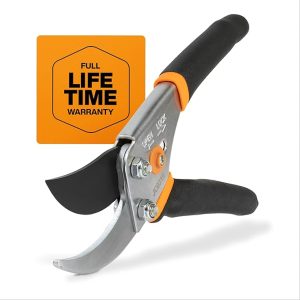
Designed for everyday garden maintenance, these pruning shears combine a bypass blade design, alloy steel cutting blades, and an ergonomic handle to help make trimming and shaping plants more manageable. Whether you’re maintaining flower beds, removing unwanted green growth, or keeping small shrubs in shape, this tool is designed to deliver clean cuts while helping minimize unnecessary crushing of delicate stems.
One of the most appealing features is its ability to cut stems and small branches up to 5/8 inch in diameter, according to the supplied product description. The bypass mechanism works much like a pair of scissors, with two blades passing alongside one another to create a controlled cut. This makes the design particularly suitable for live stems and green growth, where a clean cut can be preferable to the crushing action associated with some other cutting tools.
The Fiskars pruner also focuses on durability and ease of maintenance. Its precision-ground steel blades are designed to retain their sharpness through regular use, while a protective blade coating helps reduce friction, minimize sap buildup, and improve resistance to rust. A built-in sap groove is intended to help prevent sticky plant residue from causing the blades to stick together during use.
Comfort is another important consideration, especially if you have several plants to trim in one session. The ergonomic, non-slip handle is designed to provide a secure grip and better control during repetitive cuts. Meanwhile, the easy-open safety lock helps keep the blades closed during storage and transport, making the shears more convenient to carry around your garden.
Of course, no pruning tool is perfect for every job. With a stated cutting capacity of 5/8 inch, these shears are intended for smaller stems and branches rather than thick, woody limbs. You’ll also need to clean the blades after use and apply a little oil periodically to help maintain their performance. Understanding these limitations can help you decide whether this particular pruner is a suitable match for your gardening routine.
In this review, we’ll examine the Fiskars Bypass Pruning Shears’ specifications, key features, practical advantages, and potential drawbacks to help you determine whether they deserve a place in your collection of essential gardening tools.
Key Specifications of the Fiskars Bypass Pruning Shears
Before examining the features in detail, here’s a quick overview of the product’s main specifications.
| Specification | Details |
|---|---|
| Brand | Fiskars |
| Product Name | Fiskars Bypass Pruning Shears |
| Color | Black |
| Style | Bypass Pruner |
| Product Dimensions | 9.07″L × 2.47″W |
| Blade Material | Alloy Steel |
| Maximum Cutting Capacity | Up to 5/8 inch in diameter |
| Blade Design | Bypass cutting mechanism |
| Blade Features | Precision-ground blades, friction-reducing coating, sap groove |
| Handle Design | Ergonomic, non-slip grip |
| Safety Feature | Easy-open safety lock |
| Recommended Use | Pruning live stems, green growth, and small branches |
| Warranty | Lifetime warranty, according to the supplied listing |
| Maintenance | Wipe clean after use and lightly oil the blade |
10 Key Features of the Fiskars Bypass Pruning Shears
1. Bypass Blade Design for Clean, Precise Cuts
One of the most important features of the Fiskars Bypass Pruning Shears is its bypass cutting mechanism. Unlike some pruning tools that crush plant material against a flat surface, bypass pruners use two blades that pass alongside each other to cut through stems.
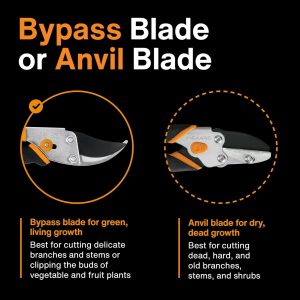
This design is particularly useful when working with delicate flowers, green stems, and living plant growth. By helping reduce crushing and unnecessary damage around the cut, the shears can make routine pruning more controlled.
For gardeners who regularly maintain roses, flowering plants, and small ornamental shrubs, this cutting action can be especially practical. Clean, appropriately positioned cuts help you remove unwanted growth while maintaining a neat appearance.
However, the quality of the result also depends on blade sharpness, cutting technique, and the condition of the plant. These shears are not intended to replace loppers or larger pruning tools when dealing with thick branches.
Best for: Gardeners who need controlled cuts when trimming live stems, flowers, and small branches.
2. Cutting Capacity of Up to 5/8 Inch
The Fiskars pruner is designed to cut stems and small branches measuring up to 5/8 inch in diameter. This capacity makes it suitable for many everyday pruning tasks without requiring a large or complicated tool.
For example, you could use it to remove spent flower stems, trim small green shoots, tidy up young shrubs, or cut back suitable plant growth during routine garden maintenance.
Having a clearly stated cutting capacity also helps you understand the tool’s limitations before purchasing. Rather than forcing the blades through branches that are too thick, you can select a more appropriate tool for heavier pruning work.
Actual cutting ease may vary depending on the plant species, branch hardness, and condition of the blades. Staying within the recommended capacity can help avoid unnecessary strain on the tool.
Best for: Everyday pruning jobs involving stems and small branches up to the advertised diameter.
3. Precision-Ground Steel Blades Designed to Stay Sharp
A pruning tool is only as useful as its ability to cut effectively. Dull blades can make trimming more difficult and may produce less satisfactory cuts, particularly when working with delicate plant growth.
According to the supplied product description, the Fiskars shears feature precision-ground steel blades engineered to retain their sharpness through heavy use. Their steel construction is intended to support consistent cutting performance during regular garden maintenance.
This is a useful feature for gardeners who frequently trim flowers, maintain shrubs, or remove unwanted growth throughout the growing season. Reliable blades can help make repetitive cutting tasks more manageable.
Nevertheless, no blade remains sharp indefinitely. Cutting unsuitable materials, neglecting cleaning, and using the tool improperly can affect its performance over time. Periodic inspection and appropriate maintenance remain important.
Best for: Gardeners who want dependable cutting performance for frequent plant care.
4. Protective Blade Coating for Smoother Cutting
Sticky sap and friction can make pruning frustrating, especially when working with plants that leave residue on cutting surfaces.
The Fiskars bypass pruner addresses this concern with a blade coating designed to reduce friction, minimize sap buildup, and improve resistance to rust. These features are intended to help the blades move more smoothly during cutting and make routine cleaning easier.
Reduced friction can be particularly helpful when making several cuts in succession. Meanwhile, improved resistance to rust is a practical advantage for a tool that is regularly exposed to outdoor conditions.
It is worth remembering that a protective coating does not make the blades maintenance-free. Sap can still accumulate, and prolonged exposure to moisture can affect metal components. Cleaning and drying the shears after use remain sensible habits.
Best for: Gardeners who value smoother cutting action and easier blade maintenance.
5. Built-In Sap Groove to Help Prevent Sticking
Anyone who has pruned sap-producing plants knows how quickly sticky residue can interfere with a cutting tool. When sap accumulates around the blades, movement may become less smooth and repetitive pruning can become inconvenient.
The Fiskars shears include a sap groove designed to help prevent the blades from sticking during use. This small but practical detail complements the blade coating and supports the tool’s overall cutting performance.
For gardeners maintaining several plants in one session, features that help manage sap buildup can make routine work less frustrating. They may also reduce the frequency of interruptions needed to clean sticky residue during suitable pruning tasks.
However, the sap groove should not be viewed as a substitute for cleaning. Plant residue can still accumulate, so wiping the blades after use is important for maintaining smooth operation.
Best for: Gardeners who frequently prune sap-producing plants and want a feature designed to reduce blade sticking.
6. Ergonomic Handle for Comfortable Handling
Pruning often involves repeated squeezing and releasing, particularly when maintaining several flower beds or shrubs. A handle that feels uncomfortable or slips in the hand can make these tasks more tiring.
The Fiskars bypass pruner features an ergonomic, non-slip handle designed to improve grip and control while helping reduce hand fatigue during repetitive cuts.
This design may be useful when shaping plants, trimming several stems in succession, or completing routine garden maintenance. A secure grip can also help you guide the blades more accurately toward the intended cutting point.
Comfort, however, depends on individual hand size, grip strength, and the number of cuts being made. If you have particularly small hands or experience discomfort when using hand tools, check the product’s fit and handling before committing to it.
Best for: Gardeners who want a secure, comfortable grip for regular pruning sessions.
7. Easy-Open Safety Lock for Storage and Transport
Pruning shears have sharp blades, so safe handling does not end when the cutting task is finished. A dependable locking mechanism can help prevent accidental exposure to the cutting edges while the tool is being carried or stored.
The Fiskars pruner includes an easy-open safety lock designed to secure the blades when they are not in use. This makes it more convenient to place the closed shears in a gardening toolbox or carry them between different areas of the garden.
The locking mechanism is especially useful for keeping the blades closed during storage, provided it is properly engaged.
As with any sharp gardening tool, store the shears somewhere secure and out of children’s reach. Always check that the lock is engaged before putting the tool away.
Best for: Gardeners who want convenient blade security during storage and transport.
8. Durable All-Steel Construction
Gardening tools often encounter dirt, moisture, plant residue, and repeated mechanical stress. Construction quality is therefore an important consideration when choosing equipment for regular use.
According to the supplied description, the Fiskars pruner uses all-steel construction to support lasting durability and consistent performance. Its alloy steel blades are designed to withstand the demands of routine pruning when used and maintained appropriately.
For homeowners who prefer to invest in tools they can use across multiple gardening seasons, durable construction is a worthwhile feature to consider.
However, the supplied information does not specify the exact steel grade, hardness rating, or independent durability-test results. It would therefore be inappropriate to claim that the tool is indestructible or guaranteed to outperform every competing pruner.
Best for: Gardeners seeking a sturdy hand pruner for regular residential garden maintenance.
9. Compact Design for Everyday Garden Tasks
Measuring approximately 9.07 inches long and 2.47 inches wide, the Fiskars bypass pruner has a compact form suitable for ordinary hand-pruning tasks.
Its size makes it a practical candidate for keeping in a gardening toolbox or carrying while moving between flower beds, vegetable patches, and ornamental shrubs.
Unlike bulky pruning equipment, hand shears allow you to work close to individual stems and select specific growth for removal. This is particularly helpful when tidying plants that require careful attention rather than broad trimming.
Although the listed dimensions provide a useful indication of the tool’s size, the supplied information does not state its weight or whether it includes a dedicated storage pouch.
Best for: Home gardeners who want a compact, hand-operated pruning tool for routine plant care.
10. Lifetime Warranty and Straightforward Maintenance
The supplied product listing states that the Fiskars bypass pruning shears are backed by a lifetime warranty. This may be an appealing consideration for buyers who value long-term product support.
Before purchasing, review the current warranty terms to understand which defects are covered, any exclusions that apply, and how claims are handled in your location. Warranty conditions can vary, and the supplied information does not provide the full terms.
Maintenance is relatively straightforward. The listing recommends wiping the pruners clean after every use to prevent sap buildup and lightly oiling the blade to support longer product life.
These simple steps can help remove residue, maintain smooth movement, and reduce the risk of corrosion. It is also sensible to store the shears in a dry location with the safety lock engaged.
For gardeners who want a practical tool without a complicated maintenance routine, this combination of straightforward care instructions and stated warranty coverage is worth considering.
Best for: Gardeners who appreciate simple maintenance and the reassurance of a stated lifetime warranty.
Pros and Cons of the Fiskars Bypass Pruning Shears
Pros
-
Clean cutting action: The bypass blade design is intended to reduce crushing when cutting live stems and green growth.
-
Practical cutting capacity: Handles suitable stems and small branches up to 5/8 inch in diameter.
-
Precision-ground blades: Designed to retain sharpness through regular use.
-
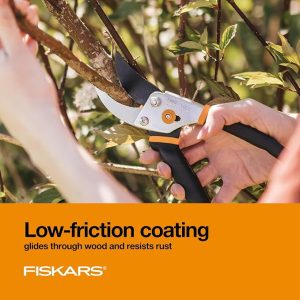
Friction-reducing coating: Helps promote smoother cutting and minimize sap buildup.
-
Built-in sap groove: Designed to help prevent the blades from sticking during use.
-
Comfortable grip: The ergonomic, non-slip handle is designed to improve control and help reduce hand fatigue.
-
Safety lock: Helps keep the blades closed during storage and transport.
-
Durable construction: The supplied description identifies an all-steel construction.
-
Compact dimensions: Its approximately 9.07-inch length is convenient for everyday hand pruning.
-
Stated lifetime warranty: Provides an additional purchasing consideration, subject to the applicable terms.
Cons
-
Limited branch capacity: The 5/8-inch maximum cutting capacity makes it unsuitable for thicker branches.
-
Requires regular cleaning: Sap and other plant residue can still accumulate despite the blade coating and sap groove.
-
Blade maintenance is necessary: Periodic cleaning and oiling are recommended to support long-term performance.
-
Comfort varies between users: The handle may not fit every hand equally well, particularly during extended pruning sessions.
-
Warranty terms need checking: The supplied listing does not explain all coverage conditions or regional limitations.
-
Not a complete pruning solution: Gardeners maintaining mature trees or thick woody shrubs may also need loppers or a pruning saw.
Who Should Buy the Fiskars Bypass Pruning Shears?
The Fiskars Bypass Pruning Shears may be a suitable choice for several types of gardeners.
1. Home gardeners
If you regularly maintain flower beds, small shrubs, and ornamental plants, these shears offer a straightforward way to handle everyday trimming without bringing out larger equipment.
2. Flower enthusiasts
The bypass cutting design is intended for delicate flower stems and green growth, making it worth considering for gardeners who regularly tidy flowering plants.
3. Vegetable gardeners
Suitable hand pruners can help with selected pruning tasks around vegetable gardens, provided the stems fall within the tool’s cutting capacity and the cuts are appropriate for the plant.
4. Gardeners who value comfort
The ergonomic, non-slip handle may appeal to people who regularly make repeated cuts and want a design intended to improve grip and reduce hand fatigue.
5. Buyers looking for a practical everyday tool
Its compact size, safety lock, blade coating, and straightforward maintenance requirements make this pruner a reasonable candidate for a general gardening toolkit.
Who should consider another tool?
These shears may not be the right choice if your main task involves cutting thick branches, pruning mature trees, or removing heavy woody growth. A pair of loppers or a suitable pruning saw would generally be more appropriate for those jobs.
Likewise, gardeners who need a specialized tool for extensive commercial pruning should compare cutting capacity, handle design, maintenance requirements, and warranty conditions before deciding.
Final Verdict: Are the Fiskars Bypass Pruning Shears Worth Considering?
The Fiskars Bypass Pruning Shears offer a practical combination of controlled cutting, comfortable handling, and features intended to support everyday garden maintenance. Their bypass blade design, stated cutting capacity of up to 5/8 inch, precision-ground steel blades, friction-reducing coating, and built-in sap groove make them worth considering for routine trimming of live stems and small branches.
The ergonomic, non-slip handle is another useful feature, particularly for gardeners who regularly prune several plants in one session. Meanwhile, the safety lock and straightforward cleaning instructions add practical value to the overall design.
There are limitations to keep in mind. These shears are designed for smaller pruning jobs rather than thick branches, and their blades still require proper cleaning and care. Buyers should also review the applicable lifetime warranty terms before purchasing.
Overall, the Fiskars Bypass Pruning Shears are a strong candidate for gardeners seeking a compact hand pruner for everyday plant care. They may be particularly useful for maintaining flower beds, trimming green growth, and keeping small shrubs tidy, provided the branches remain within the recommended cutting capacity.
For the roundup 9 Best Gardening Tools – Top Picks for Planting, Pruning, Weeding & Easy Garden Maintenance, this product is a natural option to feature as a pruning tool for clean cuts and routine garden care. Before adding it to your final recommendations, verify the current Amazon listing, price, availability, customer feedback, and warranty details so readers can make an informed purchasing decision.
Also read : 10 Best Gardening Hand Tools – Top Picks for Planting, Pruning, Weeding & Everyday Garden Care
2. Kemaier Stainless Steel Garden Hand Trowel – Best Gardening Tool for Digging, Planting, Root Cutting & Heavy-Duty Garden Work
Imagine preparing your garden for a fresh season of planting. You have seedlings waiting to be transplanted, compacted soil that needs loosening, and stubborn weeds spreading through your flower beds. A flimsy hand shovel can quickly turn these simple jobs into frustrating work, especially when its blade struggles against firm soil or its handle begins to wobble under pressure. This is where a sturdy, well-designed garden trowel can make a noticeable difference.
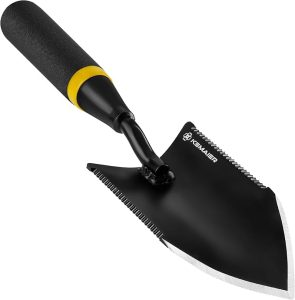
The Kemaier Stainless Steel Garden Hand Trowel is designed for gardeners who want a versatile hand tool capable of handling digging, planting, soil preparation, and selected weeding tasks. Featuring a stainless steel blade, a full-metal tang, an ergonomic grip, and a dual-sided serrated edge, this trowel combines several practical design elements intended to make demanding gardening jobs more manageable.
One of its standout features is its stainless steel construction. Gardening tools are regularly exposed to damp soil, water, plant residue, and outdoor conditions, so resistance to rust is an important consideration. According to the supplied product description, the Kemaier trowel is made from rust-resistant stainless steel and is designed to withstand repeated use across different gardening tasks. Its construction makes it worth considering for gardeners who want a dependable tool for maintaining flower beds, vegetable patches, and other planted areas.
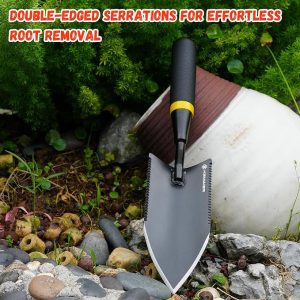
The blade design is another reason this trowel deserves attention. In addition to its pointed digging end, the tool features serrated edges on both sides, intended to help cut through stubborn roots and weeds while working in the soil. This combination can be particularly useful when ordinary digging encounters resistance from compacted earth or small roots that interfere with planting.
Comfort and control are also part of the design. The handle features a full-metal tang for added structural support and a matte rubber coating intended to provide a waterproof, non-slip grip. Whether you’re digging in damp soil, transplanting seedlings, or working through a series of planting holes, a secure handle can make the tool easier to control.
Another notable detail is the reinforced connection between the blade and handle. The manufacturer describes a manual argon arc welding process intended to create a strong joint and reduce the risk of the components separating under pressure. This is an important consideration for a hand tool expected to withstand repeated digging and levering motions, although actual durability will depend on construction quality and how the trowel is used.
Of course, a heavy-duty design does not automatically make a tool ideal for every gardener. The Kemaier trowel’s metal construction may feel less lightweight than some alternatives, and its serrated blade requires careful handling. Its performance in especially hard soil will also depend on ground conditions and the amount of force applied.
In this review, we’ll examine the Kemaier Stainless Steel Garden Hand Trowel’s specifications, key features, advantages, and potential drawbacks to help you decide whether it deserves a place in your gardening toolkit.
Key Specifications of the Kemaier Stainless Steel Garden Hand Trowel
| Specification | Details |
|---|---|
| Brand | Kemaier |
| Product Name | Kemaier Stainless Steel Garden Hand Trowel |
| Material | Stainless steel |
| Color | Listed as “Hand Trowel” in the supplied details; actual color not specified |
| Product Dimensions | 12.6″L × 2.5″W × 0.8″H |
| Style | Trowel |
| Blade Material | Stainless steel |
| Handle Material | Metal |
| Grip Type | Ergonomic |
| Handle Features | Full-metal tang with matte rubber coating |
| Blade Design | Pointed digging blade with dual-sided serrated edges |
| Construction | Reinforced blade-to-handle welding, described as manual argon arc welding |
| Quantity | 1 |
| Primary Uses | Digging, planting, soil preparation, and cutting through small roots and weeds |
| Rust Resistance | Described by the manufacturer as rust-resistant |
| Intended Users | Home gardeners, serious gardening enthusiasts, and professional landscapers |
Note: The supplied product details do not specify the trowel’s weight, exact steel grade, or independently verified load capacity.
10 Key Features of the Kemaier Stainless Steel Garden Hand Trowel
1. Heavy-Duty Stainless Steel Construction
One of the most important features of the Kemaier garden trowel is its stainless steel construction. A hand trowel often encounters considerable resistance when digging through compacted soil, working around established plants, or preparing holes for larger seedlings. A sturdy blade is therefore essential for dependable everyday use.
According to the supplied product description, the trowel uses premium rust-resistant stainless steel intended to withstand demanding gardening conditions. Stainless steel is a practical material for outdoor tools because it offers corrosion resistance, although the degree of protection depends on the particular steel grade and how the tool is maintained.
For gardeners who frequently prepare planting holes, move soil, or maintain established flower beds, this construction is an appealing feature. A well-made metal trowel can serve a variety of purposes without requiring a separate tool for every small digging task.
However, the manufacturer’s claims that the tool will not bend or break should not be interpreted as an unconditional guarantee. Applying excessive leverage, striking hard objects, or using the trowel as a pry bar can still damage the blade or handle.
Best for: Gardeners seeking a sturdy hand trowel for regular planting, digging, and general soil preparation.
2. Sharp Blade for Digging Through Difficult Soil
Not all garden soil is easy to work with. Some planting areas contain compacted earth, dense clay, gravel, or tightly packed soil that makes digging with a small hand tool more challenging.
The Kemaier trowel is described as having an ultra-sharp blade designed to cut into soil more easily. Its pointed profile helps concentrate pressure at the tip, making it useful for creating planting holes and working around established plants.
This can be particularly helpful when transplanting seedlings, adding plants to an existing flower bed, or preparing small areas for vegetables and herbs. Instead of relying entirely on repeated scooping motions, you can use the pointed blade to penetrate the soil before lifting it out.
Performance will naturally vary with ground conditions. Extremely hard, dry clay or soil filled with large stones may require prior loosening or a heavier digging tool.
Best for: Gardeners who regularly dig planting holes and work with moderately firm soil.
3. Dual-Sided Serrated Edges for Roots and Weeds
One of the more distinctive features of this Kemaier trowel is its dual-sided serrated blade. The serrations are designed to help cut through small roots and stubborn weeds that can obstruct ordinary digging.
This feature adds versatility to a tool that would otherwise be used mainly for scooping and moving soil. When preparing a planting hole, for example, you may encounter thin roots or fibrous weeds that make it difficult to position a seedling properly. The serrated edges are intended to help you work through these obstacles.
The design may also be useful when clearing small patches of unwanted growth or loosening soil around established plants.
However, the serrated edges do not make the trowel a replacement for dedicated pruning shears, a root saw, or a specialized weed-removal tool. Care is also necessary when working close to desirable plant roots, irrigation lines, or buried cables.
Best for: Gardeners who want a hand trowel that can assist with digging while tackling small roots and weeds.
4. Ergonomic Handle for Better Grip and Control
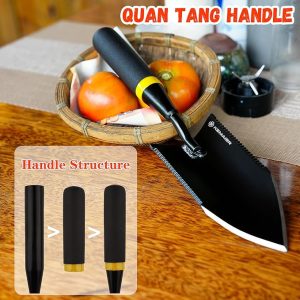
A garden trowel must do more than dig effectively. It should also feel secure in your hand, particularly when you’re repeatedly pushing the blade into the soil or lifting small amounts of earth.
The Kemaier trowel features an ergonomic handle with a matte rubber coating intended to provide a non-slip grip. According to the supplied description, the coating is also designed to maintain grip when the handle is exposed to water or muddy conditions.
This can be useful when planting several seedlings, moving soil between containers, or completing routine gardening jobs after watering. A comfortable, secure grip may help you maintain better control over the blade’s direction and movement.
Of course, handle comfort varies between users. Hand size, grip strength, and the duration of each gardening session can all affect how comfortable the trowel feels. The supplied specifications do not include a detailed handle circumference or independent ergonomic testing.
Best for: Gardeners who value a secure grip when digging, transplanting, and working in damp conditions.
5. Full-Metal Tang for Structural Support
The connection between a trowel’s blade and handle is a critical part of its construction. Even a strong blade can become unreliable if the handle connection loosens or separates under pressure.
The Kemaier hand trowel features a full-metal tang, according to the supplied product description. This design is intended to provide additional structural support through the handle assembly, helping the tool withstand the demands of ordinary digging.
For gardeners who use their trowels regularly, a reinforced internal connection is a worthwhile feature to consider. It can be particularly relevant when digging into firm soil, lifting earth, or working around established planting areas.
Nevertheless, the supplied information does not provide a detailed diagram of the tang’s length or independent strength-test results. The full-metal tang should therefore be viewed as a design feature rather than proof that the tool cannot fail.
Best for: Gardeners looking for a hand trowel with a metal-supported handle construction.
6. Reinforced Welding Between the Blade and Handle
A trowel’s blade-to-handle joint can experience repeated stress during digging and soil removal. If the connection is poorly constructed, regular use may cause movement, cracking, or separation.
Kemaier describes the blade and handle as being joined through manual argon arc welding, creating what the manufacturer characterizes as a strong, full weld point. The stated purpose is to improve the connection’s structural integrity and reduce the risk of the tool coming apart under pressure.
This is a useful detail for buyers comparing metal hand trowels, especially if they regularly work in firm soil. A securely joined assembly is an important consideration when choosing equipment intended for repeated physical use.
Still, welding quality depends on execution, materials, and the finished product. The supplied description does not include independent stress testing or long-term durability data, so real-world performance cannot be established from the welding claim alone.
Best for: Gardeners who prioritize a reinforced blade-to-handle connection when choosing a digging tool.
7. Matte Rubber Coating for Wet and Muddy Conditions
Gardening often means handling tools with wet or muddy hands. A smooth metal handle can become less comfortable or harder to hold securely under these conditions.
The Kemaier trowel’s matte rubber handle coating is designed to improve grip and provide a more comfortable contact surface. Its waterproof, non-slip properties, as described by the manufacturer, are intended to support control when working in damp garden environments.
This may be particularly useful during planting sessions when soil is moist, after watering, or when moving between different areas of the garden.
The coating also gives the handle a different feel from an entirely bare metal grip. However, the supplied information does not specify the coating’s thickness or long-term resistance to abrasion. Inspecting the handle periodically for damage is sensible, particularly if the tool is used frequently.
Best for: Gardeners who often work with moist soil and want a coated handle designed for secure handling.
8. Versatile Design for Planting and Transplanting
A good hand trowel is one of the most frequently used tools in many gardens because it can handle a range of small-scale digging tasks.
The Kemaier trowel’s pointed blade and compact dimensions make it worth considering for creating planting holes, lifting soil, and helping transplant seedlings or young plants. It can also assist with adding compost or moving small quantities of growing medium between containers and garden beds.
For a home gardener, this versatility can be more convenient than switching between several tools for simple jobs. A single hand trowel can support routine planting throughout the growing season.
When transplanting, however, it is important to work carefully around the plant’s root system. The serrated blade is useful for cutting through unwanted roots but should not be used carelessly near the roots you intend to preserve.
Best for: Home gardeners who want one hand tool for a variety of planting and transplanting tasks.
9. Compact 12.6-Inch Design for Everyday Use
The Kemaier garden trowel measures approximately 12.6 inches long, 2.5 inches wide, and 0.8 inches high, according to the supplied specifications.
These dimensions describe a hand-operated tool that can be used in relatively confined areas where a full-size shovel would be inconvenient. It may be useful when working in raised beds, tending container plants, filling small planting holes, or maintaining flower beds with limited space.
Its relatively narrow blade profile can also help when placing plants in selected spots without disturbing a large area of surrounding soil.
The exact weight is not included in the supplied details, so it is not possible to establish how lightweight the trowel feels compared with competing products. The metal construction may also feel different from lighter plastic-handled alternatives.
Best for: Gardeners who need a compact digging tool for raised beds, containers, and everyday planting.
10. Designed for Serious Gardeners and Repeated Use
Kemaier presents itself in the supplied description as a manufacturer focused on garden tools for professional landscapers and serious gardening enthusiasts.
That intended audience aligns with the trowel’s emphasis on stainless steel construction, a full-metal tang, a reinforced welded connection, and a coated ergonomic grip. Together, these features suggest a product designed with durability and practical functionality as priorities.
For gardeners who spend substantial time maintaining vegetable plots, ornamental beds, or landscaped areas, a sturdy hand trowel can be a useful part of the everyday toolkit.
However, the description does not provide independent professional endorsements, verified commercial-use testing, or customer-satisfaction data. The manufacturer’s positioning should therefore be treated as a statement of intended audience rather than proof of professional approval.
Best for: Enthusiastic home gardeners and landscapers looking for a metal hand trowel with several durability-focused design features.
Pros and Cons of the Kemaier Stainless Steel Garden Hand Trowel
Pros
-
Stainless steel blade: Designed to resist rust and support regular gardening use.
-
Heavy-duty construction: Intended to withstand routine digging and soil preparation.
-
Pointed digging blade: Useful for creating planting holes and working in moderately firm soil.
-
Dual-sided serrated edges: Designed to help cut through small roots and stubborn weeds.
-
Ergonomic handle: Provides a grip designed for comfort and control.
-
Matte rubber coating: Intended to maintain a non-slip grip in wet or muddy conditions.
-
Full-metal tang: Adds structural support to the handle assembly.
-
Reinforced welded joint: Designed to reduce the risk of the blade and handle separating under pressure.
-
Versatile functionality: Suitable for digging, planting, transplanting, and selected weeding tasks.
-
Compact dimensions: The 12.6-inch length is practical for many small-scale garden jobs.
Cons
-
Weight is unspecified: Buyers cannot assess its weight against other trowels from the supplied specifications.
-
Heavy-duty claims are not independently verified: No independent stress-test results or load-capacity figures were provided.
-
Serrated blade requires care: The edges may damage desirable roots or nearby objects if used carelessly.
-
Not intended for large-scale excavation: A hand trowel cannot replace a full-size shovel for extensive digging.
-
Very hard soil may remain challenging: Compacted clay and rocky ground can require additional tools or preparation.
-
Handle-coating longevity is unclear: The supplied description does not establish how well the rubber coating holds up over extended use.
-
Exact steel grade is unspecified: The listing does not identify the particular stainless steel alloy.
Who Should Buy the Kemaier Stainless Steel Garden Hand Trowel?
The Kemaier trowel may be worth considering for several types of gardeners.
1. Home gardeners
If you regularly prepare planting holes, loosen soil, or maintain flower beds, this trowel offers a versatile design for common gardening jobs.
2. Vegetable gardeners
The pointed blade can help with planting seedlings, moving small quantities of soil, and preparing spaces for herbs and vegetables. Use the serrated edges carefully around established roots.
3. Gardeners dealing with small roots and weeds
The dual-sided serrations are designed to help cut through root obstructions and unwanted growth encountered while digging.
4. Gardeners who prioritize sturdy construction
The stainless steel blade, full-metal tang, and reinforced welded connection may appeal to buyers who prefer a metal tool with several durability-focused design features.
5. Serious gardening enthusiasts
Gardeners who spend considerable time maintaining raised beds, ornamental gardens, or landscaped areas may appreciate having a hand trowel suited to a variety of routine tasks.
Who should consider another tool?
This trowel may not be ideal if you need a very lightweight tool, frequently work with large rocks, or undertake extensive digging in heavily compacted ground. A larger shovel, specialized digging tool, or dedicated root-cutting tool may be more appropriate for those tasks.
Gardeners who prioritize a verified weight, a specific steel grade, or independently tested durability should also seek additional product information before purchasing.
Final Verdict: Is the Kemaier Stainless Steel Garden Hand Trowel Worth Considering?
The Kemaier Stainless Steel Garden Hand Trowel combines a stainless steel blade, dual-sided serrated edges, an ergonomic rubber-coated handle, a full-metal tang, and a reinforced welded connection. These features make it an interesting option for gardeners looking for a versatile hand tool for digging, planting, transplanting, and tackling small roots or weeds.
Its greatest appeal is the combination of digging functionality and serrated cutting edges. Rather than serving only as a small shovel, the design is intended to help gardeners work through some of the root obstructions they may encounter while preparing planting holes. The coated grip and reinforced handle construction add further practical considerations.
There are some limitations to bear in mind. Its exact weight and steel grade are not specified in the supplied details, and the manufacturer’s heavy-duty claims are not accompanied by independent testing. As with any serrated gardening tool, careful handling is important when working close to desirable roots or buried irrigation components.
Overall, the Kemaier Stainless Steel Garden Hand Trowel is a product worth considering for gardeners who want a sturdy, multipurpose hand tool for routine digging and planting. Its combination of a pointed blade, serrated edges, and a grip designed for wet conditions may be particularly useful in flower beds, vegetable gardens, and raised planting areas.
For the roundup 9 Best Gardening Tools – Top Picks for Planting, Pruning, Weeding & Easy Garden Maintenance, this product is a suitable candidate to feature as a hand trowel for digging, planting, and root-related gardening tasks. Before publishing your final recommendation, verify the current Amazon listing, pricing, customer feedback, and exact specifications so your readers can make a well-informed purchase.
3. Grampa’s Weeder Review – Best Stand-Up Weed Puller for Easy, Back-Friendly Garden Maintenance
Keeping a garden free of weeds can quickly become one of the most exhausting parts of maintaining a beautiful outdoor space. Whether you’re tending to a vegetable patch, caring for flower beds, or trying to keep your lawn looking neat, unwanted weeds have a way of returning just when you think you’ve dealt with them. Pulling them out by hand can be tiring, while repeatedly bending, kneeling, and tugging at stubborn roots may leave your back and knees feeling the strain. That’s where Grampa’s Weeder comes in—a traditional, long-handled weeding tool designed to make weed removal simpler, more comfortable, and less dependent on chemical treatments.
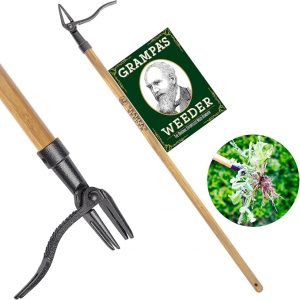
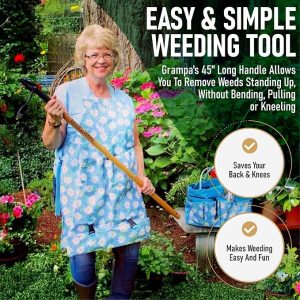
Grampa’s Weeder stands out for its old-school design, which the manufacturer says has been helping gardeners remove weeds since 1913. Instead of requiring you to crouch down and pull weeds manually, this stand-up tool features a long bamboo handle and a four-claw head designed to grip weeds and help remove them along with their roots. At approximately 46 inches tall, it allows you to work from a standing position, making it an appealing option for gardeners who want to reduce repetitive bending and kneeling during routine garden maintenance.
One of the most attractive aspects of this weed puller is its straightforward, chemical-free approach. Rather than relying on herbicides, you can use the tool to target individual weeds and physically remove them from the soil. This can be particularly useful for gardeners who prefer to minimize chemical use around their plants, children, pets, and outdoor living spaces. Its simple mechanical design also means you don’t have to worry about batteries, charging cables, or complicated operating mechanisms.
However, Grampa’s Weeder is not necessarily the right solution for every garden or soil condition. Its four-claw design is intended to work best in softer soil, especially after rainfall or watering, when weeds and their roots may be easier to extract. Hard-packed clay, rocky ground, and heavily compacted soil can make weed removal more difficult, so understanding the tool’s limitations is important before buying it.
In this detailed review, we’ll examine Grampa’s Weeder’s specifications, key features, advantages, and potential drawbacks to help you decide whether this traditional stand-up weed puller deserves a place in your gardening toolkit.
Key Specifications of Grampa’s Weeder
Before looking at its performance and practical benefits, here’s a quick overview of the product’s main specifications based on the supplied listing.
| Specification | Details |
|---|---|
| Brand | Grampa’s Weeder |
| Product Type | Stand-up weed puller |
| Product Dimensions | 8 inches wide × 46 inches high |
| Color | Brown |
| Item Weight | 2.3 pounds |
| Handle Material | Bamboo |
| Weeding Mechanism | Four-claw design |
| Primary Purpose | Removing weeds and their roots |
| Recommended Soil Conditions | Softer soil, particularly after watering or rainfall |
| Chemical-Free Operation | Yes; weeds are removed mechanically |
| Power Source | Manual |
| Company Background | Family-owned American company based in the Pacific Northwest |
| Heritage | Manufacturer states the design has been used since 1913 |
Note: The supplied product information does not specify the claw material, maximum weed diameter, or a guaranteed removal rate. Actual results will depend on weed type, root structure, and soil conditions.
10 Key Features of Grampa’s Weeder
1. Long Handle for Standing-Up Weeding
One of the biggest selling points of Grampa’s Weeder is its long handle, which measures approximately 46 inches according to the supplied product dimensions. This length is intended to let gardeners remove weeds while standing rather than repeatedly bending down to reach the ground.
For anyone maintaining a large garden, regularly clearing weeds from a lawn, or working across several flower beds, reducing the need to bend and kneel can make routine maintenance more comfortable. The upright design may be especially appealing to gardeners who find ground-level weeding tiring or inconvenient.
The long handle also makes it easier to reach weeds scattered throughout an open planting area without having to get down on your hands and knees each time. Nevertheless, comfort will vary with your height, posture, and the location of the weeds.
Best for: Gardeners who want to reduce bending and kneeling during everyday weed removal.
2. Four-Claw Weed Removal Mechanism
Grampa’s Weeder uses a four-claw design intended to grip weeds at the soil surface and help extract them from the ground. Rather than relying solely on pulling the visible leaves, the claws are designed to engage the weed so that its roots can be removed as well.
Removing more of the root system can help reduce the likelihood of certain weeds growing back immediately. However, results depend on the weed itself. Some plants have deep taproots or spreading root systems that may break during extraction, even when a dedicated weeding tool is used.
For best results, position the tool over the weed, engage the claws with the soil, and follow the manufacturer’s instructions for the correct removal motion. Taking time to learn the technique can make a meaningful difference in how effectively the tool works.
Best for: Gardeners who want a simple mechanical tool for targeting individual weeds and their roots.
3. Traditional Design With a Long History
Grampa’s Weeder is marketed as an original-style garden weeder that has been used since 1913. Its old-fashioned approach is part of its appeal: instead of introducing a complicated mechanism, it focuses on a straightforward method of removing unwanted plants from the soil.
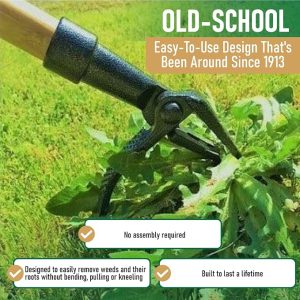
For gardeners who prefer practical, manual tools over powered equipment, this simplicity can be attractive. There’s no motor to maintain, battery to charge, or fuel to purchase. The tool is intended to be ready for use whenever weeds appear.
The company’s long-standing design is also a useful reminder that effective garden maintenance does not always require elaborate equipment. Still, a product’s history alone does not guarantee that it will work equally well in every garden, so soil conditions and correct technique remain important.
Best for: Gardeners who appreciate traditional, uncomplicated tools for routine outdoor maintenance.
4. Bamboo Handle Construction
The handle is made from bamboo, giving the tool a natural-material component rather than an entirely synthetic handle. Bamboo is commonly used in gardening equipment because it offers a combination of relatively low weight and practical strength.
For a manual tool that may be used repeatedly across a garden, handle construction matters. A comfortable, manageable handle can make it easier to position the weeder and apply the movement needed to engage its claws.
However, the supplied listing does not specify whether the bamboo has received a protective finish or provide details about its resistance to prolonged moisture exposure. As with other tools that incorporate natural materials, storing Grampa’s Weeder in a dry, sheltered location is a sensible way to help preserve it.
Best for: Gardeners who prefer tools featuring natural handle materials.
5. Lightweight Design for Routine Garden Tasks
At approximately 2.3 pounds, Grampa’s Weeder is relatively manageable for a long-handled manual gardening tool. Its weight may make it easier to carry between flower beds, vegetable patches, and other areas where weeds need attention.
A lightweight design is particularly helpful when you’re working across several sections of a garden and need to reposition the tool frequently. It may also make the weeder more approachable for gardeners who don’t want to handle heavier equipment for a simple maintenance task.
Keep in mind, however, that the tool still requires physical effort. Pulling weeds from compacted soil or extracting established roots can demand more force than removing young weeds from recently watered ground.
Best for: Gardeners looking for a manual weed puller that is relatively easy to carry and maneuver.
6. Chemical-Free Weed Control
Grampa’s Weeder removes weeds through physical action rather than herbicides. This gives gardeners an option for managing unwanted plants without applying chemical weed killers to the areas being treated.
Chemical-free weeding can be especially appealing in home gardens where vegetables, herbs, flowers, children, or pets are part of the outdoor environment. It also allows you to target individual weeds rather than treating a wider area with a chemical product.
That said, chemical-free does not mean effort-free. You’ll still need to identify the weeds, position the tool correctly, and remove them before they spread. For larger infestations or weeds with extensive underground roots, a combination of methods may be necessary.
Best for: Gardeners who prefer physical weed removal over routine herbicide use.
7. Best Suited to Softer Soil
One important detail in the product listing is that Grampa’s Weeder performs best in softer soil, particularly after watering or rainfall. This matters because soil moisture affects how easily a weed’s roots can be released from the surrounding ground.
When the soil is suitably moist, the claws may be able to engage around the weed more effectively, making extraction easier. Using the tool after a rain shower or watering session can therefore be a practical way to improve your weeding routine.
By contrast, dry, compacted clay and rocky soil may prevent the claws from penetrating or gripping the weed properly. Forcing the tool into hard ground may be frustrating and could interfere with effective removal.
Best for: Gardens with relatively loose soil, especially when the ground has been softened by watering or rain.
8. Designed to Help Remove Roots, Not Just Leaves
A common frustration with manual weeding is pulling off the visible part of a weed while leaving enough of the root behind for it to regrow. Grampa’s Weeder is designed to help address this problem by using its claws to grip weeds below or around the soil surface.
This approach can be helpful when dealing with individual weeds in lawns, garden beds, and other open areas. Removing as much of the root system as possible may reduce regrowth for some weed species.
Nevertheless, root removal is not guaranteed in every case. Deep-rooted weeds, plants with brittle roots, and weeds that spread through underground runners may require repeated treatment or a different type of tool. For persistent weeds, inspect the area after removal and deal with any regrowth promptly.
Best for: Gardeners who want to improve their chances of removing the roots of individual weeds.
9. Straightforward Manual Operation
Grampa’s Weeder doesn’t require electricity, batteries, or fuel. Its manual operation keeps the basic process simple and makes it suitable for gardens without convenient access to a power source.
The manufacturer emphasizes that users should read the instructions and watch the product videos to understand the correct technique. Although the tool looks simple, learning where to position the claws and how to operate them properly is important for achieving good results.
Following the instructions can also help prevent unnecessary strain and reduce the frustration of repeatedly trying to remove a weed with the wrong movement. Beginners should start with softer soil and easily accessible weeds while getting accustomed to the tool.
Best for: Gardeners who prefer simple, manually operated equipment and are willing to learn the recommended technique.
10. Family-Owned American Company
According to the product listing, Grampa’s Weeder comes from a family-owned American company based in the Pacific Northwest. This background may appeal to shoppers who appreciate established brands with a specific regional identity and a traditional gardening product.
The company also emphasizes the weeder’s long history, positioning it as a tool designed around a practical gardening problem rather than a short-lived trend.
Although company heritage can be a useful consideration when comparing gardening tools, it should be weighed alongside more immediate factors such as soil compatibility, handling comfort, ease of use, and the type of weeds in your garden.
Best for: Buyers who appreciate traditional gardening products from established, family-owned businesses.
Pros and Cons of Grampa’s Weeder
Every gardening tool has strengths and limitations. Here’s how Grampa’s Weeder compares based on the supplied product details.
| Pros | Cons |
|---|---|
| Long handle helps reduce bending and kneeling | May not perform well in hard clay or rocky soil |
| Four-claw design is intended to grip weeds and their roots | Deep-rooted or spreading weeds may still be difficult to remove completely |
| Manual operation requires no batteries, fuel, or electricity | |
| Chemical-free approach to weed removal | |
| Bamboo handle offers a natural-material construction | |
| Relatively manageable weight of 2.3 pounds | |
| Traditional design with a history dating back to 1913, according to the manufacturer |
Who Should Buy Grampa’s Weeder?
Grampa’s Weeder is worth considering if you want a straightforward tool for removing individual weeds while standing. Its long handle, four-claw mechanism, and chemical-free operation make it particularly suitable for certain home-gardening situations.
You may appreciate this tool if you:
-
Want to reduce bending and kneeling: The long handle allows you to work from an upright position for many routine weeding tasks.
-
Maintain flower beds or vegetable gardens: It can help you target unwanted plants without automatically treating the surrounding area with herbicides.
-
Prefer manual gardening tools: You don’t need to charge batteries, connect electricity, or use fuel.
-
Have relatively soft garden soil: The tool is intended to work best when the ground is loose or has been softened by watering or rainfall.
-
Want to remove individual weeds at their roots: Its four-claw design is intended to grip weeds for extraction rather than simply cutting off their visible growth.
-
Prefer a traditional gardening tool: Its established design may appeal to gardeners who value straightforward, practical equipment.
For the best experience, use the tool according to its instructions and choose the right moment to weed. Working after rain or watering may be much more productive than attempting to force the claws into dry, compacted ground.
Who Should Consider Another Weeding Tool?
Although Grampa’s Weeder offers several practical benefits, it won’t be ideal for every garden.
You may want to consider an alternative if:
-
Your garden has hard clay or rocky soil: The manufacturer specifically cautions that the tool may not perform as well in these conditions. A sturdy hand weeder or another tool suited to compacted ground may be more appropriate.
-
You frequently deal with deep-rooted weeds: Some weeds have long taproots or extensive underground growth that may not come out completely with a four-claw puller.
-
You need to clear large areas of dense weeds quickly: Removing weeds one at a time can become time-consuming when an area is heavily infested.
-
You need a tool for tight spaces: The long handle and ground-engaging head may be less convenient for working between closely spaced seedlings or inside small containers.
-
You want a completely effortless solution: The tool can reduce bending, but it still requires physical positioning and force, and results depend on soil conditions and technique.
In these situations, a hand weeder, a narrow weeding knife, or a combination of different tools may offer greater flexibility.
Final Verdict: Is Grampa’s Weeder Worth Considering?
Grampa’s Weeder is a practical option for gardeners who want to tackle weeds without spending the entire task bent over flower beds or kneeling on the ground. Its approximately 46-inch handle, four-claw removal mechanism, bamboo construction, and manual operation make it an appealing choice for routine garden maintenance. The ability to remove weeds without herbicides is another advantage for those who prefer a more targeted, chemical-free approach.
Its biggest limitation is soil compatibility. The tool is designed to perform best in softer soil, particularly after watering or rainfall, and may be less effective in hard clay or rocky conditions. It also cannot guarantee complete root removal for every weed species, so persistent plants may need additional attention.
Overall, Grampa’s Weeder is worth considering if you want a traditional stand-up weed puller for individual weeds in relatively soft garden soil. Use it with the correct technique, work when the ground is suitably moist, and assess whether its design matches the weeds and soil conditions in your garden. With realistic expectations, it can be a useful addition to a gardening toolkit focused on easier, chemical-free weed control.
Affiliate disclosure: As an Amazon Associate, I earn from qualifying purchases. This means I may receive a commission when you purchase through qualifying links in this article, at no additional cost to you.
4. CobraHead Original Weeder & Cultivator Review – A Versatile Hand Tool for Weeding, Cultivating & Everyday Garden Care
Weeds have a way of appearing in the most inconvenient places. One day, your flower beds look neat and organized, and the next, unwanted plants are competing with your flowers, vegetables, and herbs for space, moisture, and nutrients. Removing them by hand can be tedious, especially when their roots are firmly anchored in the soil. A reliable hand weeder can make this task much easier, and the CobraHead Original Weeder & Cultivator is designed to help gardeners tackle these everyday challenges with a simple, manual tool.
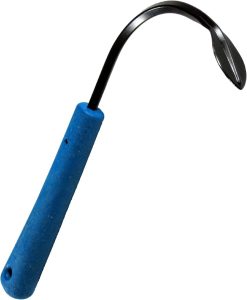
Developed by CobraHead, a brand that emphasizes practical gardening experience, this tool features a distinctive curved, tempered-steel blade designed to move through soil and help loosen unwanted plants. Rather than relying on a wide, flat blade, the CobraHead’s curved head provides a more focused working edge for getting into the soil around weeds. This design makes it worth considering for gardeners who want a compact tool that can assist with weeding and other small-scale soil preparation tasks.
Another appealing feature is its universal grip. The handle is made from recycled plastic and is designed to accommodate both left-handed and right-handed users. That flexibility can be especially useful in a household where several people share gardening tools. Its manual operation also means you don’t need batteries, electricity, or fuel to use it, making it a convenient option for quick gardening sessions whenever unwanted growth appears.
The CobraHead Original Weeder & Cultivator is also presented as a tool for gardeners of different experience levels, from beginners learning how to maintain a garden to experienced growers who need dependable hand tools for regular upkeep. Its lightweight construction, listed at just 1.76 ounces, may make it particularly appealing to those who prefer a tool that is easy to carry and maneuver around garden beds.
However, no single weeding tool is perfect for every situation. The CobraHead’s narrow, curved blade is best understood as a focused hand tool rather than a replacement for every garden implement. The supplied product information does not specify a maximum root diameter, blade length, or precise soil conditions for optimal performance, so your results will depend on the weeds you’re tackling and the condition of the ground.
In this review, we’ll examine the CobraHead Original Weeder & Cultivator’s specifications, key features, advantages, and limitations to help you decide whether it deserves a place in your gardening toolkit.
Key Specifications of CobraHead Original Weeder & Cultivator
Here’s a quick overview of the product’s main specifications based on the information provided.
| Specification | Details |
|---|---|
| Brand | CobraHead |
| Product Type | Manual garden weeder and cultivator |
| Color | Blue |
| Materials | Alloy steel and plastic |
| Item Weight | 1.76 ounces |
| Operation Mode | Manual |
| Blade Type | Curved, tempered-steel blade |
| Handle Material | Recycled plastic |
| Grip Design | Universal grip for left- and right-handed users |
| Primary Purpose | Weeding and small-scale soil cultivation |
| Power Source | None required |
| Country of Manufacture | United States |
| Manufacturing Location | Cambridge, Wisconsin |
| Intended Users | Beginner and experienced gardeners |
Note: The supplied product details do not specify the tool’s overall dimensions, blade length, exact steel grade, warranty, or maximum weed and root size. These details should be verified in the current product listing if they are important to your purchase.
10 Key Features of CobraHead Original Weeder & Cultivator
1. Distinctive Curved Blade for Targeted Weeding
The most recognizable feature of the CobraHead Original Weeder & Cultivator is its curved, tempered-steel blade. Unlike conventional hand weeders with relatively straight or flat working edges, the CobraHead uses a curved head designed to work through the soil around unwanted plants.
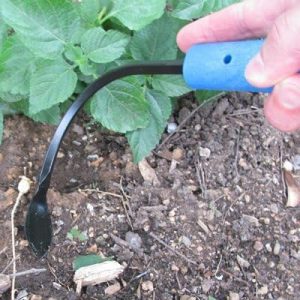
This shape can be useful when you need to loosen soil close to a weed rather than simply cutting off its visible growth. By working the blade into the ground around the plant, you can attempt to free the roots and remove more of the weed from its growing position.
The curved design also gives the tool a distinctive working profile that separates it from many basic garden trowels and straight-bladed weeders. As with any manual weeding tool, careful positioning is important, particularly when working near desirable plants whose roots you want to protect.
Best for: Gardeners who want a focused hand tool for loosening soil around individual weeds.
2. Tempered-Steel Blade Construction
The CobraHead features a tempered-steel blade, a material choice intended to provide a durable working edge for regular gardening tasks. Hand tools used for weeding frequently come into contact with soil, roots, and other resistant material, so blade construction is an important consideration when choosing equipment for long-term use.
The steel blade is designed to move through soil as you work around unwanted plants. This can help you loosen the ground and reach the area around a weed’s roots without needing a larger gardening implement.
Although tempered steel is a promising feature, the supplied information does not identify the exact alloy, blade thickness, or hardness rating. Consequently, it would be inappropriate to assign a specific level of toughness or claim that the blade is immune to bending, wear, or damage.
For better long-term care, clean the blade after use, remove adhering soil, and store the tool in a dry location.
Best for: Gardeners who want a steel-bladed hand tool for recurring weeding and cultivation tasks.
3. Lightweight Construction for Better Maneuverability
At a listed weight of just 1.76 ounces, the CobraHead is exceptionally lightweight according to the supplied specifications. This can be an attractive advantage when you’re working around closely spaced plants, moving between raised beds, or carrying several tools around your garden.
A lightweight tool may also be easier to maneuver when performing small, precise movements around individual weeds. Rather than handling a bulky implement, you can focus on positioning the curved blade where it is needed.
Its low listed weight makes it worth considering for gardeners who value portability and prefer keeping their gardening kit simple. However, lightweight construction does not eliminate the physical effort required to loosen compacted soil or remove established roots.
Best for: Gardeners who prioritize portability and easy handling during small-scale garden maintenance.
4. Universal Grip for Left- and Right-Handed Users
The CobraHead’s handle is designed for comfortable use by both left-handed and right-handed gardeners. This universal-grip approach makes the tool more versatile in households where different people may share gardening responsibilities.
Handedness can influence how naturally a tool feels during repetitive tasks. A grip designed for use with either hand offers flexibility without requiring separate left-handed and right-handed versions.
The handle’s plastic construction also keeps the tool’s materials relatively simple. However, the supplied details do not provide measurements of the handle diameter, textured grip pattern, or any specific ergonomic certification, so individual comfort may vary depending on hand size and personal preference.
If possible, pay attention to how the tool feels during use, particularly if you expect to spend extended periods weeding.
Best for: Left-handed and right-handed gardeners who want a versatile, easy-to-share hand tool.
5. Recycled Plastic Handle
The handle is made from recycled plastic, giving the CobraHead a material feature that may appeal to gardeners who appreciate products incorporating recycled materials.
A plastic handle can also be practical for a garden tool that is frequently exposed to soil and outdoor conditions. It does not require the same kind of care as an untreated natural-wood handle, although the tool should still be cleaned and stored properly.
The manufacturer emphasizes the handle’s universal usability, while the recycled material adds another consideration for buyers comparing gardening tools. The listing does not specify the percentage of recycled content or the type of plastic used, so the precise environmental impact cannot be determined from the supplied information alone.
Best for: Gardeners who appreciate practical plastic handles and the use of recycled materials in gardening equipment.
6. Designed for Both Beginners and Experienced Gardeners
CobraHead describes its tools as suitable for gardeners of different experience levels. This makes the Original Weeder & Cultivator an option for people who are just learning to maintain a garden as well as those who already have an established collection of gardening equipment.
Beginners can use a dedicated hand tool to learn how to loosen soil around weeds and work carefully near desirable plants. More experienced gardeners may appreciate having a compact implement available for smaller jobs that do not justify bringing out a larger cultivator or digging tool.
That said, ease of use still depends on the task. A curved blade may feel unfamiliar to someone accustomed to a traditional hoe or straight-bladed weeder. Starting with loose soil and a few accessible weeds can help you learn the tool’s movement before using it in more delicate areas.
Best for: New and experienced gardeners looking for a versatile manual weeding tool.
7. Manual Operation Without Batteries or Fuel
The CobraHead operates manually, so it does not need electricity, batteries, fuel, or a powered mechanism. This makes it convenient for quick jobs in different parts of the garden, including areas far from an outdoor power outlet.
Manual operation also keeps the basic setup straightforward. You can pick up the tool when you notice weeds emerging around your plants, loosen the soil, and continue with your gardening routine without preparing powered equipment.
For gardeners who prefer simple tools, this can be an important practical advantage. There are no batteries to recharge or motors to maintain, although the blade and handle still need routine care.
Keep in mind that manual operation means the work depends on your technique and physical effort. Large areas of dense weeds may be better handled with a combination of tools.
Best for: Gardeners who prefer simple, portable tools for quick maintenance jobs.
8. Useful for Small-Scale Soil Cultivation
Although the CobraHead is marketed as a weeding tool, its curved steel head is also designed to move through soil. This makes it worth considering for small-scale cultivation tasks where you need to loosen the ground around plants or prepare a limited area.
For example, you may use a hand cultivator to work around individual weeds, loosen a small patch of soil, or help prepare the immediate area around a plant. The narrow working profile can be useful when a larger garden fork or cultivator would be inconvenient.
However, the supplied information does not define the tool’s maximum cultivation depth or recommend it for breaking up heavily compacted ground. It should therefore be treated as a small hand tool rather than a substitute for larger equipment used for extensive digging or soil preparation.
Best for: Gardeners who want one compact tool for weeding and light, localized soil cultivation.
9. Developed Through Hands-On Gardening Experience
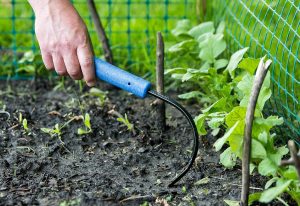
CobraHead describes its tools as being developed by gardeners drawing on seasons of practical gardening experience. This emphasis on real-world use may appeal to buyers who prefer equipment designed around the everyday demands of maintaining a garden.
A tool intended for repeated use should offer a practical balance of handling, functionality, and durability. The CobraHead’s curved blade and universal grip are central elements of its design, giving it a recognizable profile compared with more conventional hand weeders.
While a manufacturer’s design philosophy can help explain a product’s intended purpose, it is not a substitute for evaluating its actual suitability for your garden. Soil type, weed characteristics, comfort, and maintenance remain important factors in deciding whether this tool is right for you.
Best for: Gardeners who value purpose-designed tools informed by practical gardening experience.
10. Made in the USA
According to the supplied listing, CobraHead’s gardening tools are crafted in Cambridge, Wisconsin, in the United States. For some shoppers, the stated manufacturing location may be a useful consideration when comparing products from different brands.
The product also combines alloy steel with a recycled plastic handle, offering a relatively straightforward material combination for a manual garden tool.
If domestic manufacturing is important to your purchasing decision, the stated location is worth noting. However, the supplied details do not specify the origin of every raw material or component, so the manufacturing location should not be interpreted as proof that every part is sourced domestically.
Best for: Buyers who value the stated US manufacturing location when choosing gardening tools.
Pros and Cons of CobraHead Original Weeder & Cultivator
Every gardening tool has strengths and limitations. Here’s how the CobraHead compares based on the supplied product information.
| Pros | Cons |
|---|---|
| Curved blade is designed to work through soil around weeds | Exact blade dimensions and maximum working depth are not provided |
| Tempered-steel construction is intended for gardening use | Exact steel grade and hardness are unspecified |
| Very lightweight at a listed 1.76 ounces | Lightweight construction does not remove the effort needed for stubborn weeds |
| Universal grip is designed for left- and right-handed users | Individual comfort may vary with hand size and grip preference |
| Recycled plastic handle | Percentage and type of recycled plastic are not specified |
| Manual operation requires no batteries, fuel, or electricity | Large, heavily infested areas may require more efficient tools |
| Designed for beginners and experienced gardeners | Users may need time to become familiar with the curved blade |
| Stated US manufacturing location in Cambridge, Wisconsin | Current warranty details are not included in the supplied information |
Who Should Buy CobraHead Original Weeder & Cultivator?
The CobraHead Original Weeder & Cultivator is worth considering if you’re looking for a compact, manual tool that can help with targeted weeding and small-scale cultivation. Its curved tempered-steel blade and universal grip give it a distinct design compared with more traditional hand weeders.
You may appreciate this tool if you:
-
Want a lightweight gardening tool: Its listed weight of 1.76 ounces makes it easy to carry between different areas of the garden.
-
Prefer targeted weed removal: The curved blade is designed to work into the soil around individual weeds.
-
Need a tool for smaller garden tasks: It may be useful for localized weeding and light soil cultivation where larger equipment would be cumbersome.
-
Want a tool suitable for either hand: The universal grip accommodates left- and right-handed users.
-
Prefer manual gardening equipment: No batteries, fuel, or electricity are required.
-
Appreciate recycled materials: The handle is made from recycled plastic, although the precise recycled-content percentage is not specified.
-
Are new to gardening or have years of experience: The tool is marketed for gardeners across a range of experience levels.
For the best results, work carefully around desirable plants, choose a tool movement that suits the soil, and clean the blade after use.
Who Should Consider Another Weeding Tool?
Although the CobraHead offers several attractive features, it may not be the best choice for every gardening situation.
Consider another tool if:
-
You need to clear a large area quickly: A long-handled hoe or larger cultivator may be more efficient for extensive weed growth.
-
You frequently tackle deeply rooted or established weeds: Some weeds may require a specialized root extractor or a longer tool designed for deeper access.
-
You need a tool for extensive digging: The supplied information does not establish the CobraHead’s suitability for heavy-duty digging or breaking up compacted ground.
-
You prefer a conventional straight blade: The curved head has a distinctive working style that may take some getting used to.
-
You need verified measurements before purchasing: The supplied specifications do not include overall dimensions, blade length, or working depth, which may matter for certain tasks.
In these situations, a long-handled weeder, a traditional hand trowel, a narrow root-removal tool, or a garden hoe may complement or better suit your existing gardening routine.
Final Verdict: Is CobraHead Original Weeder & Cultivator Worth Considering?
The CobraHead Original Weeder & Cultivator offers a distinctive approach to everyday weeding through its curved, tempered-steel blade, lightweight construction, and universal grip. Its manual operation keeps it simple to use without batteries or fuel, while the recycled plastic handle and stated US manufacturing location may appeal to buyers who consider materials and manufacturing origin when choosing tools.
Its strongest selling points are its focused blade design, portability, and flexibility for left- and right-handed users. It is particularly worth considering for gardeners who want a compact implement for working around individual weeds and performing small-scale soil cultivation.
The main consideration is whether its design matches your gardening needs. It is not automatically the best choice for large-scale weed clearing, deep-rooted plants, or heavy digging, and the supplied listing does not provide enough detail to establish its performance in every soil type.
Overall, the CobraHead Original Weeder & Cultivator is worth considering if you want a lightweight, manually operated hand tool for targeted weeding and light cultivation. Its unusual curved blade sets it apart from conventional weeders, making it a useful option to compare with the other tools in this roundup.
Affiliate disclosure: As an Amazon Associate, I earn from qualifying purchases. This means I may receive a commission when you purchase through qualifying links in this article, at no additional cost to you.
5. Fiskars FiberComp Hand Cultivator Review – A Lightweight Garden Tool for Loosening Soil, Removing Weeds & Aerating Garden Beds
Maintaining healthy garden soil is one of the most important steps toward growing thriving flowers, vegetables, and other plants. Over time, soil can become compacted, weeds can begin competing with desirable plants, and the ground around established beds may need occasional loosening to support routine garden maintenance. Having a dependable hand cultivator makes these tasks easier to manage, especially when you want to work directly around plants without bringing out larger gardening equipment. The Fiskars FiberComp Cultivator is designed to help with these everyday jobs through a lightweight construction and a practical tine-based design.
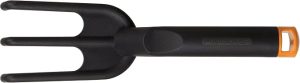
Fiskars is known for producing gardening and yard tools intended to make outdoor maintenance more convenient, and this cultivator follows that approach with its FiberComp construction. According to the supplied product information, the material is designed to provide lightweight handling while offering strength and durability for repeated gardening tasks. Its large tines are intended to make broad contact with the soil, helping you loosen the ground, remove weeds, and aerate garden beds more efficiently.
One of the tool’s standout features is its one-piece construction. Unlike tools assembled from several components that may loosen over time, the Fiskars FiberComp Cultivator is designed without a separate neck connection that could become a weak point during digging. This construction is intended to help prevent loosening, bending at the neck, or breakage during normal use. For gardeners who regularly cultivate flower beds, vegetable patches, or small planting areas, this design may offer reassuring simplicity.
Another attractive feature is its manual operation. The cultivator does not require batteries, electricity, or fuel, so it can be used whenever your garden needs attention. Its lightweight design may also make it easier to maneuver around plants and carry between different garden beds. Additionally, the supplied listing states that the tool comes with a lifetime warranty, which may be reassuring for buyers looking for a gardening implement they can keep in their toolkit over the long term. Warranty conditions should still be checked before purchase.
However, the FiberComp Cultivator is a hand tool intended for relatively focused gardening tasks rather than large-scale soil preparation. Its suitability will depend on the size of your garden, the condition of your soil, and the amount of effort required to loosen the ground. The supplied specifications also list a weight of just 8.53 grams, which is unusually low for a hand cultivator; it is worth verifying this figure against the current product listing before relying on it when comparing tools.
In this detailed review, we’ll explore the Fiskars FiberComp Cultivator’s specifications, key features, advantages, and limitations to help you determine whether it is a suitable addition to your gardening toolkit.
Key Specifications of Fiskars FiberComp Cultivator
Here’s an overview of the product’s main specifications based on the details provided.
| Specification | Details |
|---|---|
| Brand | Fiskars |
| Product Type | Hand cultivator |
| Color | Black |
| Material | FiberComp |
| Power Source | Manual |
| Item Weight | 8.53 g (as listed; verify with the retailer) |
| Tine Design | Large tines for increased soil contact |
| Construction | One-piece design |
| Primary Uses | Loosening soil, removing weeds, and aerating soil |
| Included Item | One Fiskars FiberComp Cultivator |
| Warranty | Lifetime warranty, according to the supplied listing |
Note: The supplied product details do not specify the cultivator’s overall dimensions, number of tines, working width, or recommended maximum soil hardness. Check the current product listing for additional specifications and warranty terms.
10 Key Features of Fiskars FiberComp Cultivator
1. Versatile Tool for Everyday Garden Maintenance
The Fiskars FiberComp Cultivator is designed to handle several routine gardening tasks with a single hand tool. Its main uses include loosening soil, removing weeds, and aerating the ground around plants.
Loosening the soil can help you work the surface of garden beds before planting or maintain areas that have become compacted through regular use. The cultivator’s tines can also help disturb the soil around unwanted plants, making it easier to loosen weeds and work them free.
For gardeners who prefer keeping their tool collection simple, having one implement that supports multiple maintenance tasks can be convenient. Instead of switching between several tools for every small job, you can use the cultivator for suitable light-duty work around flower beds and vegetable patches.
However, the tool is not necessarily a replacement for a larger garden fork or powered cultivator when preparing extensive areas or working with heavily compacted ground.
Best for: Home gardeners who need one hand tool for loosening soil, removing weeds, and aerating smaller garden areas.
2. Large Tines for Greater Soil Contact
One of the key design features highlighted in the product listing is its large tines. These are intended to provide maximum contact with the soil, helping gardeners work more efficiently during cultivation.
Tines are the working parts of a cultivator that enter and disturb the ground. Their shape and arrangement influence how the tool interacts with soil, breaks up surface crusting, and loosens material around plants. The larger tines on this Fiskars model are intended to make soil contact more effective during routine gardening work.
This can be useful when preparing a planting bed, loosening the surface around established plants, or disturbing soil around weeds. However, actual performance will depend on soil texture, moisture, and how compacted the ground has become.
For the best experience, start with manageable sections and avoid forcing the tool into ground that is too hard for comfortable manual cultivation.
Best for: Gardeners who want a hand cultivator designed for efficient soil contact during everyday maintenance.
3. FiberComp Construction for Lightweight Handling
The Fiskars FiberComp Cultivator uses FiberComp as its stated construction material. According to the supplied listing, this material is designed to combine lightweight handling with durability for long-term gardening use.
Weight can make a difference when you’re working repeatedly around several garden beds. A tool that is easy to lift and reposition may feel more manageable during short maintenance sessions, particularly when you’re alternating between loosening soil, removing weeds, and working around individual plants.
Fiskars also describes FiberComp as stronger than steel, but this is a manufacturer claim rather than a universal comparison that applies to every type of steel or every working condition. The practical takeaway is that the tool is designed to offer a combination of low weight and strength.
Because the supplied weight of 8.53 grams appears unusually low for this type of tool, confirm the actual weight with the retailer if weight is a deciding factor in your purchase.
Best for: Gardeners who value a lightweight hand tool designed for regular garden maintenance.
4. One-Piece Construction for Added Reliability
The cultivator features a one-piece design intended to reduce common structural weaknesses associated with tools that have separate handle and head connections.
On some gardening tools, the junction between the handle and working head can become loose or damaged after repeated digging or twisting. Fiskars states that this cultivator’s construction is designed to avoid loosening, bending at the neck, or breaking while digging.
This can be a useful consideration if you regularly maintain flower beds or vegetable patches and want a tool with a straightforward structure. Fewer separate connections may also mean fewer areas where looseness can develop during normal use.
Nevertheless, one-piece construction does not make any tool indestructible. Applying excessive force, using the cultivator for tasks beyond its intended purpose, or storing it carelessly can still lead to damage.
Best for: Gardeners who want a simple cultivator designed to withstand routine digging and soil-loosening tasks.
5. Helps Loosen Soil Around Plants
Soil can become firm or compacted around garden beds, especially in areas that experience regular foot traffic or repeated watering. The Fiskars FiberComp Cultivator is designed to help loosen the ground, making it a useful option for small-scale cultivation.
Working the soil’s surface can make routine planting and garden maintenance easier. You can use the cultivator to disturb the ground in preparation for planting or to loosen soil around established plants where a larger tool would be awkward to maneuver.
When working around existing flowers, vegetables, or seedlings, use controlled movements and avoid digging too deeply near their roots. The goal is to loosen the soil without unnecessarily disturbing the plants you want to keep.
For extensive soil preparation or deeply compacted ground, a larger digging tool may be more suitable.
Best for: Gardeners who need to loosen soil in small beds and around established plants.
6. Useful for Removing Weeds
Weeds compete with desirable plants for space, water, light, and nutrients. Regular removal can help keep garden beds tidy and reduce unwanted growth before it becomes more difficult to manage.
The Fiskars FiberComp Cultivator is intended to assist with weed removal by disturbing the soil around unwanted plants. Its tines can help loosen the surrounding ground, making it easier to work at the base of weeds rather than simply pulling at their leaves.
This can be particularly helpful for small weeds in cultivated garden beds. However, the cultivator is not described as a specialized deep-root extractor, so it may not remove every part of a weed’s root system. Deep-rooted or spreading weeds may require a dedicated weeding knife or root-removal tool.
For best results, work carefully around desirable plants and remove weeds before they become firmly established.
Best for: Gardeners who want a multipurpose hand cultivator to help loosen and remove weeds in garden beds.
7. Supports Soil Aeration
Aeration involves creating spaces in the soil to improve its structure and reduce surface compaction. The Fiskars FiberComp Cultivator is listed as suitable for aerating soil, giving it another practical use beyond basic weeding and cultivation.
Its tines can disturb the soil as you work through a garden bed, helping loosen the surface and improve its texture. This can be useful in planting areas where the top layer has become firm or where you want to prepare the ground before sowing or transplanting.
However, hand cultivation should not be confused with deep mechanical aeration. The supplied listing does not specify the working depth of the tines, so the tool’s suitability for deeper aeration cannot be established from the available details.
When cultivating around established plants, use shallow, controlled movements to avoid damaging roots near the soil surface.
Best for: Gardeners who want to loosen and aerate the surface of small planting areas manually.
8. Manual Operation for Convenient Use
The Fiskars FiberComp Cultivator is manually operated, so you don’t need electricity, batteries, or fuel to use it. This keeps it straightforward to pick up whenever you notice weeds, compacted soil, or an area that needs attention.
Manual tools are particularly convenient for small gardens because they require little preparation. You can move between flower beds, containers, and vegetable patches without setting up powered equipment.
The absence of a motor also means you don’t have to maintain electrical components or recharge a battery. Routine care is primarily focused on cleaning the working head and storing the tool properly.
Of course, manual operation means that cultivation depends on your own effort. Larger areas or very hard soil can still require considerable work, and a larger implement may be more efficient for those tasks.
Best for: Gardeners who prefer simple, ready-to-use tools for regular maintenance.
9. Designed as Part of Fiskars’ Gardening Tool Range
Fiskars describes its garden and yard tools as incorporating practical technologies and ergonomic features intended to make outdoor work easier and more enjoyable. The FiberComp Cultivator fits into that broader approach by combining a lightweight material design with a working head intended for several common garden tasks.
For shoppers building a gardening toolkit, choosing tools from an established gardening brand can make it easier to compare product styles and intended uses. However, brand reputation should be considered alongside the specific tool’s construction, comfort, and suitability for your garden.
The supplied information does not provide independent test results or detailed ergonomic measurements for this particular model, so it is best to evaluate the product according to its stated features rather than assuming all Fiskars tools perform identically.
Best for: Gardeners who are comparing practical hand tools from established gardening brands.
10. Lifetime Warranty for Added Peace of Mind
The supplied product listing states that the Fiskars FiberComp Cultivator is backed by a lifetime warranty. For buyers planning to use the tool regularly, warranty coverage may be an important part of the purchase decision.
A warranty can provide reassurance that the manufacturer offers support under the conditions specified in its policy. This is particularly relevant for a hand tool that may be used repeatedly during seasonal planting, weeding, and garden maintenance.
However, warranty terms can include limitations, exclusions, or requirements concerning normal use and product condition. The listing’s lifetime-warranty statement should therefore be checked against Fiskars’ current official warranty policy before purchase.
Best for: Gardeners who value stated long-term warranty coverage when choosing a hand tool.
Pros and Cons of Fiskars FiberComp Cultivator
Every gardening tool has strengths and limitations. Here’s how the Fiskars FiberComp Cultivator compares based on the supplied product details.
| Pros | Cons |
|---|---|
| Designed for loosening soil, removing weeds, and aerating garden beds | Not intended to replace larger tools for extensive cultivation |
| Large tines are designed to provide substantial soil contact | Tine count, width, and working depth are not specified |
| FiberComp construction is designed for lightweight handling | Listed weight of 8.53 g should be verified with the retailer |
| One-piece design is intended to reduce loosening and neck breakage | One-piece construction does not prevent all possible damage |
| Manual operation requires no batteries, fuel, or electricity | Larger areas and hard soil still require physical effort |
| Suitable for a range of routine gardening tasks | Deep-rooted weeds may require a specialized weeding tool |
| Listing states that it includes a lifetime warranty | Warranty eligibility and exclusions should be checked |
Who Should Buy Fiskars FiberComp Cultivator?
The Fiskars FiberComp Cultivator is worth considering if you want a manual tool for routine soil maintenance without the bulk of larger garden equipment. Its combination of large tines, one-piece construction, and FiberComp material makes it a practical candidate for smaller cultivation tasks.
You may appreciate this tool if you:
-
Maintain flower beds or vegetable patches: It is designed to help loosen soil and remove weeds in cultivated areas.
-
Want to aerate the soil surface: The tines can disturb the ground during routine cultivation.
-
Prefer a lightweight tool: FiberComp construction is intended to make handling easier, although the listed weight should be verified.
-
Value a straightforward design: The one-piece construction is intended to avoid loosening at a separate neck connection.
-
Prefer manual gardening equipment: No batteries, fuel, or electricity are required.
-
Want a multipurpose cultivator: It is designed to support loosening soil, weeding, and aeration.
-
Consider warranty coverage important: The supplied listing states that the tool comes with a lifetime warranty, subject to the applicable terms.
For the best results, use the cultivator for tasks suited to its size, work carefully around plant roots, and avoid applying excessive force when the ground is heavily compacted.
Who Should Consider Another Cultivator?
Although the Fiskars FiberComp Cultivator offers several useful features, it may not be the right fit for every garden.
Consider another tool if:
-
You need to cultivate a large area: A long-handled cultivator, garden fork, or powered implement may cover more ground with less repetitive effort.
-
Your soil is heavily compacted: A small hand cultivator may struggle with hard ground that requires a stronger digging tool.
-
You need to extract deep-rooted weeds: A dedicated root weeder or long-handled weed puller may be better suited to that job.
-
You need precise product measurements before buying: The supplied information does not include overall dimensions, tine count, or working width.
-
You are comparing tools by weight: Verify the listed 8.53-gram figure, as it appears unusually low for a hand cultivator.
In these situations, a larger cultivator, a traditional hand fork, a specialized root weeder, or a combination of tools may be more suitable.
Final Verdict: Is Fiskars FiberComp Cultivator Worth Considering?
The Fiskars FiberComp Cultivator is designed as a practical manual tool for three important gardening tasks: loosening soil, removing weeds, and aerating garden beds. Its large tines are intended to increase soil contact, while its one-piece construction is designed to reduce the risk of loosening or breakage around the neck. The FiberComp material is also marketed as a lightweight yet durable option for regular garden use.
Its main appeal is versatility. Rather than serving only as a dedicated weed puller or soil-loosening implement, it is intended to help with several everyday garden maintenance jobs. The manual design makes it convenient for quick tasks, and the lifetime warranty stated in the supplied listing may provide additional reassurance for buyers who plan to keep the tool for years.
The main considerations are the tool’s size and intended workload. It is best viewed as a hand cultivator for focused gardening tasks rather than a replacement for larger equipment used to prepare extensive areas or break up very compacted soil. The unusually low listed weight of 8.53 grams should also be verified before purchasing.
Overall, the Fiskars FiberComp Cultivator is worth considering if you want a multipurpose hand tool for loosening soil, removing weeds, and aerating smaller garden beds. Its one-piece design and lightweight-material focus make it an interesting option for gardeners who value convenience and straightforward maintenance tools.
Affiliate disclosure: As an Amazon Associate, I earn from qualifying purchases. This means I may receive a commission when you purchase through qualifying links in this article, at no additional cost to you.
6. PERWIN Hori Hori Garden Knife Review – A Versatile Gardening Tool for Digging, Transplanting, Root Cutting & Outdoor Tasks
Gardening often requires more than a simple trowel or a pair of pruning shears. Whether you’re planting new flowers, transplanting seedlings, dividing established plants, or tackling stubborn roots, having a versatile hand tool can make everyday garden work considerably easier. The PERWIN Hori Hori Garden Knife is designed to bring several of these functions together in one practical implement, combining a digging blade, a cutting edge, a serrated edge, and depth measurements to support a wide range of gardening tasks.
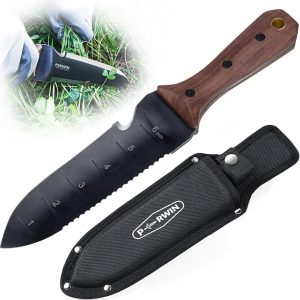
Inspired by the traditional Japanese hori hori garden knife design, this tool is intended to do more than cut. Its curved stainless steel blade can help loosen soil and dig planting holes, while the sharp edge is suited to slicing and the serrated edge is designed to cut through tougher roots. The blade also includes measurements in inches, allowing you to check planting depth when positioning bulbs, seedlings, and other plants that need to be placed at a particular depth.
One of the most appealing aspects of the PERWIN model is its combination of a stainless steel blade and a walnut wood handle. The listing describes the blade as rust-resistant and extending through the handle in a full-tang construction. Three metal rivets reinforce the handle assembly, helping secure the blade in place during use. For gardeners who want a substantial hand tool for repeated digging and cutting tasks, this construction may be an important consideration.
The knife also comes with a protective sheath featuring a belt loop, making it easier to carry the tool during gardening sessions and store it safely when not in use. Its listed overall length of 12.1 inches, including a 7-inch blade, provides a useful balance between reach and maneuverability for many small-scale gardening jobs.
Beyond the garden, the manufacturer presents the PERWIN Hori Hori as a potentially useful companion for activities such as fishing and camping. Its multifunction design includes a cord-cutting edge that also serves as a bottle opener. However, its primary purpose remains practical garden work, and the additional features should be considered secondary to its suitability for digging, cutting, and planting.
In this detailed review, we’ll examine the PERWIN Hori Hori Garden Knife’s specifications, key features, advantages, and limitations to help you decide whether it deserves a place in your gardening toolkit.
Key Specifications of PERWIN Hori Hori Garden Knife
Here’s a quick overview of the product’s main specifications based on the supplied listing.
| Specification | Details |
|---|---|
| Brand | PERWIN |
| Model Name | Hori Hori Garden Knife |
| Product Type | Multifunction garden knife |
| Recommended Use | Carving, digging, planting, cutting, and other gardening tasks |
| Blade Material | Stainless steel |
| Handle Material | Walnut wood |
| Overall Length | 12.1 inches |
| Blade Length | 7 inches |
| Special Feature | Rust-resistant blade |
| Construction | Full-tang design |
| Handle Reinforcement | Three metal rivets |
| Blade Design | Curved blade with sharp and serrated edges |
| Measurement Feature | Depth markings in inches |
| Included Components | Protective sheath with belt loop |
| Color/Variant Listed | Single Head |
| Style | Modern |
| Intended Age Range | Adults |
Note: The supplied information does not specify the exact stainless steel grade, blade thickness, total weight, or warranty terms. The listing describes the blade as rust-resistant, but stainless steel still benefits from cleaning and drying after use.
10 Key Features of PERWIN Hori Hori Garden Knife
1. Multifunction Design for Everyday Gardening
One of the main attractions of the PERWIN Hori Hori Garden Knife is its versatility. Rather than serving a single purpose, it is designed to support several common gardening tasks, including digging, transplanting, sawing, cutting, removing unwanted growth, and dividing plants.
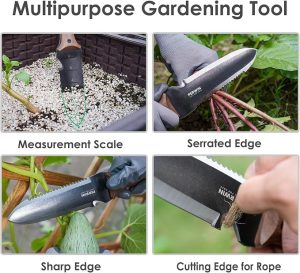
This versatility can be especially useful for gardeners who regularly move between different tasks. You might use a trowel to prepare a planting hole, a knife to trim a root, and another tool to cut through tough plant material. A hori hori knife combines several of these functions in one implement, potentially reducing the number of tools you need to carry around the garden.
Its curved blade is intended to assist with digging, while the different cutting edges support slicing and sawing tasks. The depth markings add another practical function when planting bulbs or seedlings.
However, multifunctionality does not mean the knife can replace every specialist gardening tool. Larger digging jobs, thick branches, and extensive soil preparation may still require dedicated equipment.
Best for: Gardeners who want one hand tool for a variety of planting, digging, cutting, and transplanting tasks.
2. Stainless Steel Blade With Rust-Resistant Properties
The PERWIN Hori Hori Garden Knife features a stainless steel blade described by the manufacturer as rust-resistant. This is an important feature for a gardening tool that regularly comes into contact with damp soil, plant sap, moisture, and organic material.
Stainless steel is commonly used in gardening equipment because it can offer useful resistance to corrosion when properly maintained. For the PERWIN knife, this material is intended to support repeated digging and cutting while helping the blade withstand typical outdoor gardening conditions.
However, rust-resistant does not mean rust-proof. Exposure to moisture, fertilizers, soil residues, or other corrosive substances can still affect a blade over time, depending on its precise steel composition and maintenance.
To help preserve the blade, remove soil and plant residue after use, dry it thoroughly, and store it in a sheltered location. These simple habits can help maintain the knife’s condition and readiness for future gardening tasks.
Best for: Gardeners who want a steel-bladed hand tool designed to resist corrosion during routine outdoor use.
3. Curved Blade for Digging and Planting
Unlike a conventional straight utility knife, the PERWIN Hori Hori has a curved blade designed to support digging and other soil-related tasks. This shape can be useful when creating small planting holes, loosening soil around plants, or working around roots.
The curved profile gives the knife a more specialized gardening function than a general-purpose cutting tool. You can use it to work into the soil, lift small amounts of earth, and help prepare spaces for bulbs, seedlings, or other plants.
For transplanting, the blade may also help loosen the soil around a plant before you lift it from its original position. Careful handling is important, particularly when working around delicate roots or established plants that you want to preserve.
Although the knife can assist with digging, its 7-inch blade is intended for hand-scale tasks rather than extensive excavation. A traditional spade or garden fork will generally be more appropriate for larger areas.
Best for: Gardeners who need a compact digging blade for planting holes, transplanting, and localized soil work.
4. Sharp Edge for Slicing and Cutting
The PERWIN Hori Hori features a sharp blade edge designed for slicing and cutting. This gives it a practical role beyond digging, allowing gardeners to trim suitable plant material, cut through smaller roots, and perform other controlled cutting tasks.
A dedicated cutting edge can be useful when preparing plants for transplanting or removing unwanted growth that cannot be easily pulled away by hand. It also adds versatility for routine gardening situations where carrying several separate tools would be inconvenient.
Because the blade is sharp, safe handling is essential. Always cut away from your body and keep your fingers clear of the cutting path. Avoid using the knife for tasks that exceed its intended capabilities, and store it in its protective sheath when not in use.
The supplied information does not specify the blade’s sharpening angle or edge-retention performance, so long-term sharpness will depend on the blade’s condition and appropriate maintenance.
Best for: Gardeners who need a cutting edge for routine plant preparation and suitable small-scale trimming tasks.
5. Serrated Edge for Tough Roots
In addition to its sharp edge, the PERWIN Hori Hori includes a serrated edge intended to help cut through tougher roots. This feature can be useful when dealing with root material that is difficult to slice cleanly with a smooth edge.
For example, during transplanting or plant division, you may encounter roots that resist gentle separation. The serrated edge is designed to help saw through such material, giving the knife another function beyond digging and slicing.
This can make the tool more adaptable for gardeners who work with a range of plants and frequently need to loosen, divide, or remove unwanted growth.
However, not every root is suitable for cutting with a hand knife. Thick, woody roots may require a more robust tool, and cutting healthy roots unnecessarily can harm the plant. Use the serrated edge selectively and carefully.
Best for: Gardeners who need a serrated cutting edge for suitable roots and other tough plant material.
6. Full-Tang Construction for Structural Support
The product listing states that the PERWIN Hori Hori has a full-tang design, meaning the blade’s metal extends through the handle rather than being attached only at a small connection point.
This construction is often valued in hand tools because it can provide a more continuous structural connection between the blade and handle. For a gardening knife that may be used for digging, cutting, and working against soil resistance, the construction is an important consideration.
The manufacturer describes the full-tang design as contributing to the knife’s strength during demanding use. Three metal rivets also reinforce the handle assembly, helping secure the wooden handle around the blade.
Nevertheless, full-tang construction does not make a tool indestructible. Excessive prying, twisting, or using the blade as a lever can still cause damage. For best results, use the knife for its intended digging and cutting functions rather than forcing it through tasks better suited to larger equipment.
Best for: Gardeners who value a reinforced blade-and-handle construction for regular hand-tool use.
7. Walnut Wood Handle for Grip and Control
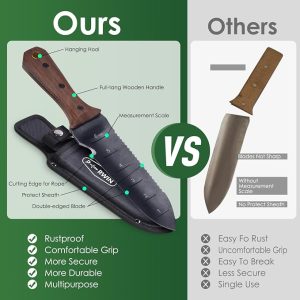
The PERWIN Hori Hori features a walnut wood handle designed to provide a comfortable grip during gardening tasks. The handle material gives the knife a traditional appearance while offering a solid surface to hold as you dig, cut, or work around plants.
A suitable handle is important for a multifunction gardening knife because the tool may be used in different positions and for tasks requiring varying levels of control. The manufacturer describes the handle as ergonomically designed to help improve grip and reduce effort during use.
The three metal rivets help secure the handle assembly, while the full-tang construction is intended to support the connection between the blade and handle.
Comfort will still vary according to hand size, grip preference, and the task being performed. Because walnut is a natural material, it is sensible to keep the handle clean and avoid prolonged exposure to moisture when possible.
Best for: Gardeners who prefer a wooden handle and want a hand tool designed for controlled digging and cutting.
8. Inch Markings for Measuring Planting Depth
The PERWIN Hori Hori includes depth measurements in inches along its blade. This feature can be useful when planting bulbs, seedlings, and other plants that need to be placed at an appropriate depth.
Planting too shallowly or too deeply can affect how a plant establishes itself, so having measurements directly on a tool can make it easier to estimate the depth of a planting hole without reaching for a separate ruler.
During planting, you can use the markings as a quick reference while working the blade into the soil. This is particularly convenient when planting several bulbs or seedlings and trying to maintain reasonably consistent depths across a bed.
The supplied information does not specify the exact measurement range or marking intervals, so consult the blade markings themselves when using the tool for a particular planting requirement.
Best for: Gardeners who want a built-in depth reference when planting bulbs, seedlings, and other garden plants.
9. Protective Sheath With Belt Loop
The PERWIN Hori Hori comes with a protective sheath designed to cover the blade when the knife is not being used. The sheath includes a belt loop, allowing you to carry the tool while moving around the garden.
This is a useful accessory for a knife with both sharp and serrated edges. Covering the blade helps prevent accidental contact during storage and transport, while the belt loop can keep the tool accessible during gardening sessions.
The handle also includes a hanging hole, according to the supplied listing, allowing you to hang the knife in a garage, shed, or tool room when it is not in use.
For safe storage, make sure the blade is clean and dry before placing it in the sheath. Store the knife securely and out of reach of children, and avoid carrying it loosely in a bag where the blade could become exposed.
Best for: Gardeners who want a dedicated blade cover and a convenient way to carry or store their knife.
10. Additional Utility for Outdoor Activities
Although the PERWIN Hori Hori is primarily a gardening tool, the manufacturer also presents it as useful for activities such as fishing and camping. Its combination of a digging blade, cutting edges, and other features may make it a versatile companion for some outdoor tasks.
The listing also mentions a cord-cutting edge that doubles as a bottle opener. This adds another function to the knife, although it should be viewed as a secondary convenience rather than the main reason to buy it.
For gardeners who also enjoy camping or other outdoor activities, a multifunction tool can reduce the number of separate implements they need to pack. However, the knife’s suitability will depend on the specific task, and it should always be handled and stored safely.
Its primary strength remains its ability to combine several gardening functions in one hand tool.
Best for: Gardeners who also enjoy outdoor activities and appreciate additional utility in a multifunction tool.
Pros and Cons of PERWIN Hori Hori Garden Knife
Every gardening tool has strengths and limitations. Here’s how the PERWIN Hori Hori compares based on the supplied product information.
| Pros | Cons |
|---|---|
| Combines digging, transplanting, cutting, sawing, and other gardening functions | May not replace specialized tools for every task |
| Stainless steel blade is described as rust-resistant | Exact steel grade and corrosion-resistance rating are unspecified |
| Sharp and serrated edges support different cutting tasks | Requires careful handling because the blade has sharp edges |
| Full-tang construction is intended to provide structural strength | Excessive prying or twisting can still damage the tool |
| Walnut wood handle offers a traditional grip | Natural wood requires sensible care and dry storage |
| Inch markings help estimate planting depth | Exact measurement range and marking intervals are not specified |
| Includes a protective sheath with a belt loop | Blade must be cleaned and dried before storage |
| Handle includes a hanging hole for storage | Total weight and warranty details are not provided |
Who Should Buy PERWIN Hori Hori Garden Knife?
The PERWIN Hori Hori Garden Knife is worth considering if you want a multifunction hand tool that combines digging, planting, cutting, and root-related tasks in one implement.
You may appreciate this knife if you:
-
Regularly plant bulbs and seedlings: The curved blade can assist with digging, while the inch markings provide a convenient depth reference.
-
Need a tool for transplanting: Its digging and cutting functions can help loosen soil and work around plants.
-
Deal with tough roots: The serrated edge is designed to help cut through suitable root material.
-
Prefer a reinforced blade-and-handle design: The full tang and three metal rivets are intended to provide a secure construction.
-
Like traditional wooden handles: The walnut wood handle offers an alternative to all-plastic grips.
-
Want a multifunction gardening tool: Its combination of digging, slicing, sawing, and measuring features can reduce the need to carry several tools.
-
Value convenient storage and carrying: The included sheath, belt loop, and hanging hole provide several storage options.
For the best experience, use the blade only for suitable tasks, maintain a secure grip, and store the knife in its sheath when it is not in use.
Who Should Consider Another Garden Tool?
Although the PERWIN Hori Hori is versatile, it may not be the best choice for every gardener.
Consider another tool if:
-
You primarily need to prune branches: Dedicated pruning shears or loppers are more appropriate for cutting woody stems and branches.
-
You need to prepare large areas of soil: A spade, garden fork, or larger cultivator will generally be more efficient for extensive digging.
-
You prefer a tool without a sharp blade: The Hori Hori requires careful handling and secure storage, particularly in households with children.
-
You want a tool for very thick roots: A hand knife may not be suitable for large, woody roots that require heavier equipment.
-
You prefer low-maintenance synthetic handles: The walnut wood handle may need more attention to keep it in good condition.
-
You need exact technical specifications before purchasing: The supplied details do not state the steel grade, blade thickness, total weight, or warranty coverage.
In these situations, a dedicated garden trowel, root weeder, pruning tool, or larger digging implement may be a better match for your needs.
Final Verdict: Is PERWIN Hori Hori Garden Knife Worth Considering?
The PERWIN Hori Hori Garden Knife offers a versatile combination of digging, cutting, sawing, and planting features in one hand tool. Its 7-inch stainless steel blade, curved profile, inch markings, and serrated edge are intended to support a range of gardening tasks, from transplanting seedlings to working around tougher roots. The full-tang construction, three reinforcing rivets, and walnut wood handle also give the tool a solid, traditional design.
Its included sheath is another practical advantage, providing a protective cover for the blade and a belt loop for convenient carrying. The handle’s hanging hole also makes storage easier when the knife is not in use.
The main consideration is that versatility comes with responsibility. The blade has sharp and serrated edges, so careful handling, proper cleaning, and secure storage are essential. It is also a hand-scale gardening tool rather than a replacement for larger equipment used for extensive digging or heavy-duty cutting.
Overall, the PERWIN Hori Hori Garden Knife is worth considering if you want a multifunction gardening tool for digging, transplanting, measuring planting depth, and cutting suitable roots. Its combination of a rust-resistant stainless steel blade, walnut wood handle, reinforced construction, and protective sheath makes it a useful option for gardeners who prefer one versatile tool for several everyday tasks.
Affiliate disclosure: As an Amazon Associate, I earn from qualifying purchases. This means I may receive a commission when you purchase through qualifying links in this article, at no additional cost to you.
Also read : 10 Best Gardening Hand Tools – Top Picks for Planting, Pruning, Weeding & Everyday Garden Care
7. COOLJOB Gardening Gloves Review – Best Breathable Garden Gloves for Planting, Weeding & Everyday Outdoor Work
Gardening can be a rewarding way to spend time outdoors, but working with soil, weeds, rough plant material, and garden equipment can quickly leave your hands dirty and uncomfortable. Whether you’re planting flowers, sowing vegetable seeds, pulling weeds, or harvesting fresh produce, a dependable pair of gardening gloves can help make routine tasks more manageable. The COOLJOB Gardening Gloves for Women are designed to provide a lightweight, flexible option for everyday gardening, combining a breathable knitted base with a latex coating intended to improve grip and help protect the hands from dirt.

One of the most appealing aspects of this set is its six-pair bundle. Rather than purchasing a single pair and having to replace it as soon as it wears out or gets misplaced, you receive six pairs in bright red and mint green. The different colors can make the gloves easier to identify in a garden shed, toolbox, or outdoor workspace. They may also be convenient for households where several people share gardening supplies or where different pairs are reserved for different jobs.
The gloves feature a knitted base designed to provide a comfortable, breathable fit, while the foamed latex coating is intended to offer a non-slip grip during common garden activities. According to the product listing, the coating is soft yet sturdy, helping reduce hand fatigue during tasks such as planting, digging, weeding, and picking fruit or vegetables. The fingertips are reinforced with thicker coating to provide additional protection for the fingers and nails, while the longer, flexible cuffs help keep dirt and debris from entering the gloves.
Another useful feature is their washable design. COOLJOB states that the gloves can be machine-washed on a gentle cycle or hand-washed with mild detergent, making it easier to clean away soil after a busy gardening session. The manufacturer recommends air-drying rather than using electric heat, which is an important care consideration if you want to maintain the gloves’ condition over time.
Although these gloves are marketed especially toward women, their suitability ultimately depends on hand size and fit. This particular bundle is listed in medium, so checking the sizing information before purchasing is important. The latex coating also means that anyone with a known latex allergy should avoid these gloves and choose a suitable alternative.
In this detailed review, we’ll explore the COOLJOB Gardening Gloves’ specifications, key features, advantages, and limitations to help you decide whether this six-pair set is a worthwhile addition to your gardening essentials.
Key Specifications of COOLJOB Gardening Gloves
Here’s an overview of the main specifications based on the supplied product information.
| Specification | Details |
|---|---|
| Brand | COOLJOB |
| Product Type | Gardening gloves |
| Material | Latex |
| Size | Medium |
| Pack Quantity | 6 pairs |
| Colors | Bright red and mint green |
| Special Feature | Breathable construction |
| Base Material | Lightweight knitted fabric |
| Coating | Foamed latex |
| Fingertip Design | Thicker protective coating |
| Cuff Design | Long and flexible |
| Grip | Non-slip coating |
| Washing Method | Machine wash on gentle cycle or hand wash |
| Recommended Water Temperature | Maximum 104°F (40°C) |
| Drying Instructions | Air-dry; avoid electric heat |
| Intended Uses | Gardening, planting, weeding, harvesting, landscaping, and selected DIY tasks |
Note: The supplied information does not specify the exact fabric composition, latex coating thickness, abrasion rating, or cut-resistance rating. These gloves should not be assumed to provide specialized protection against sharp blades, thorns, chemicals, or heavy-duty mechanical hazards.
10 Key Features of COOLJOB Gardening Gloves
1. Breathable Knitted Base for Comfortable Gardening
One of the main features of the COOLJOB Gardening Gloves is their lightweight knitted base. The fabric is designed to provide a comfortable fit while allowing breathability during routine outdoor work.
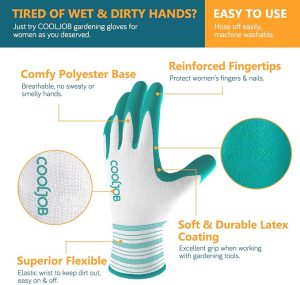
Gardening can involve extended periods of planting, digging, weeding, and harvesting, so gloves that feel overly heavy or restrictive may become uncomfortable. A lightweight knitted construction can make ordinary tasks easier to manage, especially during warmer weather when gardeners want to avoid unnecessarily bulky handwear.
The breathable design is particularly relevant for spring and summer gardening, which the manufacturer highlights as an intended use. However, breathability can vary with the intensity of your activity, the weather, and how snugly the gloves fit.
For the best experience, choose the correct size and remove the gloves periodically if your hands become excessively warm or damp.
Best for: Gardeners who want lightweight gloves for routine planting, weeding, and other everyday outdoor tasks.
2. Foamed Latex Coating for a Non-Slip Grip
The COOLJOB gloves feature a foamed latex coating designed to improve grip while handling garden tools and plant material. A secure grip can be helpful when you’re holding a hand trowel, pulling weeds, moving pots, or gathering vegetables.
The manufacturer describes the coating as soft but sturdy, with a non-slip surface intended to support a variety of activities. This may help you maintain better control of tools during ordinary gardening jobs, particularly when handling objects that might otherwise slip in your hands.
The coating also provides a barrier between your hands and much of the dirt encountered during routine gardening. However, these gloves should not be treated as waterproof or chemical-resistant unless the manufacturer specifically confirms those properties.
Because latex is part of the construction, people with a latex allergy should choose a latex-free alternative.
Best for: Gardeners who want improved grip when handling tools, plants, and everyday gardening materials.
3. Six-Pair Bundle for Better Everyday Value
A major advantage of this COOLJOB set is that it includes six pairs of gloves. For people who garden frequently, having several pairs available can be convenient when one pair becomes dirty, damp, or unavailable.
Instead of stopping work to wash a single pair, you can switch to another clean pair and continue with your gardening routine. A multipack can also be useful for households where family members share gardening responsibilities or where gloves are kept in different locations.
The manufacturer presents the bundle as a value-oriented option for garden and yard work. Whether it offers better value than buying individual pairs will depend on the current purchase price and how often you use the gloves.
The six-pair format may be especially useful for regular gardeners who prefer to keep spare hand protection readily available.
Best for: Frequent gardeners and households that want several pairs of gloves for recurring outdoor tasks.
4. Bright Colors for Easy Identification
The gloves come in bright red and mint green. These contrasting colors give the set a distinctive appearance and can make the gloves easier to spot among garden tools, plant pots, and outdoor supplies.
Misplacing gloves is a common inconvenience when moving between different areas of a garden. Brightly colored handwear may be easier to notice than gloves in muted shades, particularly when placed on a workbench or left near a planting bed.
The different colors may also help distinguish pairs used for different jobs or allow household members to identify their preferred pair. The supplied information does not specify the exact number of pairs in each color, so check the product listing if the color distribution matters to you.
Best for: Gardeners who appreciate colorful gloves that are easier to identify and organize.
5. Thicker Fingertips for Additional Protection
The COOLJOB Gardening Gloves feature thicker coating around the fingertips, which the manufacturer says is intended to protect fingers and nails.
The fingertips are often among the most exposed areas of the hands during gardening. They come into contact with soil, plant stems, small roots, pots, and gardening tools, so additional coating in this area can be a useful design feature.
For routine jobs such as planting seeds, handling seedlings, pulling weeds, and moving garden materials, the reinforced fingertips may offer a helpful extra layer between your skin and the objects you’re handling.
However, the listing does not provide a tested puncture-resistance or cut-resistance rating. The gloves should therefore not be relied upon for protection against sharp thorns, blades, needles, or other hazards that require specialized protective equipment.
Best for: Gardeners who want additional fingertip coverage during ordinary planting and garden maintenance.
6. Long, Flexible Cuffs to Help Keep Dirt Out
Another useful feature is the gloves’ long, flexible cuffs. These are designed to help keep soil and debris from entering around the wrists during gardening.
When you’re reaching into a planting bed, handling loose soil, or pulling weeds, dirt can easily work its way into gloves with short or loose openings. A longer cuff provides additional coverage around the wrist and may help reduce this inconvenience.
The flexible construction is also intended to allow comfortable movement rather than making the wrist feel excessively restricted. This can be useful when switching between tasks that involve gripping tools, handling seedlings, and reaching into garden beds.
The cuffs should not be considered a sealed barrier, however. Fine soil and debris may still enter depending on the fit and the way you move your hands.
Best for: Gardeners who want extra wrist coverage to help reduce dirt entering their gloves.
7. Suitable for Planting, Weeding, and Harvesting
The COOLJOB gloves are designed for several everyday gardening activities, including planting, digging, weeding, seeding, and picking fruits and vegetables.
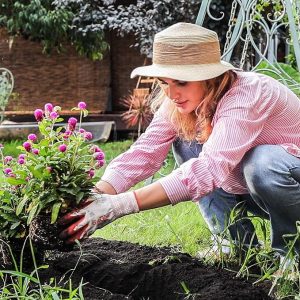
This range of intended uses makes them a practical option for gardeners who move between different tasks throughout the day. You might wear them while preparing soil, switch to planting seedlings, and continue using them when harvesting suitable produce.
The latex coating is intended to improve grip, while the knitted base supports flexibility for routine hand movements. This combination can be convenient for general garden work that requires both handling and control.
For delicate seedlings or very fine tasks, however, glove thickness and fit can affect precision. Some gardeners may prefer thinner gloves or bare hands for particularly intricate work, depending on the task and any necessary hygiene or safety precautions.
Best for: Home gardeners who need multipurpose gloves for planting, weeding, seeding, and harvesting.
8. Soft Coating Designed to Reduce Hand Fatigue
The manufacturer describes the foamed latex coating as soft but sturdy and intended to reduce fatigue during gardening and other manual tasks.
Repeatedly gripping tools, pulling weeds, and handling garden materials can make your hands tired, especially during longer sessions. Gloves that fit well and provide a comfortable grip may help make these activities more manageable.
The lightweight knitted base and flexible coating are designed to support movement without the feel of a heavy, rigid glove. This may be helpful when carrying out routine tasks across several garden beds.
However, gloves alone cannot eliminate hand fatigue. Poor fit, excessive gripping force, repetitive movements, and prolonged work can still cause discomfort. Taking breaks and using tools with suitable handles can also help make gardening more comfortable.
Best for: Gardeners who want flexible gloves for repeated everyday hand movements.
9. Machine-Washable for Convenient Cleaning
The COOLJOB gloves are designed to be washable, which is useful when gardening leaves them covered in soil, dust, and plant residue.
According to the manufacturer, the gloves can be machine-washed on a gentle cycle or cleaned by hand. The recommended maximum water temperature is 104°F (40°C), and mild detergent should be used.
The listing also advises against non-fabric-safe bleach and recommends air-drying rather than using electric heat. Following these instructions may help preserve the knitted base and latex coating over repeated cleaning cycles.
Before washing, remove loose soil and check the gloves for damage. Allow them to dry fully before storing them to help prevent unpleasant odors and keep them ready for the next gardening session.
Best for: Gardeners who want reusable gloves that can be cleaned after dirty outdoor work.
10. Versatile Beyond the Garden
Although the gloves are primarily intended for gardening, the manufacturer also lists other uses, including landscaping, handling boxes in a warehouse, car and motorcycle repairs, driving, and DIY wood carving.
This broader range of intended applications may make the six-pair set useful for people who carry out different household and outdoor tasks. Keeping separate pairs for gardening, garage work, or general handling may also help organize your supplies.
Nevertheless, these gloves are not designed to provide every type of industrial or mechanical protection. The supplied listing does not provide specialist ratings for chemical resistance, cut resistance, heat protection, or heavy-duty abrasion resistance.
For tasks involving sharp machinery, hazardous chemicals, high temperatures, or other specific risks, select gloves rated for the particular hazard rather than relying on general-purpose gardening gloves.
Best for: People who want versatile gloves for gardening and selected light-duty household tasks.
Pros and Cons of COOLJOB Gardening Gloves
Every gardening accessory has strengths and limitations. Here’s how the COOLJOB six-pair set compares based on the supplied product information.
| Pros | Cons |
|---|---|
| Six pairs included in one bundle | Only medium size is specified for this particular set |
| Lightweight knitted base designed for breathability | Fit may not suit every hand size |
| Foamed latex coating designed to improve grip | Not suitable for people with a latex allergy |
| Thicker fingertip coating provides additional coverage | No stated cut- or puncture-resistance rating |
| Long, flexible cuffs help keep dirt and debris out | Cuffs are not a sealed barrier against soil or moisture |
| Bright red and mint green colors are easy to distinguish | Exact number of pairs in each color is not specified |
| Machine-washable or hand-washable according to the listing | Requires appropriate washing and air-drying |
| Suitable for several everyday gardening tasks | Not a substitute for specialized protective gloves |
Who Should Buy COOLJOB Gardening Gloves?
The COOLJOB Gardening Gloves are worth considering if you want a reusable, multipack option for ordinary garden maintenance. Their breathable knitted base, foamed latex coating, reinforced fingertips, and flexible cuffs are designed to balance comfort, grip, and coverage.
You may appreciate this set if you:
-
Garden frequently: Six pairs give you spares when others are dirty or being washed.
-
Plant flowers or vegetables: The gloves are intended for planting, seeding, digging, and routine garden maintenance.
-
Regularly pull weeds: The latex coating is designed to provide a non-slip grip when handling weeds and tools.
-
Want breathable handwear: The lightweight knitted base is intended to provide comfort during everyday work.
-
Prefer gloves with extra fingertip coverage: The thicker coating offers additional protection for fingers and nails during suitable tasks.
-
Want help keeping soil out of your gloves: The long, flexible cuffs provide additional wrist coverage.
-
Prefer reusable gloves: The manufacturer provides washing instructions for hand-washing or machine-washing on a gentle cycle.
Before buying, check that medium is the right size for your hands and consider whether latex is suitable for you.
Who Should Consider Another Pair of Gardening Gloves?
Although the COOLJOB set offers several useful features, it may not be the right choice for everyone.
Consider an alternative if:
-
You have a latex allergy or sensitivity: Choose gloves made from a suitable latex-free material.
-
You need a different size: The supplied bundle is listed as medium, so gardeners with smaller or larger hands may need another option.
-
You work with sharp thorns or blades: The listing does not establish a tested cut- or puncture-resistance rating.
-
You handle hazardous chemicals: Use gloves specifically rated for the chemicals and exposure involved.
-
You need heavy-duty protective equipment: These gloves are presented as general-purpose gardening gloves rather than specialized industrial protection.
-
You need a fully waterproof glove: The supplied information does not establish that the gloves are waterproof.
For these situations, consider a different size, a latex-free alternative, thorn-resistant gloves, or task-specific protective equipment depending on your needs.
Final Verdict: Are COOLJOB Gardening Gloves Worth Considering?
The COOLJOB Gardening Gloves offer a practical combination of comfort-focused features and multipack convenience. Their lightweight knitted base is designed for breathability, while the foamed latex coating provides a non-slip grip for common gardening tasks. Thicker fingertip coverage and longer cuffs add useful design details for handling soil, plants, and garden tools.
The six-pair bundle is a particularly appealing feature for frequent gardeners. Having several pairs available can reduce interruptions when gloves become dirty or need washing, while the bright red and mint green colors make them easier to identify among other gardening supplies. Their washable construction also supports repeated use when cared for according to the manufacturer’s instructions.
The main considerations are sizing and protection limits. The set is listed in medium, so checking the fit is important, and the latex coating makes it unsuitable for anyone with a latex allergy. These are general-purpose gardening gloves, not specialized protection against sharp objects, hazardous chemicals, or heavy-duty workplace hazards.
Overall, the COOLJOB Gardening Gloves are worth considering if you want a colorful, breathable six-pair set for routine planting, weeding, harvesting, and everyday garden maintenance. Their combination of grip, flexible cuffs, reinforced fingertips, and convenient cleaning makes them a useful option for gardeners who want several reusable pairs readily available.
Affiliate disclosure: As an Amazon Associate, I earn from qualifying purchases. This means I may receive a commission when you purchase through qualifying links in this article, at no additional cost to you.
8. Mecheer 3-Piece Garden Tool Set Review – A Practical Choice for Digging, Planting, Transplanting & Everyday Garden Care
Gardening becomes much easier when you have the right tools for the job. Whether you are preparing flower beds, planting vegetables, loosening compacted soil, or removing small weeds, a dependable set of hand tools can help you work more efficiently without needing a large collection of separate equipment. The Mecheer 3-Piece Garden Tool Set is designed to cover several of these everyday gardening tasks with three essential tools: a garden trowel, a hand rake, and a transplanting spade with a graduated scale.
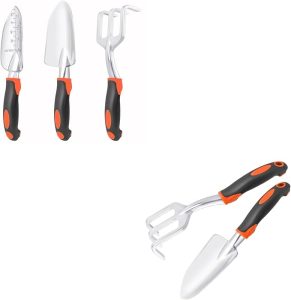
One of the main attractions of this gardening set is its combination of sturdy construction and comfortable handling. The tool bodies are made from thickened aluminum alloy, which is described as rust-resistant and durable enough for demanding gardening activities. The handles feature contoured finger grips, a palm rest, and TPR material intended to provide a secure, comfortable hold while reducing hand fatigue during extended use.
The set is also designed to help gardeners manage multiple tasks without constantly switching between unrelated tools. The trowel is intended for moving soil and digging planting holes, while the three-claw hand rake helps loosen the earth, aerate the soil, and remove weeds. The transplanting spade adds another useful option for moving seedlings and positioning plants at an appropriate depth.
For beginners, home gardeners, and people maintaining small flower beds or vegetable patches, this three-piece collection offers a practical starting point. However, its suitability for tougher jobs will depend on the condition of the soil, the size of the roots, and how much leverage each task requires.
Key Specifications
| Feature | Details |
|---|---|
| Brand | Mecheer |
| Product Type | 3-piece garden hand tool set |
| Number of Pieces | 3 |
| Included Tools | Garden trowel, three-claw hand rake, transplanting spade with graduated scale |
| Main Tool Material | Thickened aluminum alloy |
| Handle Material | TPR (thermoplastic rubber) |
| Handle Design | Contoured finger grips and palm rest |
| Rust Resistance | Described as rust-resistant |
| Storage Feature | Hanging holes at the top of the handles |
| Primary Uses | Digging, planting, transplanting, weeding, loosening soil, and aerating |
| Best Suited For | Everyday home gardening and routine plant care |
Note: Exact tool dimensions, total weight, warranty information, and the specific measurement range on the transplanting spade were not provided in the supplied product details.
10 Key Features of the Mecheer 3-Piece Garden Tool Set
1. Three Essential Gardening Tools in One Set
The most obvious advantage of the Mecheer set is that it brings together three useful hand tools in one package. Instead of purchasing a trowel, cultivator, and transplanting tool separately, you receive a collection intended to handle many routine gardening activities.
The garden trowel is useful for digging small holes and moving soil around plants. The three-claw hand rake is designed to break up loose soil, remove small weeds, and improve aeration around growing plants. Meanwhile, the transplanting spade includes a graduated scale that can help you judge planting depth when moving seedlings or setting new plants into the ground.
Having these tools together can make gardening more convenient, particularly when you are moving between different tasks in a single session.
Best for: Beginners, home gardeners, and anyone looking for a convenient starter collection of essential gardening hand tools.
2. Thickened Aluminum Alloy Construction
The main bodies of the tools are made from thickened aluminum alloy, which the product description identifies as sturdy, durable, and resistant to rust. This construction is intended to withstand the repeated handling associated with digging, cultivating, and transplanting.
The manufacturer also describes the tools as suitable for working around thick roots and rocky soil without breaking easily. That is a useful durability claim, although actual performance will depend on soil conditions, the force applied, and the size of the roots or stones encountered.
For ordinary gardening activities, the aluminum alloy construction offers a practical balance of strength and manageable handling. As with any hand tool, it is still sensible to avoid forcing the blade or claws against large roots or hard obstacles that may require a heavier digging tool.
Best for: Gardeners who want sturdy hand tools for regular planting, soil preparation, and general garden maintenance.
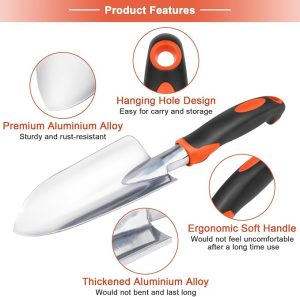
3. Ergonomic Handles for Better Comfort
Comfort matters when you spend a long time digging planting holes, loosening soil, or clearing weeds. The Mecheer garden tools feature ergonomically designed handles intended to fit naturally in the hand and make repetitive gardening movements more comfortable.
The contoured finger grips help provide a more secure hold, while the palm rest gives the hand an additional contact point during use. These features are intended to reduce strain and fatigue compared with holding a tool with a simple, narrow handle.
Although an ergonomic design cannot eliminate fatigue entirely, especially during demanding tasks, it can make routine gardening more comfortable for people who spend considerable time working with hand tools.
Best for: Gardeners who regularly plant, weed, and cultivate soil and want handles designed with comfort in mind.
4. TPR Handle Material for a Secure Grip
The handles use TPR, or thermoplastic rubber, which is commonly selected for its flexible, grippy feel. In this set, the material is intended to make the tools easier to hold while supporting a more comfortable gardening experience.
A secure grip is particularly useful when working with loose soil or performing repeated digging and pulling movements. It can also help you maintain better control of the tool as you move soil around delicate seedlings and established plants.
However, the product details do not specify whether the handles have a particular slip-resistance rating or whether they are designed for prolonged use in wet conditions. Gardeners should therefore keep the handles clean and dry when possible to maintain a comfortable hold.
Best for: People who prefer gardening tools with cushioned, easy-to-hold handles rather than bare metal grips.
5. Garden Trowel for Digging and Moving Soil
The included garden trowel is one of the most versatile pieces in the set. It is intended for digging small holes, scooping soil, filling planting spaces, and moving earth around flowers, vegetables, herbs, and other garden plants.
According to the product description, the trowel has a smooth surface that allows soil to move more easily across the blade. This can be useful when transferring loose soil into a planting hole or filling gaps around newly planted seedlings.
A hand trowel is especially practical for container gardening, raised beds, and smaller garden plots where a full-size shovel would be cumbersome. It also allows you to work more precisely around individual plants than you could with larger digging equipment.
For heavily compacted ground or deep digging, however, a small hand trowel may require more effort and may not replace a full-size spade.
Best for: Planting flowers, digging small holes, transferring potting mix, and handling routine soil-moving tasks.
6. Three-Claw Hand Rake for Loosening Soil
The three-claw hand rake is designed to loosen the soil, remove weeds, and help aerate the ground around plants. Its claw-style construction allows you to work through the upper layer of soil, breaking up loose clumps and preparing an area for planting.
This tool can be particularly helpful when preparing a small flower bed, maintaining a vegetable patch, or loosening the surface around established plants. It can also help remove smaller weeds when their roots are accessible in relatively loose soil.
The three-claw design is intended for localized cultivation rather than large-scale soil preparation. It is therefore most useful for focused work around individual plants and small garden areas.
Take care when cultivating close to shallow-rooted plants, since pulling the claws too deeply through the soil could disturb their roots.
Best for: Loosening garden soil, removing small weeds, aerating the soil surface, and preparing planting areas.
7. Transplanting Spade with Graduated Scale
The transplanting spade adds a useful feature for gardeners who frequently move seedlings or plant new flowers and vegetables. Its graduated scale is intended to help you estimate how deep you are digging, making it easier to work toward a consistent planting depth.
Planting depth matters because different plants have different requirements. A scale on the spade can provide a convenient reference while digging holes or positioning seedlings, reducing the need to measure each hole separately.
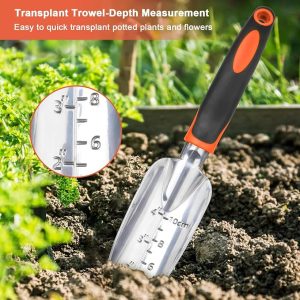
This feature may be especially helpful when planting several seedlings in a row or arranging plants in containers and raised beds. Nevertheless, the scale should be treated as a measurement aid rather than a universal planting guide. The appropriate depth will still depend on the plant species and its growing requirements.
The supplied information does not specify the scale’s measurement units or range, so those details should be checked in the retailer’s listing before purchase.
Best for: Gardeners who transplant seedlings, plant young flowers, or want a convenient reference for consistent planting depth.
8. Designed to Reduce Hand Fatigue During Extended Use
The combination of contoured finger grips, a palm rest, and TPR handle material is intended to reduce strain during longer gardening sessions. This is a useful consideration for people who regularly work through several planting beds or spend time maintaining a vegetable garden.
Comfortable handles can help make repetitive movements feel more manageable, particularly when switching between digging, cultivating, and transplanting. The ergonomic design also aims to support natural hand movements, which may reduce the discomfort associated with gripping an awkwardly shaped tool.
That said, the tools are still manually operated, so tasks involving very hard soil, extensive root removal, or prolonged digging may lead to fatigue. The handles should be viewed as a comfort feature rather than a guarantee against hand pain or strain.
Best for: Home gardeners who perform several gardening tasks in one session and value comfortable hand-tool design.
9. Hanging Holes for Convenient Storage
Each tool includes a hanging hole at the top of the handle, providing a straightforward way to store the set when it is not in use. You can hang the tools on suitable hooks in a garden shed, garage, utility room, or potting area.
This storage option helps keep the tools together and makes them easier to locate when you are ready to work in the garden. Hanging tools can also free up drawer, shelf, or workbench space.
For best results, clean off soil after use and allow the tools to dry before putting them away. Although the product is described as rust-resistant, proper storage and basic maintenance can help preserve the tools’ condition over time.
Best for: Gardeners who want a simple, accessible storage solution for frequently used hand tools.
10. Versatility for Everyday Home Gardening
The Mecheer three-piece set is intended to cover several common gardening needs without requiring a separate tool for every activity. You can use the trowel for digging and moving soil, the hand rake for loosening the ground and removing small weeds, and the transplanting spade for working with seedlings and new plants.
This versatility makes the set useful for a range of home gardening projects, including flower beds, herb gardens, vegetable patches, and container planting. It can also be a convenient option for gardeners who want a coordinated set of tools for regular maintenance.
Its main limitation is that all three tools are hand-operated and relatively specialized for smaller tasks. They are not a replacement for large shovels, long-handled hoes, heavy-duty root cutters, or other equipment needed for extensive landscaping.
Best for: Home gardeners who need a compact collection of tools for planting, cultivating, transplanting, and routine garden care.
Pros and Cons of the Mecheer 3-Piece Garden Tool Set
| Pros | Cons |
|---|---|
| Includes three practical gardening hand tools in one set | Exact dimensions and total weight are not provided |
| Thickened aluminum alloy construction is described as durable and rust-resistant | Performance in very hard or rocky soil may vary |
| TPR handles are designed for a comfortable grip | Ergonomic handles cannot eliminate fatigue during demanding work |
| Contoured finger grips and a palm rest support comfortable handling | No specific grip-performance or slip-resistance rating is supplied |
| Trowel is designed for digging and moving soil efficiently | Not intended to replace full-size digging equipment |
| Three-claw rake helps loosen soil and remove small weeds | Claws may disturb shallow roots if used too aggressively |
| Transplanting spade has a graduated scale for estimating depth | Scale units and measurement range are unspecified |
| Hanging holes make storage convenient | Storage hooks and other accessories are not mentioned as included |
| Suitable for many routine home gardening tasks | Warranty information is not provided |
| Convenient option for beginners and small gardens | No detailed long-term durability testing is provided |
Who Should Buy the Mecheer 3-Piece Garden Tool Set?
The Mecheer garden tool set is worth considering if you want a practical collection of tools for routine gardening rather than a large collection of specialized equipment.
It may be a good choice for:
-
Beginner gardeners: The three included tools cover several basic activities, making the set a useful starting point for learning to plant, dig, and cultivate soil.
-
Home vegetable gardeners: The trowel and transplanting spade can help with planting seedlings, while the hand rake is useful for loosening soil around growing vegetables.
-
Flower garden enthusiasts: The set can help with preparing planting holes, moving soil, and maintaining small flower beds.
-
Container gardeners: The hand trowel is useful for transferring potting mix and planting in pots, while the other tools can help with smaller maintenance tasks.
-
Gardeners who value comfortable handles: The contoured grips, palm rest, and TPR material are designed to make the tools more comfortable to hold.
-
People with limited storage space: The three-piece collection and hanging holes offer a convenient way to organize commonly used gardening tools.
Who Should Consider Another Tool Set?
Although this set covers many everyday gardening tasks, it may not be the best fit for every situation.
You may want to consider alternatives if:
-
You regularly dig in extremely hard or rocky ground. A heavier-duty digging tool may be more suitable for persistent compacted soil or large stones.
-
You need to remove large or deeply established roots. The included hand tools are intended for routine gardening, not heavy root excavation.
-
You maintain a large garden or landscape. Three hand tools may not provide the reach and efficiency of long-handled shovels, hoes, and larger cultivators.
-
You need detailed product measurements before buying. The supplied information does not establish the tools’ exact dimensions, weights, or the transplanting scale’s measurement range.
-
You require a specific warranty or verified durability rating. These details are not included in the provided product description and should be confirmed with the seller.
Final Verdict: Is the Mecheer 3-Piece Garden Tool Set Worth Considering?
The Mecheer 3-Piece Garden Tool Set offers a practical combination of essential hand tools for everyday gardening. With a garden trowel, three-claw hand rake, and transplanting spade featuring a graduated scale, it is designed to help gardeners dig planting holes, move soil, loosen the ground, remove small weeds, and transplant young plants.
Its main strengths are its versatile three-tool selection, thickened aluminum alloy construction, and ergonomic TPR handles with contoured finger grips and a palm rest. The hanging holes are another useful detail, providing a simple way to keep the tools organized between gardening sessions.
However, the set is best viewed as a collection for routine home gardening rather than heavy-duty landscaping. The manufacturer’s durability claims should also be considered alongside your soil conditions and the type of work you intend to perform. Before purchasing, it is worth checking the current listing for exact dimensions, weight, warranty coverage, and the graduated scale’s specifications.
Overall, if you are looking for a convenient set of hand tools for planting, transplanting, cultivating, and maintaining a small garden, the Mecheer set is a sensible option to consider. Its combination of versatility and comfort-focused handles makes it suitable for gardeners who want several everyday essentials in one package.
Affiliate Disclosure: As an Amazon Associate, I earn from qualifying purchases. This means I may receive a commission when you purchase through qualifying links in this article, at no additional cost to you.
9. VEVOR Garden Kneeler and Seat Review – Comfortable Support for Kneeling, Sitting, Weeding & Everyday Garden Maintenance
Gardening can be a rewarding way to spend time outdoors, but tasks such as weeding, planting, pruning, and trimming can put considerable pressure on your knees and back. Spending long periods close to the ground may become uncomfortable, especially when you frequently need to change positions or get up to retrieve gardening tools. The VEVOR Garden Kneeler and Seat is designed to make these everyday activities more manageable by combining a cushioned kneeling platform with a raised seat in one practical garden accessory.
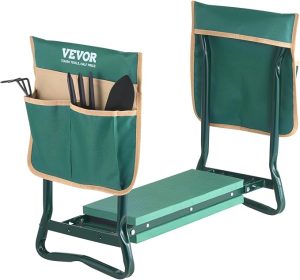
One of the main features of this garden kneeler is its 18 mm thick EVA foam cushion, which is intended to help reduce pressure on the knees during extended gardening sessions. Its dual-purpose design allows you to use it as a kneeling pad when working close to the ground or turn it into a seat when you need a more elevated position. This flexibility can be useful when moving between tasks such as planting seedlings, pruning low-growing plants, and tending to flower beds.
The VEVOR garden kneeler and seat also features a high-strength A3 steel frame with a powder-coated finish and a stated weight capacity of up to 330 pounds. Side handles provide additional support when transitioning from kneeling to standing, while two tool bags made from 600D Oxford fabric offer convenient storage for small gardening essentials.
Despite its sturdy construction, the unit weighs just 6.06 pounds, making it relatively easy to fold, transport, and store. For gardeners who want a more comfortable working position without carrying a bulky piece of equipment, this combination of portability, cushioning, and tool organization makes the VEVOR garden kneeler and seat worth considering.
Key Specifications
| Feature | Details |
|---|---|
| Brand | VEVOR |
| Product Type | Garden kneeler and seat |
| Color | Green |
| Product Dimensions | 11.42″D × 23.23″W × 19.29″H |
| Frame Material | Alloy steel |
| Frame Construction | High-strength A3 steel with powder-coated finish |
| Seat Material | EVA foam |
| Cushion Thickness | 18 mm |
| Weight Capacity | Up to 330 lbs |
| Item Weight | 6.06 lbs (2.75 kg) |
| Storage | Two 600D Oxford fabric tool bags |
| Main Features | Foldable design, dual kneeling and seating positions, side support handles |
| Primary Uses | Weeding, planting, pruning, trimming, and other low-level gardening tasks |
| Best Suited For | Home gardeners seeking added comfort and support while kneeling or sitting |
10 Key Features of the VEVOR Garden Kneeler and Seat
1. Dual-Purpose Kneeler and Garden Seat
One of the most useful features of the VEVOR garden kneeler and seat is its ability to serve two purposes. Rather than purchasing a separate kneeling pad and gardening stool, you get one piece of equipment designed for both kneeling and sitting.
When working close to the ground, you can use the cushioned platform to support your knees while planting, weeding, or tending to low-growing plants. When you need a break from kneeling or want to work from a higher position, the unit can be used as a garden seat.
This versatility makes it easier to adjust your working position throughout a gardening session. It can be particularly helpful when maintaining flower beds, vegetable patches, and other areas where tasks require frequent changes in posture.
Best for: Gardeners who alternate between kneeling and sitting and want a versatile accessory for everyday outdoor work.
2. 18 mm Thick EVA Foam Cushion
Kneeling directly on hard ground can become uncomfortable, especially when working on compacted soil, gravelly surfaces, or firm garden paths. The VEVOR garden kneeler features an 18 mm thick EVA foam cushion designed to provide a softer surface for your knees.
EVA foam is commonly used in cushioning applications because it is lightweight and offers some degree of shock absorption. In this garden kneeler, the foam is intended to help distribute pressure and reduce discomfort during activities such as planting, weeding, and trimming.
The cushioning may make longer gardening sessions more manageable, particularly when you frequently need to work at ground level. However, comfort will vary depending on your body weight, the underlying surface, and how long you remain in one position.
Best for: Gardeners who regularly kneel while planting, weeding, pruning, or maintaining beds and borders.
3. Side Handles for Easier Standing
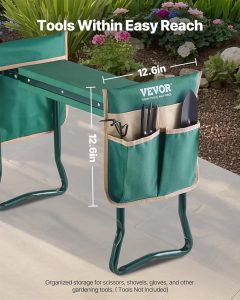
Getting up from a kneeling position can be challenging after spending time working close to the ground. The VEVOR garden kneeler addresses this concern with side handles that provide additional support when transitioning from kneeling to standing.
By holding the handles and using them for balance and leverage, you may find it easier to rise than when pushing directly against the ground. This feature can be especially useful for people who experience difficulty changing positions during gardening.
The handles may also help users maintain a more controlled movement when repositioning the kneeler. Nevertheless, they should not be treated as a substitute for a properly installed mobility aid, and anyone with significant balance or mobility difficulties should confirm that the product is appropriate for their needs.
Best for: Gardeners who appreciate additional hand support when standing up after kneeling.
4. Strong A3 Steel Frame Construction
A garden kneeler needs a dependable frame to support the user while remaining stable during everyday use. The VEVOR model uses high-strength A3 steel, which is designed to provide a sturdy foundation for both kneeling and sitting.
The steel construction is intended to handle regular gardening activities while supporting the product’s stated maximum weight capacity. This makes the frame an important feature for people who want more than a simple foam kneeling pad.
As with any folding garden accessory, stability also depends on using the product correctly and placing it on an appropriate surface. Before each session, check that the frame is fully opened and securely positioned according to the manufacturer’s instructions.
Best for: Gardeners who want a supportive frame for routine kneeling and seated gardening tasks.
5. Powder-Coated Finish for Added Protection
The steel frame features a powder-coated finish, which is intended to provide a protective outer layer and help the metal resist everyday wear. This is a useful consideration for garden equipment that may be used outdoors and exposed to soil, moisture, and repeated handling.
The coating can help protect the frame’s surface, but it does not make the entire product waterproof or eliminate the need for maintenance. Scratches, damaged coating, and prolonged exposure to damp conditions can still affect the frame over time.
To help preserve its condition, wipe away dirt after use, allow wet surfaces to dry, and store the kneeler in a sheltered location when it is not needed.
Best for: Gardeners who want a metal-framed kneeler designed for regular use and easier routine maintenance.
6. Supports Up to 330 Pounds
The VEVOR garden kneeler and seat has a stated maximum weight capacity of 330 pounds. This specification gives prospective buyers a useful reference when determining whether the product may be suitable for their needs.
The combination of a steel frame and a folding design is intended to provide support while the unit is used as a kneeler or seat. However, the stated capacity should not be interpreted as a guarantee of stability on every surface or under every type of movement.
For safer use, observe the manufacturer’s weight limit, place the kneeler on firm and level ground, and avoid sudden movements or using the handles in ways for which they were not designed.
Best for: Buyers looking for a garden kneeler and seat with a clearly stated weight capacity of up to 330 pounds.
7. Lightweight and Portable Design
Despite its steel frame, the VEVOR garden kneeler weighs approximately 6.06 pounds, or 2.75 kilograms. This relatively lightweight construction makes it easier to carry between garden beds, move around the yard, or transport when needed.
Its foldable design also helps reduce the space it occupies when not in use. According to the product description, it can be stored in a garden shed or placed in a car trunk, making it convenient for gardeners who travel with their equipment.
This portability may also be useful for household tasks that require working close to the ground. Still, the product is primarily designed for gardening, so its suitability for other activities depends on the surface, stability, and manufacturer’s guidance.
Best for: Gardeners who need equipment that is easy to move, transport, and store between uses.
8. Two Tool Bags for Better Organization
Keeping small gardening tools within reach can save time and reduce the number of interruptions during a gardening session. The VEVOR garden kneeler includes two tool bags made from 600D Oxford fabric to help organize commonly used accessories.
You can use the bags to carry items such as gardening scissors, gloves, small trowels, and other lightweight essentials. Having these items close at hand means you may spend less time getting up to retrieve equipment from a shed or workbench.
The bags are particularly useful when moving between several planting areas or maintaining a larger flower bed. However, the supplied details do not specify their individual capacities or whether they are intended for heavy tools, so it is sensible to keep the contents reasonably lightweight.
Best for: Gardeners who want quick access to frequently used small tools while working in the garden.
9. Compact Dimensions for Convenient Storage
The VEVOR garden kneeler and seat measures approximately 11.42 inches deep, 23.23 inches wide, and 19.29 inches high. These dimensions provide a useful reference for buyers considering how the unit might fit into their gardening space.
The relatively compact design, combined with its folding construction, is intended to make storage easier when the product is not being used. You can keep it in a garden shed, garage, or other suitable storage area without needing to dedicate space to a full-size bench.
Its size also makes it easier to move around a garden than larger seating equipment. Before purchasing, however, consider the space available for unfolding the unit and ensure that it can be positioned securely wherever you intend to use it.
Best for: Home gardeners with limited storage space who want a portable kneeler and seat rather than a permanent garden bench.
10. Practical Support for a Variety of Gardening Tasks
The combination of cushioning, a raised seat, support handles, and tool storage makes the VEVOR garden kneeler useful for several common gardening activities. It is designed to assist with weeding, planting, pruning, trimming, and other tasks that require spending time close to the ground.
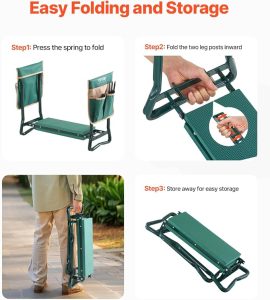
For example, you can use the kneeling position while planting small flowers or removing weeds, then switch to sitting when tending to containers or taking a short break. The tool bags keep essential accessories nearby, while the handles offer additional support when changing positions.
This flexibility can help make routine gardening more comfortable and organized. However, the kneeler is not a replacement for proper lifting techniques, medical mobility equipment, or appropriate protective equipment when carrying out demanding gardening tasks.
Best for: Home gardeners who want one accessory that combines cushioning, seating, portability, and convenient tool storage.
Pros and Cons of the VEVOR Garden Kneeler and Seat
| Pros | Cons |
|---|---|
| Dual-purpose design works as both a kneeler and a garden seat | Requires a suitable, level surface for stable use |
| 18 mm EVA foam cushion helps reduce pressure on the knees | Cushion comfort may vary during prolonged use |
| Side handles provide additional support when standing | May not meet the needs of people requiring specialized mobility equipment |
| High-strength A3 steel frame is designed for sturdy support | Steel frame adds some weight compared with a foam-only kneeling pad |
| Stated weight capacity of up to 330 pounds | Weight limit does not guarantee stability on uneven ground |
| Lightweight at 6.06 pounds | Must still be folded, carried, and positioned carefully |
| Foldable design makes storage and transport easier | Storage space is still needed when the unit is unfolded |
| Two 600D Oxford fabric tool bags keep small accessories nearby | Bag dimensions and individual capacities are not specified |
| Powder-coated frame finish is designed to protect the metal surface | Scratches and prolonged exposure to moisture may still affect the frame |
| Suitable for planting, weeding, pruning, and other low-level tasks | Does not replace full-size garden seating or specialized equipment |
Who Should Buy the VEVOR Garden Kneeler and Seat?
The VEVOR garden kneeler and seat is worth considering if you want to make gardening more comfortable while keeping your essential tools organized and accessible.
It may be a good choice for:
-
Gardeners who frequently kneel: The 18 mm EVA foam cushion provides a softer surface for working close to the ground.
-
People who alternate between kneeling and sitting: Its dual-purpose design allows you to change working positions without needing separate equipment.
-
Older gardeners seeking additional support: The side handles may make standing up easier, provided the product is appropriate for their individual mobility and balance needs.
-
Homeowners maintaining flower beds and vegetable patches: The kneeler is designed for everyday activities such as planting, weeding, trimming, and pruning.
-
Gardeners who value portability: Its 6.06-pound weight and foldable construction make it easier to move and store.
-
People who like keeping tools organized: The two included tool bags provide space for small accessories that are frequently needed while gardening.
Who Should Consider Another Garden Kneeler or Seat?
Although this VEVOR model offers several practical features, another product may be more suitable for particular requirements.
You may want to consider alternatives if:
-
You need specialized mobility support. The handles are intended to assist with standing, but the unit is not necessarily suitable as a medical mobility aid.
-
You work mainly on uneven or sloping ground. A folding kneeler may be less stable on unsuitable surfaces, so a different setup may be necessary.
-
You need a wider or more heavily cushioned seat. Check the dimensions and seating comfort carefully if you intend to sit for long periods.
-
You prefer a simple kneeling pad. A standalone foam pad may be easier to carry if you do not need a raised seat, support handles, or tool bags.
-
You need a product for heavy-duty work. This kneeler is intended to support gardening and similar low-level tasks rather than serve as a step stool or a platform for standing.
-
You require detailed durability or warranty information. Confirm the seller’s warranty terms and product instructions before purchasing, as these details were not included in the supplied specifications.
Final Verdict: Is the VEVOR Garden Kneeler and Seat Worth Considering?
The VEVOR Garden Kneeler and Seat is a practical option for gardeners who want to reduce the discomfort associated with spending long periods kneeling or working close to the ground. Its dual-purpose design allows it to function as both a cushioned kneeler and a garden seat, while the 18 mm EVA foam padding is intended to make low-level gardening tasks more comfortable.
Other useful features include the high-strength A3 steel frame, powder-coated finish, stated weight capacity of up to 330 pounds, and side handles that provide additional support when standing. The two 600D Oxford fabric tool bags also make it easier to keep frequently used gardening accessories within reach. At approximately 6.06 pounds, the unit is relatively lightweight and designed to fold away for storage or transport.
Its main appeal lies in bringing several convenience features together in one product. Rather than relying on a basic kneeling pad, you get cushioning, seating, support handles, and tool storage in a single gardening accessory.
However, it is important to use the kneeler on a firm, level surface, follow the stated weight limit, and avoid treating its handles as a substitute for specialized mobility support. Buyers should also confirm the folding mechanism and dimensions against their intended storage space before making a purchase.
Overall, if you regularly weed, plant, prune, or maintain flower beds and want a portable accessory that makes changing positions more convenient, the VEVOR Garden Kneeler and Seat is a worthwhile option to consider. Its combination of cushioning, practical storage, and a sturdy frame makes it a useful addition to a home gardener’s equipment collection.
Affiliate Disclosure: As an Amazon Associate, I earn from qualifying purchases. This means I may receive a commission when you purchase through qualifying links in this article, at no additional cost to you.
Frequently Asked Questions (FAQs)
1. What are the most essential gardening tools for beginners?
The most essential gardening tools for beginners include a hand trowel, pruning shears, a hand cultivator, a weeder, and a pair of gardening gloves. A trowel helps with digging and planting, pruning shears are useful for trimming stems and small branches, and a cultivator loosens soil. Gardening gloves provide additional hand protection, while a weeder helps remove unwanted plants. Starting with these basic tools allows beginners to handle many everyday gardening tasks without investing in a large collection of equipment.
2. Which gardening tools are best for planting flowers and vegetables?
A sturdy hand trowel is one of the best tools for planting flowers and vegetables. It helps create planting holes, move soil, and transplant seedlings. A hand cultivator can loosen compacted earth and prepare the soil before planting, while gardening gloves help protect your hands during the process. For smaller gardens, these tools are often sufficient for preparing flower beds, planting herbs, and maintaining vegetable patches.
3. What is the difference between bypass pruning shears and anvil pruning shears?
Bypass pruning shears have two blades that pass alongside each other, similar to scissors. They are generally preferred for cutting live stems and green growth because they can produce cleaner cuts with less crushing. Anvil pruners, on the other hand, have a cutting blade that closes against a flat surface and may be more suitable for certain dry or dead stems. For routine pruning of flowers, green shoots, and small living branches, bypass shears are often a practical choice.
4. How do I choose durable gardening tools?
When choosing durable gardening tools, consider the quality of the materials, blade construction, handle design, and connection between the tool’s components. Stainless steel can offer useful corrosion resistance, while well-made steel blades can provide reliable cutting performance. Ergonomic handles and reinforced joints may improve comfort and durability during regular use. Before buying, check the product specifications, customer reviews, warranty terms, and maintenance requirements to determine whether the tool suits your gardening needs.
5. What gardening tools are best for removing weeds?
The best weeding tool depends on the type of weeds and the condition of your soil. Hand weeders are useful for removing individual weeds, particularly when you want to target their roots. A hand cultivator can loosen soil around smaller weeds, while a trowel with serrated edges may help cut through small roots encountered during digging. For larger gardens or weeds with deep root systems, a specialized long-handled weeder may reduce the amount of bending required.
6. How can I maintain my gardening tools so they last longer?
Proper maintenance can help keep gardening tools in good working condition. Clean soil, sap, and plant residue from tools after each use, then dry them thoroughly before storage. Apply a light coat of suitable oil to metal components when appropriate, particularly pruning blades that require corrosion protection. Keep cutting edges sharp according to the manufacturer’s instructions, inspect handles and joints for damage, and store tools in a dry location. Regular maintenance can improve performance and help prevent premature wear.
7. Are stainless steel gardening tools better than ordinary steel tools?
Stainless steel gardening tools can offer better resistance to rust and corrosion than many untreated carbon steel alternatives. This can be useful when tools are frequently exposed to moisture and damp soil. However, the performance of a tool depends on more than its material. Steel grade, blade design, construction quality, sharpness, and maintenance all influence its suitability for different tasks. Some carbon steel tools may also offer excellent cutting performance when properly cared for, so compare the complete product rather than choosing by material alone.
8. Which gardening tools help reduce hand fatigue?
Tools with ergonomic handles, non-slip grips, and a comfortable fit can help make gardening more manageable, especially during repetitive tasks. Lightweight hand tools may also be easier to use for extended periods, although the ideal weight depends on the job. Long-handled tools can reduce bending when removing weeds or working at ground level, while a garden kneeler may provide additional comfort during planting. Choosing tools that match your hand size, strength, and gardening routine is particularly important.
9. How much should I spend on gardening tools?
The amount you should spend depends on your garden’s size, the tasks you perform, and how frequently you use your tools. Beginners can start with a few reliable essentials, such as a hand trowel, pruning shears, gloves, and a weeder, then expand their collection as their needs grow. More experienced gardeners may benefit from investing in specialized tools for regular or demanding tasks. When shopping on Amazon, compare current prices, materials, product specifications, customer feedback, and warranty coverage rather than automatically choosing the cheapest or most expensive option.
10. Can I buy good gardening tools on Amazon?
Yes, Amazon offers a wide variety of gardening tools, including hand trowels, pruning shears, cultivators, weeders, gloves, and garden tool sets. However, product quality and specifications vary between listings. Before purchasing, review the materials, dimensions, intended uses, customer feedback, return policy, and warranty information. Check that the listing matches the exact product you want, and compare similar options to find a tool that offers the right balance of functionality, durability, comfort, and price.
Also read : 10 Best Gardening Hand Tools – Top Picks for Planting, Pruning, Weeding & Everyday Garden Care
Conclusion: Finding the Best Gardening Tools for Your Garden
A thriving garden begins with the right care, and having suitable gardening tools can make that care considerably easier. Whether you’re preparing soil for new seedlings, trimming overgrown branches, removing stubborn weeds, or maintaining an established flower bed, the tools you choose can influence how comfortably and efficiently you complete everyday gardening tasks.
In this guide to the 9 Best Gardening Tools – Top Picks for Planting, Pruning, Weeding & Easy Garden Maintenance, we’ve explored a variety of tools designed to support different aspects of garden care. From versatile hand trowels and precision-oriented pruning shears to soil cultivators, weeders, gardening gloves, and other practical accessories, each category serves a particular purpose.
The Fiskars Bypass Pruning Shears, for example, are worth considering if your priority is trimming live stems and small branches. Their bypass blade design, ergonomic grip, and stated cutting capacity make them a practical option for routine pruning. Meanwhile, the Kemaier Stainless Steel Garden Hand Trowel offers a different set of advantages, with a pointed stainless steel blade, dual-sided serrated edges, and a coated handle designed for digging, planting, and tackling small root obstructions.
These examples highlight an important lesson: the best gardening tool is not necessarily the one with the most features, but the one that performs the tasks you need it for comfortably and reliably.
Before making a purchase, consider the type of gardening you do most often. If you maintain flowers and shrubs, prioritize suitable pruning shears. If you frequently plant vegetables or transplant seedlings, a sturdy hand trowel may be more useful. For gardens with persistent weeds, a dedicated weeder can make maintenance easier, while gloves and ergonomic accessories can improve comfort during longer sessions.
Durability also deserves careful consideration. Look for appropriate materials, secure construction, comfortable handles, and manageable maintenance requirements. Stainless steel can offer corrosion resistance, while well-designed cutting blades and reinforced joints may contribute to a tool’s usefulness over time. Checking product specifications, recent customer reviews, warranty conditions, and current prices can help you make a more informed decision.
If you’re shopping on Amazon, resist the temptation to choose a product based on appearance or price alone. Compare similar tools, confirm the exact features included in each listing, and consider whether a single versatile tool or a small collection of specialized tools would better suit your needs.
Ultimately, you don’t need an enormous collection of equipment to create a garden you love. A few thoughtfully selected tools, combined with regular maintenance and a little patience, can help you keep your outdoor space healthy, attractive, and enjoyable throughout the growing season.
Ready to upgrade your gardening toolkit? Explore the products featured in our roundup, compare their specifications and customer feedback, and choose the options that best match your garden, budget, and routine. With the right tools in hand, planting, pruning, weeding, and everyday garden maintenance can become simpler, more comfortable, and much more rewarding.
Affiliate disclosure: As an Amazon Associate, I earn from qualifying purchases. This means I may receive a commission when you purchase through qualifying links in this article, at no additional cost to you.