
Introduction
Have you ever looked up at the night sky and wondered what lies beyond the tiny points of light scattered across the darkness? Perhaps you’ve imagined seeing the craters of the Moon in breathtaking detail, observing the rings of Saturn, or capturing distant galaxies millions of light-years away. While the naked eye offers a beautiful glimpse into the universe, a good telescope can transform that curiosity into an extraordinary journey of discovery. And if you’re serious about exploring the cosmos, choosing the right telescope can make all the difference.
Among the different types of telescopes available today, catadioptric telescopes have earned a special place among amateur astronomers, experienced stargazers, and astrophotography enthusiasts. What makes them particularly fascinating is their clever combination of mirrors and lenses, which work together to gather and focus light while keeping the overall optical design relatively compact. Unlike traditional refractor telescopes that rely primarily on lenses or reflector telescopes that use mirrors, catadioptric models bring together the advantages of both optical systems in one instrument.
Imagine having a telescope powerful enough to reveal the intricate details of lunar landscapes, explore the cloud bands of Jupiter, and bring distant star clusters into view, without necessarily needing an enormous instrument that takes up half your storage space. That’s part of the appeal of these versatile telescopes. Their compact construction, impressive focal lengths, and adaptability make them attractive options for anyone looking to explore different aspects of astronomy. Whether you’re setting up in your backyard, heading somewhere away from city lights, or experimenting with long-exposure astrophotography, there’s plenty to appreciate.
However, finding the right model isn’t always as straightforward as it sounds. With different optical configurations, aperture sizes, focal ratios, mounting systems, and computerized tracking capabilities to consider, choosing between available options can quickly become overwhelming. A telescope that works beautifully for planetary observation may not necessarily be the ideal choice for capturing wide-field deep-sky images. Similarly, beginners may prioritize ease of setup and operation, while experienced astronomers might be more interested in optical precision, tracking accuracy, and advanced imaging capabilities.
That’s precisely why we’ve put together this comprehensive guide to the Best Catadioptric Telescopes currently worth considering. We’ve explored nine noteworthy options, highlighting their optical performance, practical features, strengths, and potential limitations to help you understand what each telescope brings to the table. From observing familiar celestial objects to venturing deeper into the mysteries of distant space, our selection aims to cover different interests, experience levels, and observing preferences.
So, whether you’re purchasing your very first telescope or looking to upgrade your existing astronomy equipment, get ready to discover some exciting possibilities. Let’s explore these nine catadioptric telescopes and find out which one deserves a place in your astronomical collection!
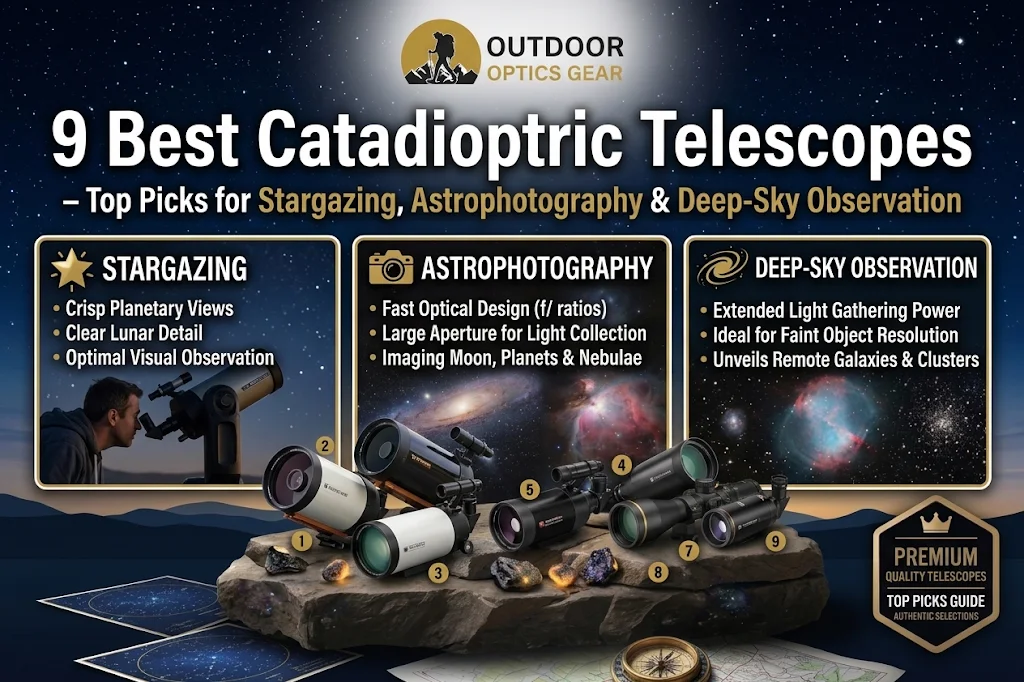
9 Best Catadioptric Telescopes – Comparison Table
Below is a comparison of nine catadioptric telescopes worth considering for this review. The selection includes popular Schmidt-Cassegrain and Maksutov-Cassegrain models from brands such as Celestron, Sky-Watcher, and Sarblue.
| # | Telescope Model | Optical Design | Aperture | Focal Length | Best For |
|---|---|---|---|---|---|
| 1 | Celestron NexStar 8SE | Schmidt-Cassegrain | 203 mm (8″) | 2,032 mm | Deep-sky observation and astrophotography |
| 2 | Celestron NexStar 6SE | Schmidt-Cassegrain | 150 mm (6″) | 1,500 mm | All-round stargazing and planetary viewing |
| 3 | Celestron NexStar 5SE | Schmidt-Cassegrain | 127 mm (5″) | 1,250 mm | Portable astronomy and lunar observation |
| 4 | Celestron NexStar 4SE | Maksutov-Cassegrain | 102 mm (4″) | 1,325 mm | Beginners and automated celestial tracking |
| 5 | Celestron NexStar 127SLT | Maksutov-Cassegrain | 127 mm (5″) | 1,500 mm | Planetary and lunar observation |
| 6 | Celestron NexStar 90SLT | Maksutov-Cassegrain | 90 mm | 1,250 mm | Beginner-friendly guided stargazing |
| 7 | Sky-Watcher Skymax 127 | Maksutov-Cassegrain | 127 mm | 1,500 mm | High-contrast planetary viewing |
| 8 | Sky-Watcher Skymax 102 | Maksutov-Cassegrain | 102 mm | 1,300 mm | Portable observation and casual astrophotography |
| 9 | Sarblue Mak70 | Maksutov-Cassegrain | 70 mm | Check specific listing | Compact travel and smartphone photography |
1. Celestron NexStar 8SE Computerized Telescope
The Celestron NexStar 8SE Computerized Telescope is a powerful and versatile catadioptric telescope designed for astronomy enthusiasts who want to explore the night sky with greater precision, convenience, and optical performance. Combining Celestron’s iconic orange optical tube with advanced computerized technology, this telescope offers an impressive balance between traditional telescope design and modern automated observation features. It is particularly appealing to users looking to move beyond basic manual telescopes and experience a more guided approach to stargazing.
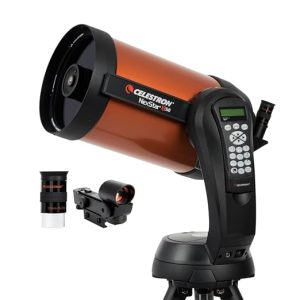
At the heart of the NexStar 8SE is an impressive 8-inch (203mm) Schmidt-Cassegrain optical system. Its relatively large aperture allows it to collect substantial amounts of light, making it suitable for observing a wide variety of celestial objects. From the Moon’s intricate craters and Jupiter’s atmospheric cloud bands to distant galaxies and globular clusters, the telescope offers opportunities to explore objects that are difficult or impossible to see with the naked eye. Its compact optical design also makes it considerably easier to transport and store than many traditional telescopes with comparable apertures.
One of its standout features is the fully computerized GoTo mount, which takes much of the guesswork out of locating celestial objects. Through the included NexStar+ hand control, users can access a database containing more than 40,000 celestial objects. Once the telescope is properly aligned, the computerized system can automatically locate selected targets and track their movement across the night sky. This is particularly useful for beginners who may not yet be familiar with star charts, constellations, or celestial coordinates.
The NexStar 8SE also incorporates Celestron’s SkyAlign technology, which simplifies the initial alignment process. Users simply center three bright celestial objects, such as stars or planets, without necessarily knowing their names. The telescope then calculates its position and establishes the alignment needed for computerized operation. This makes getting started considerably less intimidating for those who are still learning their way around astronomy.
Another practical advantage is its computerized altitude-azimuth single fork arm mount, which provides automated movement and tracking. The telescope also comes with a 25mm eyepiece and a StarPointer red dot finderscope to assist with locating celestial targets. Additionally, compatibility with Celestron accessories gives users room to expand their setup as their astronomical interests develop.
Overall, the Celestron NexStar 8SE is an attractive option for intermediate astronomers and ambitious beginners seeking a capable instrument for planetary observation, lunar exploration, and deep-sky viewing. Although its computerized features make operation easier, users should remember that proper alignment, a suitable observing location, and familiarity with the telescope’s controls are still important for achieving the best results.
Key Specifications
-
Brand: Celestron
-
Model Name: NexStar 8SE Computerized Telescope
-
Telescope Type: Schmidt-Cassegrain Catadioptric
-
Optical Tube Length: 43.2 centimeters
-
Objective Lens Diameter (Aperture): 20.3 centimeters (8 inches)
-
Eyepiece Lens: 25mm
-
Mount Type: Computerized Altitude-Azimuth Single Fork Arm Mount
-
Focus Type: Manual Focus
-
Finderscope: StarPointer Red Dot Finderscope
-
Alignment Technology: SkyAlign
-
Computerized Control: NexStar+ Hand Control
-
Celestial Object Database: 40,000+ Objects
-
Product Dimensions: 32″D x 34″W x 52″H
-
Power Source: Not specified in the supplied product details
-
Warranty: 2 Years (US Warranty)
Key Features
8-Inch Schmidt-Cassegrain Optical System
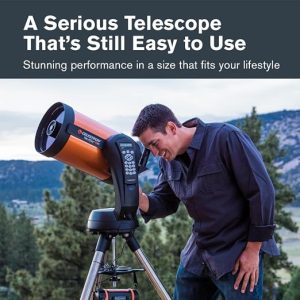
One of the biggest attractions of the NexStar 8SE is its 8-inch (203mm) aperture, which provides impressive light-gathering capabilities for astronomical observation. Its Schmidt-Cassegrain optical configuration combines mirrors and a corrector lens to deliver a relatively compact telescope with a long focal length. This makes it particularly useful for observing lunar features, planetary details, star clusters, and selected deep-sky objects.
Fully Computerized GoTo Mount
The telescope features an automated GoTo mounting system controlled through the included NexStar+ hand control. Its database contains more than 40,000 celestial objects, allowing users to select their preferred targets without having to locate everything manually. Once aligned, the mount automatically moves the telescope toward the selected object and tracks it as the Earth rotates. This feature is particularly beneficial for astronomers who want to spend more time observing and less time searching.
SkyAlign Alignment Technology
Getting a telescope properly aligned can be challenging, especially for beginners unfamiliar with celestial navigation. Fortunately, the NexStar 8SE includes SkyAlign technology, which simplifies this process. Users can center any three bright stars or planets, even without knowing their identities, allowing the computerized system to calculate the telescope’s position and establish alignment.
NexStar+ Hand Control
The included NexStar+ hand control provides access to the telescope’s computerized functions and extensive celestial database. Through this controller, users can select astronomical objects, initiate automated movements, and manage tracking. It makes navigating the night sky more convenient, particularly when exploring unfamiliar constellations and celestial regions.
Iconic Compact Orange Tube Design
Celestron maintains its recognizable orange optical tube design while incorporating an optical system that delivers substantial aperture in a relatively compact package. This construction makes the NexStar 8SE more manageable for transportation and storage than many traditional 8-inch telescopes. It is a practical consideration for astronomers who occasionally travel to darker observing locations.
StarPointer Red Dot Finderscope
The telescope comes with a StarPointer red dot finderscope, which helps users identify and initially point toward celestial targets. It complements the computerized alignment process and provides a convenient way to orient the telescope before beginning automated observation.
Expandable Accessory Compatibility
Another useful feature is its compatibility with Celestron’s range of additional accessories. As users gain experience, they can explore upgrades that enhance their observing experience, including wireless control options and accessories designed to improve location accuracy. This gives the NexStar 8SE room to grow alongside the user’s astronomical interests.
Two-Year Warranty and Technical Support
Celestron includes a two-year US warranty and access to technical support from its US-based team. This provides additional reassurance for buyers investing in a relatively advanced astronomical instrument. International buyers should confirm the warranty coverage applicable in their country before purchasing.
Technology & Special Features
The Celestron NexStar 8SE combines traditional Schmidt-Cassegrain optics with computerized navigation technology to create a telescope that is both optically capable and relatively convenient to operate.
Its primary optical technology is the Schmidt-Cassegrain design, which uses a combination of mirrors and a thin corrector plate to redirect and focus incoming light. This arrangement allows the telescope to achieve a long focal length without requiring an excessively long optical tube. The result is a compact instrument that is particularly suitable for detailed observations of the Moon and planets while remaining capable of exploring numerous deep-sky objects.
Its computerized GoTo technology is another defining feature. By combining the NexStar+ hand control, extensive object database, and motorized fork-arm mount, the telescope can automatically locate and follow selected celestial targets. Meanwhile, SkyAlign technology simplifies the initial alignment process, reducing the need for users to understand complicated astronomical coordinates.
It is worth noting that although the NexStar 8SE supports astronomical imaging with compatible cameras and accessories, its single-arm altitude-azimuth mount is not ideal for long-exposure deep-sky astrophotography because of field rotation. Users particularly interested in serious long-exposure imaging may eventually need an equatorial mounting solution.
Best Uses
The Celestron NexStar 8SE Computerized Telescope is particularly suited to:
-
Lunar observation: Its 8-inch aperture provides the ability to explore impressive lunar details, including craters, mountain ranges, and surface formations.
-
Planetary observation: Its long focal length makes it suitable for examining planetary features such as Jupiter’s cloud bands and Saturn’s rings.
-
Deep-sky observation: Its substantial light-gathering capability makes it useful for viewing selected galaxies, globular clusters, nebulae, and other distant celestial objects.
-
Automated stargazing: Its computerized GoTo system makes locating and tracking celestial targets considerably easier.
-
Intermediate astronomy enthusiasts: It offers advanced optical and computerized features for users looking to upgrade from simpler manual telescopes.
-
Beginner astronomy: Its SkyAlign technology and automated object database can help newcomers explore the night sky without relying entirely on manual navigation.
-
Casual astrophotography: With compatible cameras and accessories, it can support lunar, planetary, and selected short-exposure astronomical imaging.
-
Portable observing sessions: Its relatively compact Schmidt-Cassegrain design makes it more manageable to transport than many conventional telescopes with comparable apertures.
Pros & Cons
Pros
-
Large 8-inch (203mm) aperture provides impressive light-gathering capabilities.

-
Schmidt-Cassegrain optical design combines a long focal length with a relatively compact tube.
-
Computerized GoTo mount provides automated celestial object location and tracking.
-
Extensive database containing more than 40,000 celestial objects.
-
SkyAlign technology simplifies telescope alignment.
-
NexStar+ hand control makes navigating the night sky more convenient.
-
Suitable for lunar, planetary, and deep-sky observation.
-
Compatible with additional Celestron accessories.
-
Includes a StarPointer red dot finderscope.
-
Backed by a two-year US warranty and technical support.
Cons
-
The computerized mounting system requires electrical power, which adds to setup considerations.
-
Initial alignment may take some practice, particularly for inexperienced users.
-
Why We Selected It
The Celestron NexStar 8SE Computerized Telescope earns its place as the first product in our 9 Best Catadioptric Telescopes – Top Picks for Stargazing, Astrophotography & Deep-Sky Observation guide because it combines a substantial 8-inch aperture, versatile Schmidt-Cassegrain optics, and convenient computerized navigation in one recognizable telescope design.
What makes it particularly appealing is the balance between optical capability and automated operation. Its large aperture provides opportunities to observe a wide range of celestial objects, while the GoTo system and SkyAlign technology make exploring the night sky less dependent on manual navigation skills. These features make it an interesting option for both ambitious beginners and more experienced astronomers seeking a convenient observing setup.
We particularly appreciate its ability to accommodate different astronomical interests, from examining lunar landscapes and planetary details to exploring selected deep-sky objects. Although its altitude-azimuth mount presents limitations for serious long-exposure astrophotography, it remains a compelling choice for visual astronomy and casual imaging.
For anyone looking to invest in a capable, computerized catadioptric telescope without moving into a considerably larger optical setup, the Celestron NexStar 8SE is certainly worth considering.
Also read: 6 Best Budget 90mm Telescopes
2. Celestron NexStar 6SE Computerized Telescope
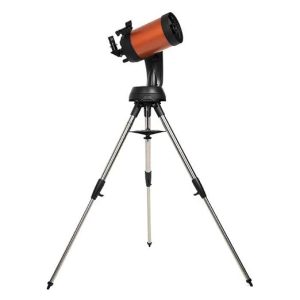
The Celestron NexStar 6SE Computerized Telescope is a versatile Schmidt-Cassegrain telescope designed for astronomy enthusiasts who want a combination of reliable optical performance, convenient operation, and modern computerized features. Featuring Celestron’s recognizable orange optical tube and an automated GoTo mounting system, this telescope offers an accessible way to explore the night sky without relying entirely on manual navigation. It is particularly appealing to beginners looking for an advanced first telescope and intermediate observers interested in upgrading their existing equipment.
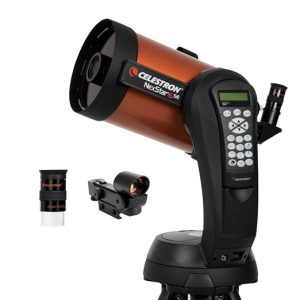
At the center of the NexStar 6SE is a 6-inch (150mm) Schmidt-Cassegrain optical system that combines mirrors and lenses to produce a long focal length within a relatively compact optical tube. Its aperture provides useful light-gathering capabilities for observing a variety of celestial objects, including the Moon, planets, star clusters, and selected deep-sky targets. Whether you’re interested in examining lunar craters, observing Jupiter’s atmospheric cloud bands, or exploring distant globular clusters, this telescope provides a versatile platform for visual astronomy.
One of its most attractive features is its fully computerized GoTo mounting system. Through the included NexStar+ hand control, users can access a database containing more than 40,000 celestial objects. Rather than manually searching through star charts to locate individual targets, users can select an object from the database and allow the computerized mount to move the telescope toward it automatically. The system also tracks the selected object, helping keep it within the field of view as the Earth rotates.
For users who are unfamiliar with astronomical alignment, the NexStar 6SE incorporates Celestron’s SkyAlign technology. This feature simplifies the setup process by allowing users to center any three bright celestial objects, such as stars or planets, without needing to identify them beforehand. The telescope then calculates its position and establishes the alignment required for computerized operation. This makes the initial observing experience considerably more approachable, particularly for those who are still learning how to navigate the night sky.
The telescope also features a computerized altitude-azimuth single fork arm mount, which supports automated positioning and tracking. Its supplied accessories include a 25mm eyepiece and a StarPointer red dot finderscope, providing useful starting equipment for locating and observing celestial objects. Additionally, compatibility with Celestron accessories allows users to expand their setup as their astronomy skills and interests develop.
Compared with the larger NexStar 8SE, the 6SE has a smaller aperture, but this also contributes to its appeal as a more compact observing instrument. It offers a practical balance between optical capability, portability, and automated functionality, making it a strong consideration for people who want an all-round telescope without moving into a larger 8-inch system.
Overall, the Celestron NexStar 6SE is a compelling option for lunar and planetary observation, casual deep-sky exploration, and beginner-friendly computerized astronomy. While its mount is not specifically optimized for long-exposure deep-sky astrophotography, it offers plenty of functionality for visual observation and selected imaging applications.
Key Specifications
-
Brand: Celestron
-
Model Name: 11068 (NexStar 6SE)
-
Telescope Type: Schmidt-Cassegrain Catadioptric
-
Optical Tube Length: 40.6 centimeters
-
Objective Lens Diameter (Aperture): 15 centimeters (6 inches)
-
Eyepiece Lens: 25mm
-
Mount Type: Computerized Altitude-Azimuth Single Fork Arm
-
Focus Type: Manual Focus
-
Finderscope: StarPointer Red Dot Finderscope
-
Alignment Technology: SkyAlign
-
Computerized Control: NexStar+ Hand Control
-
Celestial Object Database: 40,000+ Objects
-
Product Dimensions: 32″D x 34″W x 52″H
-
Power Source: Not specified in the supplied product details
-
Warranty: 2 Years (US Warranty)
Key Features
6-Inch Schmidt-Cassegrain Optical System
The NexStar 6SE features a 6-inch (150mm) aperture, providing a useful combination of light-gathering ability and compact construction. Its Schmidt-Cassegrain optical design combines reflective mirrors with a corrector lens to produce a long focal length without requiring an excessively long telescope tube.
This configuration makes it particularly suitable for observing the Moon, planets, double stars, and brighter deep-sky objects. Users can explore lunar surface formations, examine Jupiter’s cloud bands, and observe selected star clusters and galaxies under suitable viewing conditions.
Fully Computerized GoTo Mount
One of the defining features of the NexStar 6SE is its computerized GoTo mounting system. The telescope provides access to more than 40,000 celestial objects through its NexStar+ hand control.
Once the telescope has been properly aligned, users can select an object from the database and allow the motorized mount to locate it automatically. The tracking functionality then helps maintain the object’s position within the viewing area, making extended observation sessions more convenient.
SkyAlign Technology for Easier Setup
Celestron’s SkyAlign technology is designed to make telescope alignment less complicated. Instead of requiring users to identify specific stars or understand celestial coordinates, the system allows them to center any three bright celestial objects.
The telescope uses these observations to calculate its position and complete the alignment process. This is particularly helpful for beginners who may not yet recognize different constellations or know how to use traditional star charts.
NexStar+ Hand Control
The included NexStar+ hand control provides access to the telescope’s computerized navigation system. Through this controller, users can browse the extensive celestial database, select observation targets, and initiate automated telescope movements.
This feature makes the NexStar 6SE especially useful for exploring unfamiliar areas of the night sky. Rather than spending considerable time searching for individual objects, users can concentrate more on observing and learning about the universe.
Compact and Portable Optical Design
The NexStar 6SE combines a 6-inch optical system with a relatively compact Schmidt-Cassegrain tube measuring approximately 40.6 centimeters in length. Its folded optical arrangement allows it to provide a substantial focal length without the bulk associated with many traditional long-tube telescopes.
This makes it a practical option for astronomers who want to transport their equipment between home observing locations and darker outdoor environments.
StarPointer Red Dot Finderscope
The telescope includes a StarPointer red dot finderscope, which helps users initially point the instrument toward selected celestial targets. It works alongside the computerized alignment system and provides a convenient reference when setting up the telescope.
The included CR2032 battery supports the finderscope’s operation, giving users an additional locating aid straight out of the box.
Compatibility with Celestron Accessories
Another advantage is the NexStar 6SE’s compatibility with Celestron’s range of astronomical accessories. Users can explore additional equipment to improve their observing experience, including wireless control options and accessories designed to enhance location accuracy.
This flexibility is useful for astronomy enthusiasts who intend to expand their equipment as they become more familiar with different observing and imaging techniques.
Two-Year Warranty and Technical Support
Celestron includes a two-year US warranty and access to technical support from its US-based team. This offers additional reassurance for buyers investing in a computerized telescope with several integrated components. International customers should confirm whether the same warranty terms apply to purchases made in their country.
Technology & Special Features
The Celestron NexStar 6SE combines established Schmidt-Cassegrain optical technology with computerized navigation and automated tracking to create a telescope suited to a wide range of observing interests.
Its Schmidt-Cassegrain optical system uses a combination of mirrors and a corrector plate to gather and focus incoming light. This folded optical arrangement allows the telescope to achieve a relatively long focal length while maintaining a shorter physical tube. The result is a compact design particularly useful for observing the Moon and planets, as well as exploring brighter deep-sky objects.
The computerized GoTo system adds another layer of convenience. Through the NexStar+ hand control, users can access an extensive database of celestial objects and allow the telescope to locate selected targets automatically. Its motorized mounting system also provides tracking capabilities, helping keep celestial objects in view during observation sessions.
Meanwhile, SkyAlign technology simplifies the alignment process by allowing the telescope to establish its orientation using three bright celestial objects. This reduces the dependence on manual navigation and makes the instrument more approachable for people who are still developing their astronomy skills.
Although the NexStar 6SE can be used for selected astrophotography applications with compatible cameras, its altitude-azimuth mount has limitations for long-exposure deep-sky imaging because of field rotation. It is better suited to visual astronomy, lunar photography, and planetary imaging than demanding long-exposure galaxy and nebula photography.
Best Uses
The Celestron NexStar 6SE Computerized Telescope is particularly suited to:
-
Lunar observation: Its 6-inch aperture allows users to examine lunar craters, mountain ranges, and other surface features in greater detail.
-
Planetary observation: Its long focal length makes it suitable for observing Jupiter’s cloud bands, Saturn’s rings, and other planetary features.
-
Deep-sky observation: It can reveal selected galaxies, nebulae, globular clusters, and other brighter deep-sky objects under suitable observing conditions.
-
Automated stargazing: Its computerized GoTo system simplifies locating and tracking thousands of celestial targets.
-
Beginner astronomy: SkyAlign technology and the extensive object database help newcomers explore the night sky without depending entirely on manual navigation.
-
Intermediate astronomy: Its optical performance and computerized features make it a worthwhile upgrade from basic entry-level telescopes.
-
Casual astrophotography: With compatible cameras and accessories, it can support lunar, planetary, and selected short-exposure imaging.
-
Portable observation: Its relatively compact optical tube makes it suitable for users who want to transport their telescope to different observing locations.
Pros & Cons
Pros
-
6-inch (150mm) aperture provides useful light-gathering capabilities.
-
Schmidt-Cassegrain optical design offers a long focal length in a compact tube.
-
Fully computerized GoTo mount simplifies celestial navigation.
-
Extensive database containing more than 40,000 celestial objects.
-
SkyAlign technology makes alignment easier for beginners.
-
NexStar+ hand control provides convenient access to automated functions.
-
Suitable for lunar, planetary, and selected deep-sky observations.
-
Includes a 25mm eyepiece and StarPointer red dot finderscope.
-
Compatible with additional Celestron accessories.
-
Backed by a two-year US warranty and technical support.
Cons
-
Its 6-inch aperture collects less light than the larger NexStar 8SE.
-
The computerized mounting system requires an appropriate external power supply or compatible power source.
Why We Selected It
The Celestron NexStar 6SE Computerized Telescope earns its place as our second selection because it offers an appealing combination of optical performance, automated navigation, and portability. Its 6-inch Schmidt-Cassegrain optical system provides enough aperture for exploring numerous celestial objects, while its computerized GoTo mount makes locating and tracking astronomical targets considerably easier.

What makes this telescope particularly interesting is its balance between capability and physical size. While the NexStar 8SE offers a larger aperture and greater light-gathering potential, the 6SE provides a more compact alternative for astronomers who want reliable visual performance without necessarily investing in a larger 8-inch system.
We particularly appreciate its 40,000-plus object database and SkyAlign technology, which help simplify the process of exploring unfamiliar areas of the night sky. These features make it suitable for beginners who want automated assistance while still providing enough functionality to keep intermediate astronomy enthusiasts engaged.
Although it has limitations for serious long-exposure astrophotography, the NexStar 6SE remains a versatile option for lunar exploration, planetary observation, and casual deep-sky viewing.
For anyone seeking a computerized catadioptric telescope that balances useful optical capabilities with convenient operation, the Celestron NexStar 6SE is certainly worth considering.
3. Celestron NexStar 5SE Computerized Telescope
The Celestron NexStar 5SE Computerized Telescope is a compact and versatile Schmidt-Cassegrain telescope designed for astronomy enthusiasts who want reliable optical performance, convenient computerized navigation, and opportunities to explore astrophotography. Combining Celestron’s recognizable orange optical tube with a fully automated GoTo mounting system, this telescope offers an interesting balance between traditional astronomical observation and modern technology. It is particularly suitable for beginners looking to move beyond basic manual telescopes and intermediate users who want a capable instrument without investing in a larger optical system.
At the heart of the NexStar 5SE is a 5-inch (127mm) Schmidt-Cassegrain optical system. Its aperture provides useful light-gathering capabilities for observing a variety of celestial objects, including the Moon, planets, star clusters, and selected deep-sky targets. Whether you’re interested in examining the Moon’s craters, observing Jupiter’s cloud bands, or exploring distant globular clusters, this telescope provides a convenient way to experience more of the night sky. Its folded optical design also allows it to deliver a relatively long focal length within a compact optical tube measuring approximately 33 centimeters.
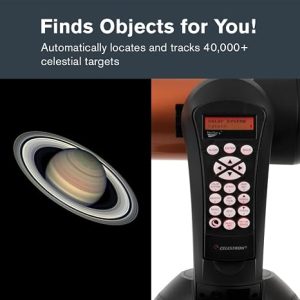
One of its most appealing features is its fully computerized GoTo mounting system, which helps simplify the process of locating celestial objects. Through the included NexStar+ hand control, users can access a database containing more than 40,000 astronomical objects. Rather than spending considerable time manually searching through star charts, users can select a preferred target and allow the computerized mount to move the telescope toward it automatically. The system also tracks the selected object, helping maintain its position within the viewing area as the Earth rotates.
For users who are unfamiliar with astronomical alignment, the NexStar 5SE incorporates Celestron’s SkyAlign technology. This feature allows the telescope to establish its orientation by centering any three bright celestial objects, such as stars or planets, without requiring users to know their names. The system then calculates its position and completes the alignment process. This makes the telescope considerably more approachable for people who are still learning how to navigate the night sky.
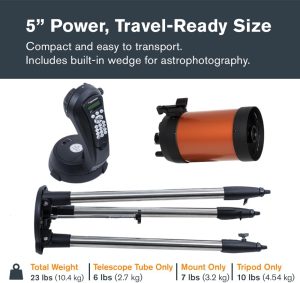
Perhaps one of the most interesting features of the NexStar 5SE is its built-in equatorial wedge, which gives it an additional advantage for entry-level astrophotography. Unlike the standard altitude-azimuth configuration, the integrated wedge allows users to polar-align the mount, helping reduce field rotation during longer imaging sessions. This makes the telescope particularly interesting for astronomy enthusiasts who want to experiment with capturing images of celestial objects beyond basic visual observation. However, successful long-exposure imaging still depends on accurate polar alignment, tracking performance, camera equipment, and other observing conditions.
The NexStar 5SE also comes with a 25mm eyepiece and a StarPointer red dot finderscope, providing useful starting equipment for locating and observing astronomical targets. Its compatibility with additional Celestron accessories further allows users to expand their setup as their interests develop.
Overall, the Celestron NexStar 5SE is an appealing choice for anyone seeking a compact computerized catadioptric telescope with additional imaging flexibility. Although its 5-inch aperture collects less light than the larger NexStar 6SE and 8SE models, its portability, automated navigation, and integrated wedge make it a worthwhile option for beginners and intermediate astronomers interested in both stargazing and introductory astrophotography.
Key Specifications
-
Brand: Celestron
-
Model Name: NexStar 5SE Computerized Telescope
-
Telescope Type: Schmidt-Cassegrain Catadioptric
-
Optical Tube Length: 33 centimeters
-
Objective Lens Diameter (Aperture): 12.7 centimeters (5 inches)
-
Eyepiece Lens: 25mm
-
Mount Type: Computerized Altitude-Azimuth Single Fork Arm
-
Focus Type: Manual Focus
-
Finderscope: StarPointer Red Dot Finderscope
-
Alignment Technology: SkyAlign
-
Computerized Control: NexStar+ Hand Control
-
Celestial Object Database: 40,000+ Objects
-
Astrophotography Feature: Built-in Equatorial Wedge
-
Polar Alignment: Supported
-
Product Dimensions: 32″D x 34″W x 52″H
-
Power Source: Not specified in the supplied product details
-
Warranty: 2 Years (US Warranty)
Key Features
5-Inch Schmidt-Cassegrain Optical System
The NexStar 5SE features a 5-inch (127mm) aperture that provides useful light-gathering capabilities for a variety of astronomical observations. Its Schmidt-Cassegrain optical configuration combines mirrors and a corrector lens to produce a relatively long focal length without requiring an excessively long telescope tube.
This arrangement makes the telescope particularly useful for lunar and planetary observation. Users can explore lunar craters, examine Jupiter’s atmospheric features, and observe Saturn’s rings under suitable viewing conditions. Its aperture also allows it to explore selected deep-sky objects, including brighter galaxies, nebulae, and star clusters.
Fully Computerized GoTo Mount
One of the defining features of the NexStar 5SE is its automated GoTo mounting system. Through the included NexStar+ hand control, users can access a database containing more than 40,000 celestial objects.
Once the telescope has been properly aligned, users can select an astronomical target from the database and allow the computerized mount to locate it automatically. The tracking system then helps keep the selected object within the telescope’s viewing area as the Earth rotates.
This feature is particularly useful for beginners who may not yet be familiar with celestial navigation or identifying individual stars and constellations.
SkyAlign Technology for Easy Alignment
Celestron’s SkyAlign technology simplifies the initial telescope alignment process. Instead of requiring users to identify specific stars or enter complicated astronomical coordinates, the system allows them to center any three bright celestial objects.
These can include bright stars or planets visible in the sky. The telescope then uses the selected objects to calculate its position and establish the alignment needed for computerized operation.
This makes getting started easier, especially for users who are still developing their understanding of astronomy.
Built-In Equatorial Wedge for Astrophotography
One of the most distinctive features of the NexStar 5SE is its integrated equatorial wedge, which provides additional flexibility for astronomical imaging.
In its normal altitude-azimuth configuration, the telescope moves horizontally and vertically to follow celestial objects. Although this works well for visual observation, it can introduce field rotation during longer-exposure photography.
The built-in wedge allows users to polar-align the mount, enabling it to track celestial objects in a way that reduces field rotation. This makes the NexStar 5SE particularly interesting for beginners who want to experiment with longer-exposure astrophotography.
However, the wedge does not automatically turn the telescope into a professional deep-sky imaging system. Accurate polar alignment and suitable imaging accessories are still necessary for achieving good results.
NexStar+ Hand Control
The included NexStar+ hand control provides access to the telescope’s computerized navigation features. Through this controller, users can browse the extensive celestial database, select observation targets, and initiate automated telescope movements.
Its extensive object selection makes exploring unfamiliar areas of the night sky more convenient. Rather than relying entirely on manual searching, users can use the computerized system to discover different astronomical objects.
Compact and Portable Optical Design
With an optical tube measuring approximately 33 centimeters, the NexStar 5SE offers a relatively compact arrangement for a computerized telescope.
Its Schmidt-Cassegrain optical design folds the light path, allowing it to achieve a long focal length without requiring a physically long tube. This makes it easier to transport and store compared with many traditional telescopes that have similar focal lengths.
For astronomy enthusiasts who occasionally travel to darker observing locations, this compact construction is a particularly useful advantage.
StarPointer Red Dot Finderscope
The telescope comes with a StarPointer red dot finderscope, which helps users initially point the optical tube toward celestial targets.
The finderscope complements the computerized alignment process and provides a convenient visual reference when setting up the telescope. The supplied product details also identify a CR2032 battery for the finderscope.
Compatibility with Celestron Accessories
The NexStar 5SE supports additional Celestron accessories, allowing users to expand their astronomical setup as their experience develops.
Depending on their interests, users can explore compatible accessories for wireless control, improved location accuracy, and different observation or imaging applications.
This flexibility makes the telescope a useful long-term investment for people who intend to gradually develop their astronomy equipment.
Two-Year Warranty and Technical Support
Celestron includes a two-year US warranty and access to technical support from its US-based team. This provides additional reassurance for buyers investing in a computerized telescope with integrated optical and electronic components.
International customers should confirm the warranty terms and support arrangements applicable to their location before purchasing.
Technology & Special Features
The Celestron NexStar 5SE combines Schmidt-Cassegrain optical technology, computerized celestial navigation, and an integrated equatorial wedge to provide a telescope with several useful capabilities.
Its primary optical technology is the Schmidt-Cassegrain design, which uses a combination of mirrors and a corrector plate to gather and focus incoming light. By folding the optical path, the system achieves a relatively long focal length within a shorter physical tube. This makes it particularly useful for observing the Moon and planets while maintaining a compact overall design.
The computerized GoTo system adds another layer of convenience. Through the NexStar+ hand control, users can access an extensive database of astronomical objects and allow the motorized mount to locate selected targets automatically. Its tracking functionality also helps maintain the position of celestial objects during observation sessions.
However, the most interesting addition is the built-in equatorial wedge. This feature allows the telescope’s mounting system to be polar-aligned, reducing field rotation that would otherwise affect longer-exposure astrophotography with an altitude-azimuth mount.
For beginners interested in astronomical imaging, this provides an opportunity to explore a more advanced approach to tracking celestial objects. It is particularly useful when experimenting with imaging star fields and selected deep-sky targets, although the telescope’s tracking accuracy and mount limitations should be considered before attempting demanding long-exposure photography.
Best Uses
The Celestron NexStar 5SE Computerized Telescope is particularly suited to:
-
Lunar observation: Its 5-inch aperture allows users to explore lunar craters, mountain ranges, and other surface formations.
-
Planetary observation: Its long focal length makes it suitable for examining Jupiter’s cloud bands, Saturn’s rings, and other planetary features.
-
Deep-sky observation: It can reveal selected brighter galaxies, nebulae, globular clusters, and star clusters under suitable viewing conditions.
-
Beginner astrophotography: Its integrated equatorial wedge provides an opportunity to experiment with polar alignment and longer-exposure imaging.
-
Automated stargazing: Its GoTo system makes locating and tracking more than 40,000 celestial objects considerably easier.
-
Beginner astronomy: SkyAlign technology simplifies telescope alignment for users who are unfamiliar with celestial navigation.
-
Intermediate astronomy: Its optical system, automated tracking, and imaging flexibility provide room for developing astronomical skills.
-
Portable observing sessions: Its compact optical tube makes it suitable for users who want to transport their telescope between different observing locations.
Pros & Cons
Pros
-
5-inch (127mm) Schmidt-Cassegrain aperture provides useful light-gathering capabilities.
-
Compact optical design combines a long focal length with a relatively short tube.
-
Fully computerized GoTo mount simplifies locating celestial objects.
-
Extensive database containing more than 40,000 astronomical objects.
-
SkyAlign technology makes initial alignment easier.
-
Built-in equatorial wedge supports polar alignment for astrophotography.
-
Reduces field rotation during longer-exposure imaging when properly aligned.
-
Suitable for lunar, planetary, and selected deep-sky observation.
-
Includes a 25mm eyepiece and StarPointer red dot finderscope.
-
Compatible with additional Celestron accessories.
-
Backed by a two-year US warranty and technical support.
Cons
-
Its 5-inch aperture collects less light than the larger NexStar 6SE and 8SE models.
-
The computerized mounting system requires an appropriate power supply.
Why We Selected It
The Celestron NexStar 5SE Computerized Telescope earns its place as our third selection because it combines a capable 5-inch Schmidt-Cassegrain optical system with automated navigation and an additional feature that makes it particularly interesting for aspiring astrophotographers: its built-in equatorial wedge.
What makes this telescope stand out is its versatility. While it provides useful capabilities for observing the Moon, planets, and selected deep-sky objects, it also gives users an opportunity to explore polar alignment and experiment with longer-exposure astronomical imaging. This makes it more than just a conventional computerized stargazing instrument.
We particularly appreciate its 40,000-plus celestial object database, SkyAlign technology, and integrated imaging wedge. Together, these features provide a convenient observing experience while introducing users to some of the more advanced techniques involved in astronomy.
Although its 5-inch aperture is smaller than those of the NexStar 6SE and 8SE, this also contributes to its compact construction. For users who prioritize portability and want a telescope that can support both visual observation and introductory astrophotography, it offers an interesting combination of features.
Overall, the Celestron NexStar 5SE is a worthwhile consideration for astronomy enthusiasts seeking a compact computerized telescope with greater imaging flexibility than a basic entry-level observing instrument.
Also read: 6 Best Budget 90mm Telescopes
4. Celestron NexStar 4SE Computerized Telescope
The Celestron NexStar 4SE Computerized Telescope is a compact and beginner-friendly Maksutov-Cassegrain telescope designed for astronomy enthusiasts who value portability, automated navigation, and sharp optical performance. Featuring Celestron’s recognizable orange optical tube and a fully computerized GoTo mounting system, this telescope combines traditional astronomical optics with modern technology to make exploring the night sky more convenient. It is particularly appealing to beginners who want to move beyond basic manual telescopes, as well as experienced observers looking for a smaller instrument for convenient planetary and lunar observation.
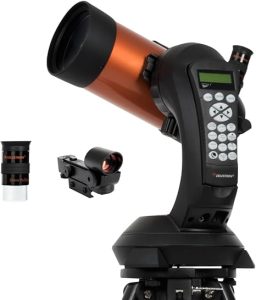
At the heart of the NexStar 4SE is a 4-inch (102mm) Maksutov-Cassegrain optical system. Unlike the Schmidt-Cassegrain design used in some of the other NexStar models, this configuration combines a primary mirror, a secondary reflective surface, and a curved front corrector lens to gather and focus incoming light. The result is a compact optical arrangement with a relatively long focal length, making it particularly suitable for observing the Moon, planets, and other bright astronomical objects.
One of the telescope’s main attractions is its ability to deliver sharp, high-contrast views of celestial targets despite its relatively small physical size. Its 102mm aperture provides useful light-gathering capabilities for examining lunar craters, observing Jupiter’s cloud bands, and viewing Saturn’s rings under suitable atmospheric conditions. Although it does not gather as much light as the larger 5-inch, 6-inch, and 8-inch telescopes in the NexStar family, its optical design makes it an interesting choice for users who prioritize detailed planetary observation and portability.
The NexStar 4SE also features a fully computerized GoTo mounting system operated through the included NexStar+ hand control. This controller provides access to a database containing more than 40,000 celestial objects, allowing users to select astronomical targets without having to locate everything manually. Once aligned, the motorized mount automatically moves toward the selected object and tracks it as the Earth rotates. This makes the telescope particularly useful for beginners who are still learning how to identify constellations and navigate the night sky.
To simplify the alignment process, Celestron incorporates its SkyAlign technology, which allows users to center any three bright stars or planets without necessarily knowing their names. The system then calculates the telescope’s position and establishes the alignment required for computerized operation. This reduces the complexity associated with traditional telescope alignment and helps users begin observing more quickly.
Another interesting addition is its built-in equatorial wedge, which provides the option of polar-aligning the mount for astronomical imaging. By changing the tracking orientation, the wedge helps reduce field rotation that can affect longer-exposure photography when using a standard altitude-azimuth configuration. This provides an opportunity for beginners to experiment with astrophotography, although the telescope’s relatively small aperture and mounting capabilities should be considered when planning more demanding imaging projects.
The NexStar 4SE also comes with a 25mm eyepiece and a StarPointer red dot finderscope, providing useful starting equipment for locating and observing celestial objects. Its compatibility with Celestron accessories further allows users to expand their setup as their astronomical interests develop.
Overall, the Celestron NexStar 4SE is an attractive option for beginners and casual astronomers seeking a compact computerized telescope with an emphasis on lunar and planetary observation. Its combination of Maksutov-Cassegrain optics, automated navigation, and integrated wedge makes it a versatile little instrument for anyone interested in discovering more of the night sky without dealing with a bulky telescope.
Key Specifications
-
Brand: Celestron
-
Model Name: NexStar 4SE Computerized Telescope
-
Telescope Type: Maksutov-Cassegrain Catadioptric
-
Optical Tube Length: 34.3 centimeters
-
Objective Lens Diameter (Aperture): 10.2 centimeters (4 inches)
-
Eyepiece Lens: 25mm
-
Mount Type: Computerized Altitude-Azimuth Single Fork Arm
-
Focus Type: Manual Focus
-
Finderscope: StarPointer Red Dot Finderscope
-
Alignment Technology: SkyAlign
-
Computerized Control: NexStar+ Hand Control
-
Celestial Object Database: 40,000+ Objects
-
Astrophotography Feature: Built-in Equatorial Wedge
-
Polar Alignment: Supported
-
Product Dimensions: 32″D x 34″W x 52″H
-
Power Source: Not specified in the supplied product details
-
Warranty: 2 Years (US Warranty)
Key Features
4-Inch Maksutov-Cassegrain Optical System
The NexStar 4SE features a 4-inch (102mm) aperture combined with a Maksutov-Cassegrain optical configuration. This design uses mirrors and a curved corrector lens to produce a long focal length within a relatively compact telescope tube.
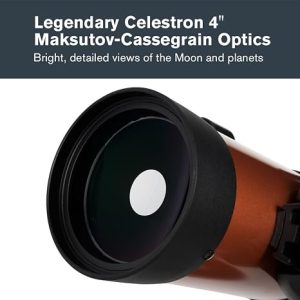
One of its main advantages is its ability to deliver sharp, high-contrast views of bright celestial objects. It is particularly suitable for lunar observation and planetary viewing, allowing users to explore the Moon’s surface features, examine Jupiter’s atmospheric bands, and observe Saturn’s rings under favorable viewing conditions.
Although its smaller aperture limits its light-gathering ability compared with larger telescopes, its optical design makes it a practical choice for users interested in detailed observations of relatively bright astronomical targets.
Fully Computerized GoTo Mount
The telescope features a fully computerized GoTo mounting system that simplifies celestial navigation. Through the included NexStar+ hand control, users can access a database containing more than 40,000 astronomical objects.
After completing the alignment process, users can select their preferred targets and allow the motorized mount to move the telescope automatically. Its tracking functionality also helps maintain the selected object’s position within the viewing area as the Earth rotates.
This feature is particularly useful for beginners who may find manually locating celestial objects challenging.
SkyAlign Technology
Celestron’s SkyAlign technology is designed to make telescope setup easier and less intimidating. Instead of requiring users to identify specific stars or understand complicated celestial coordinates, the system allows them to center any three bright celestial objects.
These can include stars or planets visible in the sky. The telescope then calculates its position and establishes the alignment required for computerized operation.
This feature is especially beneficial for newcomers who are still learning about constellations and celestial navigation.
Built-In Equatorial Wedge for Astroimaging
Another interesting feature of the NexStar 4SE is its integrated equatorial wedge, which provides additional flexibility for astronomical imaging.In its standard altitude-azimuth configuration, the telescope tracks celestial objects through horizontal and vertical movements. Although this arrangement works well for visual observation, it can introduce field rotation during longer-exposure photography.
The built-in wedge allows users to polar-align the mount, helping reduce this rotational effect during imaging sessions. This makes the telescope an interesting starting point for beginners who want to experiment with capturing astronomical photographs.
However, users should understand that the wedge does not eliminate every limitation associated with the telescope’s tracking system. Accurate polar alignment and suitable imaging equipment remain important, particularly when attempting longer exposures.
NexStar+ Hand Control
The included NexStar+ hand control provides access to the telescope’s computerized functions and extensive celestial object database.
Users can browse available astronomical targets, select objects for observation, and initiate automated telescope movements. This makes exploring unfamiliar regions of the night sky considerably easier than relying exclusively on manual navigation.
For beginners, the controller provides a convenient introduction to computerized astronomy while allowing them to gradually become familiar with different celestial objects.
Compact and Portable Construction
With an optical tube measuring approximately 34.3 centimeters, the NexStar 4SE is designed to provide useful optical performance without occupying excessive physical space.
Its Maksutov-Cassegrain configuration folds the optical path, allowing the telescope to achieve a relatively long focal length within a compact tube. This makes it particularly attractive to users who need equipment that is easier to transport and store.
For casual astronomers who enjoy observing from their backyards, traveling to darker locations, or setting up their equipment in different environments, portability is a significant advantage.
StarPointer Red Dot Finderscope
The NexStar 4SE includes a StarPointer red dot finderscope, which helps users initially point the telescope toward selected celestial targets.
This accessory complements the computerized alignment process by providing a convenient visual reference during setup. The supplied product information also identifies a CR2032 battery for the finderscope.
Compatibility with Celestron Accessories
The telescope supports additional Celestron accessories, allowing users to customize and expand their observing setup as their experience develops.
Options for wireless control and improved location accuracy can help enhance the overall observing experience. This flexibility is particularly useful for beginners who may want to gradually invest in additional astronomical equipment.
Two-Year Warranty and Technical Support
Celestron includes a two-year US warranty and access to technical support from its US-based team. This provides additional reassurance for buyers investing in a computerized astronomical instrument.
International buyers should confirm the warranty coverage and support arrangements applicable to their country before purchasing.
Technology & Special Features
The Celestron NexStar 4SE combines Maksutov-Cassegrain optical technology with computerized navigation and an integrated equatorial wedge to create a compact telescope with several useful astronomical capabilities.
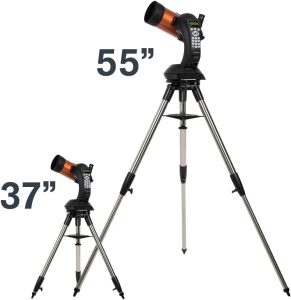
Its primary optical technology is the Maksutov-Cassegrain design, which uses a curved front corrector lens alongside reflective mirrors to gather and focus incoming light. This folded optical arrangement allows the telescope to achieve a relatively long focal length without requiring a physically long tube.
One of the main benefits of this configuration is its suitability for high-contrast observations of the Moon and planets. Its 102mm aperture provides a practical balance between optical performance and portability, although it is less capable of collecting faint light than larger-aperture alternatives.
The computerized GoTo system adds another layer of convenience. Through the NexStar+ hand control, users can access thousands of astronomical targets and allow the motorized mount to locate and track selected objects automatically. Meanwhile, SkyAlign technology simplifies the initial alignment process by using three bright celestial objects.
The integrated equatorial wedge is another notable feature. It allows the telescope to be polar-aligned, helping reduce field rotation during longer-exposure astrophotography. This gives users an opportunity to experiment with astronomical imaging beyond basic lunar and planetary photography.
Although the NexStar 4SE is not intended to replace a dedicated deep-sky astrophotography setup, its combination of computerized navigation, compact optics, and wedge-assisted tracking makes it an interesting introduction to more advanced observing techniques.
Best Uses
The Celestron NexStar 4SE Computerized Telescope is particularly suited to:
-
Lunar observation: Its 4-inch aperture and high-contrast optics make it useful for examining lunar craters, mountain ranges, and surface formations.
-
Planetary observation: Its long focal length makes it particularly suitable for viewing Jupiter, Saturn, and other bright planets.
-
Beginner astronomy: SkyAlign technology and computerized navigation simplify the process of discovering celestial objects.
-
Automated stargazing: Its GoTo system provides access to more than 40,000 celestial objects.
-
Casual deep-sky observation: It can be used to explore brighter star clusters, selected galaxies, and nebulae under suitable observing conditions.
-
Entry-level astrophotography: Its integrated equatorial wedge provides an opportunity to experiment with polar alignment and longer-exposure imaging.
-
Portable astronomy: Its compact optical tube makes it suitable for users who need a telescope that is relatively easy to transport and store.
-
Intermediate planetary observation: Its Maksutov-Cassegrain optical system provides an interesting option for enthusiasts who prioritize detailed views of bright celestial objects.
Pros & Cons
Pros
-
4-inch (102mm) Maksutov-Cassegrain optical system.
-
Compact design with a relatively long focal length.
-
Sharp, high-contrast views of lunar and planetary objects.
-
Fully computerized GoTo mounting system.
-
Extensive database containing more than 40,000 celestial objects.
-
SkyAlign technology simplifies initial alignment.
-
Built-in equatorial wedge supports polar alignment for astrophotography.
-
Helps reduce field rotation during longer-exposure imaging.
-
Includes a 25mm eyepiece and StarPointer red dot finderscope.
-
Compatible with additional Celestron accessories.
-
Relatively portable compared with larger-aperture telescope systems.
-
Backed by a two-year US warranty and technical support.
Cons
-
Its 4-inch aperture collects less light than larger NexStar models.
-
Less suitable for observing very faint deep-sky objects.
Why We Selected It
The Celestron NexStar 4SE Computerized Telescope earns its place as our fourth selection because it offers a combination of compact Maksutov-Cassegrain optics, automated celestial navigation, and additional imaging flexibility in a relatively portable design.
What makes this telescope particularly interesting is its emphasis on sharp lunar and planetary observation. Its 4-inch optical system provides a long focal length and high-contrast views, making it suitable for users who enjoy examining the Moon and exploring the visible features of planets. While it does not offer the same light-gathering capabilities as the larger NexStar 5SE, 6SE, and 8SE models, it provides a practical alternative for those who prioritize portability.
We also appreciate its computerized GoTo system and SkyAlign technology, which make locating celestial objects considerably easier for beginners. The addition of an integrated equatorial wedge further distinguishes it from many basic entry-level telescopes by providing an opportunity to experiment with polar alignment and astrophotography.
Although its smaller aperture limits its performance when observing faint deep-sky objects, the NexStar 4SE remains a worthwhile consideration for anyone seeking a compact, automated telescope for exploring the night sky.
For beginners, casual stargazers, and astronomy enthusiasts who want a portable instrument with useful computerized features, the Celestron NexStar 4SE offers an interesting combination of convenience, optical design, and versatility.
5. Celestron NexStar 127SLT Maksutov-Cassegrain Computerized Telescope
The Celestron NexStar 127SLT Maksutov-Cassegrain Telescope is a computerized astronomical instrument designed for enthusiasts who want detailed planetary observation, convenient celestial navigation, and a portable setup for exploring the night sky. Combining a 127mm Maksutov-Cassegrain optical system with Celestron’s automated GoTo technology, this telescope offers an interesting balance between optical performance and ease of use. It is particularly appealing to beginners, families, and intermediate astronomers looking for a telescope that can reveal impressive celestial details without requiring an excessively large optical tube.
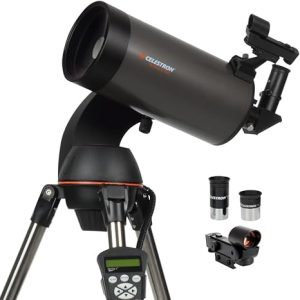
At the heart of the NexStar 127SLT is a 5-inch (127mm) Maksutov-Cassegrain optical system. This design combines mirrors and a curved front corrector lens to gather and focus incoming light, producing a relatively long focal length within a compact optical arrangement. One of its main advantages is its ability to deliver sharp, high-contrast views of bright celestial objects, making it particularly suitable for observing the Moon and planets.
With its 127mm aperture, the telescope provides useful light-gathering capabilities for exploring different astronomical targets. Users can observe the Moon’s craters and surface formations, examine Jupiter’s atmospheric cloud bands, and view Saturn’s distinctive rings under suitable atmospheric conditions. Beyond the Solar System, it can also reveal selected deep-sky objects, including the Orion Nebula, brighter galaxies, and star clusters. Although its optical configuration particularly favors planetary observation, it offers enough versatility to introduce users to several different areas of astronomy.
One of its standout features is the computerized GoTo mounting system, which provides access to a database containing more than 40,000 celestial objects. Instead of manually searching through star charts to locate astronomical targets, users can select an object and allow the motorized mount to move the telescope toward it automatically. The system also tracks the selected object as it moves across the night sky, making extended observation sessions more convenient.
For users who are new to computerized astronomy, the NexStar 127SLT incorporates Celestron’s SkyAlign technology. This alignment procedure allows users to center any three bright celestial objects without necessarily knowing their names. The computerized system then calculates the telescope’s position and establishes the alignment needed for automated operation. This makes getting started considerably easier for people who are still learning about constellations and celestial navigation.
Another appealing characteristic is its compact and portable construction. Despite having a 127mm aperture, the Maksutov-Cassegrain optical design keeps the optical tube relatively manageable. This makes the telescope suitable for backyard observation, family stargazing sessions, and trips to darker locations away from city lights. It also comes with two eyepieces, measuring 20mm and 9mm, giving users different magnification options for observing celestial objects.
The NexStar 127SLT also includes a StarPointer red dot finderscope and a complimentary download of Starry Night Special Edition astronomy software. The software allows users to simulate the night sky, learn about celestial objects, and plan observing sessions before taking their telescope outdoors.
Overall, the Celestron NexStar 127SLT is an attractive option for astronomy enthusiasts seeking a computerized Maksutov-Cassegrain telescope with a useful aperture, convenient automated navigation, and good portability. Its optical design makes it particularly appealing for lunar and planetary observation, while its extensive object database provides opportunities to explore beyond the Solar System.
Key Specifications
-
Brand: Celestron
-
Model Name: NexStar 127SLT Maksutov-Cassegrain Telescope
-
Telescope Type: Maksutov-Cassegrain Catadioptric
-
Optical Tube Length: 27 inches
-
Objective Lens Diameter (Aperture): 12.7 centimeters (127mm / 5 inches)
-
Eyepieces: 20mm and 9mm
-
Mount Type: Computerized Altitude-Azimuth Single Fork Arm
-
Focus Type: Manual Focus
-
Finderscope: StarPointer Red Dot Finderscope
-
Alignment Technology: SkyAlign
-
Computerized Control: GoTo Computerized Mount
-
Celestial Object Database: 40,000+ Objects
-
Power Source: Battery Powered
-
Product Dimensions: 34″D x 30″W x 50″H
-
Included Software: Starry Night Special Edition (Free Download)
-
Warranty: 2 Years (US Warranty)
Key Features
5-Inch Maksutov-Cassegrain Optical System
The NexStar 127SLT features a 127mm (5-inch) aperture, providing useful light-gathering capabilities for exploring a variety of astronomical objects. Its Maksutov-Cassegrain optical configuration combines reflective mirrors with a curved corrector lens to produce a long focal length within a relatively compact telescope tube.
One of its main advantages is its ability to deliver sharp, high-contrast images, particularly when observing bright celestial objects. This makes it well suited to examining lunar craters, observing Jupiter’s cloud bands, and exploring Saturn’s rings. Under suitable viewing conditions, users can also observe brighter deep-sky objects such as the Orion Nebula and selected star clusters.
Computerized GoTo System with 40,000+ Objects
One of the defining features of the NexStar 127SLT is its computerized celestial navigation system. It provides access to a database containing more than 40,000 stars, galaxies, nebulae, and other astronomical objects.

Users simply select their preferred target through the computerized control system, and the telescope automatically moves toward it. Once positioned, its motorized tracking system helps maintain the object’s position within the viewing area as the Earth rotates.
This feature is particularly useful for beginners who may not yet be familiar with locating constellations or navigating the night sky using traditional star charts.
SkyAlign Technology for Fast Setup
Celestron’s SkyAlign technology simplifies the initial alignment process by allowing users to center any three bright celestial objects.
These objects can be bright stars or planets, and users do not necessarily need to know their names. The telescope uses the selected objects to calculate its position and establish the alignment required for computerized operation.
This makes the NexStar 127SLT particularly approachable for families and beginners who want to spend more time observing and less time figuring out complicated setup procedures.
Two Included Eyepieces: 20mm and 9mm
The NexStar 127SLT comes with two eyepieces, providing users with different magnification options depending on their observing interests.
The 20mm eyepiece offers a lower magnification that is useful for locating celestial objects and observing larger targets. Meanwhile, the 9mm eyepiece provides higher magnification, making it more suitable for examining smaller details on the Moon and planets.
Having two eyepieces included gives beginners a useful starting point for experimenting with different viewing experiences without immediately needing to purchase additional accessories.
Compact and Portable Construction
Despite its 5-inch aperture, the NexStar 127SLT maintains a relatively compact optical arrangement through its Maksutov-Cassegrain design.
Its folded optical path allows the telescope to achieve a long focal length without requiring the physical length associated with traditional long-tube telescopes. This makes it easier to transport between different observing locations.
Whether setting up in the backyard, visiting a campsite, or traveling to a darker observing location, its portable construction makes it a practical option for astronomy enthusiasts who enjoy observing away from home.
StarPointer Red Dot Finderscope
The telescope includes a StarPointer red dot finderscope, which helps users initially point the optical tube toward their intended targets.
It provides a convenient visual reference during telescope setup and works alongside the computerized alignment process. This is particularly helpful when users are learning how to position their equipment before beginning automated observation.
Free Starry Night Special Edition Software
Another useful addition is the complimentary download of Starry Night Special Edition astronomy software.
This software allows users to explore simulated representations of the night sky, learn about different celestial objects, and plan future observing sessions. It can be particularly helpful for beginners who want to understand what they are likely to see before setting up their telescope.
For families and younger astronomy enthusiasts, the software also provides an educational introduction to celestial navigation and astronomical observation.
Two-Year Warranty and Technical Support
Celestron includes a two-year US warranty and access to technical support from its US-based team.
This provides additional reassurance for buyers investing in a computerized telescope with integrated optical and electronic components. International customers should confirm the applicable warranty terms and support arrangements before purchasing.
Technology & Special Features
The Celestron NexStar 127SLT combines Maksutov-Cassegrain optical technology with computerized celestial navigation to create a telescope particularly suited to detailed astronomical observation.
Its primary optical technology is the Maksutov-Cassegrain design, which uses a curved front corrector lens alongside reflective mirrors to gather and focus incoming light. This folded optical arrangement allows the telescope to achieve a relatively long focal length while maintaining a manageable physical size.
One of its main advantages is its suitability for high-contrast observations of the Moon and planets. Its 127mm aperture provides a useful balance between light-gathering ability and portability, allowing users to explore lunar formations, planetary details, and selected deep-sky objects.
The computerized GoTo system adds another layer of convenience. With access to more than 40,000 astronomical objects, users can select targets through the telescope’s computerized controls and allow the motorized mount to locate and track them automatically.
Meanwhile, SkyAlign technology simplifies the alignment process by allowing users to center three bright celestial objects. This reduces the need for complicated manual navigation and makes the telescope more approachable for newcomers.
The included Starry Night Special Edition software further complements these capabilities by helping users simulate celestial movements, identify astronomical objects, and plan observation sessions.
Unlike the NexStar 5SE and 4SE, the supplied NexStar 127SLT specifications do not identify an integrated equatorial wedge. Its standard altitude-azimuth mount is therefore better suited to visual astronomy and basic lunar or planetary imaging than demanding long-exposure deep-sky astrophotography.
Best Uses
The Celestron NexStar 127SLT Maksutov-Cassegrain Telescope is particularly suited to:
-
Lunar observation: Its 127mm aperture and high-contrast optics make it useful for examining lunar craters, mountain ranges, and other surface features.
-
Planetary observation: Its long focal length makes it particularly suitable for observing Jupiter’s cloud bands, Saturn’s rings, and other bright planets.
-
Deep-sky observation: It can reveal selected brighter galaxies, nebulae, and star clusters, including the Orion Nebula, under suitable observing conditions.
-
Automated stargazing: Its GoTo system provides access to more than 40,000 astronomical objects.
-
Beginner astronomy: SkyAlign technology makes locating and tracking celestial targets easier for newcomers.
-
Family astronomy: Its automated operation and educational software make it suitable for shared stargazing experiences involving adults and children.
-
Portable observation: Its compact Maksutov-Cassegrain construction makes it practical for backyard use and trips to darker observing locations.
-
Educational astronomy: The included Starry Night software helps users learn about celestial objects and plan observation sessions.
-
Casual astrophotography: With compatible imaging equipment, it can support lunar and planetary photography, although its standard mount has limitations for long-exposure deep-sky imaging.
Pros & Cons
Pros
-
127mm (5-inch) Maksutov-Cassegrain optical system.
-
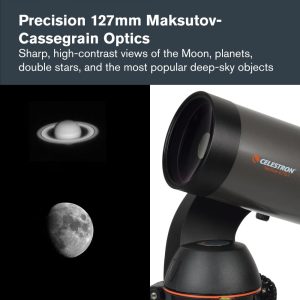
Sharp, high-contrast views of lunar and planetary objects.
-
Computerized GoTo system with access to more than 40,000 celestial objects.
-
SkyAlign technology simplifies telescope alignment.
-
Includes two eyepieces: 20mm and 9mm.
-
Automated tracking helps keep selected celestial objects in view.
-
Compact optical design makes transportation more convenient.
-
StarPointer red dot finderscope included.
-
Complimentary Starry Night Special Edition astronomy software.
-
Suitable for beginners, families, and intermediate astronomy enthusiasts.
-
Backed by a two-year US warranty and technical support.
Cons
-
Its 5-inch aperture collects less light than larger 6-inch and 8-inch telescope alternatives.
-
Maksutov-Cassegrain optics have a relatively long focal ratio, limiting their suitability for wide-field observations.
Why We Selected It
The Celestron NexStar 127SLT Maksutov-Cassegrain Telescope earns its place as our fifth selection because it combines a useful 5-inch aperture, high-contrast Maksutov-Cassegrain optics, and computerized celestial navigation in a relatively portable design.
What makes this telescope particularly appealing is its emphasis on detailed lunar and planetary observation. Its 127mm optical system provides the ability to explore familiar celestial objects while also offering opportunities to discover brighter deep-sky targets. The combination of a computerized GoTo system and SkyAlign technology further makes it easier for beginners to locate astronomical objects without relying entirely on manual navigation.
We particularly appreciate its 40,000-plus object database, two included eyepieces, and complimentary Starry Night Special Edition software. These features provide a useful starting package for anyone developing an interest in astronomy, especially families who want an educational and interactive stargazing experience.
Although its standard altitude-azimuth mount is not designed for demanding long-exposure astrophotography, the telescope remains a compelling option for visual observation and casual lunar or planetary imaging.
For beginners, families, and intermediate astronomers looking for a portable computerized telescope with sharp planetary viewing capabilities, the Celestron NexStar 127SLT is certainly worth considering.
Also read: 6 Best Budget 90mm Telescopes
6. Celestron NexStar 90SLT Computerized Telescope
The Celestron NexStar 90SLT Computerized Telescope is a compact Maksutov-Cassegrain telescope designed for beginners, casual stargazers, and astronomy enthusiasts who want an accessible way to explore the night sky. Combining a 90mm aperture with Celestron’s computerized GoTo technology, this telescope offers a practical balance between portability, automated celestial navigation, and optical performance. As the smallest model in Celestron’s SLT telescope family, it is particularly appealing to users who want a relatively lightweight instrument that can be transported easily between different observing locations.
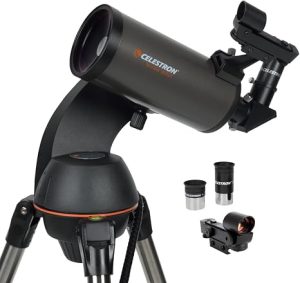
At the heart of the NexStar 90SLT is a 90mm Maksutov-Cassegrain optical system. This design combines reflective mirrors with a curved front corrector lens to gather and focus incoming light. Its folded optical arrangement allows the telescope to achieve a relatively long focal length without requiring an excessively long optical tube. This makes it particularly suitable for observing bright celestial objects, especially the Moon and planets.
Despite its relatively modest aperture, the NexStar 90SLT provides opportunities to explore several fascinating astronomical targets. Users can observe lunar craters, examine Jupiter’s cloud bands, and view Saturn’s distinctive rings under suitable atmospheric conditions. Its optical design also makes it useful for observing double stars and brighter star clusters. Although it cannot collect as much light as larger 127mm, 150mm, or 203mm telescopes, it offers a convenient starting point for people who are developing an interest in astronomy.
One of its most attractive features is its computerized GoTo system, which provides access to a database containing more than 40,000 celestial objects, including stars, galaxies, and nebulae. Rather than manually searching through star charts to locate astronomical targets, users can select an object through the computerized system and allow the telescope to move toward it automatically. The motorized mount also tracks the selected object as it moves across the night sky, making observation sessions more convenient.
For beginners who are unfamiliar with telescope alignment, the NexStar 90SLT incorporates Celestron’s SkyAlign technology. This feature allows users to center any three bright celestial objects without necessarily knowing their names. The telescope then calculates its position and establishes the alignment required for computerized operation. This simplifies the initial setup process and reduces the learning curve associated with locating celestial objects.
Portability is another important advantage of the NexStar 90SLT. Its optical tube measures approximately 21 inches, and its compact construction makes it suitable for backyard observation, weekend camping trips, and excursions to darker locations away from city lights. The telescope also comes with a StarPointer red dot finderscope, helping users initially orient the instrument toward their intended targets.
Another useful addition is the complimentary astronomy software download included with the telescope. This software provides an interactive simulation of the night sky, allowing users to explore celestial objects, learn about astronomical formations, and prepare for observation sessions before taking their equipment outdoors.
Overall, the Celestron NexStar 90SLT is an appealing option for beginners and casual astronomers who prioritize convenience, portability, and automated navigation. While its smaller aperture limits its ability to reveal faint deep-sky objects compared with larger telescopes, its Maksutov-Cassegrain optics and computerized features make it a worthwhile entry point into visual astronomy.
Key Specifications
-
Brand: Celestron
-
Model Name: NexStar 90SLT Computerized Telescope
-
Telescope Type: Maksutov-Cassegrain Catadioptric
-
Optical Tube Length: 21 inches
-
Objective Lens Diameter (Aperture): 9 centimeters (90mm)
-
Eyepiece Lens: Plössl
-
Mount Type: Computerized Altazimuth Mount
-
Focus Type: Manual Focus
-
Finderscope: StarPointer Red Dot Finderscope
-
Alignment Technology: SkyAlign
-
Computerized Control: GoTo Computerized Mount
-
Celestial Object Database: 40,000+ Objects
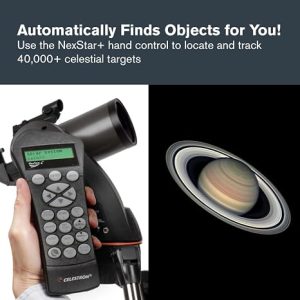
-
Power Source: Battery Powered
-
Product Dimensions: 16″D x 32″W x 54″H
-
Included Software: Free Astronomy Software Download
-
Warranty: 2 Years (US Warranty)
Key Features
90mm Maksutov-Cassegrain Optical System
The NexStar 90SLT features a 90mm aperture combined with a Maksutov-Cassegrain optical configuration. This design uses reflective mirrors and a curved corrector lens to gather and focus incoming light, producing a relatively long focal length within a compact telescope tube.
One of its main advantages is its suitability for observing bright celestial objects with good contrast. Users can explore lunar craters, observe Jupiter’s atmospheric cloud bands, and examine Saturn’s rings under favorable viewing conditions.
Its optical configuration also makes it useful for observing double stars and brighter star clusters. However, its smaller aperture means that very faint galaxies and nebulae will be more challenging to observe than with larger telescopes.
Computerized GoTo System with 40,000+ Objects
One of the defining features of the NexStar 90SLT is its computerized celestial navigation system. It provides access to a database containing more than 40,000 astronomical objects, including stars, galaxies, and nebulae.
Users can select their preferred targets through the computerized control system, allowing the telescope to move automatically toward the selected object. Its motorized tracking system then helps keep the target within the viewing area as the Earth rotates.
This feature is particularly useful for beginners who are still learning how to identify constellations and navigate the night sky.
SkyAlign Technology for Easy Setup
Celestron’s SkyAlign technology simplifies the initial alignment process by allowing users to center any three bright celestial objects.
These objects can be bright stars or planets, and users do not necessarily need to know their names. The computerized system uses their positions to calculate the telescope’s orientation and establish the alignment required for automated operation.
This makes the NexStar 90SLT particularly approachable for first-time telescope owners who may find traditional alignment procedures complicated.
Compact and Portable Construction
The NexStar 90SLT is designed with portability in mind. Its optical tube measures approximately 21 inches, making it relatively manageable for transportation and storage.
Its Maksutov-Cassegrain optical design folds the light path, allowing it to provide a long focal length without requiring a physically long telescope tube. This makes it suitable for people who enjoy observing from different locations rather than remaining restricted to their backyards.
Whether heading to a campsite, visiting a darker observing site, or simply setting up outdoors at home, its compact construction makes transportation more convenient.
StarPointer Red Dot Finderscope
The telescope includes a StarPointer red dot finderscope, which helps users initially point the optical tube toward their intended celestial targets.
It provides a useful visual reference during setup and complements the computerized alignment process. This is particularly helpful for beginners who are still becoming familiar with positioning and operating astronomical equipment.
Plössl Eyepiece
The NexStar 90SLT comes with a Plössl eyepiece, an optical design commonly used in astronomical telescopes.
Plössl eyepieces are valued for their relatively good image quality and useful apparent field of view. They can provide a practical starting point for observing the Moon, planets, and other bright celestial objects.
Users interested in exploring different magnifications can also consider additional compatible eyepieces, depending on their observing preferences.
Free Interactive Astronomy Software
Another useful addition is the complimentary astronomy software download included with the NexStar 90SLT.
The software provides an interactive simulation of the night sky, allowing users to explore celestial objects, learn about astronomical formations, and prepare for observing sessions.
This is particularly beneficial for beginners and younger astronomy enthusiasts who want to understand what they are likely to encounter before setting up their telescope.
Two-Year Warranty and Technical Support
Celestron includes a two-year US warranty and access to technical support from its US-based team.
This provides additional reassurance for buyers investing in a computerized telescope. International customers should confirm the warranty terms and support arrangements applicable to their country before purchasing.
Technology & Special Features
The Celestron NexStar 90SLT combines Maksutov-Cassegrain optical technology with computerized celestial navigation to provide a relatively compact instrument for exploring the night sky.
Its primary optical technology is the Maksutov-Cassegrain design, which uses a curved front corrector lens alongside reflective mirrors to gather and focus incoming light. This folded optical arrangement allows the telescope to achieve a relatively long focal length without requiring an excessively long optical tube.
One of its main advantages is its suitability for high-contrast observation of bright celestial objects. Its 90mm aperture provides a practical starting point for observing the Moon, planets, and brighter star clusters, although its light-gathering capabilities are more limited than those of larger-aperture alternatives.
The computerized GoTo system adds another layer of convenience. Through its computerized controls, users can access more than 40,000 celestial objects and allow the motorized mount to locate and track selected targets automatically.
Meanwhile, SkyAlign technology simplifies telescope alignment by allowing users to center three bright celestial objects. This reduces the dependence on manual navigation and makes the telescope easier to operate for newcomers.
The included interactive astronomy software further complements the telescope’s computerized features by helping users simulate the night sky, identify celestial objects, and plan future observing sessions.
Unlike some of the larger NexStar models, the 90SLT uses a standard altitude-azimuth mounting arrangement without a supplied equatorial wedge. Consequently, it is primarily intended for visual astronomy and basic lunar or planetary imaging rather than demanding long-exposure deep-sky astrophotography.
Best Uses
The Celestron NexStar 90SLT Computerized Telescope is particularly suited to:
-
Lunar observation: Its 90mm aperture allows users to explore lunar craters, mountain ranges, and other visible surface formations.
-
Planetary observation: Its long focal length makes it suitable for observing Jupiter’s cloud bands, Saturn’s rings, and other bright planets.
-
Beginner astronomy: Its computerized controls and SkyAlign technology simplify the process of locating celestial objects.
-
Automated stargazing: Its GoTo system provides access to more than 40,000 astronomical objects.
-
Double-star observation: Its optical configuration makes it useful for examining suitable double-star systems.
-
Bright deep-sky observation: It can be used to explore brighter star clusters and selected nebulae under suitable viewing conditions.
-
Family astronomy: Its compact construction and automated operation make it suitable for shared stargazing sessions involving adults and children.
-
Portable observation: Its relatively small optical tube makes it practical for camping trips, backyard astronomy, and excursions to darker observing locations.
-
Educational astronomy: Its complimentary interactive software helps users learn about celestial objects and prepare observation sessions.
Pros & Cons
Pros
-
90mm Maksutov-Cassegrain optical system.
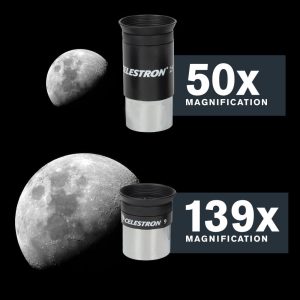
-
Compact design with a relatively long focal length.
-
Suitable for sharp observations of the Moon and bright planets.
-
Computerized GoTo system with access to more than 40,000 celestial objects.
-
SkyAlign technology simplifies telescope alignment.
-
Automated tracking helps keep selected celestial objects in view.
-
Relatively portable 21-inch optical tube.
-
Includes a StarPointer red dot finderscope.
-
Plössl eyepiece included.
-
Complimentary interactive astronomy software download.
-
Suitable for beginners, families, and casual stargazers.
-
Backed by a two-year US warranty and technical support.
Cons
-
Its 90mm aperture collects less light than larger 127mm, 150mm, and 203mm alternatives.
-
Less suitable for observing faint galaxies and nebulae.
Why We Selected It
The Celestron NexStar 90SLT Computerized Telescope earns its place as our sixth selection because it provides an accessible combination of Maksutov-Cassegrain optics, automated celestial navigation, and portability in a relatively compact telescope.
What makes this model particularly appealing is its beginner-friendly design. Its 90mm aperture provides opportunities to explore the Moon, planets, and brighter astronomical objects, while the computerized GoTo system helps users locate celestial targets without relying entirely on manual navigation.
We particularly appreciate its 40,000-plus object database, SkyAlign technology, and compact construction. These features make it an interesting choice for families, younger astronomy enthusiasts, and beginners who want to develop their understanding of the night sky through practical observation.
Although its smaller aperture limits its deep-sky observation capabilities compared with larger telescopes in this guide, it offers a convenient starting point for anyone interested in visual astronomy. Its portable design also makes it attractive to users who enjoy taking their equipment on camping trips or to locations with darker skies.
For beginners and casual stargazers seeking a computerized telescope that prioritizes convenience, portability, and lunar and planetary observation, the Celestron NexStar 90SLT is certainly worth considering.
7. Sky-Watcher Skymax 127 AZ-GTi Computerized Telescope
The Sky-Watcher Skymax 127 AZ-GTi Computerized Telescope is a compact yet capable Maksutov-Cassegrain telescope designed for astronomy enthusiasts who want a combination of optical performance, computerized tracking, and modern wireless control. Featuring a 127mm aperture and an innovative Wi-Fi-enabled altazimuth mount, this telescope offers an interesting balance between traditional optical engineering and smartphone-controlled astronomy.
At the center of this system is Sky-Watcher’s 127mm SkyMax Maksutov-Cassegrain optical tube. Its design combines mirrors and a curved corrector lens to fold the optical path, allowing the telescope to deliver a relatively long focal length within a compact 15-inch tube. This arrangement makes it particularly suitable for observing bright celestial objects that benefit from higher magnification and good image contrast.
With its 127mm aperture, the Skymax 127 gathers considerably more light than smaller 90mm telescopes, giving observers greater opportunities to explore the night sky. It is particularly well suited to lunar and planetary observation, allowing users to examine the Moon’s surface, observe Jupiter’s cloud bands, and distinguish Saturn’s rings under favorable atmospheric conditions. It can also be used to explore brighter deep-sky targets, including star clusters and selected nebulae, although its long focal length and relatively narrow field of view make it less suited to wide-field observation.
One of the most interesting aspects of this model is its AZ-GTi computerized mounting system. Unlike traditional telescope mounts that rely primarily on manual controls or a dedicated hand controller, the AZ-GTi generates its own Wi-Fi signal, allowing users to operate the telescope through a compatible smartphone or tablet. This provides a modern and convenient approach to locating celestial objects, controlling telescope movement, and tracking selected targets.
The mount also incorporates an 11-pound payload capacity, making it compatible with a variety of optical telescope tubes and many DSLR camera setups within the supported weight limit. This flexibility makes the AZ-GTi particularly appealing to users who may eventually want to experiment with different observing or imaging equipment.
Another standout feature is Sky-Watcher’s Freedom Find dual-encoder technology. This system allows users to move the telescope manually without losing its computerized alignment. For example, an observer can physically reposition the telescope toward an interesting region of the sky and then continue using the computerized tracking system without necessarily repeating the alignment procedure. This combination of manual freedom and automated precision makes the observing experience more flexible.
The AZ-GTi also includes photography-oriented capabilities. Its built-in SNAP port supports automated camera shutter control, while its photography mode provides options for creating panoramas and time-lapse sequences. These features add versatility beyond conventional visual astronomy, although the standard altazimuth configuration remains subject to field rotation during long-exposure deep-sky imaging.
Portability is another advantage. The AZ-GTi mount itself weighs approximately 8.6 pounds, making it relatively convenient for mobile astronomy. Combined with the compact SkyMax optical tube, the system is suitable for backyard observation, camping trips, and travel to darker observing locations.
The package also includes two eyepieces, identified as the Super 10mm and 25mm, providing different magnification options for observing celestial objects. A reflex finderscope further assists with initially positioning the telescope toward the intended target.
Overall, the Sky-Watcher Skymax 127 AZ-GTi is an appealing choice for intermediate beginners and experienced casual observers who want more than a basic telescope. Its 127mm Maksutov-Cassegrain optics provide a capable platform for lunar and planetary observation, while its wireless computerized mount, dual encoders, and photography features introduce a level of flexibility that makes it particularly interesting for technology-oriented astronomy enthusiasts.
Key Specifications
-
Brand: Sky-Watcher
-
Model Name: Skymax 127 AZ-GTi
-
Telescope Type: Maksutov-Cassegrain Catadioptric
-
Objective Lens Diameter (Aperture): 12.7 centimeters (127mm)
-
Optical Tube Length: 15 inches
-
Eyepieces: Super 10mm and 25mm
-
Mount Type: Computerized Altazimuth Mount
-
Mount Model: AZ-GTi
-
Mount Weight: Approximately 8.6 pounds
-
Mount Payload Capacity: 11 pounds
-
Focus Type: Manual Focus
-
Finderscope: Reflex Finderscope
-
Connectivity: Built-in Wi-Fi
-
Control Method: Compatible Smartphone or Tablet
-
Encoder Technology: Freedom Find Dual Encoders
-
Photography Features: Panorama and Time-Lapse Modes
-
Camera Connectivity: Built-in SNAP Port
-
Product Dimensions: 34″D x 30″W x 50″H
-
Listed Item Weight: 18 pounds
Key Features
127mm Maksutov-Cassegrain Optical System
The Skymax 127 features a 127mm aperture Maksutov-Cassegrain optical system designed to provide high magnification and good image contrast within a relatively compact telescope tube.
Its optical arrangement uses a curved front corrector lens and reflective mirrors to fold the incoming light path. This allows the telescope to achieve a relatively long focal length without requiring the physical length associated with many traditional telescope designs.
The 127mm aperture provides a useful amount of light-gathering capability for exploring the Moon, planets, double stars, and brighter deep-sky objects. Compared with smaller 90mm Maksutov-Cassegrain telescopes, it offers greater light collection, making it a worthwhile step up for observers interested in exploring more astronomical targets.
Computerized AZ-GTi Altazimuth Mount
The AZ-GTi mount is one of the defining features of this telescope. It provides computerized movement and tracking, allowing users to locate and follow selected celestial objects without constantly adjusting the telescope manually.
Its altazimuth configuration moves the optical tube horizontally and vertically, providing straightforward positioning and a convenient observing experience.
The mount also has an impressive payload capacity of approximately 11 pounds, allowing it to support the included Skymax 127 optical tube and a variety of other compatible telescope tubes or camera configurations within its weight limit.
This flexibility makes the AZ-GTi more than just a mounting system for one telescope. It can also serve as a foundation for future equipment configurations.
Wi-Fi Connectivity and Smartphone Control
One of the most attractive features of the AZ-GTi is its built-in Wi-Fi capability.
Rather than requiring users to operate the telescope exclusively through traditional physical controls, the mount generates its own proprietary Wi-Fi signal. Compatible smartphones and tablets can connect to this network and control telescope movement through the appropriate astronomy application.
This allows users to interact with their equipment using a familiar mobile device, making celestial navigation more accessible and convenient.
For beginners, this can reduce the intimidation associated with computerized telescope controls. More experienced observers can also appreciate the convenience of adjusting telescope positioning and tracking through a wireless interface.
Freedom Find Dual-Encoder Technology
Sky-Watcher incorporates its patented Freedom Find dual-encoder technology into the AZ-GTi mount.
This feature allows users to move the telescope manually without losing the computerized alignment already established during setup.
Ordinarily, manually repositioning a computerized telescope can interfere with its alignment, potentially requiring the user to repeat the setup procedure. Freedom Find helps avoid this inconvenience by allowing the mount to recognize manual movement while maintaining its ability to track celestial objects.
This provides a useful combination of manual control and computerized convenience, particularly during observation sessions where users want to explore nearby objects without repeatedly restarting the alignment process.
11-Pound Payload Capacity
The AZ-GTi mount supports an approximate payload capacity of 11 pounds, providing flexibility for different telescope tubes and compatible camera equipment.
This is particularly useful for astronomy enthusiasts who may want to expand their equipment collection over time.
For example, users can explore alternative optical configurations or experiment with DSLR camera setups, provided the complete equipment arrangement remains within the mount’s supported capacity.
The additional flexibility makes the AZ-GTi an interesting investment for observers who do not want to be restricted to a single optical tube configuration.
Panorama and Time-Lapse Photography Modes
Beyond conventional visual observation, the AZ-GTi incorporates photography-oriented features that allow users to experiment with automated imaging projects.
Its photography mode supports panorama and time-lapse creation, making it possible to capture sequences of images across different sections of the sky or document changes over time.
The mount also includes a built-in SNAP port, which supports automated camera shutter control with compatible camera equipment.
These features can be particularly useful for users interested in experimenting with night-sky photography, landscape panoramas, and time-lapse projects.
However, it is important to distinguish these capabilities from advanced deep-sky astrophotography. Since the AZ-GTi uses an altazimuth mount, it experiences field rotation during tracking, which limits its suitability for demanding long-exposure imaging without additional equipment or specialized techniques.
Super 10mm and 25mm Eyepieces
The telescope package includes two eyepieces: a Super 10mm and a 25mm.
These provide different magnification options, allowing users to adjust their viewing experience depending on the celestial object being observed.
The 25mm eyepiece provides lower magnification and is useful for initially locating objects and observing larger celestial targets. The 10mm eyepiece offers higher magnification, making it useful for examining smaller and more detailed objects, particularly the Moon and planets when atmospheric conditions permit.
Having two eyepieces included gives beginners a practical starting point without immediately requiring additional optical accessories.
Reflex Finderscope
The Skymax 127 AZ-GTi also includes a reflex finderscope to assist with initial telescope positioning.
This accessory provides a simple visual reference that helps users direct the optical tube toward their intended observing region.
Although the computerized mount handles much of the object-location process, a finderscope remains useful during setup and alignment.
Technology & Special Features
The Sky-Watcher Skymax 127 AZ-GTi combines traditional Maksutov-Cassegrain optical engineering with modern computerized mounting technology.
Its optical system uses a 127mm aperture and a folded light path to deliver a relatively long focal length within a compact telescope tube. This arrangement is particularly useful for observing bright celestial objects that benefit from higher magnification and good contrast.
However, the most distinctive technology is arguably the AZ-GTi wireless computerized mount. By generating its own Wi-Fi signal, the mount allows compatible smartphones and tablets to function as wireless telescope controllers. This reduces reliance on conventional manual navigation and makes it easier to explore celestial objects through computerized positioning.
Another important innovation is the Freedom Find dual-encoder system. By recognizing manual movement, this technology allows observers to reposition the telescope without automatically losing their computerized alignment. It creates a more flexible operating experience by combining traditional hands-on telescope movement with automated tracking.
The mount’s photography capabilities add further versatility. Its panorama and time-lapse modes, together with the built-in SNAP port, provide opportunities to experiment with automated camera operation.
Its 11-pound payload capacity is also worth highlighting because it allows the mount to accommodate different compatible telescope tubes and camera arrangements, subject to the manufacturer’s mounting and balance requirements.
While these features make the AZ-GTi a versatile platform, its altazimuth design is primarily intended for visual astronomy and selected short-exposure imaging applications. Long-exposure deep-sky astrophotography generally benefits from an equatorial tracking arrangement that compensates for the apparent rotation of the sky.
Best Uses
The Sky-Watcher Skymax 127 AZ-GTi Computerized Telescope is particularly suited to:
-
Lunar observation: Its 127mm aperture and Maksutov-Cassegrain optics provide opportunities to examine lunar craters, mountain ranges, and other surface features.
-
Planetary observation: Its optical configuration makes it particularly useful for viewing Jupiter’s cloud bands, Saturn’s rings, and other bright planets.
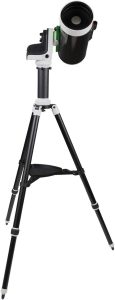
-
Computerized stargazing: Its AZ-GTi mount provides automated positioning and tracking of selected celestial objects.
-
Beginner and intermediate astronomy: Smartphone control and computerized navigation make it accessible to users developing their observing skills.
-
Bright deep-sky observation: It can be used to explore brighter star clusters and selected nebulae under suitable sky conditions.
-
Double-star observation: Its relatively high magnification capabilities make it useful for examining suitable double-star systems.
-
Mobile astronomy: Its compact optical tube and lightweight mount make it convenient for transporting to different observing locations.
-
Time-lapse photography: Its photography mode and SNAP port support automated camera operation for compatible setups.
-
Panorama photography: The mount’s photography capabilities provide opportunities to capture panoramic sequences.
-
Equipment experimentation: Its 11-pound payload capacity allows compatible alternative telescope tubes and camera configurations to be mounted.
Pros & Cons
Pros
-
127mm Maksutov-Cassegrain optical system.
-
Good contrast for lunar and planetary observation.
-
Compact 15-inch optical tube.
-
Computerized AZ-GTi altazimuth tracking mount.
-
Built-in Wi-Fi connectivity for smartphone and tablet control.
-
Freedom Find dual-encoder technology allows manual movement without losing alignment.
-
11-pound mount payload capacity.
-
Supports compatible telescope tubes and DSLR camera configurations.
-
Panorama and time-lapse photography modes.
-
Built-in SNAP port for automated camera shutter control.
-
Includes Super 10mm and 25mm eyepieces.
-
Reflex finderscope included.
-
Suitable for portable and mobile astronomy.
Cons
-
The 127mm aperture collects less light than larger 150mm and 203mm telescope alternatives.
-
Its long focal length provides a relatively narrow field of view.
Why We Selected It
The Sky-Watcher Skymax 127 AZ-GTi Computerized Telescope earns its place as our seventh selection because it combines capable Maksutov-Cassegrain optics with a modern wireless mounting system that offers considerably more flexibility than a basic manual telescope.
What makes this model particularly interesting is the way it brings together optical performance and technology. Its 127mm aperture provides a useful platform for lunar and planetary observation, while the computerized AZ-GTi mount allows users to locate and track celestial objects through smartphone or tablet control.
We particularly appreciate its Freedom Find dual-encoder technology. The ability to move the telescope manually without losing computerized alignment is a practical advantage that makes observing sessions more flexible. Its 11-pound payload capacity also provides opportunities for experimenting with different compatible telescope tubes and camera configurations.
Another reason we selected this model is its photography-oriented functionality. The built-in SNAP port and panorama and time-lapse modes introduce additional possibilities for astronomy enthusiasts who want to explore imaging alongside conventional visual observation.
Although its altazimuth mount is not the ideal platform for demanding long-exposure deep-sky astrophotography, its overall combination of portability, computerized navigation, and optical capability makes it a compelling option for visual astronomers.
For anyone seeking a compact telescope with a capable 127mm optical system, wireless control, and room to experiment with different observing and photography applications, the Sky-Watcher Skymax 127 AZ-GTi is certainly worth considering.
8. Sky-Watcher Maksutov-Cassegrain 102mm Telescope
The Sky-Watcher Maksutov-Cassegrain 102mm Telescope is a compact optical instrument designed for astronomy enthusiasts who value portability, optical contrast, and versatility. Featuring a 102mm aperture Maksutov-Cassegrain optical system, this telescope combines carefully matched mirrors, a coated corrector plate, and a fully baffled optical tube to deliver clear, contrast-rich views of celestial objects.
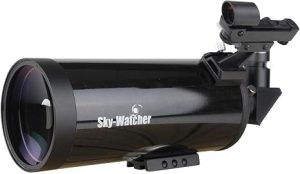
Unlike larger computerized telescope packages that integrate automated navigation and tracking systems, this Sky-Watcher model focuses on providing a capable optical tube that can be paired with a compatible altazimuth mount or photographic tripod. Its relatively lightweight construction makes it particularly appealing to beginners, casual stargazers, and experienced observers looking for a portable telescope that can be transported without much difficulty.
At the center of its optical performance is a 102mm Maksutov-Cassegrain design. This catadioptric configuration combines reflective mirrors with a curved corrector plate to fold the optical path, allowing the telescope to achieve a relatively long focal length within a compact tube. The result is an instrument particularly suited to observing bright celestial objects, including the Moon, planets, and double stars.
The telescope’s 102mm objective aperture provides a useful balance between light-gathering ability and portability. It gathers more light than smaller 70mm and 90mm instruments, giving users additional opportunities to explore astronomical targets. Under suitable observing conditions, users can examine lunar craters, observe Jupiter’s cloud bands, and view Saturn’s rings. It can also reveal brighter star clusters and selected deep-sky objects, although its relatively long focal length makes it less suitable for wide-field observation.
One of the most impressive aspects of this model is its 94% mirror reflectivity rating. Sky-Watcher achieves this through a borosilicate primary mirror featuring an aluminum coating and quartz overcoat. These coatings are designed to improve light reflection within the optical system, helping the telescope deliver efficient light transmission and detailed images.
The optical tube also features a fully baffled interior. This construction helps prevent unwanted stray light from interfering with incoming light, improving contrast and supporting darker-looking backgrounds around observed objects. Combined with the matched primary and secondary mirrors and coated corrector plate, this creates an optical system designed to produce satisfying viewing experiences.
Another advantage is its standardized Vixen-style dovetail mounting system. This widely used mounting interface allows the telescope to be attached to compatible astronomical mounts. Additionally, the inclusion of a 1/4-20 tripod thread beneath the dovetail bar provides another mounting option, making it possible to use many compatible photographic tripods.
Sky-Watcher also provides several useful accessories to help users begin observing shortly after assembling their equipment. These include 10mm and 25mm 1.25-inch eyepieces, a red-dot finder, a 90-degree star diagonal, and a padded carrying bag. Having two eyepieces provides different magnification options, while the star diagonal offers a more comfortable viewing position when observing objects high in the sky.
Overall, the Sky-Watcher Maksutov-Cassegrain 102mm is an attractive option for anyone seeking a lightweight telescope with carefully engineered optics and flexible mounting compatibility. While it does not offer the automated GoTo capabilities of some computerized alternatives, its optical coatings, baffled tube, and compact construction make it a worthwhile choice for visual astronomy and portable observing.
Key Specifications
-
Brand: Sky-Watcher
-
Model Name: Sky-Watcher Maksutov-Cassegrain 102mm
-
Telescope Type: Maksutov-Cassegrain Catadioptric
-
Objective Lens Diameter (Aperture): 10.2 centimeters (102mm)
-
Eyepieces Included: 10mm and 25mm, 1.25-inch
-
Additional Eyepiece Accessory: Barlow (as indicated in the product listing)
-
Mount Compatibility: Altazimuth Mount
-
Mounting Interface: Vixen-Style Dovetail
-
Additional Tripod Connection: 1/4-20 Tripod Thread
-
Focus Type: Manual Focus
-
Finderscope: Red-Dot Reflex Finder
-
Mirror Reflectivity: 94%
-
Optical Tube Construction: Fully Baffled
-
Primary Mirror Material: Borosilicate Glass
-
Mirror Coating: Aluminum with Quartz Overcoat
-
Corrector Plate: Coated Corrector Plate
-
Power Source: Battery Powered (for compatible powered mounting equipment)
-
Product Dimensions: 12.25″D x 4.63″W x 4.63″H
-
Item Weight: 4.6 pounds
-
Included Accessories: 10mm and 25mm Eyepieces, Red-Dot Finder, 90-Degree Star Diagonal, and Padded Carrying Bag
Key Features
102mm Maksutov-Cassegrain Optical System
The Sky-Watcher 102mm features a Maksutov-Cassegrain optical configuration designed to provide good image contrast and detailed views within a relatively compact telescope tube.
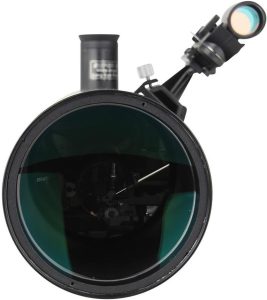
Its optical system combines a curved corrector plate with primary and secondary mirrors to fold the incoming light path. This arrangement allows the telescope to achieve a relatively long focal length without requiring a physically long optical tube.
With its 102mm aperture, the telescope offers a useful amount of light-gathering capability for observing the Moon, planets, double stars, and brighter deep-sky objects. Its optical design is particularly appealing to observers who prioritize detailed views of smaller, brighter celestial targets.
94% Reflectivity Mirror Coatings
One of the standout features of this telescope is its 94% mirror reflectivity rating.
The primary mirror is constructed from borosilicate glass and features an aluminum coating with a quartz overcoat. These coatings are designed to improve the amount of incoming light reflected through the optical system.
Efficient reflection is important because light must travel through the telescope’s optical components before reaching the eyepiece. By using highly reflective mirror coatings, Sky-Watcher aims to preserve light transmission and support bright, detailed observations.
For astronomy enthusiasts, this contributes to the telescope’s overall optical performance, particularly when examining bright objects such as the Moon and planets.
Fully Baffled Optical Tube
The Skymax 102 features a fully baffled optical tube designed to minimize the effects of unwanted stray light.
Stray light can enter the telescope and scatter within its optical tube, potentially reducing image contrast and making the background around celestial objects appear brighter than desired.
The internal baffling helps limit this interference by controlling unwanted light paths before they reach the eyepiece.
This is particularly useful when observing bright astronomical objects against darker backgrounds, where contrast plays an important role in distinguishing visible details.
Matched Primary and Secondary Mirrors
Sky-Watcher’s Maksutov-Cassegrain optical tubes feature carefully matched primary and secondary mirrors alongside a coated corrector plate.
These components work together to gather, reflect, and focus incoming light into a usable image.
The combination is designed to provide contrast-rich observations while maintaining the compact characteristics associated with Maksutov-Cassegrain telescopes.
For users interested in lunar and planetary observation, this optical arrangement provides a practical foundation for exploring fine details in bright celestial targets.
Vixen-Style Dovetail Mounting System
Another important feature is the telescope’s Vixen-style dovetail mounting interface.
The Vixen dovetail is a widely used standard in astronomical equipment, making it easier to attach compatible optical tubes to a variety of telescope mounts.
This gives users flexibility when selecting or upgrading their mounting equipment. Rather than being permanently restricted to one particular mount, the telescope can be paired with compatible alternatives as observing needs evolve.
Additionally, Sky-Watcher includes a 1/4-20 tripod thread beneath the dovetail bar. This provides another mounting option, allowing the telescope to be attached to many compatible photographic tripods.
10mm and 25mm Eyepieces
The telescope comes with two 1.25-inch eyepieces: a 10mm and a 25mm.
These provide different magnification levels, allowing users to adapt their observations depending on the size and characteristics of their chosen target.
The 25mm eyepiece offers lower magnification and is useful for locating objects and observing relatively larger targets. The 10mm eyepiece provides higher magnification, making it more suitable for examining details on the Moon and planets when atmospheric conditions permit.
This combination gives beginners a convenient starting point without requiring them to purchase additional eyepieces immediately.
Red-Dot Reflex Finder
The included red-dot reflex finder helps users initially point the telescope toward their intended observing targets.
By providing a visible reference against the night sky, it makes it easier to orient the optical tube before looking through the main eyepiece.
This is particularly useful for beginners who are still developing their telescope-positioning skills.
90-Degree Star Diagonal
Sky-Watcher includes a 90-degree star diagonal to make observing more comfortable.
The diagonal redirects the light emerging from the rear of the telescope, allowing users to look through the eyepiece from a more convenient angle.
This can be especially helpful when observing objects positioned high overhead, where looking directly into the rear of the optical tube may otherwise require an uncomfortable viewing position.
Lightweight Construction and Padded Carrying Bag
Weighing approximately 4.6 pounds, the optical tube is designed with portability in mind.
Its compact dimensions make it relatively easy to transport, store, and attach to compatible mounting equipment.
The included padded carrying bag provides additional convenience by helping protect the telescope during transportation and storage. This makes the Skymax 102 a practical option for observers who frequently travel to different viewing locations.
Technology & Special Features
The Sky-Watcher Maksutov-Cassegrain 102mm combines a compact catadioptric optical design with several features intended to improve image quality, mounting flexibility, and ease of transportation.
Its central optical technology is the Maksutov-Cassegrain configuration, which combines reflective mirrors and a curved corrector plate to fold the light path within a relatively short optical tube. This design provides a practical balance between aperture, focal length, and portability.
A particularly noteworthy specification is its 94% mirror reflectivity rating. The borosilicate primary mirror uses an aluminum coating with a quartz overcoat, helping maximize reflection within the optical system. The matched mirrors and coated corrector plate further contribute to the telescope’s intended contrast-rich viewing performance.
Another important feature is its fully baffled optical tube. Internal baffles help control stray light, reducing unwanted interference that can affect the contrast of observed objects. This is particularly beneficial when viewing bright celestial targets against darker backgrounds.
The telescope’s Vixen-style dovetail introduces additional versatility by allowing it to connect to compatible astronomical mounts. The supplementary 1/4-20 tripod thread also makes it possible to use many compatible photographic tripods, offering an alternative mounting arrangement for portable observation.
Unlike computerized telescopes, this model relies on manual positioning and focusing. Consequently, users have greater freedom to choose compatible mounting arrangements but must locate and track celestial objects themselves unless using a computerized mount.
The included 10mm and 25mm eyepieces, red-dot finder, 90-degree star diagonal, and padded carrying bag make it a convenient package for getting started with visual astronomy.
Best Uses
The Sky-Watcher Maksutov-Cassegrain 102mm Telescope is particularly suited to:
-
Lunar observation: Its 102mm aperture and Maksutov-Cassegrain optics allow users to explore lunar craters, mountain ranges, and other surface formations.
-
Planetary observation: Its optical design is suitable for viewing Jupiter’s cloud bands, Saturn’s rings, and other bright planets under favorable conditions.
-
Double-star observation: Its relatively long focal length makes it useful for examining suitable double-star systems.
-
Bright deep-sky observation: It can be used to explore brighter star clusters and selected nebulae, although faint targets will be more challenging.
-
Portable astronomy: Its 4.6-pound weight makes it convenient for transporting to different observing locations.
-
Backyard stargazing: Its compact design makes it practical for regular observation sessions at home.
-
Tripod-based observation: Its Vixen-style dovetail and 1/4-20 tripod thread provide mounting flexibility.
-
Beginner astronomy: Its included eyepieces, reflex finder, and star diagonal provide useful accessories for newcomers.
-
Equipment upgrades: Its standardized dovetail mounting system allows users to explore compatible telescope mounts as their astronomy interests develop.
Pros & Cons
Pros
-
102mm Maksutov-Cassegrain optical system.
-
Compact and lightweight 4.6-pound optical tube.
-
94% mirror reflectivity rating.
-
Borosilicate primary mirror with aluminum coating and quartz overcoat.
-
Matched primary and secondary mirrors.
-
Fully baffled optical tube helps minimize stray light.
-
Designed to provide contrast-rich lunar and planetary observations.
-
Standard Vixen-style dovetail mounting interface.
-
Additional 1/4-20 tripod thread for compatible photographic tripods.
-
Includes 10mm and 25mm 1.25-inch eyepieces.
-
Red-dot reflex finder included.
-
90-degree star diagonal included.
-
Padded carrying bag for transportation and storage.
-
Compatible with a variety of suitable astronomical mounts.
Cons
-
Does not include an integrated computerized GoTo navigation system.
-
Manual positioning requires users to locate celestial objects themselves.
Why We Selected It
The Sky-Watcher Maksutov-Cassegrain 102mm Telescope earns its place as our eighth selection because it offers a thoughtfully engineered optical system in a lightweight and highly portable package.
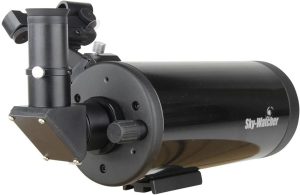
What makes this telescope particularly appealing is its attention to optical performance. Its 94% reflectivity mirror coatings, matched optical components, and fully baffled tube demonstrate Sky-Watcher’s focus on delivering contrast-rich observations. These features make it an interesting choice for astronomy enthusiasts who want to explore the Moon, planets, and other bright celestial objects without investing in a considerably larger telescope.
We particularly appreciate its Vixen-style dovetail mounting system and additional 1/4-20 tripod thread. These features give users flexibility when choosing compatible mounting equipment, making the telescope suitable for different observing arrangements. Its relatively low weight also makes transportation much easier, especially for people who enjoy visiting darker locations away from city lights.
The included accessories are another advantage. With two eyepieces, a red-dot finder, a 90-degree star diagonal, and a padded carrying bag, users receive several useful components for beginning their observing journey.
Although it lacks the computerized navigation and automated tracking available in some of the other telescopes featured in this guide, it makes up for this with portability, optical engineering, and mounting versatility.
For beginners and experienced casual observers seeking a compact Maksutov-Cassegrain telescope with carefully designed optics and flexible mounting options, the Sky-Watcher Maksutov-Cassegrain 102mm is a worthy addition to our list of the best catadioptric telescopes.
9. SARBLUE Mak70 Maksutov-Cassegrain Telescope
The SARBLUE Mak70 Maksutov-Cassegrain Telescope is a compact and travel-friendly catadioptric telescope designed for beginners, casual stargazers, and outdoor enthusiasts who want an accessible way to explore both terrestrial and celestial objects. Featuring a 70mm aperture, a folded 1000mm focal length, and a lightweight optical tube measuring approximately 21 centimeters, this telescope combines a portable design with optical features intended to deliver clear and detailed viewing experiences.
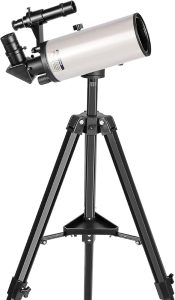
One of its most interesting characteristics is its Maksutov-Cassegrain optical design. This configuration combines reflective mirrors with a curved corrector lens to fold the optical path, allowing the telescope to achieve a relatively long focal length without requiring an equally long physical tube. In the case of the Mak70, the 1000mm focal length is accommodated within an optical tube measuring just 210mm. This makes it particularly attractive to users who want a telescope that can fit conveniently into a backpack when travelling or heading out for a camping trip.
Despite its small size, the Mak70 offers several features that make it suitable for exploring the night sky. Its 70mm aperture gathers light for observing bright astronomical objects, including the Moon, planets, and brighter star clusters. Under favorable viewing conditions, users can examine lunar craters, observe Jupiter, and explore Saturn’s rings. However, its relatively small aperture means that faint galaxies and nebulae will be more difficult to observe compared with those viewed through larger-aperture telescopes.
The telescope’s optical components are fully multi-coated, with high-reflectivity coatings designed to improve light transmission and preserve image quality. These coatings, combined with the Maksutov-Cassegrain configuration, help reduce optical aberrations and produce crisp views of terrestrial and celestial targets.
Another standout feature is its micro-movement tripod with slow-motion controls. Unlike basic tripods that rely entirely on quick manual adjustments, this system combines quick positioning with finer movements, allowing users to make more controlled adjustments when centering an object. This can be particularly useful when observing planets or other small celestial targets at higher magnifications.
The tripod is also adjustable, extending from approximately 23 inches to 56 inches. This provides flexibility when choosing a comfortable observing height and makes the equipment useful for different environments. The telescope can also be attached to compatible field tripods through its 3/8-inch or 1/4-20 threaded mounting connections.
SARBLUE includes several accessories to make the Mak70 more versatile. These include a 20mm eyepiece offering 50x magnification, a 10mm photographic eyepiece offering 100x magnification, and a 5×24 finderscope with adjustable positioning. The package also includes a universal smartphone mount and a 1.5x Barlow lens, allowing users to connect a compatible smartphone and experiment with basic astrophotography.
The smartphone compatibility is particularly appealing to beginners who want to document their observations without immediately investing in dedicated astronomical cameras. While smartphone imaging can be useful for capturing the Moon and other bright targets, the telescope’s small aperture and manual tracking arrangement make it less suitable for demanding deep-sky astrophotography.
Overall, the SARBLUE Mak70 is an interesting option for anyone looking for a compact, lightweight, and relatively versatile telescope. Its combination of Maksutov-Cassegrain optics, adjustable tripod, slow-motion controls, and smartphone photography accessories makes it particularly attractive to beginners and travelers who want to explore astronomy without carrying bulky equipment.
Key Specifications
-
Brand: SARBLUE
-
Model Name: Mak70
-
Telescope Type: Maksutov-Cassegrain Catadioptric
-
Objective Lens Diameter (Aperture): 7 centimeters (70mm)
-
Focal Length: 1000mm
-
Optical Tube Length: 21 centimeters (210mm)
-
Optical Coatings: Fully Multi-Coated
-
Eyepieces Included: 20mm Eyepiece and 10mm Photographic Eyepiece
-
Magnification: 50x with 20mm Eyepiece; 100x with 10mm Eyepiece
-
Additional Optical Accessory: 1.5x Barlow Lens
-
Mount Type: Gimbal-Style Mount with Slow-Motion Controls
-
Tripod Height: Adjustable from 23 to 56 inches
-
Focus Type: Manual Focus
-
Finderscope: 5×24 Adjustable Finderscope
-
Smartphone Compatibility: Universal Smartphone Mount
-
Tripod Compatibility: 3/8-inch and 1/4-20 Threaded Connections
-
Compatible Devices: Smartphone
-
Product Dimensions: 24″D x 5.5″W x 10″H
Key Features
70mm Maksutov-Cassegrain Optical System
The SARBLUE Mak70 features a 70mm aperture Maksutov-Cassegrain optical system designed to deliver clear views within a compact optical tube.
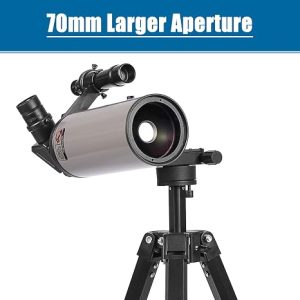
This catadioptric configuration combines reflective mirrors with a curved corrector lens to fold the incoming light path. This allows the telescope to achieve a relatively long focal length while maintaining a much shorter physical length.
With its 70mm aperture, the Mak70 provides an accessible starting point for observing bright celestial objects. Users can explore the Moon’s surface, observe brighter planets, and examine selected star clusters under suitable sky conditions.
Its optical design also makes it useful for terrestrial observation, allowing users to examine distant landscapes and other outdoor subjects.
1000mm Focal Length in a Compact 210mm Tube
One of the most impressive characteristics of the Mak70 is its ability to accommodate a 1000mm focal length within a tube measuring approximately 210mm.
This is made possible by the folded optical path associated with Maksutov-Cassegrain telescopes. Instead of requiring a physically long tube to achieve the desired focal length, the optical system redirects light internally before bringing it to focus.
The resulting compact construction makes the Mak70 particularly convenient for transportation and storage.
Its relatively long focal length also supports higher magnification, making it useful for examining smaller, distant objects such as the Moon and planets.
Fully Multi-Coated Optical Components
The Mak70 incorporates fully multi-coated optical components designed to improve light transmission and support clear image formation.
These coatings help reduce unwanted light reflection at optical surfaces, allowing more light to pass through the system.
SARBLUE also highlights the high reflectivity and durability of its optical coatings, which are intended to maintain their performance over time.
Combined with the Maksutov-Cassegrain design, these features contribute to the telescope’s ability to produce crisp views of terrestrial and celestial objects.
Micro-Movement Tripod with Slow-Motion Controls
Another distinctive feature is the included micro-movement tripod.
This mounting arrangement combines quick movement with slower, more controlled adjustments, allowing users to position the telescope and make finer corrections when centering an observing target.
Slow-motion controls are particularly useful at higher magnifications because even relatively small movements can cause an object to shift noticeably within the eyepiece’s field of view.
For beginners, this can make the observation process more manageable, especially when following small targets such as planets.
Adjustable Tripod from 23 to 56 Inches
The Mak70 comes with an adjustable tripod that extends from approximately 23 inches to 56 inches.
This provides flexibility when selecting an observing position, whether users are sitting, standing, or setting up the telescope on different outdoor surfaces.
The tripod can also support compatible telescope tubes and DSLR camera configurations equipped with suitable dovetail mounting arrangements, subject to the manufacturer’s weight and compatibility requirements.
Its 3/8-inch and 1/4-20 threaded connections provide additional mounting flexibility, allowing the telescope to be attached to compatible field tripods.
20mm and 10mm Eyepieces
SARBLUE includes two eyepieces designed to provide different magnification options.
The 20mm eyepiece delivers approximately 50x magnification, while the 10mm photographic eyepiece provides approximately 100x magnification.
The 20mm eyepiece is useful for general observation and locating celestial objects, while the 10mm option provides greater magnification for examining smaller targets.
This combination gives beginners an opportunity to experiment with different viewing levels without immediately purchasing additional eyepieces.
Actual viewing performance at higher magnifications will depend on atmospheric conditions, target brightness, and the stability of the mounting arrangement.
1.5x Barlow Lens and Smartphone Photography
One of the most appealing accessories included with the Mak70 is its universal smartphone mount paired with a 1.5x Barlow lens.
The smartphone mount allows users to position a compatible phone behind the eyepiece, making it possible to capture photographs and videos of objects viewed through the telescope.
The Barlow lens increases the effective magnification of the optical arrangement, providing another option for experimenting with closer views.
This makes the telescope particularly attractive to beginners who want to document their observations or share images of the Moon and other bright targets.
Although the included accessories provide an accessible introduction to smartphone astrophotography, they should not be confused with the capabilities of dedicated astronomical imaging equipment. Capturing detailed deep-sky images generally requires more specialized cameras and tracking systems.
5×24 Adjustable Finderscope
The Mak70 includes a 5×24 finderscope with adjustable positioning.
This accessory helps users initially identify and align the telescope with their intended observing targets before looking through the main eyepiece.
Its adjustable angle and position provide additional flexibility during setup, helping beginners become familiar with locating objects in the sky.
Compact and Travel-Friendly Construction
Portability is one of the Mak70’s strongest selling points.
Its 210mm optical tube is considerably shorter than many traditional telescopes, while its Maksutov-Cassegrain design provides a 1000mm focal length within this compact arrangement.
This makes it convenient for users who want to carry their telescope during camping trips, outdoor excursions, or visits to locations with darker skies.
Its compact construction also makes storage easier for people who have limited space at home.
Technology & Special Features
The SARBLUE Mak70 combines Maksutov-Cassegrain optical technology with practical mounting and smartphone imaging accessories to create a compact telescope intended for both terrestrial and celestial observation.
Its central optical feature is the folded Maksutov-Cassegrain light path. By using reflective mirrors and a curved corrector lens, the telescope achieves a 1000mm focal length within a physical tube measuring approximately 210mm. This arrangement provides the benefits of a relatively long focal length without the bulk associated with many traditional optical tube designs.
The fully multi-coated optical components are another important part of its construction. These coatings are designed to improve light transmission and reduce unwanted reflections, supporting clear and contrast-rich views. The optical configuration also helps reduce aberrations, contributing to its suitability for observing distant terrestrial objects and bright celestial targets.
The micro-movement tripod introduces additional control through its combination of quick positioning and slow-motion adjustments. This makes it easier to make small corrections when observing objects at higher magnifications.
Its adjustable tripod extends from 23 to 56 inches and supports different observing positions. The 3/8-inch and 1/4-20 threaded connections also provide compatibility with suitable photographic and field tripods.
Another distinctive feature is its smartphone imaging arrangement. The universal phone mount and 1.5x Barlow lens allow users to experiment with basic photography through the telescope, particularly when observing bright targets such as the Moon.
The included 20mm and 10mm eyepieces provide approximately 50x and 100x magnification respectively, while the adjustable 5×24 finderscope assists with initial target alignment.
Unlike computerized GoTo telescopes, the Mak70 relies on manual focusing and positioning. This makes it a straightforward option for users who prefer hands-on observation, although manually following celestial objects requires more effort than using a motorized tracking mount.
Best Uses
The SARBLUE Mak70 Maksutov-Cassegrain Telescope is particularly suited to:
-
Lunar observation: Its 70mm aperture and 1000mm focal length make it suitable for examining lunar craters and other prominent surface features.
-
Planetary observation: Users can explore bright planets such as Jupiter and Saturn under favorable viewing conditions.
-
Terrestrial observation: Its optical design supports viewing distant landscapes and other outdoor subjects.
-
Beginner astronomy: Its included eyepieces, finderscope, and slow-motion controls provide a practical starting point for learning telescope operation.
-
Smartphone astrophotography: Its universal smartphone mount and 1.5x Barlow lens allow users to experiment with capturing images through the eyepiece.
-
Camping and travel: Its compact 210mm optical tube makes it convenient to transport in a backpack or travel bag.
-
Backyard stargazing: Its lightweight construction makes it suitable for casual observation sessions at home.
-
Bright star clusters: It can be used to explore selected brighter star clusters under suitable observing conditions.
-
Educational astronomy: Its accessible design and smartphone compatibility make it useful for introducing younger users to basic astronomical observation.
Pros & Cons
Pros
-
Compact 70mm Maksutov-Cassegrain optical system.
-
1000mm focal length within a 210mm optical tube.
-
Fully multi-coated optical components.
-
Designed to reduce optical aberrations and produce crisp views.
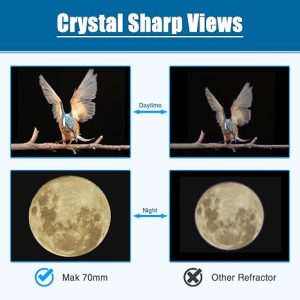
-
Suitable for lunar, planetary, and terrestrial observation.
-
Lightweight and travel-friendly construction.
-
Micro-movement tripod with slow-motion controls.
-
Adjustable tripod extending from 23 to 56 inches.
-
Compatible with suitable 3/8-inch and 1/4-20 tripod connections.
-
Includes 20mm and 10mm eyepieces.
-
Provides 50x and 100x magnification with the included eyepieces.
-
Includes a 1.5x Barlow lens.
-
Universal smartphone mount for basic astrophotography.
-
Adjustable 5×24 finderscope.
-
Suitable for beginners and casual astronomy enthusiasts.
Cons
-
Its 70mm aperture collects less light than larger 90mm, 102mm, 127mm, and 203mm alternatives.
- Less suitable for observing faint galaxies and nebulae.
Why We Selected It
The SARBLUE Mak70 Maksutov-Cassegrain Telescope earns its place as our ninth and final selection because it offers a compact and accessible approach to astronomy without sacrificing several useful optical and practical features.
What makes this model particularly interesting is its ability to deliver a 1000mm focal length within a 210mm optical tube. Its folded Maksutov-Cassegrain design makes it exceptionally convenient for users who want a telescope that can be transported easily, whether for camping trips, outdoor adventures, or casual backyard observation.
We particularly appreciate its fully multi-coated optical components and micro-movement tripod. The optical coatings are designed to support clear, contrast-rich viewing, while the slow-motion controls provide greater precision when positioning the telescope toward smaller celestial targets.
The included accessories also add considerable value for beginners. With two eyepieces, a 1.5x Barlow lens, a smartphone mount, and an adjustable finderscope, users have several useful tools for exploring the night sky and experimenting with basic smartphone photography.
Although its 70mm aperture cannot match the light-gathering capabilities of the larger telescopes featured in this guide, its portability and beginner-friendly accessories make it an appealing alternative for casual observers.
For anyone seeking a compact telescope that can handle basic lunar and planetary observation, terrestrial viewing, and introductory smartphone astrophotography, the SARBLUE Mak70 is a worthwhile option to consider.
Frequently Asked Questions (FAQs)
1. What is a catadioptric telescope?
A catadioptric telescope is an optical instrument that combines mirrors and lenses to gather and focus incoming light. Unlike refracting telescopes, which primarily use lenses, or reflecting telescopes, which rely on mirrors, catadioptric designs use both optical elements to produce images.
The two most common types are Schmidt-Cassegrain and Maksutov-Cassegrain telescopes. Both use a folded optical path, allowing them to achieve relatively long focal lengths within compact optical tubes. This makes them popular among astronomy enthusiasts who want a balance between portability, optical performance, and versatility.
2. Are catadioptric telescopes good for beginners?
Yes. Catadioptric telescopes can be excellent choices for beginners because many models offer compact designs, versatile observing capabilities, and relatively straightforward operation.
Models such as the Celestron NexStar 4SE, NexStar 90SLT, and SARBLUE Mak70 provide accessible starting points for exploring the Moon, planets, and brighter celestial objects. Computerized models, including the NexStar SE and SLT series, offer additional convenience through automated object location and tracking.
However, beginners should consider their budgets, observing interests, and willingness to learn manual alignment and telescope operation before choosing a model.
3. What is the difference between Schmidt-Cassegrain and Maksutov-Cassegrain telescopes?
Both designs combine mirrors and corrective lenses to produce a compact optical system, but they differ in their optical construction.
-
Schmidt-Cassegrain: Uses a Schmidt corrector plate and mirrors. These telescopes are generally versatile instruments suitable for lunar, planetary, and deep-sky observation.
-
Maksutov-Cassegrain: Uses a curved meniscus corrector lens and mirrors. These telescopes are particularly appreciated for their compact construction and high-contrast views of the Moon and planets.
Neither design is automatically superior in every situation. The best choice depends on aperture, focal length, optical quality, mounting equipment, and intended use.
4. What aperture should I look for when buying a catadioptric telescope?
Aperture is one of the most important specifications to consider because it determines how much light a telescope can collect.
For beginners, a telescope with a 70mm to 102mm aperture can provide a useful introduction to lunar and planetary observation. Those interested in exploring more celestial objects may benefit from a 127mm aperture, while 150mm and 203mm instruments offer greater light-gathering capabilities.
For example, the Celestron NexStar 8SE features a 203mm aperture, making it considerably more capable of collecting light than the 70mm SARBLUE Mak70. However, larger telescopes are generally more demanding in terms of transportation, storage, and mounting requirements.
5. Are catadioptric telescopes suitable for astrophotography?
Yes. Catadioptric telescopes can be used for astrophotography, particularly lunar and planetary imaging. Their relatively long focal lengths make them useful for capturing detailed views of smaller celestial targets.
However, successful astrophotography depends on more than the optical tube. The mount, tracking accuracy, camera, and exposure requirements also matter.
For example, the Celestron NexStar 5SE includes an equatorial wedge, while the Sky-Watcher Skymax 127 AZ-GTi offers photography features such as panorama and time-lapse modes. These features provide additional imaging possibilities, although neither should automatically be considered a high-end long-exposure deep-sky imaging platform.
For demanding deep-sky astrophotography, a suitable equatorial tracking mount is particularly important because standard altazimuth mounts experience field rotation during tracking.
6. Can I use a catadioptric telescope to observe galaxies and nebulae?
Yes. Catadioptric telescopes can reveal galaxies, nebulae, and star clusters, provided the targets are within the instrument’s optical capabilities and observing conditions are favorable.
However, aperture plays a significant role. Larger telescopes collect more light, making faint objects easier to observe.
A 203mm telescope, such as the Celestron NexStar 8SE, generally offers greater potential for deep-sky observation than a 70mm or 90mm telescope. Dark skies, atmospheric conditions, and light pollution also influence what you can see.
It is worth remembering that most galaxies and nebulae will not appear in an eyepiece as brightly colored or detailed as they do in long-exposure astronomical photographs.
7. What is a computerized GoTo telescope, and is it worth buying?
A computerized GoTo telescope uses a motorized mount and electronic control system to locate selected celestial objects automatically.
Instead of manually searching the night sky, users can choose an object from the telescope’s database and allow the mount to move toward it. Many GoTo systems also track the selected object as it moves across the sky.
Models such as the Celestron NexStar 8SE, 6SE, 5SE, 4SE, and 127SLT feature computerized navigation.
These telescopes are particularly useful for beginners who are unfamiliar with star charts and celestial coordinates. However, they generally cost more than comparable manual telescopes and require an appropriate power source.
8. What is the best catadioptric telescope for planetary observation?
The best choice depends on your budget, observing experience, and preferred aperture.
For detailed planetary observation, larger-aperture telescopes generally provide an advantage because they collect more light and can resolve finer details under suitable atmospheric conditions.
Among the models featured in this guide, the Celestron NexStar 8SE is a particularly strong option because of its 203mm aperture. The Sky-Watcher Skymax 127 AZ-GTi and Celestron NexStar 127SLT are also worthwhile alternatives for users seeking compact Maksutov-Cassegrain telescopes.
For smaller budgets and greater portability, the 90mm and 102mm Maksutov-Cassegrain models provide accessible alternatives.
9. Do catadioptric telescopes require regular maintenance?
Catadioptric telescopes generally require relatively little routine maintenance compared with some open-tube reflecting telescope designs.
Their enclosed optical tubes help protect internal components from dust and other environmental contaminants. However, the corrector plate and external optical surfaces still require careful handling and occasional cleaning when necessary.
Users should avoid touching optical surfaces directly and should follow the manufacturer’s cleaning recommendations.
Some models may also require occasional collimation or optical alignment checks, although many Maksutov-Cassegrain telescopes are designed to maintain their alignment well during normal use.
10. Can I use a catadioptric telescope for terrestrial observation?
Yes. Many catadioptric telescopes can be used to observe distant terrestrial objects, including landscapes, buildings, and wildlife.
Their compact optical designs and relatively long focal lengths can make them useful for examining distant subjects.
However, image orientation depends on the optical accessories being used. A standard astronomical diagonal may produce an image that is not correctly oriented for terrestrial viewing. Users interested in daytime observation should consider a compatible erecting prism or other suitable accessory.
The SARBLUE Mak70 is particularly interesting in this regard because its manufacturer specifically highlights its suitability for both terrestrial and celestial observation.
11. What is the difference between an altazimuth mount and an equatorial mount?
An altazimuth mount moves a telescope horizontally and vertically. It is generally straightforward to operate and is commonly used in beginner-friendly and computerized telescope systems.
An equatorial mount is designed to align with Earth’s rotational axis. Once properly aligned, it can track celestial objects by compensating for Earth’s rotation along a single primary axis.
The main distinction becomes important during astrophotography. Standard altazimuth mounts experience field rotation during tracking, which can limit long-exposure imaging. Equatorial mounts are generally preferred for this type of astrophotography.
For ordinary visual observation, however, both mounting arrangements can be effective.
12. What should I consider before purchasing a catadioptric telescope?
Before purchasing, consider the following factors:
-
Aperture: Determines the telescope’s light-gathering ability and potential resolution.
-
Optical design: Decide whether a Schmidt-Cassegrain or Maksutov-Cassegrain configuration better suits your observing interests.
-
Focal length: Influences magnification and field of view.
-
Mount type: Consider whether you prefer manual positioning, computerized GoTo navigation, or an equatorial tracking system.
-
Portability: Consider the telescope’s weight, dimensions, and storage requirements.
-
Eyepieces and accessories: Check what is included and whether additional accessories may be necessary.
-
Astrophotography compatibility: Consider the mount’s tracking capabilities and camera compatibility if imaging is important to you.
-
Budget: Account for additional expenses such as eyepieces, power supplies, camera adapters, and mounting accessories.
Ultimately, the best telescope is one that matches your observing goals, experience, and practical requirements.
Conclusion: Choosing the Best Catadioptric Telescope for Your Astronomy Adventures
Exploring the night sky can be an extraordinary experience, whether you are observing the Moon’s rugged surface for the first time, examining Saturn’s magnificent rings, or attempting to locate distant galaxies hidden among the stars. Having the right telescope can make these experiences considerably more rewarding, and catadioptric telescopes offer an appealing combination of optical versatility, compact construction, and observing potential.
Throughout this guide, we have explored nine of the Best Catadioptric Telescopes, covering different optical configurations, apertures, mounting systems, and price-oriented features. From Celestron’s computerized NexStar range to Sky-Watcher’s compact Maksutov-Cassegrain instruments and the travel-friendly SARBLUE Mak70, each model brings something different to the table.
For astronomy enthusiasts seeking impressive light-gathering capabilities and computerized convenience, the Celestron NexStar 8SE stands out with its 203mm aperture and extensive celestial object database. Those who prefer a balance between portability and optical performance may find the Celestron NexStar 6SE, NexStar 5SE, or Sky-Watcher Skymax 127 AZ-GTi particularly appealing.
Meanwhile, the Celestron NexStar 4SE, NexStar 127SLT, and NexStar 90SLT provide accessible alternatives for observers interested in lunar and planetary exploration. The Sky-Watcher Maksutov-Cassegrain 102mm offers a lightweight optical tube with carefully engineered coatings and flexible mounting options, while the SARBLUE Mak70 is an interesting choice for travelers and beginners who appreciate compact equipment and smartphone photography accessories.
It is important to remember that choosing a telescope should involve more than comparing magnification figures or attractive product specifications. Aperture, optical quality, focal length, mount stability, tracking capabilities, and portability all influence the overall observing experience. Your intended use matters just as much. A telescope designed primarily for visual planetary observation may not necessarily be the best choice for long-exposure deep-sky astrophotography.
If you are new to astronomy, start by identifying the celestial objects you are most interested in observing and the amount of equipment you are comfortable transporting and maintaining. If you are more experienced, consider whether a larger aperture, computerized navigation system, or more capable tracking mount would help you achieve your observing and imaging goals.
Ultimately, the best catadioptric telescope is not necessarily the largest or most expensive model. It is the one that encourages you to step outside, look upward, and continue discovering the extraordinary universe beyond our planet.
Choose your telescope carefully, prepare for clear skies, and let every observation bring you one step closer to understanding the wonders of the cosmos.