
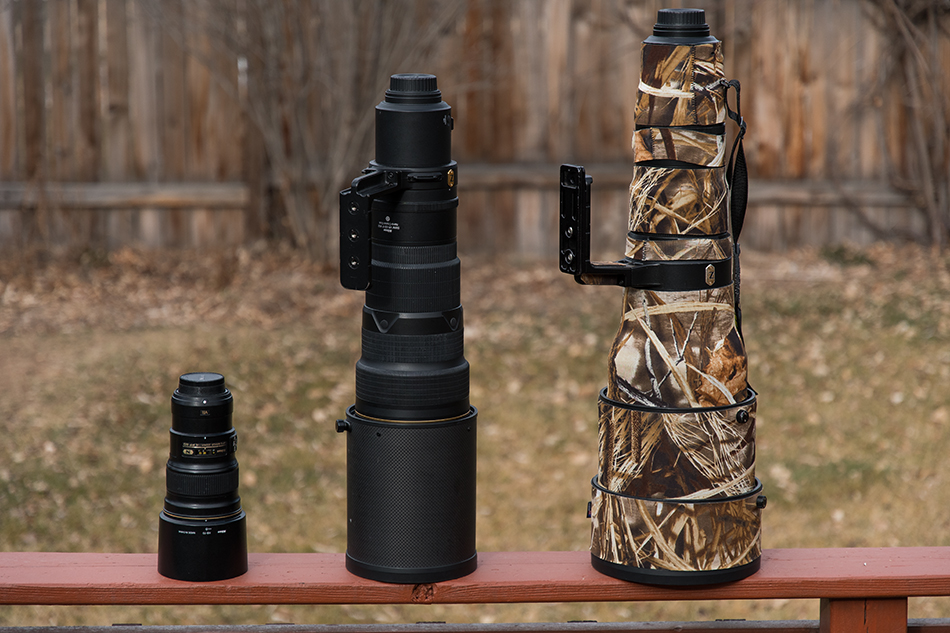
Wildlife photography is a powerful blend of patience, precision, and passion. It demands equipment that can capture fleeting moments from a safe distance while preserving fine detail, color accuracy, and emotional impact. This is why choosing the Best Camera Lens for Wildlife Photography is just as important as selecting the camera body itself.
A camera lens is an optical device attached to a camera that focuses light onto the camera’s image sensor (or film) to create a photograph or video. It controls how much of a scene you see, how sharp the image appears, and how light is captured, making it one of the most important parts of any camera system.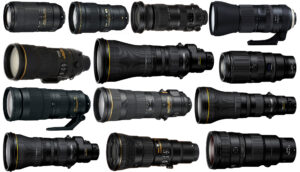
At its core, a camera lens is made of multiple glass elements arranged in a precise design. These elements bend and direct light so the camera can form a clear, detailed image. Different lenses are designed for different purposes, such as wide landscapes, close-up portraits, or distant wildlife.
In the wild, animals rarely wait for perfect framing, so a lens must be fast, sharp, and capable of reaching distant subjects without disturbing their natural behavior. The Best Camera Lens for Wildlife Photography allows photographers to isolate subjects beautifully, compress backgrounds, and reveal textures that the human eye might miss.
A well-chosen lens transforms challenging conditions into creative opportunities. Early morning light, fast-moving birds, or unpredictable animal movements all require advanced optics with reliable autofocus and strong image stabilization. The Best Camera Lens for Wildlife Photography offers long focal lengths, wide apertures, and superior glass quality to maintain clarity even at extreme zoom levels. Whether photographing birds in flight or mammals across open plains, the Best Camera Lens for Wildlife Photography ensures every shot remains sharp, balanced, and full of life.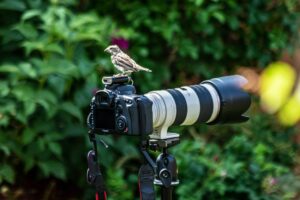
Beyond reach and sharpness, durability matters in outdoor environments. Dust, moisture, and temperature changes are common in wildlife settings, making weather-sealed construction essential. The Best Camera Lens for Wildlife Photography is built to withstand these elements while delivering consistent performance. Ultimately, investing in the Best Camera Lens for Wildlife Photography empowers photographers to tell authentic stories of nature, capturing rare moments with stunning detail and professional-level results.
Importance of a lens in wildlife photography:
1. Long Focal Length for Safe Distance Shooting
Wildlife animals are often dangerous, shy, or easily disturbed. A specialized wildlife lens, usually a telephoto or super-telephoto lens, allows photographers to capture close-up images from a safe distance. This ensures the animal’s natural behavior is not disrupted while still producing detailed and impactful photos.
2. Sharpness and Fine Detail Capture
Wildlife photography relies heavily on capturing details such as feathers, fur textures, eyes, and facial expressions. High-quality lenses use advanced optical glass and coatings that reduce distortion, chromatic aberration, and softness. This results in sharper images with better contrast and realistic colors.
3. Fast and Accurate Autofocus Performance
Animals move quickly and unpredictably. A good wildlife lens features advanced autofocus motors that lock onto subjects rapidly and track motion smoothly. This is especially important for photographing birds in flight, running animals, or sudden wildlife interactions where timing is critical.
4. Wide Aperture for Low-Light Conditions
Wildlife photography is often done during early mornings or late evenings when light is limited. Lenses with wide apertures allow more light to reach the camera sensor, enabling faster shutter speeds. This helps freeze motion and reduces image noise in low-light environments.
5. Image Stabilization for Blur Reduction
Long focal lengths magnify even the smallest hand movements. Image stabilization technology built into wildlife lenses helps reduce camera shake, allowing photographers to shoot handheld at slower shutter speeds while maintaining image sharpness.
6. Subject Isolation and Background Blur
A high-quality wildlife lens creates smooth background blur, known as bokeh. This helps isolate the animal from busy surroundings, making the subject stand out clearly. Proper subject separation adds depth and professional quality to wildlife images.
7 Best Camera Lens for Wildlife Photography
1.Sigma 100-400mm f/5-6.3 DG OS HSM Contemporary Lens for Canon EF.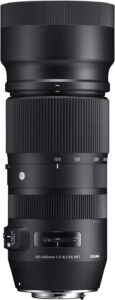
The Sigma 100‑400mm f/5‑6.3 DG OS HSM Contemporary Lens for Canon EF is a versatile telephoto zoom designed for photographers who want excellent reach without the weight and bulk of a super‑telephoto prime. Built by Sigma, this lens delivers strong image quality in a compact size, making it a compelling choice for Canon DSLR users looking to step into serious wildlife, travel, or nature photography.
Right out of the box, the lens feels solid yet portable. Its zoom range of 100‑400mm gives photographers the flexibility to capture everything from distant birds to wildlife action without changing lenses. While the maximum aperture of f/5‑6.3 isn’t as bright as pro‑level lenses, it provides a good balance between weight and performance, especially for outdoor lighting conditions. The inclusion of Optical Stabilization (OS) helps minimize camera shake at longer focal lengths, which is essential when shooting handheld in the field.
Autofocus performance is reliable thanks to the Hyper Sonic Motor (HSM), which quickly locks onto subjects and tracks movement—very useful when photographing unpredictable wildlife or fast‑moving birds. The lens is also full‑frame compatible while maintaining APS‑C support, giving crop–sensor Canon shooters an effective reach up to 640mm equivalent focal length. Despite its reach, the lens remains compact and easy to handle, perfect for photographers who hike or travel frequently.
In terms of build quality and value, the Sigma 100‑400mm excels. It comes with a 4‑Year USA Warranty, offering peace of mind for long‑term use. The 67mm filter thread makes adding polarizers or ND filters easy without spending extra on large filter systems. Overall, this lens bridges performance and portability beautifully.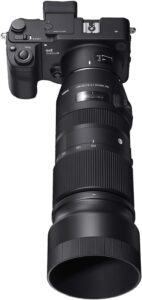
Key Specifications
- Brand: Sigma
- Focal Length Description: 100‑400mm f/5‑6.3
- Lens Type: Zoom
- Compatible Mountings: Canon EF
- Filter Size: 67mm
- Warranty: 4‑Year USA Warranty
Pros
- Excellent reach for wildlife and bird photography
- Compact and lightweight for its focal range
- Good image quality with effective optical stabilization
- Affordable compared to pro‑level super‑telephoto lenses
- Long warranty for added reliability
Cons
- Aperture range (f/5‑6.3) is not ideal for low‑light performance
2.Nikon AF-S NIKKOR 500mm F/5.6E Pf ED VR Super-Telephoto Lens.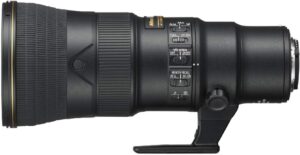
The Nikon AF‑S NIKKOR 500mm F/5.6E PF ED VR Super‑Telephoto Lens stands out as a remarkable blend of reach, optical performance, and portability. Designed for Nikon F‑mount cameras, this super‑telephoto lens brings distant wildlife and action scenes dramatically closer while maintaining excellent image quality. Whether you’re photographing birds in flight or tracking shy animals on safari, this lens delivers pro‑level results in a surprisingly manageable package.
One of the most striking features of this lens is its compact size. Thanks to a specially engineered Phase Fresnel (PF) lens element, the Nikon 500mm f/5.6E is significantly smaller and lighter than most traditional 500mm lenses. This makes it far easier to carry handheld or on long field shoots—a major advantage for wildlife and nature photographers who often trek long distances in challenging environments.
Image quality is outstanding across the board. The lens’s optical design incorporates Extra‑low Dispersion (ED) glass, which effectively minimizes chromatic aberrations and enhances sharpness and contrast. The built‑in Vibration Reduction (VR) system further improves image clarity by compensating for camera shake, especially when shooting at slow shutter speeds or handheld. This combination ensures consistently crisp and detailed results, even at maximum focal length.
Durability is another highlight. The lens features a robust construction with advanced weather sealing, making it dependable in harsh outdoor conditions. Additionally, internal focusing and a Nikon nonstick fluorine coating help keep the front element clean and resistant to smudges, dust, and moisture. This rugged build gives photographers the confidence to shoot in unpredictable weather without worry.
Key Specifications
- Brand: Nikon
- Focal Length Description: 500 mm
- Lens Type: Telephoto
- Compatible Mountings: Nikon F
- Model: Nikon AF‑S NIKKOR 500mm F/5.6E PF ED VR Super‑Telephoto Lens
Pros
- Exceptionally compact and lightweight for a 500mm lens
- Phase Fresnel design reduces size without sacrificing performance
- Effective Vibration Reduction (VR) image stabilization
- Excellent sharpness and contrast with ED glass
- Durable build with advanced weather sealing and fluorine coating
Cons
- Fixed focal length lacks the versatility of a zoom lens
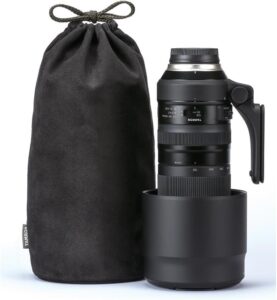
3.Tamron SP 150-600mm F/5-6.3 Di VC USD G2 for Nikon Digital SLR Cameras.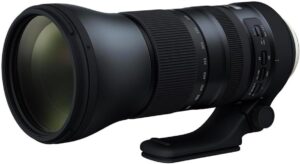
The Tamron SP 150‑600mm F/5‑6.3 Di VC USD G2 for Nikon F (FX) mount is a powerhouse telephoto zoom that brings extraordinary reach, versatility, and performance to Nikon DSLR users. This lens is built for photographers who demand flexibility and reliability—from distant wildlife to fast‑moving action—without sacrificing image quality or handling comfort.
Right away, the 150–600mm focal range opens up exciting possibilities. You can frame subjects from mid‑range through extreme distances without swapping lenses. Whether you’re tracking birds in flight, capturing elusive mammals on safari, or shooting distant sports action, this zoom gives you the range needed to get the shot without intruding on the scene.
One of the standout upgrades in this G2 version is the FLEX ZOOM LOCK mechanism. Unlike fixed‑position locks on older lenses, this lets you lock the zoom ring at any position, preventing creep and giving you full control when shooting from uneven angles or while hiking. Its lightweight, moisture‑resistant construction and fluorine coating also help protect the lens in challenging environments, making it a reliable choice for outdoor and nature photographers.
Optically, the lens uses 21 elements in 13 groups, a design that produces sharp results throughout the zoom range. Autofocus performance is noticeably improved—thanks to faster and more responsive AF—so you’re more likely to capture crisp frames of moving subjects. Tamron’s Vibration Compensation (VC) further stabilizes handheld shots, offering up to 4.5 stops of shake reduction (VC mode 3) and three optimized VC modes to match your shooting style and conditions.
The included lightweight and easy‑to‑hold tripod mount enhances stability for extended shooting sessions, and its compatibility with Arca‑Swiss style quick‑release plates makes it a practical choice for photographers who frequently move between handheld and tripod setups.
Key Specifications
- Brand: Tamron
- Focal Length Description: 150‑600mm
- Lens Type: Telephoto Zoom
- Compatible Mountings: Nikon F (FX)
- Optical Construction: 21 elements in 13 groups
- Features: FLEX ZOOM LOCK, VC with three modes, fluorine coating, moisture‑resistant design, lightweight tripod mount
Pros
- Extensive 150–600mm range for wildlife, birding, and sports
- Flexible zoom lock at any focal position
- Improved autofocus speed and responsiveness
- Powerful Vibration Compensation (up to 4.5 stops)
- Protective fluorine coating and moisture resistance
- Tripod mount compatible with Arca‑Swiss plates
Cons
- Slightly large at full zoom for some handheld shooters
4.Sigma 150-600mm 5-6.3 Contemporary DG OS HSM Lens for Canon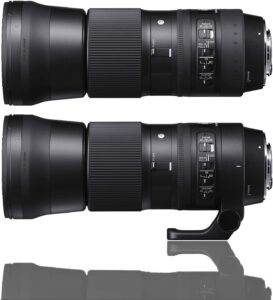
The Sigma 150‑600mm f/5‑6.3 Contemporary DG OS HSM Lens for Canon EF is a highly capable telephoto zoom built to deliver impressive reach and strong performance without the weight and bulk of traditional super‑telephoto lenses. Designed for Canon DSLR users who shoot wildlife, sports, or distant subjects, this lens strikes an excellent balance between usability and optical quality.
One of the first things you’ll notice about this lens is its lightweight and compact construction. Compared to many other super‑telephoto zooms, this Sigma model remains relatively easy to handle—even during long handheld sessions or when hiking through nature. This portability makes it ideal for field shooters who want extended reach without cumbersome gear slowing them down.
The 150‑600mm focal range offers tremendous flexibility. At 150mm, the lens can capture mid‑range wildlife or environmental portraits, while 600mm lets you bring distant subjects dramatically closer. This wide range covers most scenarios that wildlife and nature photographers encounter, making it a versatile all‑around choice.
Sigma has also added practical enhancements such as a water and oil repellent coating on the front glass element, which helps keep the lens surface cleaner and makes maintenance easier in outdoor conditions. This is especially useful when shooting in dusty or wet environments, as it helps protect delicate optical surfaces.
The lens’s Optical Stabilization (OS) system helps reduce camera shake at longer focal lengths, an important feature when shooting handheld with heavy zoom. Autofocus performance powered by the Hyper Sonic Motor (HSM) is quick and accurate, allowing you to lock onto subjects with confidence. Additionally, the lens’s minimum focusing distance of 280 cm (110.2 inches) gives you decent close‑up capability for subjects that aren’t too far away.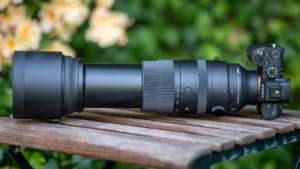
Key Specifications
- Brand: Sigma
- Focal Length Description: 150‑600mm f/5‑6.3
- Lens Type: Telephoto Zoom
- Compatible Mountings: Canon EF
- Filter Size: 95mm
- Minimum Focusing Distance: 280 cm / 110.2 in
- Coating: Water and oil repellent on front element
Pros
- Excellent reach and flexibility from 150mm to 600mm
- Lightweight and compact for a super‑telephoto zoom
- Water and oil repellent coating makes upkeep easier
- Effective optical stabilization for handheld shooting
- Smooth and responsive autofocus
Cons
- Large 95mm filters can be expensive
5.EF 650-1300mm F8 Telephoto Lens JINTU- Zoom Manual Cameras Lens for Canon EOS Rebel T Series.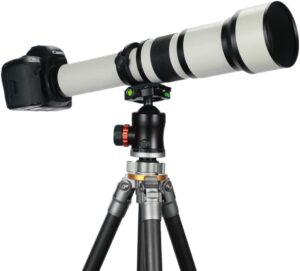
The JINTU EF 650‑1300mm F8 Telephoto Lens is an impressive super-telephoto zoom designed for Canon EOS DSLR users who want extreme reach for wildlife, sports, or even celestial photography. With a focal range of 650‑1300mm, this lens brings distant subjects dramatically closer, making it ideal for capturing small or faraway objects such as birds, airplanes, or athletes in action. Its combination of long reach and solid construction makes it a unique option for photographers exploring super-telephoto applications without breaking the bank.
Built with a full metal body and low dispersion multilayer glass elements, this lens delivers durable construction and high-definition image quality. The robust build ensures stability and reliability in outdoor conditions, while the optical elements help reduce chromatic aberration and maintain sharpness across its long zoom range. Despite its size, the lens is thoughtfully designed for handling and long-distance photography, giving photographers the tools to frame distant subjects clearly.
This lens features a manual focus design, which encourages creative control over every shot. While it does not offer autofocus and the aperture cannot be adjusted, the manual focus mechanism allows precise focusing, particularly useful for static or slow-moving subjects. The lens is compatible with a wide range of Canon EF and EF-S cameras, including Rebel T series, 5D, 6D, 7D, 90D, and many more. For other brands like Nikon, Pentax, or micro 4/3 cameras, adapters can be purchased separately, expanding its versatility.
For long-distance photography, the 650‑1300mm zoom is ideal for wildlife, sports, or astronomy enthusiasts. It allows photographers to frame subjects that would otherwise be impossible to capture with standard telephoto lenses. However, because it is a manual lens with a fixed F8 aperture, shooting in low-light conditions can be challenging, and shutter speed management is critical to achieve sharp results.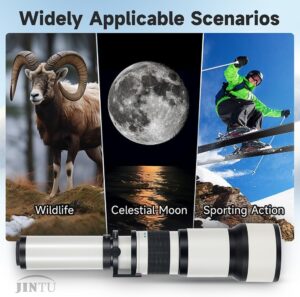
Key Specifications
- Brand: JINTU
- Focal Length Description: 650‑1300mm
- Lens Type: Telephoto Zoom
- Compatible Mountings: Canon EF, EF-S
- Focus Type: Manual Focus
- Construction: Full metal body with low dispersion multilayer glass elements
Pros
- Extremely long reach for distant wildlife, sports, and celestial objects
- Durable full-metal construction ensures stability and longevity
- Sharp image quality with low dispersion glass elements
- Wide compatibility with Canon EF/EF-S DSLR cameras
- Manual focus allows precise creative control

Cons
- Large and bulky, requiring careful handling or tripod use
6.Canon EF 100-400mm f/4.5-5.6L is II USM Lens, Lens Only.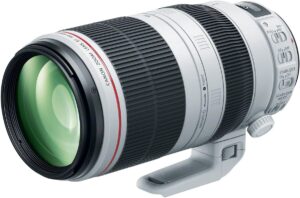
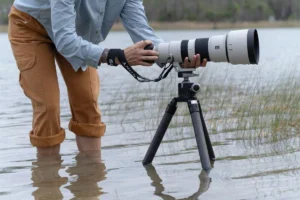
The Canon EF 100‑400mm f/4.5‑5.6L IS II USM Lens is a professional-grade L-series super-telephoto zoom designed for photographers who demand exceptional performance for wildlife, sports, and action photography. With its versatile 100‑400mm focal range, this lens provides the flexibility to capture everything from distant wildlife to fast-moving sports subjects while maintaining sharpness, clarity, and color accuracy. Its combination of portability and performance makes it one of the most respected telephoto zooms in Canon’s lineup.
One of the standout features of this lens is its compact yet robust design. Despite its reach, it is easier to handle than many other telephoto zooms thanks to a well-balanced build and a rotation-type zoom ring, which allows precise composition and smooth zooming. The lens also includes a rounded 9-blade diaphragm, producing beautiful background blur and pleasing bokeh, which is essential for isolating subjects in dynamic environments.
The optical construction of 21 elements in 16 groups ensures outstanding image quality, while the new Air Sphere Coating (ASC) significantly reduces flaring and ghosting in backlit situations. This is especially beneficial for wildlife photographers working in open environments or early morning light. Additionally, the lens is highly resistant to dust and water, providing durability for harsh outdoor conditions and long shooting sessions.
With a closest focusing distance of 3.2 feet (0.98 meters), photographers can get relatively close to subjects when needed, while the improved zoom torque adjustment ring allows for easy customization of zoom tension for handheld shooting. This lens is fully compatible with Canon EF mount cameras and delivers professional-grade optical performance across the zoom range.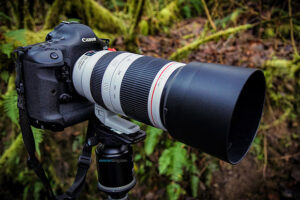
Key Specifications
- Brand: Canon
- Focal Length Description: EF Mount 100‑400mm f/4.5‑5.6 L Lens II
- Lens Type: Telephoto Zoom
- Compatible Mountings: Canon EF
- Optical Construction: 21 elements in 16 groups
- Closest Focusing Distance: 3.2 feet / 0.98 meters
Pros
- Compact and highly portable for a super-telephoto zoom
- Excellent sharpness and clarity throughout the 100‑400mm range
- Air Sphere Coating reduces flaring and ghosting
- Durable and weather-resistant, suitable for harsh conditions
- Smooth zoom and focus operation with rotation-type zoom ring
Cons
- Higher price point compared to consumer telephoto lenses
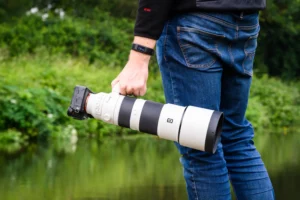
7.Sony FE 200-600mm F5.6-6.3 G OSS Super Telephoto Zoom Lens (SEL200600G).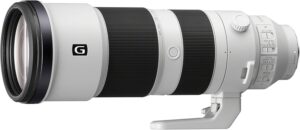
The Sony FE 200‑600mm F5.6‑6.3 G OSS is a super-telephoto zoom lens designed for Sony E-mount full-frame mirrorless cameras. With an incredible 200‑600mm focal range, this lens gives photographers the reach needed to capture distant wildlife, sports, and nature subjects with precision and clarity. Its combination of high-resolution optics, advanced stabilization, and fast autofocus makes it a top choice for professionals and enthusiasts seeking extreme telephoto capabilities.
One of the key strengths of this lens is its G lens quality, which provides outstanding resolution across the entire zoom range. The lens features 5 Extra-low Dispersion (ED) glass elements that significantly reduce chromatic aberration, while the aspherical lens element minimizes spherical aberrations, producing sharp, clear images from edge to edge. Additionally, the Nano AR Coating suppresses reflections, flare, and ghosting, ensuring excellent contrast and color fidelity even in challenging lighting conditions.
Autofocus performance is handled by a Direct Drive Supersonic Wave Motor (DDSSM), delivering fast, precise, and virtually silent focusing. This is especially important for photographing skittish wildlife or capturing action in sports, where every millisecond counts. The Optical SteadyShot (OSS) image stabilization further ensures sharp results, even at extreme focal lengths, making handheld shooting much more practical for long-range subjects.
The lens also balances its heavy reach with ergonomic design. Despite being a super-telephoto lens, it is thoughtfully engineered for better handling and mobility, allowing photographers to work in the field for extended periods without excessive fatigue. Whether tracking birds in flight or distant animals on safari, the Sony FE 200‑600mm G OSS delivers professional performance with excellent reliability.
Key Specifications
- Brand: Sony
- Focal Length Description: 200‑600mm F5.6‑6.3
- Lens Type: Telephoto Zoom
- Compatible Mountings: Sony E, Sony FE
- Features: 5 ED glass elements, aspherical lens element, Nano AR coating, OSS, Direct Drive Supersonic Wave Motor
Pros
- Exceptional resolution across the zoom range
- Advanced ED and aspherical glass elements reduce aberrations and distortion
- Nano AR coating minimizes flare and ghosting
- Fast, quiet, and precise autofocus with DDSSM
- Optical SteadyShot image stabilization allows handheld shooting at long focal lengths
Cons
- Large and relatively heavy, requiring careful handling or tripod support
Why These Are Great for Wildlife Photography
• Long reach: Focal ranges from ~100mm up to 600mm give you the ability to photograph distant animals without disturbing them.
• Autofocus and stabilization: Most of these lenses include fast autofocus motors and built‑in stabilization, helping you capture sharp images even at long focal lengths.
• Versatility: Zoom lenses offer flexibility for framing while prime telephoto (like the 500mm) delivers outstanding image quality if you shoot specific subjects often.
Factors to consider when choosing the Best Camera Lens for Wildlife Photography.
1. Focal Length
Focal length determines how close you can get to your subject without physically moving. For wildlife photography, a long focal length (typically 300mm or more) is ideal for photographing distant animals safely. A longer lens lets you fill the frame with the subject while maintaining a safe distance, which is crucial for capturing natural behavior without disturbing wildlife.
2. Aperture Size
The aperture controls how much light enters the lens and affects background blur (bokeh). A wide aperture (f/2.8–f/5.6) allows more light, enabling faster shutter speeds in low-light conditions such as dawn or dusk. It also helps isolate the subject from distracting backgrounds, making animals stand out sharply in your photos.
3. Autofocus Speed and Accuracy
Wildlife moves unpredictably, and fast autofocus is essential for capturing sharp images of animals in motion. Look for lenses with advanced autofocus motors and tracking capabilities. Lenses with reliable autofocus allow you to quickly lock onto moving subjects, like birds in flight or running mammals, reducing the chance of missed shots.
4. Image Stabilization
When using long focal lengths, even slight hand movements can cause blurry images. Image stabilization (IS or VR) in a lens reduces camera shake, allowing you to shoot handheld at slower shutter speeds. This is particularly helpful when hiking in the field or when a tripod is impractical.
5. Durability and Weather Sealing
Wildlife photography often happens outdoors in harsh conditions—rain, dust, and extreme temperatures are common. A lens with weather sealing and durable construction ensures it continues performing reliably. Choosing a robust lens protects your investment and allows you to photograph confidently in any environment.
Next Read: 8 Best Camera for Wedding Photography
Conclusion
Choosing the Best Camera Lens for Wildlife Photography is a defining step toward capturing powerful and unforgettable images of nature. Wildlife moments are often rare and unpredictable, making the right lens essential for reaching distant subjects, freezing motion, and preserving fine details. With the Best Camera Lens for Wildlife Photography, photographers gain the confidence to work in challenging environments while maintaining image clarity and precision.
A well-designed lens enhances every aspect of the shooting experience, from fast autofocus to smooth background separation. The Best Camera Lens for Wildlife Photography ensures animals remain sharp and well-defined, even in low light or fast-moving situations. By investing in the Best Camera Lens for Wildlife Photography, photographers improve their ability to tell authentic wildlife stories through striking visuals.
Durability and performance go hand in hand when working outdoors. The Best Camera Lens for Wildlife Photography is built to withstand harsh conditions while delivering consistent results in the field. Ultimately, mastering wildlife photography begins with choosing the Best Camera Lens for Wildlife Photography, as the Best Camera Lens for Wildlife Photography turns distant wildlife encounters into stunning, professional-quality images that truly bring nature to life.