
When you’re trying to place every shot precisely on target, being able to clearly see your impacts can make all the difference. Whether you’re practicing at the local range, working on long-range accuracy, or competing in precision shooting, a quality spotting scope gives you the detailed view you simply can’t get with the naked eye. The right scope can help you identify bullet holes, evaluate your groups, and make adjustments without constantly walking downrange.
But with so many models offering impressive magnification numbers, choosing the right one isn’t always easy. The best spotting scopes for target shooting need more than high magnification—they should deliver sharp, high-contrast images, excellent resolution, reliable performance in changing light, and enough optical quality to remain useful at extended distances.
In this guide, we’ve selected and reviewed some of the best spotting scopes for target shooting, focusing on optical performance, magnification range, objective size, build quality, ease of use, and overall value. Whether you’re looking for an affordable option for regular range sessions or a premium spotting scope for serious long-range shooting, our top picks will help you find the right balance of clarity, performance, and price.
8 Best Spotting Scopes for Target Shooting.
| # | Spotting Scope | Magnification | Objective Lens | Best For |
|---|---|---|---|---|
| 1 | Vortex Razor HD 27-60×85 | 27-60x | 85mm | Best Overall |
| 2 | Athlon Ares G2 UHD 20-60×85 | 20-60x | 85mm | Best Value Premium |
| 3 | Vortex Viper HD 20-60×85 | 20-60x | 85mm | Best Mid-Range |
| 4 | Celestron Regal M2 65ED | 16-48x | 65mm | Best Compact Option |
| 5 | Vortex Diamondback HD 20-60×85 | 20-60x | 85mm | Best Budget Vortex |
| 6 | Bushnell Legend Ultra HD 20-60×80 | 20-60x | 80mm | Best Affordable Full-Size |
| 7 | SVBONY SV406P 20-60×80 | 20-60x | 80mm | Best Budget Pick |
| 8 | Gosky 20-60×80 Spotting Scope | 20-60x | 80mm | Best Beginner Option |
7 Best Spotting Scopes for Target Shooting in – Clear Views at Long Range
1.Vortex Razor HD 27-60×85 Spotting Scope – Best Overall for Target Shooting.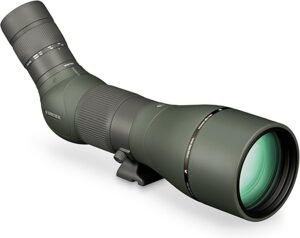
When you’re shooting at extended distances, seeing your target clearly is just as important as making the shot. The Vortex Razor HD 27-60×85 is designed for exactly this kind of demanding optical work, combining a powerful 27-60× magnification range with a large 85mm objective lens. Whether you’re checking bullet impacts, evaluating group sizes, or monitoring targets at long range, this premium spotting scope is built to reveal fine details that cheaper optics can struggle to show.
Vortex specifically lists the Razor HD for precision long-range shooting and competition, making it a natural fit for serious target shooters. Its HD optical system, APO lens design, XR Plus coatings, and dielectric prism coatings are designed to produce high-resolution, color-accurate images while maximizing light transmission.
Check Price on Amazon
If you’re looking for a premium spotting scope for serious target shooting, the Vortex Razor HD 27-60×85 is one of the models worth considering. [Check the latest price and availability on Amazon].
Key Features
- 27-60× magnification for detailed long-range viewing
- 85mm objective lens for strong light-gathering capability
- HD optical system for high resolution and color fidelity
- APO optical design to reduce chromatic aberration
- XR Plus lens coatings for improved light transmission
- Dielectric prism coatings for bright, clear images
- Helical focus system for quick and precise focusing
- Argon purging for fogproof performance
- O-ring sealing for waterproof protection
- Shockproof construction for demanding outdoor use
- Arca-Swiss compatible foot for convenient tripod mounting
- 16.7–17mm eye relief
- 117–68 ft field of view at 1,000 yards
Exceptional Optical Clarity for Long-Range Targets
The biggest reason to consider the Razor HD is its optical performance. Its 85mm objective lens gathers substantial light, while the HD optical system is designed to deliver resolution, color fidelity, and edge-to-edge sharpness. For target shooting, this can be particularly useful when you’re trying to distinguish small bullet holes or inspect targets at considerable distances.
The scope’s APO design is also intended to correct color across the visual spectrum, helping minimize distracting chromatic aberration. Independent testing has found particularly strong central-field performance, although some optical aberration becomes more noticeable toward the edges and at certain magnifications.
27-60× Magnification for Precision Shooting
The 27-60× zoom range gives you plenty of flexibility at the range. At the lower end, 27× provides a wider field of view for locating and tracking targets. When you need maximum detail, increasing the magnification to 60× lets you get much closer optically to distant targets.
At 1,000 yards, Vortex specifies a linear field of view ranging from 117 feet at 27× to 68 feet at 60×. This gives shooters a useful combination of target acquisition and high-magnification observation.
However, maximum magnification isn’t always the best setting. Atmospheric conditions, heat shimmer, and mirage can reduce the usefulness of very high magnification. In many real-world shooting situations, you’ll often get a cleaner image somewhere in the middle of the zoom range.
Built for the Shooting Range
The Razor HD isn’t designed as a delicate piece of glass that needs to stay indoors. Vortex uses rubber armor, ArmorTek exterior lens protection, argon gas purging, and O-ring sealing to help protect the scope against demanding outdoor conditions. It is rated as waterproof, fogproof, and shockproof.
For shooters who regularly move between different ranges, travel with their equipment, or spend long days outdoors, this rugged construction is a significant advantage.
Easy Focusing and Tripod Setup
Another useful feature for target shooters is the helical focus system. Instead of relying on a complicated setup, the focus mechanism is integrated into the scope body and is designed for quick, precise adjustments.
The Razor HD also has an Arca-Swiss-compatible foot, allowing it to mount directly to compatible Arca-Swiss tripod heads without requiring an additional plate. That’s particularly convenient when the scope is being used alongside other range or photography equipment.
What We Like
- Excellent overall optical resolution
- Large 85mm objective lens
- Powerful 27-60× magnification
- Excellent performance for long-range observation
- Strong low-light capability
- Durable waterproof and fogproof construction
- Precise helical focusing
- Arca-Swiss-compatible mounting foot
- Vortex’s unconditional lifetime VIP Warranty
What Could Be Better
- Premium price makes it less accessible to casual shooters
- At 60×, atmospheric distortion can become a significant limitation
- The scope weighs about 65.6 oz, so it isn’t exactly a lightweight travel optic
- Optical performance can soften somewhat at the highest magnification compared with the center of its zoom range
Is the Vortex Razor HD 27-60×85 Good for Target Shooting?
Yes. The Vortex Razor HD 27-60×85 is particularly well suited to shooters who prioritize optical quality and frequently shoot at extended distances. Its combination of an 85mm objective, 27-60× magnification, high-quality glass, rugged construction, and precise focusing makes it a strong choice for serious range use.
For someone shooting occasionally at shorter distances, however, its premium specifications may be more than necessary. A less expensive spotting scope can provide excellent value for casual range sessions.
Final Verdict
The Vortex Razor HD 27-60×85 earns its position as our Best Overall spotting scope for target shooting because it brings together the qualities that matter most when you’re trying to see small targets at long distances: excellent resolution, strong light transmission, powerful magnification, rugged construction, and precise focusing.
If you’re serious about long-range target shooting and want a spotting scope that can grow with your shooting ability, the Razor HD is a premium investment worth considering.
2.Athlon Ares G2 UHD 20-60×85 Spotting Scope – Best Premium Value for Target Shooting.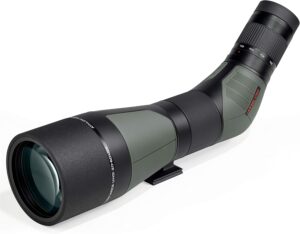
When you’re serious about target shooting, optical clarity becomes increasingly important as the distance increases. The Athlon Ares G2 UHD 20-60×85 is built for shooters who need to clearly observe distant targets and bullet impacts without stepping up to the most expensive European optics. With an 85mm objective lens, 20-60× magnification, UHD extra-low dispersion glass, and an apochromatic lens system, the Ares G2 UHD is designed to deliver the sharp, high-contrast images needed for demanding long-range observation. Athlon specifically describes this model as suitable for precision shooters spotting impacts at 1,000 yards.
Check Price on Amazon
For shooters looking for premium optical performance without moving straight into the highest-priced spotting scopes, the Athlon Ares G2 UHD 20-60×85 is an excellent model to consider. Check the latest price and availability on Amazon.
Key Features
- 20-60× magnification for flexible long-range viewing
- 85mm objective lens for strong light-gathering capability
- UHD extra-low dispersion glass for improved clarity and reduced chromatic aberration
- Apochromatic lens system for better color correction and definition
- ESP dielectric prism coating with over 99% light reflection
- Advanced fully multi-coated lenses
- BaK-4 prisms
- Dual-focus system for precise focusing
- Magnesium/aluminum alloy chassis
- Argon purged and waterproof
- Twist-up eyecup
- Tripod adaptable
- Available in 45-degree and straight viewing configurations
Excellent Optical Clarity for Long-Range Target Shooting
The biggest strength of the Ares G2 UHD is its optical system. The scope uses UHD extra-low dispersion glass designed to minimize chromatic fringe while maintaining sharpness and color definition. For target shooters, this matters when you’re trying to distinguish small bullet holes, evaluate shot groups, or observe hits on distant steel targets.
The apochromatic lens system further improves color correction by helping bring different wavelengths of light into a common focus. Combined with the UHD glass and fully multi-coated lenses, the system is designed to produce a bright, detailed image with accurate colors.
20-60× Magnification for Detailed Viewing
The 20-60× magnification range gives the Ares G2 UHD plenty of versatility for the shooting range. At 20×, the wider field of view makes it easier to locate your target and monitor a larger area. Increasing the magnification toward 60× gives you significantly more detail when you’re trying to inspect targets at longer distances.
Athlon lists a field of view of approximately 99 feet at 20× and 47 feet at 60× at 1,000 yards. This provides a useful balance between target acquisition at lower magnification and detailed observation at higher power.
As with any high-powered spotting scope, however, maximum magnification isn’t always the clearest setting. Heat waves, atmospheric distortion, and mirage can make extremely high magnification less useful under certain conditions. For this reason, shooters may find that the clearest image comes somewhere below the maximum 60× setting depending on the weather and distance.
Designed With Precision Shooters in Mind
The Ares G2 UHD isn’t simply marketed as a general-purpose spotting scope. Athlon specifically identifies precision shooting as one of its applications and highlights its ability to help shooters spot impacts at 1,000 yards. That makes it particularly interesting for long-range target shooting where seeing the result of each shot is essential.
Being able to see impacts from the firing position can help shooters evaluate groups and make adjustments without repeatedly traveling downrange. It can also make range sessions more efficient when shooting with a partner.
Dual-Focus System for Precise Adjustments
The Ares G2 UHD features a dual-focus system that allows you to make precise adjustments to the image. This is especially useful at high magnification, where even small focus changes can have a noticeable effect on image sharpness.
For target shooting, precise focusing becomes increasingly important as you move toward longer distances. A properly focused image can make the difference between clearly identifying an impact and seeing nothing more than a small blur on the target.
Bright Images in Challenging Light
The 85mm objective lens is another major advantage for long-range shooters. A larger objective can gather more light than a smaller objective, which can be beneficial during early morning, late afternoon, or overcast range sessions.
Athlon combines the large objective with UHD glass, fully multi-coated lenses, and ESP dielectric coatings. The company states that the ESP dielectric coating reflects over 99% of light toward the viewer, helping produce a bright image with accurate color reproduction.
Rugged Construction for Outdoor Use
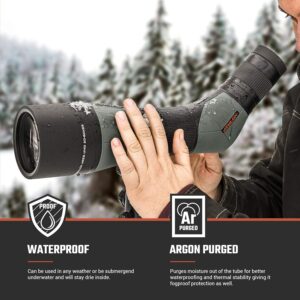
Target shooting doesn’t always take place under perfect weather conditions, so durability is important. The Ares G2 UHD uses a rugged metal chassis and is designed to withstand outdoor use. Athlon lists the scope as waterproof and argon purged, with the argon gas helping prevent internal fogging.
The exterior lenses also receive an XPL protective coating intended to provide additional protection against dirt, oil, and potential scratches.
45-Degree or Straight Viewing Options
One useful advantage is that the Ares G2 UHD 20-60×85 is available in both 45-degree angled and straight configurations. The 45-degree version can be particularly comfortable when the scope is mounted on a tripod for extended observation, while the straight version may appeal to shooters who prefer a more direct viewing position. Both versions have the same 20-60×85 configuration and approximately 99-47 feet of field of view at 1,000 yards.
What We Like
- Excellent optical clarity for its class
- UHD extra-low dispersion glass
- Apochromatic optical system
- Large 85mm objective
- Powerful 20-60× magnification
- Designed with 1,000-yard observation in mind
- Strong light transmission
- Dual-focus system
- Waterproof and argon purged
- Rugged metal chassis
- Available in straight and 45-degree configurations
- Tripod adaptable
What Could Be Better
- At approximately 70 oz, it is a substantial full-size spotting scope rather than a lightweight travel option.
- The 85mm objective and large chassis make it less convenient to carry than compact 60-65mm spotting scopes.
- Atmospheric mirage can still limit what you can see at 60×, regardless of the quality of the optics.
- The premium optical design makes it more expensive than entry-level spotting scopes.
Is the Athlon Ares G2 UHD 20-60×85 Good for Target Shooting?
Yes. The Ares G2 UHD 20-60×85 is particularly well suited to serious target shooters who need high-resolution viewing at extended distances. Its 85mm objective, UHD glass, apochromatic optical system, and 20-60× magnification provide the combination of brightness, detail, and magnification that long-range shooting demands.
It’s especially attractive for shooters who want premium optical performance but don’t necessarily want to pay flagship-level prices for their spotting scope.
Athlon Ares G2 UHD 20-60×85 – Final Verdict
The Athlon Ares G2 UHD 20-60×85 earns its position as our Best Premium Value because it focuses heavily on the features that actually matter when you’re trying to see distant targets: optical resolution, color accuracy, light transmission, magnification, and precise focusing.
For serious target shooters working at distances approaching 1,000 yards, the combination of 20-60× magnification, an 85mm objective, UHD glass, and an apochromatic optical system makes the Ares G2 UHD one of the most compelling choices in this lineup.
3.Vortex Viper HD 20-60×85 Spotting Scope – Best Mid-Range for Target Shooting.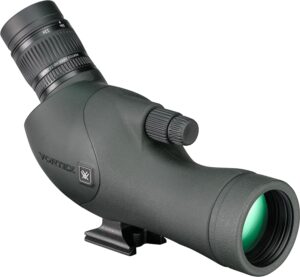
When you’re looking for a spotting scope that delivers serious long-range performance without stepping into the price range of Vortex’s flagship Razor HD, the Vortex Viper HD 20-60×85 is an excellent middle-ground option. With a powerful 20-60× magnification range, large 85mm objective lens, HD optical system, and rugged construction, this spotting scope is designed to give target shooters a detailed view of distant targets, bullet impacts, and shot groups.
The Viper HD is particularly appealing for shooters who spend regular time at the range and want better optical performance than entry-level spotting scopes can provide. Its combination of a large objective lens and high magnification makes it well suited to long-range target observation, while its relatively straightforward controls make it easy to use from a tripod.
Check Price on Amazon
If you want a full-size spotting scope capable of handling regular target shooting and long-range observation without moving into the highest premium price category, the Vortex Viper HD 20-60×85 is worth considering. Check the latest price and availability on Amazon.
Key Features
- 20-60× magnification for short- to long-range observation
- 85mm objective lens for increased light gathering
- HD optical system for improved resolution and color fidelity
- XR fully multi-coated lenses for enhanced light transmission
- Dielectric prism coatings for bright, clear images
- Porro prism optical design
- Dual-focus system for fast and fine focusing
- Helical focus system
- Argon purged for fogproof performance
- O-ring sealed for waterproof protection
- Rubber-armored construction for improved durability
- Built-in sunshade to reduce glare
- Compatible with standard tripods
Clear Viewing for Long-Range Targets
The Viper HD’s biggest advantage for target shooting is its combination of an 85mm objective lens and HD optical system. The large objective allows the scope to collect plenty of light, while the HD glass is designed to provide improved resolution and color fidelity.
This becomes particularly useful when you’re trying to identify small bullet holes or evaluate groups at longer distances. Rather than simply providing a magnified image, the goal is to maintain enough detail and contrast that the target remains recognizable at high magnification.
The scope’s XR fully multi-coated lenses and dielectric prism coatings further contribute to light transmission and image brightness, making the Viper HD suitable for a variety of range conditions.
20-60× Magnification for Flexible Range Use
The 20-60× magnification range gives shooters plenty of flexibility. At 20×, the scope provides a wider view that makes it easier to locate the target and monitor the surrounding area. As you increase the magnification, you can progressively zoom in for more detailed observation.
At 60×, the scope is capable of providing a highly magnified view of distant targets. However, maximum magnification isn’t necessarily the best setting in every situation. Heat waves and atmospheric mirage can become increasingly visible at high power, so reducing the magnification can sometimes produce a sharper and more useful image.
For this reason, experienced shooters will often start at a lower magnification and increase the power only as needed.
How to Use the Vortex Viper HD for Target Shooting
Using the Viper HD at the range is relatively straightforward, but setting it up correctly can make a significant difference in what you see.
First, mount the spotting scope securely on a stable tripod. An 85mm spotting scope is relatively large and heavy, so a sturdy tripod is important. A weak or lightweight tripod can introduce vibration, making it difficult to maintain a steady image at 40×, 50×, or 60× magnification.
Once the scope is mounted, position it so that the eyepiece is comfortable to access from your shooting position. The angled configuration is particularly convenient when the scope is positioned beside a rifle or shooting bench because you don’t necessarily need to place your head directly behind the scope.
Next, set the magnification to around 20×. Look through the scope and locate your target. Starting at lower magnification gives you a wider field of view and makes target acquisition easier.
After finding the target, use the focusing controls to sharpen the image. Once the target is clearly visible, gradually increase the magnification until you reach the level of detail you need.
If you’re shooting at long distances, don’t automatically turn the magnification all the way to 60×. If the image begins to shimmer or lose contrast because of atmospheric conditions, reduce the magnification slightly. You may actually see the target more clearly at 40× or 50× than at 60×.
Using It to Spot Bullet Impacts
One of the main reasons shooters use spotting scopes is to see where their shots landed without having to walk downrange after every group.
After firing a few rounds, look through the Viper HD and carefully inspect the target. At shorter distances, you may be able to identify individual bullet holes. At longer distances, the ability to see impacts will depend heavily on the target size, ammunition, lighting, atmospheric conditions, and the quality of the target itself.
For paper targets, use the scope to examine the group and determine whether your shots are centered or consistently hitting high, low, left, or right.
For steel targets, the scope can help you observe impacts and watch the target move or react when struck.
Using It to Improve Your Shooting
A spotting scope becomes even more useful when another shooter is firing. One person can concentrate on shooting while the other watches through the scope.
The observer can help identify:
- Where shots are landing
- Whether shots are grouping consistently
- Whether impacts are high or low
- Whether shots are drifting left or right
- How the group changes after adjustments
- Whether a shot appears to have missed the target
This makes the Viper HD useful not only for viewing targets but also as a practical tool for analyzing shooting performance.
Adjusting the Focus for Maximum Detail
The Viper HD incorporates a dual-focus system that allows you to quickly bring an object into focus and then make finer adjustments.
When shooting at long range, take your time with focusing. At high magnification, a target that looks slightly blurry can often become noticeably sharper with a small focus adjustment.
If you change the magnification significantly, check the focus again. Atmospheric conditions can also change throughout a shooting session, so periodically adjusting the focus can help maintain the clearest possible image.
Using the Built-In Sunshade
Bright sunlight can create glare that reduces contrast and makes distant targets more difficult to see. The Viper HD includes a built-in sunshade that can be extended when necessary.
If you’re shooting with the sun positioned toward the front of the scope, extending the sunshade can help reduce unwanted glare entering the objective lens.
This is a simple feature, but it can make the image easier to inspect during bright daytime range sessions.
Performance in Different Lighting Conditions
The 85mm objective lens is particularly useful when lighting conditions aren’t ideal. A larger objective lens can collect more light, which can help maintain a brighter image during early morning, late afternoon, or cloudy conditions.
The fully multi-coated optical system is designed to maximize available light transmission, while the dielectric prism coatings help maintain brightness and contrast.
However, no spotting scope can completely overcome extremely poor lighting. If you’re trying to observe small bullet holes in very low light, image quality will eventually be limited by the available illumination.
Built for Outdoor Range Conditions
The Viper HD is designed for outdoor use and features a rugged construction intended to withstand the demands of regular field and range use.
Vortex uses O-ring seals and argon purging to make the scope waterproof and fogproof. The rubber armor provides additional protection against bumps and impacts during transportation and setup.
For shooters who regularly transport their spotting scope between different ranges, this type of rugged construction is an important advantage.
What We Like
- Excellent 20-60× magnification range
- Large 85mm objective lens
- HD optical system
- Good resolution and color fidelity
- Fully multi-coated lenses
- Dielectric prism coatings
- Dual-focus system
- Rugged waterproof and fogproof construction
- Built-in sunshade
- Excellent option for regular range use
- Good balance between performance and price
What Could Be Better
- The 85mm design makes it relatively large and heavy compared with compact spotting scopes.
- Maximum 60× magnification can reveal atmospheric mirage under hot conditions.
- A sturdy tripod is strongly recommended for high-magnification use.
- Shooters who demand the absolute highest optical performance may prefer a premium model such as the Vortex Razor HD.
Who Should Buy the Vortex Viper HD 20-60×85?
The Viper HD is best suited to regular target shooters, range enthusiasts, and long-range shooters who want strong optical performance without paying for the very highest-end spotting scope available.
It’s particularly useful for shooters who frequently observe targets at several hundred yards and want enough magnification to inspect impacts while still having a practical lower-power setting for finding and tracking targets.
For occasional shooters working primarily at short distances, a smaller and less expensive spotting scope may be sufficient.
Is the Vortex Viper HD 20-60×85 Good for Target Shooting?
Yes. The Vortex Viper HD 20-60×85 is a strong choice for target shooting because it combines a large 85mm objective, useful 20-60× magnification range, HD optics, and rugged outdoor construction.
Its biggest advantage is versatility. You can start at 20× to locate your target, increase magnification when you need more detail, and use the focusing system to refine the image before examining your shots.
Vortex Viper HD 20-60×85 – Final Verdict
The Vortex Viper HD 20-60×85 earns its place as our Best Mid-Range spotting scope for target shooting because it delivers many of the features serious shooters need without requiring them to move into the most expensive category.
With its 20-60× magnification, 85mm objective lens, HD optical system, dual-focus controls, and rugged weather-resistant construction, it is a dependable choice for regular range use.
If you’re looking for a spotting scope that can serve you well from everyday target practice to more demanding long-range shooting, the Viper HD 20-60×85 offers a compelling combination of clarity, versatility, and durability.
Also Read: 7 Best Hunting Tripods for Spotting Scope – Expert Reviews & Buying Guide.
4.Celestron Regal M2 65ED Spotting Scope – Best Compact Option for Target Shooting.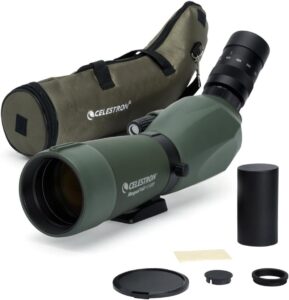
If you want the optical performance of a serious spotting scope without carrying one of the larger 80mm or 85mm models, the Celestron Regal M2 65ED is an excellent alternative. Its 65mm objective lens makes it noticeably more compact than many full-size spotting scopes, while its ED glass, 16-48× magnification range, and multi-coated optics provide the clarity needed for target observation. For shooters who regularly move between ranges or want a more portable setup, the Regal M2 65ED offers an appealing balance between size, optical performance, and versatility.
Among the best spotting scopes for target shooting, the Regal M2 65ED stands out because it doesn’t try to win the specification race with extreme magnification. Instead, it focuses on providing a practical magnification range, quality optics, and a manageable design that is easier to transport and set up.
Check Price on Amazon
If you’re looking for a compact spotting scope for target shooting, range observation, hunting, or general outdoor use, the Celestron Regal M2 65ED is worth considering. Check the latest price and availability on Amazon.
Key Features
- 16-48× magnification for versatile target observation
- 65mm objective lens for a balance between brightness and portability
- ED glass for improved color correction
- Fully multi-coated optics for enhanced light transmission
- BaK-4 prisms for improved image quality
- 45-degree viewing angle for comfortable extended observation
- Dual-speed focusing system for fast and precise focusing
- Built-in extendable sunshade
- Waterproof and nitrogen purged
- Durable magnesium alloy body
- Rotating tripod mount for flexible positioning
- Compatible with standard photographic tripods
Why the Celestron Regal M2 65ED Is Great for Target Shooting
The main advantage of the Regal M2 65ED is its balance. An 85mm spotting scope can provide excellent light-gathering capability, but it also adds considerable bulk to your shooting setup. The Regal M2’s 65mm objective makes it easier to transport while still providing enough aperture for many range applications.
For shooters who primarily practice at moderate distances, the combination of 16-48× magnification and ED glass can provide more than enough optical performance to inspect targets and evaluate groups.
This makes the Regal M2 particularly interesting for shooters who want one scope that can serve both at the range and during other outdoor activities.
16-48× Magnification for Flexible Viewing
The 16-48× magnification range is well suited to shooters who don’t necessarily need 60× magnification.
At 16×, you have a relatively broad field of view that makes it easier to locate your target and observe the surrounding area. Once the target is centered, you can gradually increase magnification to inspect bullet impacts or examine your group.
At 48×, the scope provides considerably more detail for longer-distance observation. As with any high-magnification optic, however, atmospheric conditions can affect the image. On hot days, mirage may become more noticeable as magnification increases.
One benefit of stopping at 48× rather than pushing toward extremely high magnification is that you may find the image remains more usable under challenging atmospheric conditions.
ED Glass for Improved Target Detail
Celestron equips the Regal M2 65ED with extra-low dispersion glass, commonly referred to as ED glass. The purpose of ED glass is to reduce chromatic aberration and improve color correction.
For target shooting, better color correction can contribute to a cleaner, more natural-looking image, particularly around high-contrast objects. This can be useful when viewing dark bullet holes against bright paper targets or examining steel targets under strong sunlight.
The ED glass doesn’t eliminate the limitations caused by atmospheric distortion, but it helps ensure that the optical system itself isn’t unnecessarily reducing image quality.
How to Use the Celestron Regal M2 65ED for Target Shooting
Using the Regal M2 65ED at the shooting range is straightforward.
Start by mounting the scope on a stable tripod. Because the scope can reach 48× magnification, even small vibrations can become noticeable at higher power. A stable tripod will help you maintain a steady image while examining targets.
Position the scope beside your shooting bench or firing position and adjust the tripod height so that you can comfortably look through the angled eyepiece without bending your neck excessively.
Begin at around 16× magnification and locate your target. Once you’ve found it, slowly increase the magnification until you reach the level of detail you need.
Use the coarse focus to quickly bring the target into view, then use the fine-focus control to sharpen the image. If you’re examining bullet holes, take a moment to fine-tune the focus rather than relying solely on the initial image.
Using It to Spot Bullet Holes
One of the most useful applications of the Regal M2 65ED is checking your target after a group of shots.
Once you’ve finished firing, look through the scope and inspect the target. At shorter and moderate distances, the optical system should allow you to examine your group without walking downrange.
For longer distances, visibility will depend on several factors, including the size of the bullet holes, target color, lighting, atmospheric conditions, and your distance from the target.
If the target appears unclear at maximum magnification, try reducing the magnification slightly. A sharper image at 35× can be much more useful than a blurry image at 48×.
Using the Scope to Evaluate Shot Groups
Target shooting isn’t only about determining whether you hit the target. You also need to understand how your shots are grouping.
The Regal M2 can be used to observe:
- The overall size of your group
- Shot placement relative to the center of the target
- Vertical or horizontal dispersion
- Changes in group placement after adjustments
- Impacts on steel targets
- Whether a shot appears to have missed
This is especially useful when shooting with another person. One shooter can remain behind the rifle while the second person observes the target and communicates where each shot lands.
The 45-Degree Viewing Angle
The Regal M2’s 45-degree angled viewing design is particularly convenient for range use.
Instead of requiring you to position your eye directly behind the scope, the angled eyepiece allows the scope to sit at a more comfortable position on the tripod. This can be useful when the spotting scope is positioned beside a rifle rather than directly behind it.
The angled design can also make it easier to share the scope between shooters of different heights because you can adjust the tripod without dramatically changing the viewing position.
Compact Design for Easier Transportation
One of the biggest advantages of the Celestron Regal M2 65ED is portability.
A 65mm objective provides a useful compromise between optical performance and size. Compared with a large 80mm or 85mm spotting scope, the Regal M2 can be easier to transport to and from the range.
This is particularly valuable if you regularly travel to different shooting ranges or already carry a rifle, ammunition, tripod, shooting bag, and other equipment.
The smaller objective does mean that the scope won’t gather as much light as an 85mm model. However, for daytime target shooting, that trade-off can be perfectly reasonable.
Performance in Different Lighting Conditions
The 65mm objective lens provides a good amount of light-gathering capability while keeping the scope relatively compact.
In bright daylight, the Regal M2 should have no problem providing a useful image for normal target observation. Its fully multi-coated optics are designed to maximize light transmission through the optical system.
In low-light conditions, however, a larger 80mm or 85mm objective will generally have an advantage. If most of your shooting takes place around sunrise, sunset, or under heavily overcast conditions, a larger spotting scope may be worth considering.
Durable Construction for Outdoor Use
A spotting scope used at a shooting range needs to handle transportation, changing weather, and the occasional bump.
The Regal M2 uses a durable magnesium-alloy body and is designed to be waterproof and nitrogen purged. This helps protect the internal optics from moisture and fogging when moving between different temperatures.
The built-in sunshade is another useful feature for outdoor shooting because it can help reduce glare when you’re working under strong sunlight.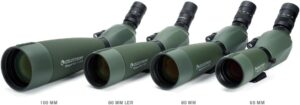
What We Like
- Compact 65mm objective
- 16-48× magnification range
- ED glass for improved color correction
- Fully multi-coated optics
- Comfortable 45-degree viewing angle
- Dual-speed focusing
- Good portability
- Waterproof and nitrogen purged
- Durable magnesium alloy construction
- Useful for both range and general outdoor observation
What Could Be Better
- The 65mm objective gathers less light than larger 80mm and 85mm models.
- Maximum 48× magnification is lower than the 60× offered by several competitors.
- It may not be the ideal choice for shooters who regularly need maximum resolution at extreme distances.
- A stable tripod is still necessary for comfortable high-magnification viewing.
Who Should Buy the Celestron Regal M2 65ED?
The Celestron Regal M2 65ED is a good choice for target shooters who value portability without wanting to sacrifice optical quality.
It’s particularly suitable for shooters who visit different ranges, shoot primarily during daylight, or want a spotting scope that can serve multiple purposes beyond target shooting.
If your priority is maximum optical performance at very long distances, an 80mm or 85mm premium spotting scope may be a better option. But if you want a more manageable scope that still delivers strong performance, the Regal M2 deserves serious consideration.
Is the Celestron Regal M2 65ED Good for Target Shooting?
Yes. The Celestron Regal M2 65ED is a capable target-shooting spotting scope, especially for shooters who prioritize portability and versatility.
Its combination of 16-48× magnification, ED glass, a 65mm objective, fully multi-coated optics, and a comfortable 45-degree viewing angle gives it the essential characteristics needed for range observation.
It may not provide the same light-gathering capability as an 85mm spotting scope, but its smaller size makes it significantly easier to carry and set up.
Celestron Regal M2 65ED – Final Verdict
The Celestron Regal M2 65ED earns its place as our Best Compact option among the best spotting scopes for target shooting. Instead of focusing exclusively on maximum magnification and objective size, it delivers a practical combination of optical quality, portability, and ease of use.
For shooters who want a spotting scope they can comfortably take to the range without adding excessive bulk to their equipment, the Regal M2 65ED is an excellent choice. Its 16-48× magnification, ED glass, 65mm objective, and 45-degree viewing design make it a versatile companion for target shooting and general outdoor observation.
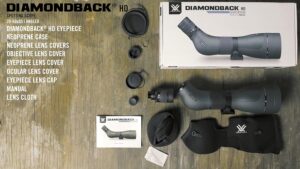
5.Vortex Diamondback HD 20-60×85 Spotting Scope – Best Value for Target Shooting.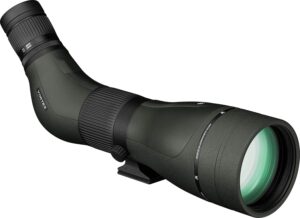
When you’re looking for a spotting scope that gives you plenty of magnification, a large objective lens, and reliable optical performance without spending premium money, the Vortex Diamondback HD 20-60×85 deserves a close look. It combines a powerful 20-60× magnification range with a large 85mm objective, making it particularly appealing for shooters who want to observe distant targets, check bullet impacts, and evaluate shot groups from the shooting bench.
Among the Best Spotting Scopes for Target Shooting, the Diamondback HD stands out as a value-focused option. It doesn’t have all the premium optical refinements of the Vortex Razor HD, but it delivers the core features many range shooters actually need in a durable and practical package.
Check Price on Amazon
If you’re looking for an affordable full-size spotting scope for target shooting, long-range observation, or general outdoor use, the Vortex Diamondback HD 20-60×85 is worth considering. Check the latest price and availability on Amazon.
Key Features
- 20-60× magnification for flexible target observation
- 85mm objective lens for increased light gathering
- HD optical system designed for improved resolution and color fidelity
- Fully multi-coated lenses for better light transmission
- Dielectric prism coatings for bright, clear images
- Porro prism design
- Dual-focus system for fast and fine adjustments
- Built-in extendable sunshade
- Argon purged for fogproof performance
- O-ring sealed for waterproof protection
- Rubber-armored construction for added durability
- Tripod compatible
- Adjustable tripod collar for comfortable positioning
Why the Vortex Diamondback HD Is a Good Choice for Target Shooting
The Diamondback HD’s strongest feature for range use is its combination of 20-60× magnification and an 85mm objective lens. This gives shooters the flexibility to locate targets at lower power and then increase magnification when more detail is needed.
The 85mm objective is especially useful because it can collect more light than smaller spotting scopes. This can help maintain a brighter image when shooting early in the morning, late in the afternoon, or under cloudy conditions.
For daytime range sessions, the Diamondback HD provides the basic optical capability needed to inspect targets and observe impacts without requiring a premium investment.
20-60× Magnification for Range and Long-Range Use
The 20-60× zoom range is one of the reasons the Diamondback HD is so versatile.
At 20×, you get a wider field of view that makes it easier to find and center your target. Once the target is located, you can gradually increase magnification to examine bullet holes, shot groups, or impacts on steel.
At 60×, you can achieve much greater detail when conditions allow. However, shooters should remember that high magnification also magnifies atmospheric distortion. On hot days, mirage can make a target appear to shimmer or become less defined.
If 60× produces a poor image, reducing the magnification to 40× or 50× can sometimes produce a clearer view.
How to Use the Vortex Diamondback HD for Target Shooting
Using the Diamondback HD at the range starts with proper tripod setup. Because this is a full-size 85mm spotting scope, you’ll want a stable tripod capable of supporting its weight without excessive vibration.
Position the tripod next to your shooting bench and adjust the scope to a comfortable viewing height. The angled configuration allows you to observe the target without having to place your head directly behind the scope.
Start at approximately 20× magnification and locate the target. Once the target is centered, adjust the focus until the target becomes sharp.
After establishing a clear image, gradually increase the magnification. If you’re trying to see bullet holes, increase the power until you can identify the impacts clearly. Don’t assume maximum magnification is always best—use the lowest magnification that gives you the necessary detail while maintaining a sharp image.
Using It to Spot Bullet Impacts
The Diamondback HD can be especially useful when you’re shooting groups and want to see the results without walking downrange.
After firing several rounds, look through the spotting scope and examine the target. At moderate distances, the combination of magnification and optical resolution can help you identify individual impacts and determine the overall group location.
If you’re shooting at steel targets, the scope can also be used to watch for impacts and observe target movement.
The actual distance at which bullet holes remain visible will depend on the size and color of the target, ammunition, lighting conditions, atmospheric distortion, and the shooter’s ability to maintain a steady image.
Using It to Evaluate Shot Groups
A good spotting scope isn’t just about seeing whether you hit the target. It can also help you analyze your shooting.
The Diamondback HD can be used to observe:
- Bullet-hole placement
- Group size
- Vertical dispersion
- Horizontal dispersion
- Changes in point of impact
- Hits on steel targets
- Missed shots
This can make range sessions more productive because you can observe your results immediately and make informed adjustments before firing another group.
Large 85mm Objective for Better Light Gathering
The 85mm objective lens is a major advantage of the Diamondback HD.
Compared with smaller 60mm or 65mm spotting scopes, the larger objective can collect more light and help produce a brighter image. This is particularly beneficial when you’re using higher magnification or shooting under less-than-perfect lighting.
However, the larger objective also contributes to the scope’s size and weight. If portability is your main concern, a 65mm spotting scope such as the Celestron Regal M2 may be more convenient.
For shooters who prioritize brightness and long-range viewing over compactness, the 85mm objective is a worthwhile trade-off.
HD Optical System for Better Target Detail
Vortex uses an HD optical system in the Diamondback HD designed to provide improved resolution and color fidelity.
For target shooters, this is useful because a highly magnified image isn’t necessarily useful if the image lacks contrast or definition. The optical system needs to maintain enough detail for the shooter to distinguish bullet holes and target markings.
The Diamondback HD isn’t positioned as Vortex’s flagship optical system, but it offers a practical balance between performance and affordability.
Dual-Focus System for Precise Focusing
The Diamondback HD features a dual-focus system that allows you to quickly bring the image into focus and then make more precise adjustments.
This is particularly useful when operating near the top end of the magnification range. At 50× or 60×, even a small focus adjustment can make a noticeable difference in image sharpness.
When inspecting bullet holes, take the time to fine-tune the focus rather than simply turning the magnification to maximum.
Built for Outdoor Range Conditions
The Diamondback HD is designed to withstand outdoor use. Its rubber-armored body provides additional protection during transport and setup, while the scope is sealed and argon purged for waterproof and fogproof performance.
This is important for shooters who regularly move their equipment between shooting ranges or operate in changing weather conditions.
The built-in sunshade is also useful during bright shooting sessions because it can help reduce glare entering the objective lens.
What We Like
- Strong 20-60× magnification range
- Large 85mm objective
- Good light-gathering capability
- HD optical system
- Fully multi-coated optics
- Dielectric prism coatings
- Dual-focus system
- Waterproof and fogproof
- Durable rubber-armored construction
- Built-in sunshade
- Excellent value for a full-size spotting scope
- Well suited to range and long-distance observation
What Could Be Better
- Larger and heavier than compact 60mm and 65mm spotting scopes
- Optical performance doesn’t reach the level of premium Vortex Razor models
- Atmospheric mirage can reduce image quality at maximum magnification
- Requires a sturdy tripod for the best high-power performance
- Not the best option if portability is your primary concern
Who Should Buy the Vortex Diamondback HD 20-60×85?
The Diamondback HD is best suited to shooters who want a full-size spotting scope with strong magnification and a large objective without paying premium prices.
It’s a particularly good option for recreational shooters, range enthusiasts, hunters, and people getting more serious about long-range shooting.
If you’re regularly shooting at extended distances and want more optical capability than an entry-level spotting scope can provide, the Diamondback HD offers a practical step up.
Is the Vortex Diamondback HD 20-60×85 Good for Target Shooting?
Yes. The Vortex Diamondback HD 20-60×85 is a strong choice for target shooting, particularly for buyers who want to balance optical performance and value.
Its 20-60× magnification, 85mm objective, HD optical system, dual-focus controls, and rugged construction give it the essential characteristics needed for range use.
The large objective is especially useful for shooters who frequently work at longer distances or in changing lighting conditions.
Vortex Diamondback HD 20-60×85 – Final Verdict
The Vortex Diamondback HD 20-60×85 earns its position as our Best Value pick among the Best Spotting Scopes for Target Shooting.
It delivers the features that matter most to range shooters—high magnification, a large 85mm objective, useful optical clarity, precise focusing, and durable construction—without moving into the premium price category.
If you’re looking for your first serious full-size spotting scope or want a dependable optic for regular target shooting without spending heavily on a flagship model, the Diamondback HD 20-60×85 is one of the strongest value-oriented options to consider.
6.Bushnell Legend Ultra HD 20-60×80 Spotting Scope – Best Affordable Full-Size Option for Target Shooting.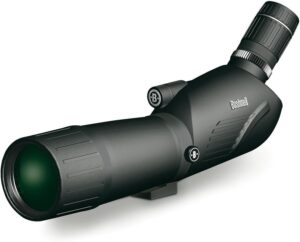
If you’re looking for a full-size spotting scope that provides strong magnification, a large objective lens, and useful optical performance without moving into premium pricing, the Bushnell Legend Ultra HD 20-60×80 is a compelling option. Its 20-60× magnification range and 80mm objective provide the reach and light-gathering capability that target shooters need when observing distant targets, checking bullet impacts, and analyzing shot groups.
Among the Best Spotting Scopes for Target Shooting, the Bushnell Legend Ultra HD stands out as an affordable full-size option. It is designed to provide a bright, detailed image while remaining versatile enough for the shooting range, hunting, wildlife observation, and other outdoor activities.
Check Price on Amazon
If you want a capable full-size spotting scope for target shooting without stepping into the highest-priced category, the Bushnell Legend Ultra HD 20-60×80 is worth considering. Check the latest price and availability on Amazon.
Key Features
- 20-60× magnification for short- to long-range observation
- 80mm objective lens for strong light-gathering capability
- Ultra HD optical system for enhanced image detail
- ED Prime Glass for improved color correction
- Fully multi-coated optics for increased light transmission
- BaK-4 prisms for improved image quality
- PC-3 phase-corrected prism coating
- RainGuard HD water-repellent coating
- EXO Barrier protective coating
- 45-degree angled viewing design
- Dual-focus controls
- Built-in extendable sunshade
- Waterproof and fogproof construction
- Tripod compatible
Why the Bushnell Legend Ultra HD Is Good for Target Shooting
Target shooting places specific demands on a spotting scope. You need enough magnification to see distant targets, sufficient light transmission to maintain image quality, and enough resolution to distinguish small bullet holes and shot groups.
The Bushnell Legend Ultra HD addresses these requirements with its 20-60× magnification range and 80mm objective lens. This combination gives you a good balance between viewing power and light gathering without the extra bulk of some 85mm models.
For shooters who want a full-size scope for regular range sessions but don’t want to spend heavily on premium optics, this combination makes the Legend Ultra HD an attractive choice.
20-60× Magnification for Long-Range Target Observation
The 20-60× zoom range provides flexibility throughout a shooting session.
At 20×, you can locate your target relatively easily thanks to the wider field of view. Once you’ve found the target, increasing the magnification lets you examine smaller details.
At 60×, the scope provides maximum optical magnification for distant target observation. This can be useful when you’re trying to inspect bullet impacts or evaluate a group at longer distances.
However, high magnification also makes atmospheric conditions more apparent. If heat shimmer or mirage is affecting the image, reducing the magnification can sometimes produce a clearer and more useful view.
80mm Objective Lens for Bright Images
The 80mm objective lens is one of the strongest features of the Legend Ultra HD.
A large objective allows more light to enter the optical system, which can be particularly helpful when using high magnification. It can also provide an advantage during early morning, late afternoon, or cloudy range sessions.
The 80mm objective represents a useful middle ground. It’s large enough to provide strong light-gathering capability but slightly more manageable than some 85mm spotting scopes.
For target shooters who want a full-size optic but still need reasonable portability, this can be an appealing compromise.
ED Prime Glass for Improved Clarity
Bushnell equips the Legend Ultra HD with ED Prime Glass, which is designed to reduce chromatic aberration and improve color correction.
This is important when you’re viewing high-contrast targets at long distances. A target against a bright background can expose optical color fringing, while improved color correction can help produce a cleaner and more natural-looking image.
For target shooting, better optical correction can contribute to easier identification of bullet holes and target markings.
How to Use the Bushnell Legend Ultra HD for Target Shooting
Using the Bushnell Legend Ultra HD at the range starts with mounting it securely on a stable tripod.
Because the scope can reach 60× magnification, stability is extremely important. Even small tripod movements can become very noticeable when you’re viewing a distant target at high power.
Set the tripod beside your shooting position and adjust the height until the angled eyepiece is comfortable to use. Start with the scope at approximately 20× magnification.
Locate the target, center it in the field of view, and adjust the focus until the image is sharp. Once the target is clearly visible, gradually increase magnification until you reach the level of detail required.
If the image becomes blurry or begins to shimmer at maximum power, reduce the magnification. In real-world shooting conditions, 40× or 50× may provide a clearer image than 60×.
Using It to Spot Bullet Impacts
One of the primary reasons to use a spotting scope is to determine where your shots landed without having to travel downrange.
After firing a group, look through the Legend Ultra HD and inspect the target. The combination of 20-60× magnification and an 80mm objective gives you the optical reach needed to examine distant targets.
The scope can be used to identify bullet holes on paper targets, inspect shot placement, and observe impacts on steel.
How far away you can clearly identify a bullet hole depends on several factors, including the size of the hole, target color, lighting, atmospheric conditions, ammunition, and the stability of your tripod.
Using It to Analyze Shot Groups
The Legend Ultra HD can also help you analyze the consistency of your shooting.
After firing a group, use the scope to determine:
- Where the group is centered
- How large the group is
- Whether shots are drifting horizontally
- Whether shots are spreading vertically
- Whether adjustments changed the point of impact
- Whether a shot appears to have missed
- How steel targets react to impacts
This makes a spotting scope more than just a magnified viewing device. It becomes a useful tool for understanding what is happening on the target.
RainGuard HD for Changing Weather
Range sessions don’t always happen under perfect weather conditions. Bushnell’s RainGuard HD coating is designed to help water bead up and roll away from the optical surfaces rather than spreading across the lens.
This can be useful when you’re caught in light rain or dealing with moisture during outdoor shooting sessions.
The Legend Ultra HD is also designed to be waterproof and fogproof, providing additional protection when weather conditions change.
EXO Barrier Lens Protection
Bushnell also uses its EXO Barrier coating to provide additional protection for the exterior lens surfaces. The coating is designed to help repel water, oil, dust, and other contaminants.
For shooters who frequently transport their spotting scope to outdoor ranges, this added protection can help make the optic easier to maintain.
45-Degree Viewing Angle for Comfortable Range Use
The angled viewing design is particularly convenient when using the scope beside a shooting bench.
Instead of having to position your eye directly behind the scope, the 45-degree eyepiece allows you to look downward into the scope from a more comfortable position.
This can be useful during long range sessions because you can maintain a comfortable posture while repeatedly checking the target.
Dual-Focus Controls
The Legend Ultra HD uses a dual-focus system that allows you to make quick and fine focusing adjustments.
Start by using the faster focusing adjustment to bring the target into view. Once you’re close, use the finer adjustment to sharpen the image.
This becomes particularly useful at high magnification, where small focus errors can make distant targets appear noticeably softer.
What We Like
- Useful 20-60× magnification range
- Large 80mm objective
- ED Prime Glass
- Good light-gathering capability
- Fully multi-coated optics
- 45-degree viewing angle
- Dual-focus system
- RainGuard HD coating
- EXO Barrier protection
- Waterproof and fogproof
- Good option for range and outdoor use
- Strong balance between size and optical performance
What Could Be Better
- The 80mm design is heavier and less portable than compact spotting scopes.
- Maximum 60× magnification can be affected by atmospheric mirage.
- It doesn’t provide the same premium optical performance as high-end flagship spotting scopes.
- A sturdy tripod is essential for getting the most out of the scope at high magnification.
Who Should Buy the Bushnell Legend Ultra HD 20-60×80?
The Bushnell Legend Ultra HD is best suited to target shooters who want a full-size spotting scope without spending premium money.
It’s particularly attractive for recreational shooters, range enthusiasts, hunters, and beginners who are ready to move beyond basic entry-level optics.
If your shooting sessions involve moderate to long distances and you want a large objective for better light gathering, the Legend Ultra HD offers a practical combination of magnification, optical performance, and durability.
Is the Bushnell Legend Ultra HD 20-60×80 Good for Target Shooting?
Yes. The Bushnell Legend Ultra HD 20-60×80 is a capable spotting scope for target shooting, especially for buyers looking for a full-size optic at a more accessible price.
Its combination of 20-60× magnification, an 80mm objective, ED Prime Glass, multi-coated optics, dual focusing, and weather-resistant construction gives it the features necessary for regular range use.
It’s not necessarily the scope for someone demanding the absolute best optical performance available, but it offers a sensible balance for shooters who want dependable performance without a flagship price tag.
Bushnell Legend Ultra HD 20-60×80 – Final Verdict
The Bushnell Legend Ultra HD 20-60×80 earns its place as the Best Affordable Full-Size option in our list of the Best Spotting Scopes for Target Shooting.
Its 20-60× magnification, 80mm objective, ED Prime Glass, weather-resistant construction, and comfortable angled viewing design make it a versatile choice for target shooting and other outdoor activities.
If you’re looking for a full-size spotting scope that can help you observe distant targets, inspect bullet impacts, and analyze shot groups while keeping the overall investment reasonable, the Bushnell Legend Ultra HD 20-60×80 is a strong option to consider.
7.SVBONY SV406P 20-60×80 ED Spotting Scope – Best Budget Option for Target Shooting.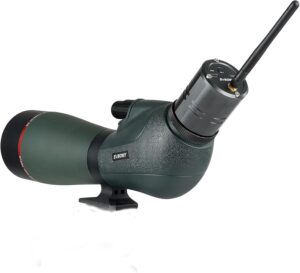
If you’re searching for one of the Best Spotting Scopes for Target Shooting without spending heavily on a premium optical system, the SVBONY SV406P 20-60×80 ED is an interesting budget-friendly option. It combines an 80mm objective lens, 20-60× zoom range, extra-low dispersion (ED) glass, fully multi-coated optics, a BaK-4 prism, and a dual-focus system. These specifications give it considerably more capability than a basic entry-level spotting scope.
Check Price on Amazon
For shooters who want a large-aperture spotting scope with useful long-range magnification while keeping the budget under control, the SVBONY SV406P 20-60×80 ED is worth considering. Check the latest price and availability on Amazon.
Product Features
The SV406P comes with a surprisingly strong feature set for a budget-oriented spotting scope:
- 20-60× variable magnification
- 80mm objective lens
- Extra-low dispersion (ED) glass
- BaK-4 prism
- Fully multi-coated (FMC) optics
- Dual-focus mechanism for coarse and fine adjustments
- Angled eyepiece for comfortable viewing
- 20-18mm eye relief
- 108-60 ft field of view at 1,000 yards
- 4-1.33mm exit pupil
- 18 ft / 5.5m minimum focus distance
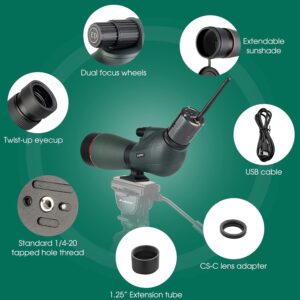
- 1.25-inch detachable eyepiece
- Nitrogen-filled construction
- IPX5 waterproofing
- Twist-up eyecup
- Approximately 57.3 oz / 3.58 lb
- Approximately 405 × 180 × 120mm in size
ED Glass for Better Target Detail
One of the most interesting features of the SV406P is its extra-low dispersion ED glass. This is a feature you don’t always find on budget spotting scopes.
ED glass is designed to improve color correction and reduce chromatic aberration. For target shooting, that can help produce a cleaner, higher-contrast image when you’re examining distant targets.
This becomes particularly useful when you’re trying to distinguish small bullet holes against a contrasting paper target or identify impacts on steel. The ED glass doesn’t eliminate atmospheric distortion, but it helps the optical system deliver a cleaner image under suitable conditions.
20-60× Magnification for Target Shooting
The 20-60× zoom range gives the SV406P enough flexibility for a variety of range situations.
At 20×, you have a wider field of view for locating your target. SVBONY specifies a field of view of approximately 108 feet at 1,000 yards at the low end, narrowing to about 60 feet at 60×.
Once you’ve located your target, you can increase the magnification to examine bullet impacts or shot groups in greater detail.
At the maximum 60× setting, atmospheric conditions become increasingly important. If heat shimmer or mirage makes the target appear unstable, reducing the magnification can actually produce a more useful image.
How to Use the SVBONY SV406P for Target Shooting
The first step is to mount the SV406P securely on a stable tripod. High magnification magnifies movement as well as the target, so a shaky tripod can make even a good spotting scope difficult to use.
Place the scope beside your shooting position and adjust the tripod until the angled eyepiece is comfortable to view.
Start at approximately 20× magnification and locate your target. Once the target is centered, use the coarse focus to bring it into view. Then use the fine-focus adjustment to sharpen the details.
After obtaining a clear image, gradually increase the magnification until you have the amount of detail required. Don’t automatically leave the scope at 60×. If the image becomes hazy or distorted, back the magnification down until the target becomes clearer.
Using It to Spot Bullet Impacts
The SV406P can be used to monitor targets after each shooting group. From the firing position, you can look through the scope and inspect the target rather than repeatedly walking downrange.
At moderate distances and under favorable lighting conditions, the combination of 80mm aperture, ED glass, and 20-60× magnification can provide enough detail to examine shot placement.
At extreme distances, however, visibility depends on more than magnification. Bullet-hole size, target color, lighting, atmospheric conditions, mirage, and tripod stability all influence how clearly an impact can be seen.
Using It to Analyze Shot Groups
A spotting scope can turn a range session into a more informative exercise because you’re able to see what your shots are actually doing.
With the SV406P, you can use the magnified view to inspect:
- Shot placement
- Group size
- Horizontal dispersion
- Vertical dispersion
- Changes in point of impact
- Impacts on steel targets
- Possible misses
This is especially convenient when shooting with a partner. One person can concentrate on the shooting position while the other observes the target and communicates the results.
Dual-Focus System for Better Precision
The dual-focus mechanism is another feature that makes the SV406P interesting for target shooting.
The coarse focus allows you to quickly bring the target into focus, while the fine adjustment lets you make smaller corrections for maximum sharpness.
This is particularly valuable when you’re using 40×, 50×, or 60× magnification. At these levels, precise focusing can make a significant difference in how much detail you can extract from the target.
BaK-4 Prism and Fully Multi-Coated Optics
The SV406P uses a BaK-4 prism and fully multi-coated optics. These components are intended to maximize light transmission and help produce a bright, high-contrast image.
For target shooting, good light transmission is important because you’re often trying to identify relatively small details at considerable distances.
The 80mm objective also helps the scope collect a substantial amount of light, particularly compared with smaller compact spotting scopes.
80mm Objective for Bright Range Viewing
The 80mm objective lens gives the SV406P an important advantage over many smaller budget scopes.
A larger objective can gather more light, which can help when you’re operating at high magnification or when the lighting isn’t ideal. For daytime target shooting, this provides a useful combination of brightness and magnification.
The trade-off is size. At approximately 57.3 ounces, the SV406P is not a lightweight pocket optic.
If portability is your biggest concern, a 50-65mm spotting scope would be easier to carry. If brightness and long-range viewing matter more, the 80mm objective makes more sense.
Angled Eyepiece for Comfortable Viewing
The angled design makes the SV406P convenient for shooting-range use. Instead of positioning your eye directly behind the scope, you can look downward through the angled eyepiece.
This is particularly useful when the spotting scope is positioned next to your shooting bench.
It also makes the scope easier to share between people of different heights because you can adjust the tripod without needing to completely change the scope’s viewing orientation.
Waterproof and Nitrogen-Filled Construction
Outdoor shooting exposes equipment to changing weather and temperature. The SV406P is nitrogen-filled and rated IPX5 waterproof, helping protect it against moisture and internal fogging.
That makes it better suited to outdoor range sessions than an unsealed optical instrument.
Nevertheless, it’s still sensible to protect the scope from unnecessary exposure to heavy rain and to use the supplied case when transporting it.
Detachable Eyepiece Adds Flexibility
A particularly interesting feature is the detachable 1.25-inch eyepiece. SVBONY states that the eyepiece can be removed and replaced with a compatible 1.25-inch astronomical eyepiece.
This isn’t essential for target shooting, but it gives the SV406P additional versatility for users who want to experiment with other observation applications.
What We Like
- Affordable full-size design
- 20-60× magnification
- Large 80mm objective
- ED glass
- BaK-4 prism
- Fully multi-coated optics
- Dual-focus system
- Comfortable angled eyepiece
- Good eye relief
- Nitrogen-filled construction
- IPX5 waterproofing
- Detachable 1.25-inch eyepiece
- Useful for target shooting and other outdoor observation
What Could Be Better
- The scope is relatively heavy at about 3.58 lb.
- Optical performance at 60× will still be affected by atmospheric conditions.
- It doesn’t compete with premium spotting scopes in overall optical refinement.
- A sturdy tripod is important for getting the best results at high magnification.
- Buyers looking for maximum long-range resolution may benefit from moving to a premium ED/UHD scope.
Who Should Buy the SVBONY SV406P 20-60×80 ED?
The SV406P is best suited to budget-conscious target shooters, beginners, recreational range users, and outdoor enthusiasts who want a capable full-size spotting scope without making a major investment.
It’s particularly attractive if you want features such as ED glass, an 80mm objective, dual focusing, and 20-60× magnification but don’t need the optical refinement of a flagship spotting scope.
Is the SVBONY SV406P Good for Target Shooting?
Yes. The SVBONY SV406P 20-60×80 ED is a capable budget spotting scope for target shooting. Its combination of ED glass, 20-60× magnification, 80mm objective, BaK-4 prism, FMC optics, and dual-focus controls gives it a solid specification sheet for its category.
It is best suited to daytime and moderate-distance range use, while shooters working at very long distances should keep their expectations realistic because atmospheric conditions can become the limiting factor regardless of the scope.
SVBONY SV406P 20-60×80 ED – Final Verdict
The SVBONY SV406P 20-60×80 ED earns its place as our Best Budget choice among the Best Spotting Scopes for Target Shooting.
Its combination of an 80mm objective, 20-60× magnification, ED glass, BaK-4 prism, fully multi-coated optics, and dual-focus system gives budget-conscious shooters a surprisingly capable platform for observing distant targets and analyzing shot groups.
If you’re just getting started with target shooting or want a reasonably priced full-size spotting scope for regular range sessions, the SV406P offers a compelling feature set without requiring you to jump immediately into premium optics.
Also Read: 7 Best Hunting Tripods for Spotting Scope – Expert Reviews & Buying Guide.
8.Gosky 20-60×80 Spotting Scope – Best Beginner Option for Target Shooting.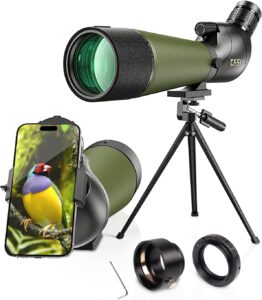
Getting started with target shooting doesn’t necessarily mean spending hundreds or thousands of dollars on premium optics. The Gosky 20-60×80 Spotting Scope offers beginners a practical combination of high magnification, a large 80mm objective lens, fully multi-coated optics, a BaK-4 prism, and a comfortable 45-degree viewing angle. It is designed to provide a closer look at distant targets while remaining simple enough for first-time spotting-scope users.
For anyone comparing the Best Spotting Scopes for Target Shooting, the Gosky stands out as an accessible option for beginners and recreational range users. Its 20-60× zoom gives you plenty of magnification to experiment with, while the included tripod and smartphone adapter make it possible to start using the scope without immediately purchasing a large collection of accessories. Gosky’s current Horizon 20-60×80 model lists an 80mm objective, fully multi-coated optics, BaK-4 prism, 45-degree eyepiece, waterproof/fogproof construction, and a smartphone/camera mounting system.
Check Price on Amazon
If you’re buying your first spotting scope and want a reasonably priced setup for target shooting, the Gosky 20-60×80 is worth considering. Its combination of magnification, large aperture, accessories, and straightforward controls makes it particularly attractive to beginners. Check the latest price and availability on Amazon.
Product Features
The Gosky 20-60×80 comes with a useful collection of features for a beginner-oriented spotting scope:
- 20-60× variable magnification
- 80mm objective lens
- BaK-4 prism
- Fully multi-coated optical lenses
- Dynamic focusing system
- 45-degree angled eyepiece
- 17.9-15mm eye relief
- 82.9-48 ft field of view at 1,000 yards
- 3.3-1.22mm exit pupil
- Retractable sunshade
- Waterproof and fogproof construction
- Shock-resistant rubber armor
- Smartphone digiscoping adapter
- Nikon camera T-ring and M42 T-mount on the current Horizon package
- Tripod included with the Horizon package
- Carrying case and lens caps included
Why the Gosky 20-60×80 Is Good for Target Shooting
The main attraction of the Gosky is its combination of 20-60× magnification and an 80mm objective lens. These specifications give beginners enough optical reach to explore both moderate- and longer-distance target shooting.
At 20×, you have a relatively wide view for finding your target. Once you’ve located it, you can gradually increase magnification to inspect the target in greater detail.
The 80mm objective also provides useful light-gathering capability, which can help produce a brighter image during normal daytime range sessions.
20-60× Magnification for Beginners
The 20-60× zoom range makes the Gosky easy to adapt to different distances.
Start at 20× when locating your target. The wider field of view makes it easier to find and center the target than starting immediately at 60×.
Once the target is centered, gradually increase the magnification. At 30× or 40×, you may already have enough detail to inspect the target. If conditions are favorable, you can continue toward 50× or 60× when you need additional magnification.
The important thing for beginners is not to assume that 60× is always better. High magnification also magnifies atmospheric shimmer and vibration. If the image becomes unstable, reducing the power can actually make the target easier to see.
How to Use the Gosky 20-60×80 for Target Shooting
Using the Gosky at the range is relatively simple, which is one of the reasons it works well as a beginner spotting scope.
First, mount the scope on a stable tripod. Although the package may include a tripod depending on the model, stability becomes increasingly important as you increase magnification.
Position the spotting scope next to your shooting position and adjust the tripod height so that the 45-degree eyepiece is comfortable to use.
Set the magnification to approximately 20× and look through the eyepiece. Locate your target and center it in the field of view.
Next, adjust the focus until the target appears sharp. Once you have a clear image, gradually increase the magnification until you have enough detail to inspect the target.
If you’re using 50× or 60× and the image becomes blurry, don’t immediately assume there is something wrong with the scope. Try reducing the magnification slightly and refocusing. Heat waves, mirage, wind, and tripod movement can all affect high-magnification viewing.
Using It to Spot Bullet Impacts
One of the biggest benefits of having a spotting scope at the range is being able to inspect your target from the shooting position.
After firing a group, look through the Gosky and examine the target. At suitable distances and under good conditions, you can use the magnified view to identify impacts and determine where your shots are landing.
The actual distance at which individual bullet holes remain visible will vary considerably. Target size, bullet-hole size, target color, lighting, atmospheric conditions, and image stability all make a difference.
For beginners, the most important lesson is to use the scope as an observation tool rather than expecting any 20-60× spotting scope to resolve tiny impacts at extreme distances in every weather condition.
Using It to Evaluate Shot Groups
The Gosky can also help you understand your shooting results.
After firing several shots, use the scope to inspect:
- Where the group is located
- Approximate group size
- Vertical spread
- Horizontal spread
- Changes in point of impact
- Impacts on steel targets
- Whether a shot appears to have missed
This allows you to spend more time analyzing your shooting instead of repeatedly walking downrange.
For beginners, this can be especially useful because it provides immediate visual feedback during practice.
45-Degree Angled Eyepiece for Comfortable Viewing
The 45-degree angled eyepiece is a practical feature for range use. Rather than requiring your eye to be positioned directly behind the scope, the angled design lets you look downward into the eyepiece.
This can make prolonged observation more comfortable, especially when the scope is positioned beside a shooting bench.
It can also make the scope easier to share between people of different heights because the tripod can be adjusted without dramatically changing the scope’s viewing orientation.
80mm Objective for Better Light Gathering
The 80mm objective lens gives the Gosky an advantage over smaller compact spotting scopes.
A larger objective can gather more light, which can be useful when you’re viewing distant targets at higher magnification. Gosky specifically describes the 80mm objective as providing strong light-gathering capability and a wide field of view.
For normal daytime target shooting, the 80mm aperture should provide a useful balance between brightness and portability.
The downside is that an 80mm spotting scope is considerably larger than a compact 50mm or 60mm model, so it isn’t the best choice if minimizing equipment size is your highest priority.
Fully Multi-Coated Optics and BaK-4 Prism
The Gosky uses fully multi-coated optics and a BaK-4 prism, two important components for a budget spotting scope.
The multi-coated lenses are designed to improve light transmission and help produce a brighter, higher-contrast image. The BaK-4 prism is commonly used in optical instruments to help maintain image quality.
For beginners, these features provide a solid foundation for general target observation without requiring a more expensive optical system.
Using the Smartphone Adapter
One feature that can make the Gosky particularly appealing to beginners is its smartphone digiscoping capability.
The current Horizon package includes a smartphone adapter, allowing you to position your phone over the eyepiece and capture photographs or video through the spotting scope.
This can be useful for documenting targets, sharing observations, or simply experimenting with digiscoping.
However, smartphone images taken through a spotting scope may not perfectly represent what you see with your eye. Alignment, phone-camera quality, lighting, focus, and atmospheric conditions all affect the final image.
Retractable Sunshade for Bright Conditions
Bright sunlight can create glare and reduce the contrast of a distant target. The Gosky includes a retractable sunshade that can be extended when necessary.
If you’re shooting with strong sunlight coming from the direction of the target, extending the sunshade can help reduce unwanted glare and make the viewing experience more comfortable.
Waterproof, Fogproof, and Shock-Resistant Design
A spotting scope used outdoors needs to deal with changing conditions. The Gosky uses a durable exterior with rubber armor designed to provide grip and protection.
The manufacturer also lists the scope as waterproof and fogproof, allowing it to be used in changing outdoor conditions.
This is useful for range shooters who don’t want to stop their session simply because the weather becomes less predictable.
What We Like
- 20-60× variable magnification
- Large 80mm objective
- BaK-4 prism
- Fully multi-coated optics
- Comfortable 45-degree viewing angle
- Useful for beginner target shooters
- Smartphone digiscoping capability
- Waterproof and fogproof design
- Shock-resistant rubber armor
- Retractable sunshade
- Tripod and carrying accessories available with the package
- Good versatility for outdoor observation
What Could Be Better
- High magnification can be affected by atmospheric mirage.
- The 80mm design is larger than compact beginner scopes.
- Included tripods may not provide the same stability as a quality full-size shooting tripod.
- Optical performance is aimed at the budget/beginner market rather than competing with premium spotting scopes.
- At extreme distances, users should have realistic expectations about seeing individual bullet holes.
Who Should Buy the Gosky 20-60×80?
The Gosky is best suited to beginners, recreational shooters, range enthusiasts, and outdoor observers who want an affordable way to get started with spotting scopes.
It is particularly attractive if you want an optic that can do more than simply observe shooting targets. The smartphone adapter and general-purpose design make it useful for wildlife observation, scenery, and other outdoor activities as well.
If you’re already an experienced long-range shooter and routinely need to resolve very small impacts at extreme distances, however, a premium spotting scope with higher-end optical glass may be a better investment.
Is the Gosky 20-60×80 Good for Target Shooting?
Yes. The Gosky 20-60×80 is a practical option for target shooting, particularly for beginners and recreational shooters.
Its combination of 20-60× magnification, 80mm objective, BaK-4 prism, fully multi-coated optics, angled eyepiece, and smartphone compatibility gives new shooters a versatile platform for learning how to use a spotting scope.
Independent review analysis of a Gosky 20-60×80 dual-focusing model also found positive user sentiment around ease of use, picture quality, scope range, and value, although some users reported concerns about fragility.
Gosky 20-60×80 – Final Verdict
The Gosky 20-60×80 earns its place as our Best Beginner option among the Best Spotting Scopes for Target Shooting.
It doesn’t attempt to compete directly with premium spotting scopes costing several times more. Instead, it focuses on providing beginners with the features they need to get started: 20-60× magnification, an 80mm objective, fully multi-coated optics, BaK-4 prism, comfortable angled viewing, weather-resistant construction, and smartphone compatibility.
For someone buying their first spotting scope for the shooting range, the Gosky offers a practical entry point. It gives you enough magnification to explore longer-range target observation while remaining versatile enough for other outdoor activities.
If you’re new to target shooting and want to understand what a spotting scope can add to your range sessions before investing in premium glass, the Gosky 20-60×80 is a sensible place to start.
FAQS:best spotting scopes for target shooting
1. What are the best spotting scopes for target shooting?
The best spotting scopes for target shooting depend on your shooting distance, budget, and the level of detail you need. Popular choices include the Vortex Viper HD 20-60×85, Vortex Diamondback HD 20-60×85, Celestron Regal M2 65ED, Bushnell Legend Ultra HD 20-60×80, SVBONY SV406P 20-60×80 ED, and Gosky 20-60×80. For serious long-range shooting, prioritize high-quality glass, strong light transmission, a large objective lens, and a stable tripod.
2. What magnification is best for target shooting?
For most target shooting applications, 20-60× magnification provides an excellent balance of versatility and detail. Lower magnification around 20× makes it easier to locate your target, while 40× to 60× can provide the additional detail needed to inspect distant targets and shot groups. However, maximum magnification isn’t always best because heat waves and atmospheric mirage can make a highly magnified image less clear.
3. What size objective lens is best for a target shooting spotting scope?
An 80mm to 85mm objective lens is an excellent choice for long-range target shooting because it gathers more light and can help produce a brighter image at higher magnifications. A 60mm or 65mm spotting scope is usually lighter and easier to transport, making it suitable for shooters who prioritize portability. If you frequently shoot at long distances, an 80mm or larger objective is generally worth considering.
4. Can a spotting scope see bullet holes at 100 yards or more?
Yes, a good spotting scope can often help you see bullet holes at 100 yards and beyond, but the actual viewing distance depends on the scope’s optical quality, magnification, lighting, target color, bullet-hole size, and atmospheric conditions. A scope with 20-60× magnification and quality glass can provide enough detail for many target-shooting applications. For very small impacts at much longer distances, premium optics and favorable weather conditions become increasingly important.
5. What should I look for when buying a spotting scope for target shooting?
When choosing among the best spotting scopes for target shooting, focus on optical quality, magnification, objective size, focusing system, eye relief, durability, and tripod stability. A 20-60× zoom range is versatile for most shooters, while an 80mm or 85mm objective provides excellent light-gathering capability. ED or HD glass can improve clarity and color correction, and a reliable tripod is essential because even small vibrations become noticeable at high magnification.
Conclusion: Choosing the Best Spotting Scopes for Target Shooting
Choosing among the Best Spotting Scopes for Target Shooting ultimately comes down to finding the right balance between optical clarity, magnification, objective size, portability, and budget. A good spotting scope should do more than simply magnify your target—it should provide a clear, steady image that allows you to examine shot placement, observe impacts, and evaluate your groups without constantly moving downrange.
Throughout this guide, we looked at options ranging from compact and beginner-friendly models to larger scopes designed for demanding long-range observation. Models with 20-60× magnification and 80mm to 85mm objectives offer an excellent combination of reach and light-gathering capability for many range applications, while compact 65mm models can be more convenient when portability is a priority.
For shooters who want a strong balance of optical performance and value, the Vortex Viper HD is an excellent choice. If affordability is more important, the Vortex Diamondback HD, Bushnell Legend Ultra HD, SVBONY SV406P, and Gosky 20-60×80 provide attractive alternatives. Meanwhile, the Celestron Regal M2 65ED is worth considering if you want a more compact setup without giving up quality optics.
It’s also important not to judge a spotting scope by magnification alone. At very high power, atmospheric mirage and heat shimmer can become significant limitations, meaning a slightly lower magnification can sometimes produce a clearer and more useful image. A stable tripod is equally important because vibrations become increasingly noticeable as magnification increases.
Ultimately, the best spotting scopes for target shooting are the ones that match your shooting distance, range conditions, and budget. Whether you’re a beginner practicing at 100 yards or an experienced shooter observing targets at several hundred yards, investing in good glass and a stable setup can make your range sessions more productive, comfortable, and enjoyable.
Also Read: 8 Best Spotting Scope Tripods for Hunting – Expert Reviews & Buying Guide
8 Best Spotting Scope Tripods for Hunting – Expert Reviews & Buying Guide